Uncategorized

Happy Skalidays!

ska-christmas

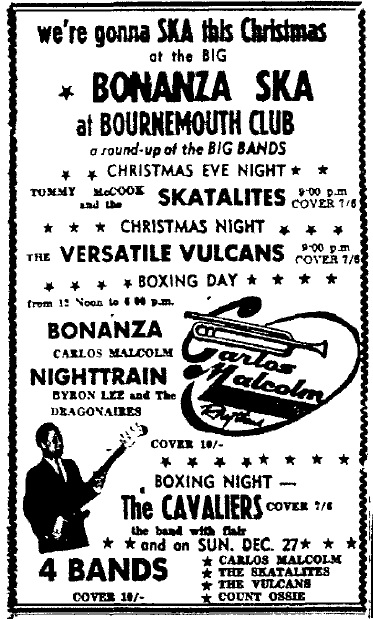
The winter holidays are upon us, so why not take a look at holiday traditions in Jamaican culture and how these relate to ska? Then, make sure to get your vinyl ready because I have a fairly comprehensive list of holiday-related Jamaican tunes, some ska, some post-ska, for your festive parties! I’ve also included a few clips throughout to keep you dancing as you read!

First of all, here is a little primer on holiday traditions and history in Jamaica, which is very important to ska history, as you will see. Much of the showmanship and competition found in the music industry in Jamaica today and throughout the last century can be traced back to the pomp and swagger of the Caribbean festivals where music and performance combined in a flamboyant display of prowess. These festivals, Carnival in Trinidad, and Jonkunnu in Jamaica, were celebrations that took place during the height of the Great Revival (spiritual traditions that stemmed from African religions–Pukkumina, Zion, Kumina, etc.) and continue today. Jonkunnu in Jamaica has its origins in the Carnival celebration in Trinidad, which, in turn, had its origins in the Masquerade celebrated by Europeans. Carnival began at Christmas time and lasted sometimes until Ash Wednesday. Celebrations included feasting and processions through the streets, the biggest of which took place on Shrove Tuesday, or the Tuesday before Ash Wednesday.
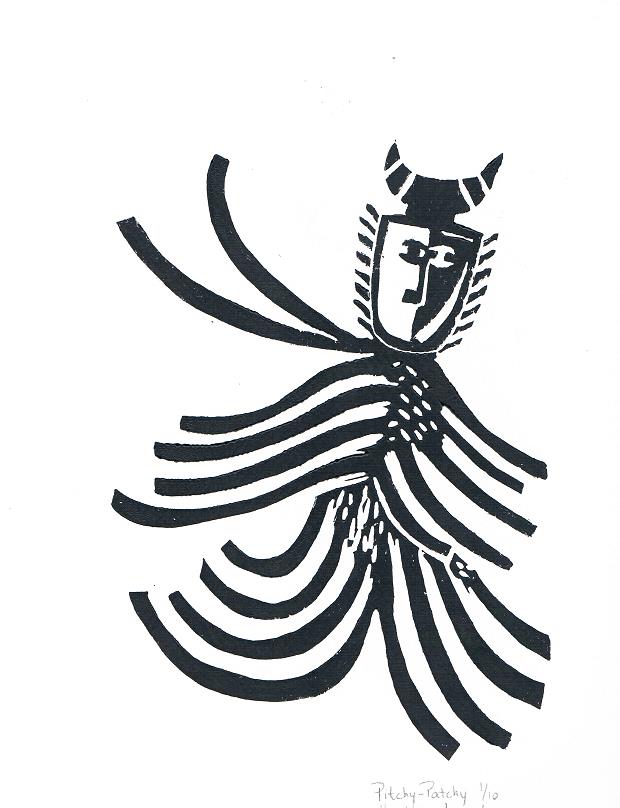
pitchy-patchy

These processions were called canboulay, a derivation of the French words cannes brulees, which translates as burning canes. Slaves carried burning canes as torches to light the way during the night when a plantation owner’s crops caught fire. Slaves from nearby plantations were summoned to help extinguish the fire. Taken to the field by a driver with a whip, the slaves carried flaming torches to light the way. Canboulay processions draw elements from these events, utilizing participants with whips who emulate the slave master, masked characters representing people and animals, in an entertaining lampoon of life. The content of these processions, these marches, were serious, but the tone was lighthearted and enjoyable.

One of the main displays in canboulay during Carnival is kalinda. Kalindas were stick fights, similar to the art of dula meketa in Ethiopia or mousondi in the Congo, and were tests of strength and skill. During Carnival, a group or band of some two dozen men were led by a “big pappy” who directed his crew through the streets until they encountered a rival group. In a spirit of camaraderie and competition, each group threw out boasts to one another, stating their prowess and challenges frequently set to song which was called kalinda, since the warlike song and the stick fight itself were part of the festival procession. Fighters chose their sticks carefully, visiting a region in Trinidad called Gasparillo to select a stick made of Baton Gasparee wood. They then prepared their stick by singeing it over a fire until the bark came off, then they rubbed coconut oil into the wood. The stick was ready to use and when horns or empty bottles were sounded, the bands assembled accompanied by instrumentalists, singers, and dancers who performed a dance called a belair, or bele. The display involved the participation of all and the boasting was competitive in a respectful, boisterous, convivial manner. This spirit of competitive camaraderie continued in the days of sound system clashes in the 1950s and 1960s as producers attempted to one-up each other to appeal to the crowds. And ska recording artists, following the lead of the big pappies, also threw down challenges to each other to boast of their talent–Derrick Morgan and Prince Buster is a classic example, as are the boasts and challenges between producers like Coxsone, Duke Reid, Prince Buster, and King Edwards.

Due to the perceived threat of riot and revolt, canboulay and kalindas were banned by the government and police. The masks used by characters in the procession were also banned in festivals in 1840 by the British governor. Drums and fiddles, associated with Africa, were considered heathen and therefore instruments of the devil, plus they were loud and disturbing late at night. Open letters in local newspapers called the revelers “savages” and spoke of celebrations as “orgies” full of “crime” and “barbarism.” The people resisted, but they were squashed by military troops and were forced to either conform to the establishment or they simply adapted the festival in ways to elude the establishment.

In Jamaica, this festival was called Jonkunnu, named after John Conny, a powerful leader of the Guinea people in the early 1700s. The British spelled his name John Canoe, hence the name Jonkunnu. The white planters allowed their slaves to celebrate this secular festival which took place during the Christmas season. Elaborate street parades began on the island as early as 1774. Like Carnival, Jonkunnu involved masked characters. Performance and music always went hand in hand. The leader of the festival wore cow horns, a cow tail, and sometimes carried swords or wore a mask with tusks. This character was John Canoe. Other characters included those mocking the military, aristocrats, police, sailors, the devil, Horsehead, Jack-in-the-Green, Pitchy-Patchy, Belly Woman, Warrior, Red Indian or Wild Indian, Koo-Koo or Actor Boy, King and Queen, and Red-Set and Blue-Set Girls. These characters did not remove their masks in public, nor did they speak or sing.

Those who did provide the vocal and instrumental accompaniment for the procession included a band of drummers, bamboo fife, banjo, and metal grater performers. Tambour-bamboo bands also provided percussion by banging together lengths of bamboo or using one to knock on the ground. Since they were hollow they produced varying tones. Soon musicians sought other items for their percussion as well, especially since the stick bands were prohibited by the British government. Participants used household items such as spoons, bottles, and metal pans. In Trinidad, this progression soon led to the use of oil drums which were crafted to produce different notes and tones, and the steel bands were born. But everyone was a participant. Jonkunnu was not a spectator event. Everyone performed, everyone played, everyone danced, and this custom was always a part of the people’s music.

The Burru, a group of men who became influential to ska musicians through their association with Rastafarianism, emerged during the days of slavery on the island. Bands of Burru, African drummers, were permitted by slave owners to play drums and sing for the workers in the Jamaican fields to raise the slaves’ spirits—not for emotional reasons, but to impose more productivity. After slavery was abolished, the Burru could not find work and so they congregated in the impoverished areas of Kingston. Their drumming style, like the African vocal styles, exhibited a call-and-response format with a drum leading the rhythm, followed by “licks” from the answering drums.

Each Christmas season, the Burru men gathered to compose their own music with words about local events or about people in the community who had committed an act of wrongdoing. They worked on these songs starting in September and then on the holiday they traveled throughout the community, in a procession not unlike Jonkunnu, going from home to home, playing their bamboo scraper, shakka, and rhumba box for percussion, singing their songs which were intended to purge the evil of the previous year before the new one began. Although the music was composed during the months previous to the event, they also improvised on the spot, a practice that musicians continued in the decades that followed. Because the Burru were mischievous in their songs, and because they lived in the slum areas of the city, they were mistakenly considered by many to be criminals or undesirables. In the 1930s and 1940s, the Burru came to live with the Rastafarians at camps throughout the island’s mountains, especially in Kingston, and the music of the Burru combined with the spirituality of the Rastafarians, as both groups found solace together from society’s rejection. These camps became a refuge for musicians as well during the ska era since they were a place for uninhibited musical communion, a place for performance without restriction or limitations, and a place for retreat from the hardships of oppressive life. The Burru drumming became a part of ska music as Prince Buster recorded “Oh Carolina” using Count Ossie and his drummers who were informed by the Burru tradition.

So, how can you enjoy this tradition this holiday season? Well queue up a little ska, rocksteady, and reggae–here is a list I compiled using the Roots Knotty Roots database, thanks to good friend Michael Turner. If you prefer something more contemporary, I would recommend Toasters Christmas Ska which is a killer selection of 11 holiday songs and it is available on colored vinyl from Jump Up! Records here: http://www.jumpuprecords.com/christmaska/

Here’s one of my personal favorite holiday selections from the incredible Byron Lee and the Dragonaires album Christmas Party Time in the Tropics–super fun stuff!

And for those who want to bring a little island flavor to the snow, here you go!

Admiral Bailey, Christmas Style

Al Vassel, Happy Christmas

Albert Morrison, Santa Claus is Coming to Town

Alton Ellis, A Merry Merry Christmas

Alton Ellis, Christmas Coming

Amlak, Christmas Is Here

Angela Stewart and U Brown, Gee Whiz It’s Christmas

Aquizim, Merry Christmas

Arcainians, Christmas In Jamaica

Barrington Levy and Trinity, I Saw Mommy Kiss A Dreadlocks

Black Crucial, Christmas Time

Black Pearls, Babe In Bethlehem

Black Pearls, Christmas Joys

Bob Marley and The Wailers, Christmas Is Here

Bob Marley and The Wailers, White Christmas

Boris Gardiner, The Meaning Of Christmas

Cables, Christmas

Cables, Christmas Is Not A Holiday

Cables, White Christmas (When Christmas Is Here)

Carlene Davis, White Christmas

Carlene Davis and Trinity, Santa Claus (Do You Ever Come To The Ghetto)

Carlos Malcolm and His Afro Jamaican Rhythm, Good King Wenceslas

Carlos Malcolm and His Afro Jamaican Rhythm, Santa Claus Is Coming To Town

Carlton Livingston, Long Cold Winter

Cassandra, What Do The Lonely Do At Christmas

Cedric Bravo and Rico Rodrigues, Merry Christmas

Charmers, Merry Christmas Blues

Charmers, Long Winter

Chatanhoogatin, Christmas Reggae

Cimarons, Holy Christmas

Cimarons, Silent Night White Christmas (Medley)

Claudelle Clarke, Franking Scent and Merry Christmas

Coco Tea, Christmas Is Coming

Cornel Campbell and The Eternals, Christmas Joy

Count Lasher and Lord Tanamo, Christmas Time

Culture, Rudolph the Red-Nosed Reindeer

Cutty Ranks, Christmas Time

Danny Dread, Winter

Dennis Brown, Trinity, Dhaima, Mighty Diamonds, Christmas Rockers

Denzil Dennis, Christmas Message

Derrick Harriott and The Tamlins and Joy White and Reasons and U Brown, Christmas Songbook

Desmond Dekker, Christmas Day

Desmond Tucker, Oh Holy Night

Devon Russell, After Christmas

Diane Lawrence, Have A Merry Christmas

Diane Lawrence, Ring The Bell For Christmas

Dicky Roots, Christmas Rock

Dillinger, Christmas Season

Doreen Schaeffer, Wish You A Merry Christmas

Eek A Mouse, Christmas A Come

Eric Tello, A Child Is Born (When A Child Is Born)

Father Richard Ho Lung, Christmas Mento

Frank Cosmo, Merry Christmas

Frank Cosmo, Merry Christmas

Frankie Paul, Christmas Time

Gable Hall School Choir, Reggae Christmas

Gaylads, Christmas Bells Are Ringing

Gladstone Anderson, Lights of Christmas

Glen Adams, Christmas Rock Reggae

Glen Brown, East Christmas Song

Glen Ricketts, This Christmas

Granville Williams and Orchestra, Santa Claus Is Skaing To Town

Granville Williams and Orchestra, Silver Bells

Heptones, Christmas Time (Give Me)

Home T 4, Rock It For Christmas

Home T and Trinity, Dub It For Christmas

Hopeton Lewis, Happy Christmas

Horace Andy, Christmas Time

I Roy, Christmas Dubwise

Inventor and Studio One Band, Caribbean Christmas

Iron Phoenix, Natty Dread Christmas

Jackie Edwards, Bright Christmas

Jackie Edwards, White Christmas

Jackie Mittoo, Christmas Rock

Jackie Mittoo, Joy Joy (Ghetto Child)

Jah Walton, DJ Christmas

Jamaican Folk Singers, A Christmas Carol

Jamaican Folk Singers, John Canoe Medley (Christmas A Come, Tenk Yu For De Christmas)

Jays, Dancehall Christmas Medley

Johnny Clarke, I Saw Mommy Kissing Santa Claus

Judge Dread, Christmas In Dreadland

Judge Dread, Merry Christmas Mr. Dread

Junior Soul, Christmas Party

Karl Bryan, Christmas Version

King Everald, Santa Claus

King Kong, Nice Christmas

Kingstonians, Merry Christmas

Kojak, Christmas Style

Laurel Aitken, Rock Santa Rock

Lee Perry and Sandra Robinson, Merry Christmas Happy New Year

Little John, It’s Christmas Time

Little John, Save A Little For Christmas

Lord Creator, Merry Christmas To You

Lord Kitchener, Party For Santa Claus

Lord Nelson, Party For Santa Claus

Lucy Myers, Christmas Day

Maytals, Christmas Season (Christmas Feeling)

Maytals, Happy Christmas (Christmas Song)

Mel Turner and Souvenirs, White Christmas

Methodist Male Voice Choir, A Christmas Medley

Methodist Male Voice Choir, Silent Night

Michael Palmer, Christmas Time Again (Happy Merry Xmas)

Michael Powell, Christmas Time

Mikey Dread, Herbal Christmas Gift

Miss Misty, Merry Christmas

Mr. and Mrs. Yellowman, Where Is Santa Claus

Mutabaruka, Postpone Christmas

Neville Willoughby, Christmas Jamaica

Neville Willoughby, J.A. Xmas Day

Nicodemus, Winter Wonderland

Nora Dean, Merry Christmas

Norma Isaacs, Christmas Time

Norman T Washington, It’s Christmas Time Again

Norman T Washington and Lloyd Clarke, Happy Christmas

Nyah and The Sunflakes, Merry Christmas

Nyah and The Sunflakes, White Christmas

One Blood, The Christmas Present

Pablove Black and Bagg, God Rest Ye Merry Gentlemen

Palemina, Faith D’Aguilar and Cedric Brooks, Santa Ketch Up Eena Mango Tree

Pat Rhoden, Christmas Song

Pat Rhoden, It Must Be Santa Claus

Phillip Fraser, Rub A Dub Christmas

Raymond Harper, White Christmas

Reuben Anderson, Christmas Time Again

Rhythm Aces, Christmas (C-H-R-I-S-T-M-A-S)

Richard Ace, Christmas Reggae

Rio Guava, Christmas Day Is Coming

Robert French, Have A Merry Christmas

Roman Stewart, Christmas Affair

Roman Stewart and Glen Brown and Dean Beckford and Charley, Christmas Song

Ruddy Grant and Sketto Richard, Christmas Blues

Ruddy Thomas, Roots Christmas

Ruddy Thomas, What A Happy Christmas

Rupie Edwards,                 Christmas Rush (Christmas Parade)

Sammy Dread, Christmas Jamboree

Sheridons, Merry Christmas (And A Happy New Year)

Sheridons, Silent Night

Shorty The President, Natty Christmas

Sir Jablonski, Merry Christmas Day

Sonie and Pretty Boy Floyd, It May Be Winter Outside

Steve Golding, Strictly Rock Christmas

Sugar Minott, Christmas Holiday

Sugar Minott, Christmas Jamboree

Sugar Minott, Christmas Time

Tappa Zukie, Red Rose (Archie The Red Nose Reindeer)

Teddy Davis, Christmas Bells

Tim Chandell, Christmas Time

Tony J and The Toys, Christmas Dragon

Top Grant, A Christmas Drink

Trinity, Video Christmas

Trinity and the Mighty Diamonds, Christmas Carol

Triston Palmer, Christmas Jamboree

Tyrone Evans, International Christmas Medley

Ugliman, Christmas Boogie Christmas Is Here)

Vibrators, Merry Christmas (Merry Christmas Is Here)

Wain Nelson, Christmas Time

Wain Nelson, Santa Claus

Winston Groovy, Merry Christmas

Winston Jones, Joyful Christmas

Zoot Simms and Roy Robinson, White Christmas

Uncategorized

Vere Johns is Santa

vere

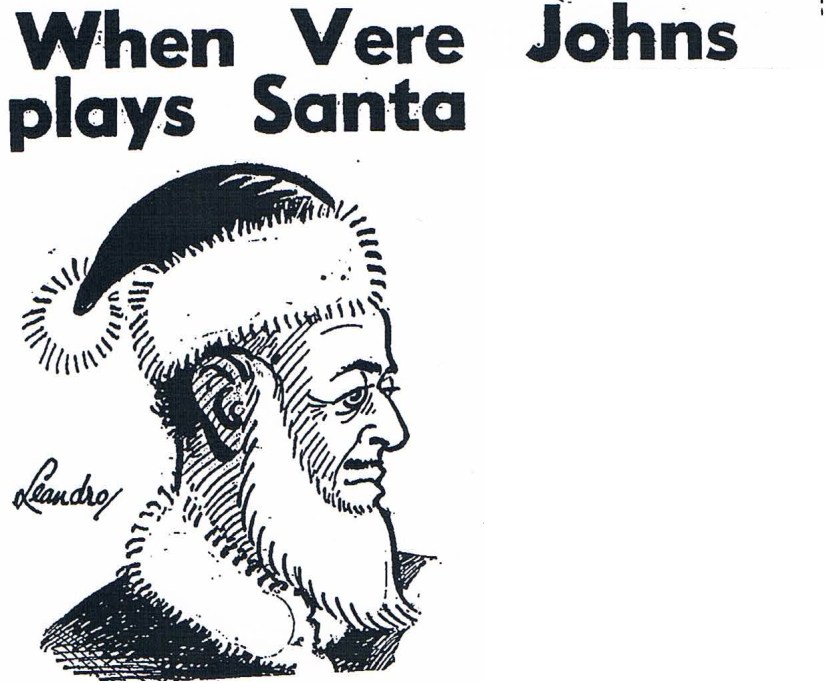
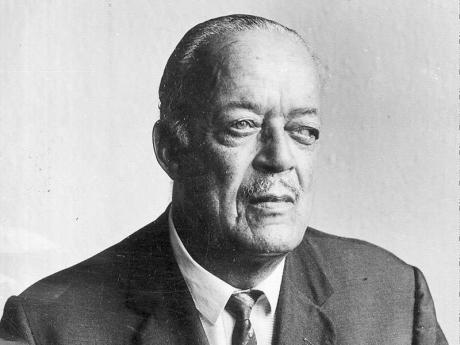
It’s December, and so the winter holidays are right around the corner. It’s a time of celebration, so why not celebrate Vere Johns, that Santa himself whose show, the Vere Johns Opportunity Hour, gave the world a gift by launching so many musical careers?! Here is our Santa, or a sketch of him, in 1961 in the same newspaper, the Star, where he had his column in which he discussed various aspects of Jamaican culture and life–everything from politics to medical care to labor issues to the mistreatment of the “bearded men.” The column was called “Vere Johns Says” and he always spoke his mind, sometimes eliciting readers to write in their opposing thoughts and maybe throw a barb or two.

vere-johns

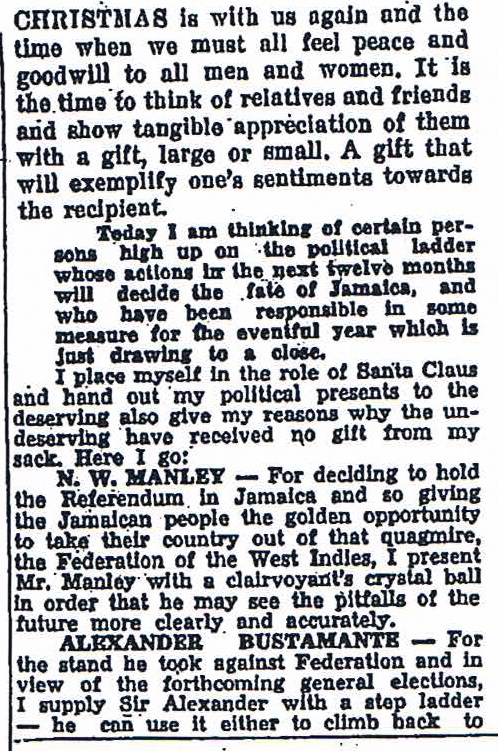
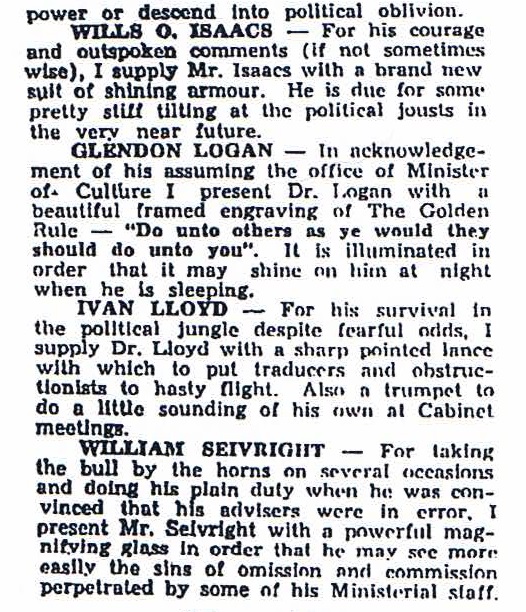
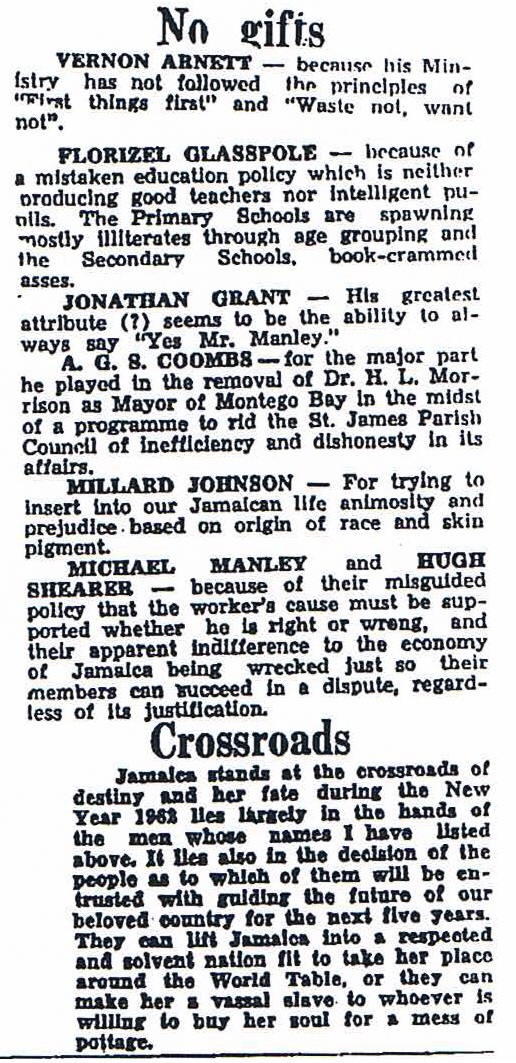
In the column from which the illustration above was taken, Johns weighs in on the “gifts” that he would like to give to local leaders in the year before his country would gain their independence. And when I read about the “referendum” I can’t help but cue up Lord Creator’s “Independent Jamaica” in my musical mind.

vere1

This is a pretty typical Vere Johns column, and I think it’s interesting in light of the independence on the horizon. On the “crossroads” Jamaica certainly was during this time. And Vere Johns was involved as conduit or a discriminator and analyst of the events, just as he was with the musical acts that came across his stage. He presented this cultural revolution as it was happening, a conduit of the music that would go on to change the world.

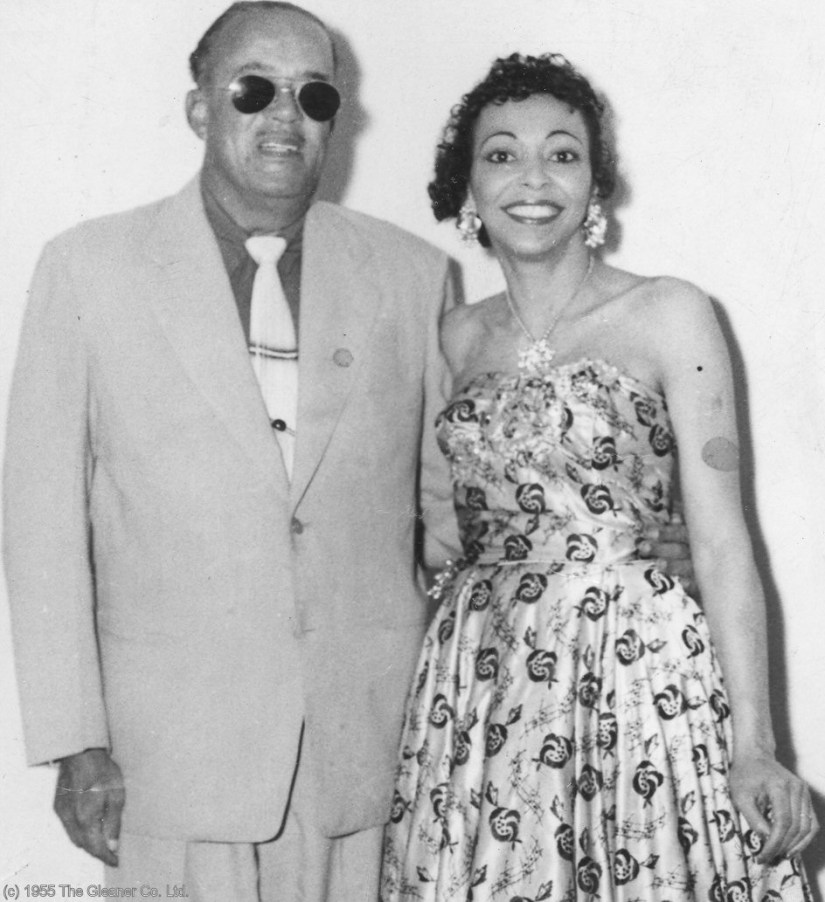
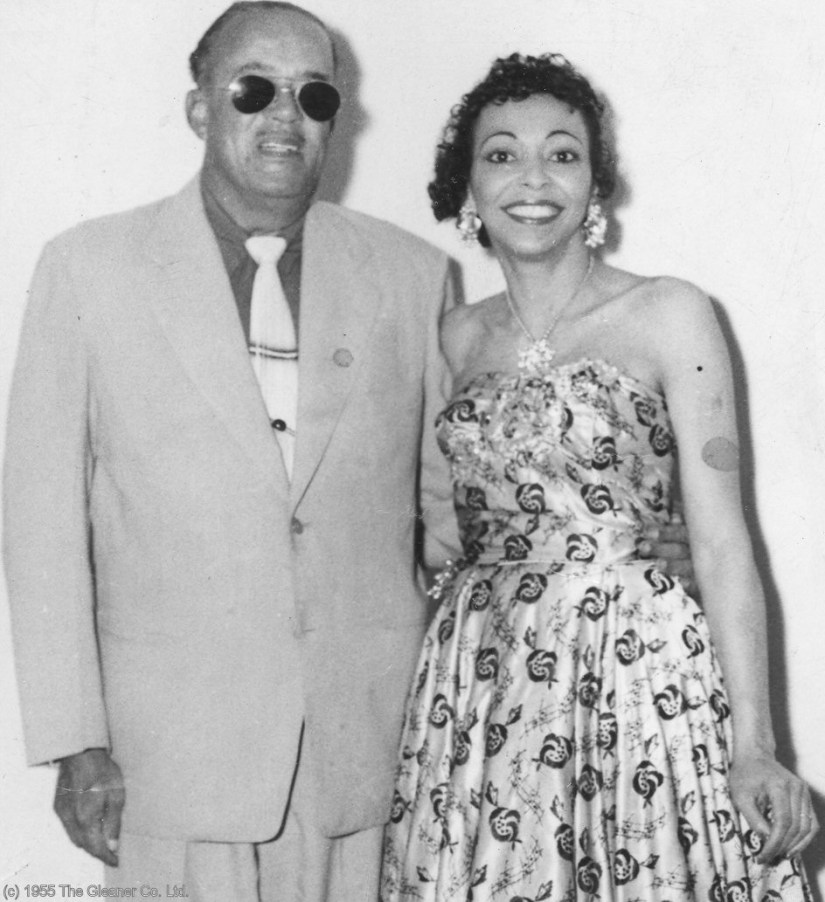
Here is Vere Johns and his wife, the lovely Lucille whose idea it was to host a variety show on the stages of the movie theaters the Johns managed.

vere-johns-and-lucille-johns

This is the same Lucille Johns who appeared with Margarita (Anita Mahfood) in the film “It Could Happen to You” which I had the pleasure of sharing with Margarita’s daughter last week. Incidentally, Margarita won the Vere Johns Opportunity Hour herself in 1952 at the age of 12. Below is an excerpt from my book Songbirds: Pioneering Women in Jamaican Music that sheds a little light on this powerhouse couple.

Ask any vocalist from the 1950s and 1960s where they got their start and they will often tell you that they either participated in or attended the Vere Johns Opportunity Hour. This talent show was responsible for launching the careers of a great percentage of Jamaican vocalists during the time when studios were looking for talent. It was a test, a rehearsal, a springboard for further success. They began the show in April, 1939. After the first show, Lucille told a reporter, “Everybody wishes to be a singer,” and she was nicknamed “Lady Luck.” The Daily Gleaner, July 25, 1939 gave a review of the Opportunity Hour series which had just wrapped up for the season. It stated, “At the close of Friday night’s finals of the popular all-Island ‘Opportunity Hour’ at the Palace Theater, Mr. Vere Johns and his popular wife ‘Lady Luck’ received tremendous compliment for their very laudable efforts of unearthing the talent of Jamaica in the entertainment world and for the undoubted success achieved. . . . with the close of the ‘Opportunity Hour’ we say to Mr. and Mrs. Johns ‘THANK YOU!’ We hope Friday night’s close will not bring an end to such fine efforts. We hope that with Friday night’s close the work of unearthing Jamaica’s talent will continue by this pair, and we hope that by their effort bigger and greater things will be achieved for Jamaica in this respect.” If ever there was a statement of prophecy, this was it.

Music historian and journalist Roy Black said of the Vere Johns Opportunity Hour, “It goes without saying that stars such as Millie Small, John Holt, Bob Marley, Jimmy Cliff, Alton Ellis, Hortense Ellis, The Blues Busters, Derrick Harriott, Derrick Morgan, Lascelles Perkins, Higgs and Wilson, Bunny and Scully, Laurel Aitken, Wilfred ‘Jackie’ Edwards. Jimmy Tucker, Girl Satchmo, Lloyd ‘Sparrow’ Clarke, and musicians Roy Richards, Charlie Organaire, and Rico Rodriguez, who all came under his wing, played significant roles in shaping Jamaica’s popular music. They came in droves – hopeful actors, dancers, tricksters, singers, kneeling at his feet for an opportunity to become popular entertainers. There was hardly a performer who grew up in Kingston who didn’t come into his fold. To them it seemed that only one man held the key to the door of success. The city’s famous theatres – The Palace, at the corner of East Queen Street and South Camp Road; The Majestic, which faces Maxfield Avenue from the Spanish Town Road intersection; and The Ambassador, along Seventh Street in Trench Town – were the venues that Johns found logistically convenient to host these shows. The events took on a carnival atmosphere following auditions held mainly in the hometown of the aspirants. With the winners being decided by crowd reaction, competition was fierce and intense.”

Black describes how the idea for the talent show came about. It was a team effort with his wife who also acted as emcee of the events alongside her husband. Black states, “According to Colby Graham, who did extensive research on Johns, the idea for a Vere Johns talent show was born out of a request by the boss of the Savannah Journal newspaper with whom Johns worked, to devise a strategy to boost attendance at cinemas. With the help of his wife, Lillian, they came up with the idea for the show which began in Savannah, Georgia, in 1937, before the couple moved the event to Jamaica in 1939. In the late 1940s, he began a long-running STAR newspaper column ‘Vere Johns Says,’ mainly on the topic of music. But half the story has never been told as, in the 1950s, Johns added another dimension to his already illustrious career where he was a talent scout, impresario, journalist, radio personality, elocutionist and war veteran, by venturing into the world of movies. He played roles in the 1955 adventure thriller Man Fish, which also featured Eric Coverly, and returned a year later in the 26-minute documentary, It Can Happen To You, in which he played the role of a father of two sons who had syphilis.” That film was the same documentary in which Margarita (Anita Mahfood) portrayed a rhumba dancer who performed in a club as patrons watched and caroused with one another.

Not only did Vere Johns encourage other performers to have a career through his talent show, but he himself was a performer on stage and screen. He even dressed up as Santa Claus at some of his holiday shows. He and Lucille performed a comedy radio show in 1943 called “Razzle Dazzle.” Lucille was also a stage actress, “Lady Luck,” who conducted the talent show band and sang at the talent performances. In 1940 on New Year’s Day, Lucille danced in a troupe that performed a production of “Show-Boat,” which was described as a vaudevillian presentation. An article in the February 18, 1941 issue of the Daily Gleaner states, “The cast of ‘Pagan Fire’ stage presentation at popular Majestic tomorrow night is hard at work and will be ready to give of their best. They comprise the following: Mrs. Vere Johns (Jungle girl)—returns to the Jamaica stage and will be seen in two dance specialties . . . Vere Johns (Chief Crandall)–veteran actor and director in a stirring dramatic role. . . . ‘Pagan Fire’ is an original playlet by Mr. Vere Johns. Place: Kango Isle in the South Seas. Production and direction by Mr. Johns, dance sequences by Mrs. Johns.” In 1943 Lucille Johns wrote a play called “Fool’s Paradise” that was directed by Vere Johns. It was performed at the Ward Theatre and was billed as “A Rich Action Packed Drama of Our Every Day Life in 3 Acts.”

Lucille and Vere Johns had served as supporters, mentors, and directors to the Caribbean Thespians, a group of actors from various theaters around the city. An August 5, 1941 Daily Gleaner article stated, “Vere Johns, well known locally for his many talents, has been heard only too infrequently in the one role in which he excels as a truly great artist. Vere Johns is a Shakespearian actor of extraordinary power. His grip and understanding of the dramatic possibilities of the Shakespearian tradition will amaze and delight his audience, sustaining at the same time the lyrical beauty of the Elizabethan English,” showing that both Vere and Lucille were greatly involved in the theater community.

Another article from the Daily Gleaner on June 22, 1939 with the headline “Play at Palace,” detailed another one of the plays presented by the Johns that Lucille herself had written. “’When a Heat Wave Hit Breadnut Bottom,’ a one-act comedy written by Mrs. Vere Johns and directed by her husband, and in which both took leading parts, was presented, at the Palace Theatre last night to a very appreciative audience. Like their ‘Opportunity Hour’ progammes, this presentation was a further endeavour of Mr. and Mrs. Vere Johns to present to the Jamaica public, Jamaica talent, and they succeeded in no uncertain way in this respect. Throughout its 40 minutes duration, the presentation was followed with interest, interspersed with the applause of the audience. Apart from Mr. and Mrs. Johns, outstanding performers in the play were little golden-voiced Frederick Stanley, who sang three very delightful songs, little Lester Johns (son of Mr. and Mrs. Vere Johns), and Ranny Williams, who as Tom, the headman of Mass Charlie’s (Mr. Vere Johns) plantation did justice to his part.” Lucille and Vere also had at least one other son, Vere Johns Jr., who went on to emcee in 1984 for the Vere Johns Opportunity Hour where Bunny and Scully performed. This event took place at the Odeon Theater and Vere Johns Jr. was billed as the “Ace from Outa Space.”

Here is a link to the article I cite from Roy Black, the legendary music columnist: VERE JOHNS

verejohns9089519700704

Uncategorized

Lost Chapter of Ska: An Oral History

For those who have read my book, Ska: An Oral History, you may notice there are two significant artists who are omitted. In fact, the subject of ska history is so large that there are many artists who are not in this book because it is a cursory introduction to the music, many artists have died and therefore cannot be interviewed, and there are some who were unwilling to participate. One of these artists was Prince Buster who granted me an interview for my book, but then when I went to obtain permission in writing, asked for monetary compensation. It was disappointing, to say the least, to receive such a response after being granted the interview, which I still have on tape. I do respect Prince Buster though and know that as a producer, money is the name of the game. Unfortunately, in publishing a book for an academic press, there is no money to be made for authors at all. When I explained this reality, he said this was another reason why he would not want to grant me permission. I also explained that journalism ethics prevented me from offering those I interviewed any money, as that would taint the interview and bias the material. Thus, I maintained my integrity and rewrote the chapter in the eleventh hour.

Another artist who was omitted was Desmond Dekker. I had obtained an interview with Dekker’s manager and close personal friend Delroy Williams and was unable to publish it in the book at the time due to some publishing obligations that Delroy had at the time, but five years have passed and so now I offer this chapter here. Delroy is a sweet man, a kind soul, and an artist in his own right. He still carries the legacy of Desmond Dekker forward and his words here are full of love and friendship. Enjoy.

Dadanddesmond

My Brother’s Keeper, by Heather Augustyn
Featuring Leon Delroy Williams on Desmond Dekker

His tassels swing from the length of each arm, punctuating the rocksteady rhythm. He electrifies the stage with his charisma, Desmond Dekker in his slanty black beret while people in the crowd who are half his age, even younger, sway to his voice which has become more mellow, more soulful with age, and he still nails every note in the wide vocal range of the hit song “Israelites.” Behind him stands his manager and fellow musician. He echoes the chorus, strums the guitar. But Leon Delroy Williams is much more than a mere manager or performer to Dekker. They are life-long friends, standing together on stage, and standing together through life, and now death. They are brothers.
Desmond Dekker was born Desmond Adolphus Dacres on July 16, 1941 in Kingston. He had a talent for singing, even as a very young child, performing the tunes of artists popular in the U.S., such as Little Richard, Bill Haley, Nat “King” Cole, and Sam Cooke. He attended the famous Alpha Boys School as an orphan since his mother died and his father was unable to raise him. Later in life, Dekker began working as a welder apprentice, but after his fellow employees heard his singing, they encouraged him to seek a career in music. He performed at the Vere Johns Opportunity Hour like so many of his contemporaries and he took time off from work repeatedly to audition at the leading studios of the day. He auditioned for Coxsone Dodd and Duke Reid, but both turned him down. However, Leslie Kong saw Dekker’s immeasurable talent, and after a couple of auditions, in front of Derrick Morgan and Jimmy Cliff, accompanied by pianist Theophilus Beckford of “Easy Snappin’” fame, Dekker impressed them all and Kong signed him to the Beverly’s label in 1961.
Dekker was excited to have the promise of a new life and he shared his experience with a fellow welder at his work, encouraging this worker to give Kong another try. This worker, a young Bob Marley, had previously been rejected by Kong, but with Dekker’s support, Marley visited Kong’s studio again, met Jimmy Cliff, and went on to overwhelming fame.
But for Dekker, it would be two years before Kong’s label recorded and released a song. Derrick Morgan recalls, “Desmond Dekker used to be my backup singer because he was with Beverly’s for two years before he sang a song called ‘Honour Your Mother and Father,’ so while he was there, he was doing backup with me.” Dekker’s brother George Dekker, of later Pioneers fame, also sang back up for Morgan on the song “Tougher Than Tough.” For Desmond Dekker, “Honour Your Mother and Father” was an immediate hit in Jamaica. It was recorded under the artist name, “Desmond Dekker & Beverly’s Allstars” since Kong suggested Dacres change his moniker to Dekker. Dekker recorded two more songs before “King of Ska” was another huge hit in 1964, backed up by the Cherrypies who would go on to be known as the Maytals with Toots Hibbert. “King of Ska” put Dekker “right there on top.” He assembled his own group, Desmond Dekker and the Four Aces, backed by Clive Campbell, Easton Barrington Howard, Wilson James, and Patrick Johnson. Dekker continued to put out hits in 1965, including “Get Up Edina” and “Generosity,” among others.
The topics of many of Dekker’s songs were finger-pointing prescriptions for good behavior and finger-wagging admonishments for bad behavior. But in 1967, Dekker added another topic to his repertoire that would endear him, not only to Jamaican youth, but to the British who craved the Jamaican style. The rude boy culture was commemorated in Dekker’s huge hit “007 (Shanty Town)” which reached number one on Jamaican charts, as well as number 15 in the U.K. The tune even became a hit in the U.S. and it was also featured in the movie The Harder They Come. Dekker wrote the song about the violence among the Jamaican youth in the late 1960s. “Dem a loot, dem a shoot, dem a wail in Shanty Town,” said it all. And for the British youth who glamorized such stylish culture, the song sealed Dekker’s position as an icon.
The next year, Dekker won the 1968 Jamaica Festival song contest with “Intensified” and in the same year Desmond release perhaps his greatest song that established Dekker even further as one of the greatest Jamaican artists of all time. The song, “Israelites,” was such a huge hit in Jamaica that Commercial Entertainment, a management company, brought him to the U.K. to tour where he met Leon Delroy Williams. “I first met Desmond when he came over to do ‘Israelites’ and ‘Israelites’ was number one. And we were with the same management company at the time and I was the only black artist they have on their book, and Desmond was the next black artist to get on the books. So the first tour Desmond did, I had to go around with him. He didn’t know nobody,” says Williams.
Leon Delroy Williams was an artist in his own right, and still is today. Raised on a farm in Bamboo St. Ann, Jamaica, Williams moved to England when he was just nine years old. Always having a great love and talent for music, Williams became involved in a soul band and they signed to the Commercial Entertainment management company. “I was doing my own thing with my band at the time,” says Williams. This involved recording for Bell Records in 1968 with reggae renditions of Ben E. King and Billy Joe Royal tunes since Williams had a love for both reggae and soul music.
After the tour with Dekker, the two remained friends, which Williams says was hard for others, but not for him. “Desmond wasn’t the kind of guy that . . . it’s not easy to be his best friend. Desmond did not really trust people. I’m more English and he just arrived from Jamaica and I used to speak the truth to him and I wasn’t a yes man. Because he was a big star, all he had around him was yes men. Nobody was really telling him the truth or trying to educate him about the English ways and the music business,” says Williams. Williams left his management company and signed with another, but he and Dekker would join forces again later, for good.
Until then, Dekker continued to be a popular artist in England as the 2Tone era kicked off in the late 1970s. Dekker signed with Stiff Records, a label that embraced punk and ska music with a slogan, “If it ain’t Stiff, it ain’t worth a fuck.” Bands like Madness, The Belle Stars, The Damned, The Pogues, and Elvis Costello also called Stiff Records home. Dekker’s work inspired the reggae of the Clash, and he produced hit after hit over the years. When the 2Tone movement waned though, Dekker found himself looking for new work.
“About a year after I left, Desmond fell out with his management company so he just went down the road a bit and one time he just say to me, ‘Why don’t we just join together. You do the management. We’ll work on stage together and you be the manager.’ And I just thought about it for a while. I said, ‘Okay, let’s go for it,’ and it lasted for 27 years,” Williams says. It was the longest business partnership that Dekker had. “The longest time he had a manager before I came around was Leslie Kong, which only lasted a few years, and then Commercial Entertainment, he only lasted a few years with them as well. But we were 27 years, traveled the world. We had a good time together,” he says. The two joined forces in 1981.
That business partnership took time, says Williams. “It took him about a year to really put his trust in me. Of course, he had a rough time. All the people he work with before, the managers, they really kind of took him to the cleaners financially. That was the nature of the business. If I was there from day one, he would have made a lot of money. And I could understand why it took him a year to really put his trust in me,” he says. Williams was good for Dekker, both personally and as a business partner. His career grew. “Even when ‘Israelites’ was number mine in the Billboard charts in America, he never get to go there to promote it. Because this company was owned by two people. One don’t like to fly, and one wouldn’t let the other one go with Desmond alone because they know that in America when you go there, next thing they are left behind and they’re out of the picture, so Desmond didn’t get to America until I take over and we did a tour or America. The first tour was five weeks and every couple of years we do five weeks tour and we’ve been all over America,” says Williams who also sang back up for Dekker as a member of the Aces.
One listen to Dekker’s awe-inspiring vocals tells anyone that he was an incredible talent, far surpassing the skill of most all others. So why then isn’t Dekker held up by the masses as one of the greatest artists of all time? Says Williams, “There’s nobody else, no reggae artist, that’s got Desmond’s voice. There are people like Bob Marley and all them who was marketed in a big way. Desmond Dekker wasn’t marketed in a big way. He just got his fame by doing his thing. You don’t read about Desmond in the paper going out with Miss World, or Desmond smoking, and you don’t read those things about Desmond, you understand? You don’t see Desmond on no television game show. He would go on TV just to sing. Desmond was happy to go on stage to sing but he wasn’t happy with being a star, you understand? He just wanted to sing. He didn’t want nothing else, and a lot of people don’t understand that. But that was Desmond. And because people didn’t read a lot of propaganda, people trying to build him up in the papers and things like that, when they see him, they just love him. Of course he wasn’t blasted all over, going out here, doing this, doing that. When you come to a tour, that’s when you see him. And when he’s coming and touring to your part of the world, that’s when you read about him. But apart from that, Desmond wasn’t one of them people that you find in the nightclubs. Desmond, when he’s on tour, he’s on tour. When he home, he’s hard to get out of his house. He love his home. It’s hard to get Desmond out of his house when he’s not working. He just love to be home,” Williams says, speaking of his friend, flipping between past and present tense because he knows he is gone, but yet he is somehow still very present.
Williams speaks of Dekker’s death with great pain. Even though Dekker died of a heart attack at his London home, where he loved to be, on May 25, 2006, the hurt is still so strong for Williams, as well as Dekker’s many fans. “When Desmond died, he was at his fittest. And I say fit because about two weeks before he died we were getting ready to go on this long tour and he left my house on Wednesday at seven o’clock in the evening. At first we were going around looking, he was trying to move from London and he want to go out to the country. For about a week we’ve been driving around looking at different property and we went looking at property on Wednesday and I drop him off and I came home about three o’clock and then at seven o’clock he came round by me because he had to see his kids on Thursday to give them the places of where we were going to be on tour, where we could be contacted and all that. But when he came in, my computer was down so, my printer was down, so I had to write it off. That took a while and he left and the last thing he said to me, we were supposed to meet up at 10:30 the next morning. The last thing he said to me was, ‘Make sure. Make sure. Don’t be late,’ and I laugh, he laugh, and he got in his car and drove off. Four o’clock in the morning, he was dead. So fast. Four o’clock in the morning he was dead. And that was one of the worst times of my life. The worst time of my life. A heart attack came on through high blood pressure and that was it. He was gone,” says Williams.
It is still difficult for Williams to perform, having been used to performing together with his best friend for nearly three decades. “Now I’m back on the road and it took me a year and a half to muster up the strength and the courage to go up there and stand there on my own. The only difference, why we weren’t brothers, was because we weren’t from the same mom and dad. But we were brothers and the whole world knows that,” he says.
As it was in life, now it is in death, that Williams is Dekker’s brother and his keeper. “It still hurts. He’s buried not far from here. I walk down there about once every two weeks. He’s got a beautiful tomb. Some people say I shouldn’t go down there so often, but I have to go, and the reason why I have to go is because he has fans that go down there, and they go and see it in terrible condition, they’re not going to say it’s his children, they’re going to say it’s me. How can you let Desmond’s tomb get in that condition, so that’s why I do it,” says Williams.

Uncategorized

Totlyn Jackson–First Lady of Jamaican Jazz

totlyn-jackson1-e1448061201590

Totlyn Jackson is one of the leading ladies of Jamaican jazz, and beyond. She has an incredible vocal range and can scat with the best of them. Many may know her from her recent work with Basement Jaxx on the 2003 album Kish Kash. But Totlyn has had a long career that started in Jamaica before she moved in London where she still lives today.

Although I devote an entire chapter to Totlyn Jackson in my book, Songbirds: Pioneering Women in Jamaican Music, I recently came across these photos and articles on her when I was scouring the Star Newspaper on microfilm this summer–only four years have been preserved so hopefully the Gleaner, who owns these archives, will be able to fund digitizing all of them. I know they are in the process of making this a priority before the history crumbles forever, as these newspaper are in a very fragile condition at this point. But I digress.

Here is an excerpt from my book that gives a bit of background on Totlyn Jackson:

Totlyn Jackson was born in 1930 in a small village in Port Maria, St. Mary. Her father worked for the government so the family had a bit of status in their town, and their mother was a skilled dressmaker who took care of the home and raised Totlyn and her three siblings—sisters Claire and Peggy and brother Peploe. The family was extremely involved in the Hampstead Presbyterian Church and other social and civic organizations in the community so Totlyn had the opportunity to sing in the church choir and participate in Christmas and other holiday performances. Plus, there was an organ in the family home, so Totlyn taught herself to play and sing, and she also began taking piano lessons from a neighbor. She was born with a club foot which was aggravated by an operation in her childhood. As a result, she has always had a significant physical deformity but she has never let that slow her down.
When Totlyn was 19 years old she moved to Kingston after winning a scholarship to Lincoln College. It was an enormous change for Totlyn, moving from a small village where her family enjoyed social status, to an urban city where she was an unknown. She joined the choir at North Street Cathedral as a soprano and then, like many other talented vocalists and musicians, Totlyn decided to try her hand at the Vere Johns Opportunity Hour. Accompanied by Frankie Bonitto, Totlyn won by singing, “With a Song in My Heart.” She then entered a contest at the upscale Colony Club where Eric Deans led the orchestra.

In Myrna Hague’s article in the spring/summer 2009 issue of Wadabagei, Totlyn remembers, “Coming out of a church situation, I was wearing boots and socks and an inappropriate dress, but Eric [Deans] knew what he was doing with me. Eric had inherited a big band folio—we didn’t call it jazz—I didn’t know anything about jazz. I was treated as a curiosity but I didn’t know it then! . . . I began to work with Eric and was making a name for myself at the Bournemouth Club every Friday where I came into my own. When Lester left, many of his abandoned musicians joined the Eric Deans band including Don Drummond, Brevett, and Lloyd Knibb. He [Lloyd Knibb] never had the hang-ups like Brevett and Don Drummond; Drummond and I never spoke more than ten sentences; he had his anger and stuff that he did—I was never a part of what was going on. I was the only full-time professional singer; the others were part-time with daytime jobs. Friday nights at the Bournemouth and Sonny’s [Bradshaw] got in touch with me for the first big band concert at the Ward; by this time everyone thought of me as a jazz singer because of this concert, and I could sight-read, so I was easy to work with.”

totlyn2

Totlyn Jackson also performed at the Bournemouth Beach Club with Lester Hall’s Orchestra featuring Don Drummond and she frequently sang with Baba Motta’s Band, the Zodiacs, Sonny Bradshaw’s Orchestra, and Herman Lewis and the Glass Bucket Band. She performed in a show at the Carib Theatre on February 5, 1966 with the son of Frank Sinatra, the 18-piece Tommy Dorsey Orchestra, and the Caribs. She even performed for Prime Minister Norman Manley’s birthday on July 3, 1956, singing a song composed for him by Frank Clarice of Little London in Westmoreland that moved Manley to tears. Her only recording on the island was for W.I.R.L—“Island in the Sun” with the B side “Yellow Bird” in 1963 with the Audley Williams Combo.

totlyn1

In the mid-1950s, Totlyn frequently sang with another jazz vocalist who predated her career—Julian Iffla. Iffla had been singing in Kingston clubs since the late 1949s and also performed with orchestras of the day including Eric Deans, Baba Motta, Sonny Bradshaw, George Moxey, Frankie Bonitto, and Lester Hall with Don Drummond. Iffla also performed in musicals and pantomime and was billed as “Velvet Voiced.”

While Totlyn’s life was beginning to thrive in Kingston, her family’s life back in Port Maria was crumbling. Her mother and father split up and her mother came to stay with Totlyn. But Totlyn had been living in the home of one of her professors at Lincoln College as part of the scholarship arrangement and her mother couldn’t live there. So Totlyn moved her fractured family into the home of Joe Issa, owner of Issa’s department store. “One day my two sisters and brother arrived, because Dada said that if I was big enough to look after Mama, I could look after them too,” she said in Myrna Hague’s article. Hague comments, “Her father was probably resentful of her [Totlyn’s] show of independence, and because of whatever had gone on between her mother and him, he no longer wanted them or perhaps responsibility of them.”

totlyn

Soon, Totlyn had yet another family member to care for while balancing her career. She met an advertising executive from New York on his travels to the island when he came to Glass Bucket Club for one of her performances. “I eventually became pregnant. I didn’t want to get married. I had seen how unhappy these wives were, including my mother. I wondered, ‘Should I have this child?’ There was no one to ask this kind of intimate question,” she says in Hague’s article. But she did have the child, a son named Franz. His father, Jack Conroy, the ad executive, died in a car accident shortly before he was born. Totlyn never married—not then, not ever. But she did have her share of boyfriends. “That’s where I met my contacts and my boyfriends,” said Totlyn to Myrna Hague of her time singing at the Glass Bucket Club. “I wanted a first-class life and so what I needed was people who could take me onto that plateau, to take me up.”

One of those boyfriends who took her career up was a man named Michael Rouse and she left Jamaica to go to London with him in 1960. She also left her son to be raised by her mother. “I went to London to join him [Michael Rouse] when he offered to handle my career, and then he became a fully-fledged impresario who was handling people like Juliet Greco, Los Paraguayos, Gilbert Becaud, Miriam Makeba, and others of that ilk. We eventually broke up because he couldn’t sell me and I resented that. When I complained he said that he loved me too much. I thought that was crap but friends said that it was possible because he was afraid of losing me. . . . He couldn’t or wouldn’t arrange a tour for me. He was not a very good businessman,” Totlyn told Myrna Hague.

You can read more about Totlyn and her career in my book, but suffice to say that she has had a long and successful career in London. Below are a few clips of Totlyn Jackson performing in recent years. She’s still got it!!

Here’s a video of Totlyn Jackson performing a tune with Basement Jaxx to get you in the mood for Christmas!

Amateur footage of Totlyn Jackson performing in 2011, scat-a-lat-a-dong-dong!

Basement Jaxx with Totlyn Jackson, “Supersonic.”

Here is a link to Myrna Hague’s brilliant article about Totlyn Jackson, which begins on page 40:

Don Drummond, Uncategorized

Don Drummond in the Mid-1950s

My friend Roberto Moore, a researcher and historian who lives in Kingston, was generous to send me a few clips related to Don Drummond from Star Newspaper archives from the mid-1950s. I asked him if I could share these on my blog and he kindly said yes, so here are the fruits of his labor.

Don-Drummond-insurance-0ct-26-1956-Batman-aka-Sonny-Bradshaw


First is this clip from the Star Newspaper on October 26, 1956 in the “Batman” column, rumored to have been written by Sonny Bradshaw which states, “Don Drummond, ace-trombonist is now selling insurance by day.” I had heard this over the years and was never able to confirm it and I find this instance of it in print intriguing. As I discussed with Roberto, Drummond would have recently left Bradshaw’s band in 1956, so Bradshaw, if he is the writer of this column, is not what the journalism world would call impartial here. He may have a bias, who knows. If it is Bradshaw, might be be kind of sticking it to Drummond? How long did this venture last and was it really a foray into a new line of work and why would he pursue this at this point in his life? Who knows, but it should be viewed in context, and it is quite a thought to entertain, Drummond in his suit and boogas, briefcase in hand, peddling paperwork, as Roberto and I mused.

jazz-at-the-carib

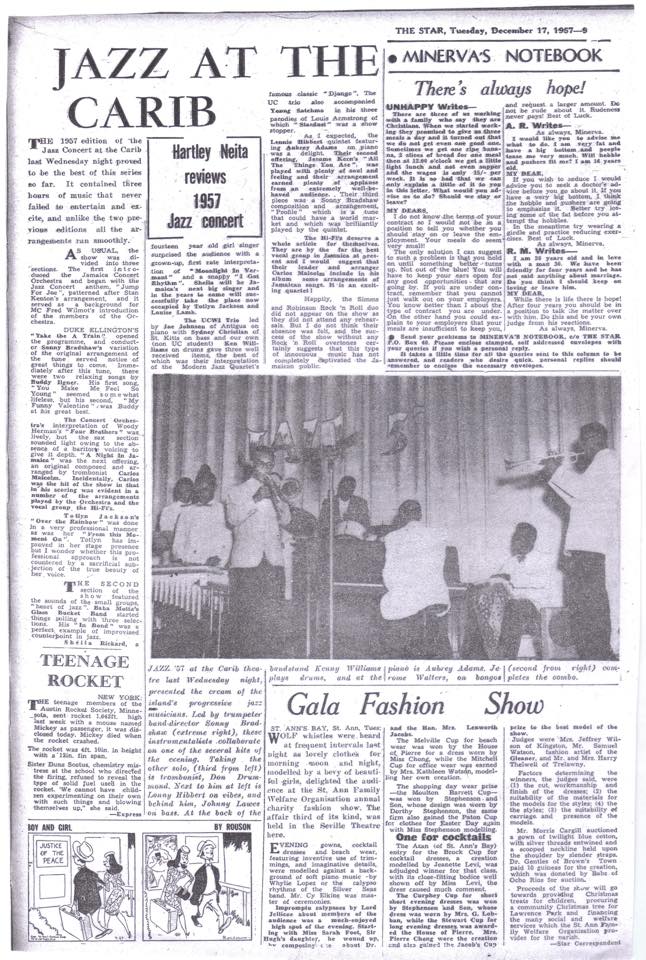
Drummond’s day job was likely short lived, if it ever did amount to anything, because as this clip shows from December 17, 1957, Drummond was back center stage for Jazz at the Carib performing with Sonny Bradshaw. Here is a better photo of the one pictured above in the article.

CaribTheatre3466243545195717-copy

The article, written by Hartley Neita, reads: The 1957 edition of the jazz concert at the Carib last Wednesday night proved to be the best of this series so far. It contained three hours of music that never failed to entertain and excite, and unlike the two previous editions all the arrangements ran smoothly.

As usual the show was divided into three sections. The first introduced the Jamaica concert orchestra and began with the jazz concert anthem “Jump for Joe,” patterned after Stan Kenton’s arrangement, and it served as a background for MC Fred Wilmot’s introduction of the members of the orchestra.

Duke Ellington’s “Take the A Train” opened the program, and conductor Sonny Bradshaw’s variation of the tune served notice of great things to come. Immediately after this time, there were two relaxing songs by Buddy Eigner. His first song, “You Make Me Feel So Young,” seemed somewhat lifeless, but his second, “My Funny Valentine” was Buddy at his great best.

The concert orchestra’s interpretation of Woody Herman’s “Four Brothers” was lively but the sax section sounded light owing to the absence of a baritone voicing to give it depth. “A Night in Jamaica” was the next offering, and original composed and arranged by trombonist Carlos Malcolm. Incidentally, Carlos was the hit of the show in that in his scoring was evident in a number of the arrangements played by the Orchestra in the vocal group, the Hi-Fis.

Totlyn Jackson’s “Over the Rainbow” was done in a very professional manner as was her “From this Moment On.” Totlyn has improved in her stage presence but I wonder whether this professional approach is not countered by a sacrificial subjection of the true beauty of her voice.

The second section of the show featured the sounds of the small group’s “heart of jazz.” Baba Motta’s Glass Bucket Band started things sailing with three sections. His “In Bond” was a perfect example of improvised counterpoint in jazz.

Sheila Rickard, a fourteen-year-old girl singer, surprised the audience with a grown-up, first rate interpretation of “Moonlight in Vermont” and a snappy “I Got Rhythm.” Sheila will be Jamaica’s next big singer and in the years to come will successfully take the place now occupied by Totlyn Jackson and Louise Lamb.

The UCWI Trio led by Lee Johnson of Antigua on piano with Sydney Christian of St. Kitts on bass and our own (non-UC student) Ken Williams on drums gave three well received items, the best of which was their interpretation of the Modern Jazz Quartet’s famous classic “Django.” The UC Trio also accompanied Young Satchmo in his three parodies of which “Standard” was a showstopper.

As I expected the Lennie Hibbert Quintet featuring Aubrey Adams on piano was a delight. Theirsecond offering, Jerome Kern’s “All the Things You Are” was played with plenty of soul and feeling and their arrangement earned plenty of applause from an extremely well behaved audience. Their third piece was a Sonny Bradshaw composition and arrangement, “Profile,” which is a tune that could have a world market and which was brilliantly played by the quintet.

Tthe Hi-Fi’s deserve a whole article for themselves. They are by far the best vocal group in Jamaica at present and I would suggest that their leader and arranger Carlos Malcolm include in his album some arrangements of Jamaican songs. It is an exciting quartet!

Happily the Simms and Robinson Rock ‘n Roll duo did not appear on the show as they did not attend any rehearsals. But I do not think their absence was felt, and the success of the show without any rock ‘n roll overtones certainly suggests that this type of innocuous music has not completely captivated the Jamaican public. 

jazz-at-the-carib2

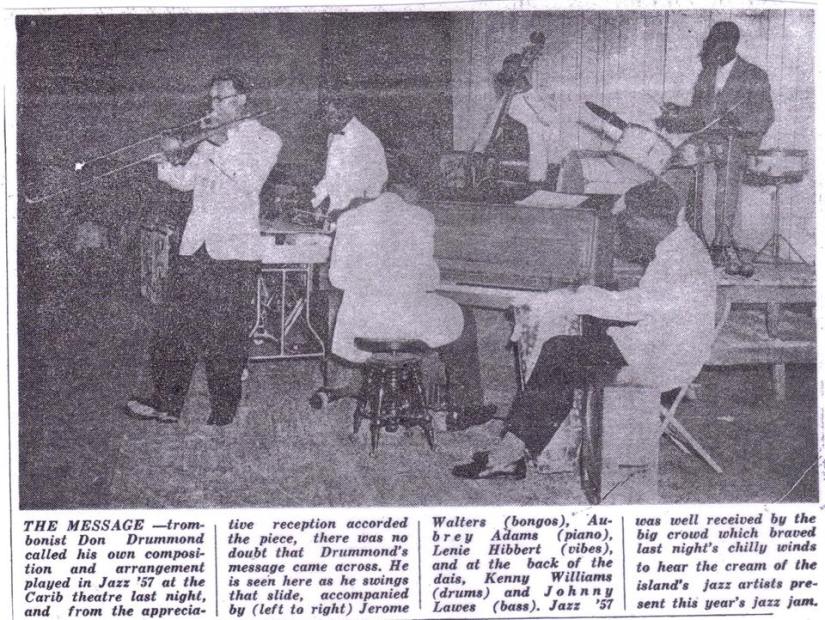
Here is another photo that ran in that same newspaper. The caption reads, “The Message–from trombonist Don Drummond called his own composition and arrangement played in Jazz ’57 at the Carib theatre last night, and from the appreciative reception accorded the piece, there was no doubt that the message came across. He is seen here as he swings that slide, accompanied by (left to right) Jerome Walters (bongos), Aubrey Adams (piano), Lennie Hibbert (vibes), and at the back of the dais, Kenny Williams (drums) and Johnny Lawes (bass). Jazz ’57 was well received by the big crowd which braved last night’s chilly winds to hear the cream of the island’s jazz artists present at this year’s jazz jam.

I write about that song, “The Message,” in my book, Don Drummond: The Genius and Tragedy of the World’s Greatest Trombonist. It was a song that made crowds go wild. Below is a better resolution of the photo above.

don-drummond-Lennie-Hibbert-Aubrey-Adams-Johnny-Lawes-Jerome-Walters-ans-Kenny-Williams

Uncategorized

Calypso Contest and the Jolly Boys

jolly-boys

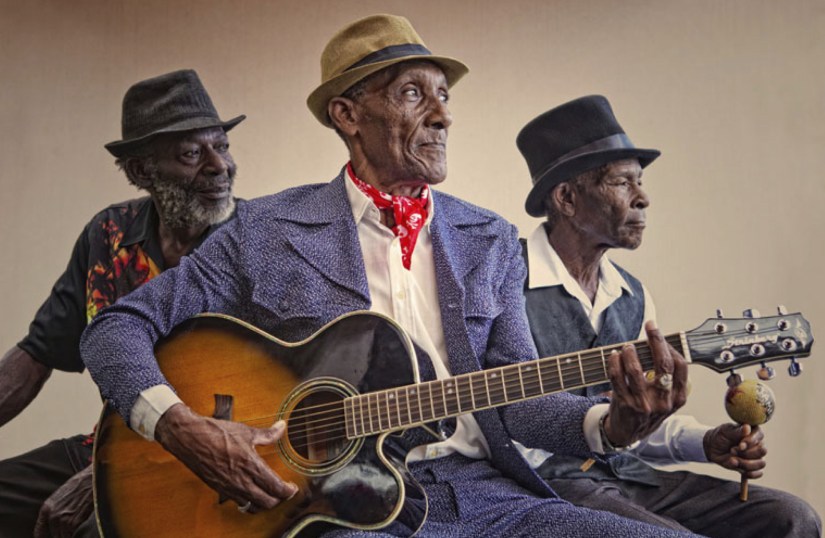
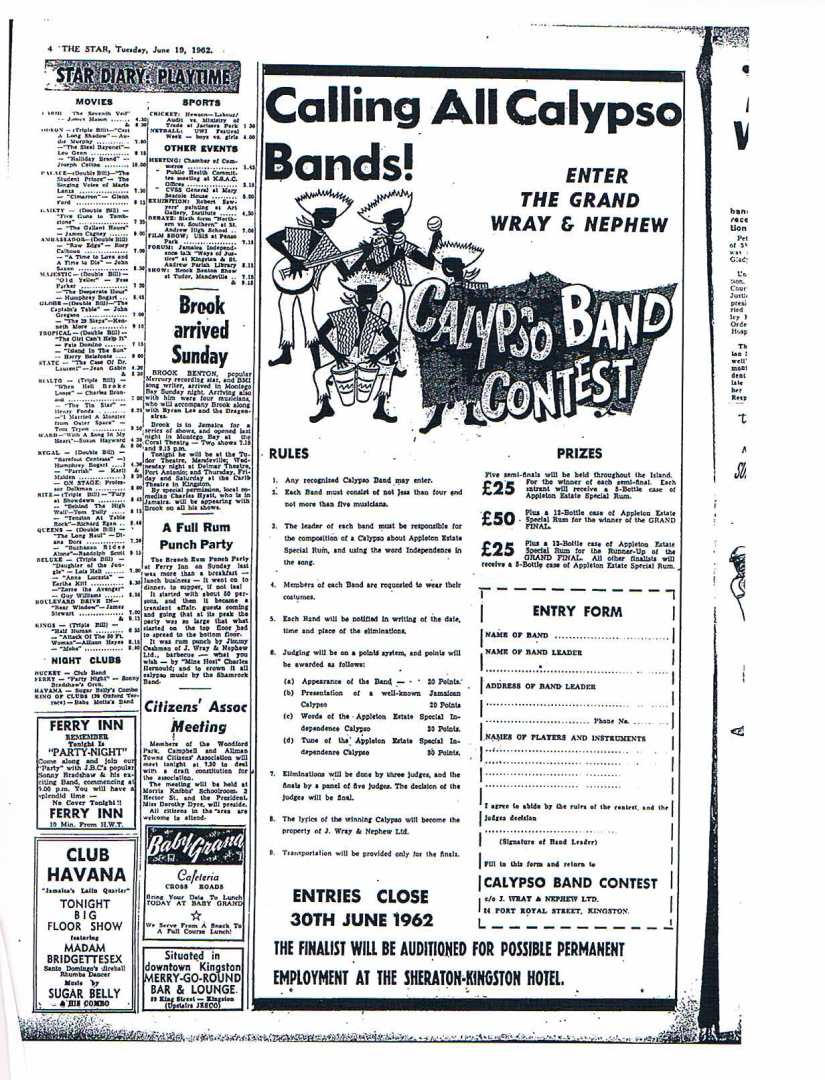
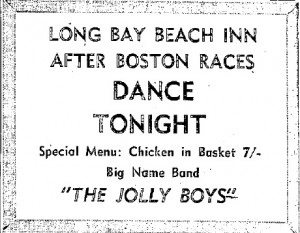
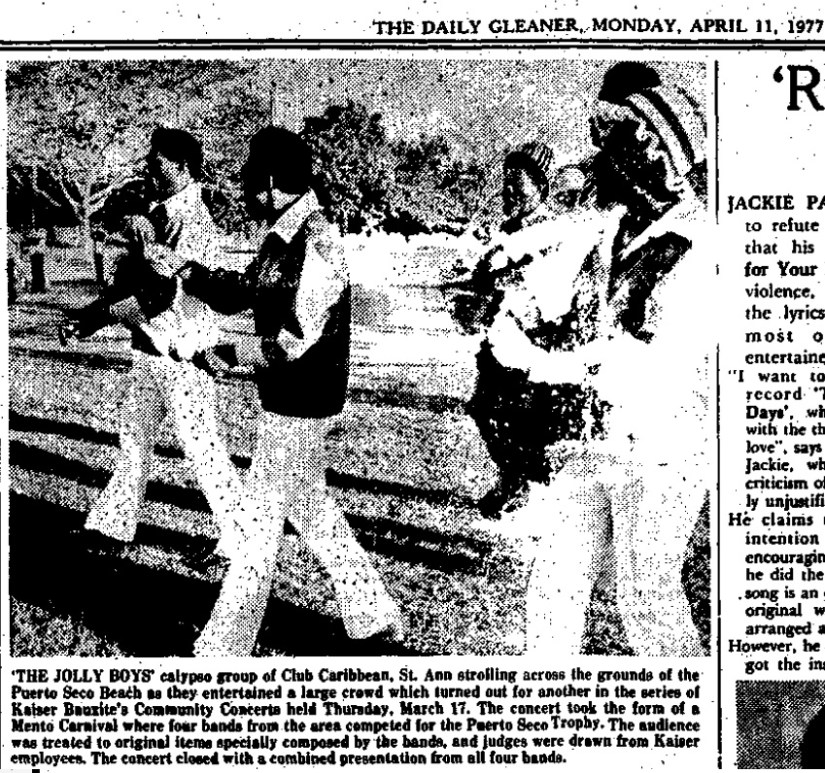
The Jolly Boys have experienced a rebirth in recent years, perhaps due in part to their calypso coverage of Amy Winehouse’s “Rehab,” which is a spirited and novel rendition. I especially love their calypso cover of Iggy Pop’s “Passenger.” It is said that their name was given was given to them by Errol Flynn since they frequently played for his shin-digs in Port Antonio. I don’t pretend to know much about the Jolly Boys, but I do want to share here two articles that I recently found in the Star Newspaper that are related to the Jolly Boys. One is an advertisement for a Calypso Band Contest sponsored by Wray & Nephew from the Star on June 19, 1962. The Jolly Boys entered this contest and performed quite well, as evidenced in the next article I found.

03181101

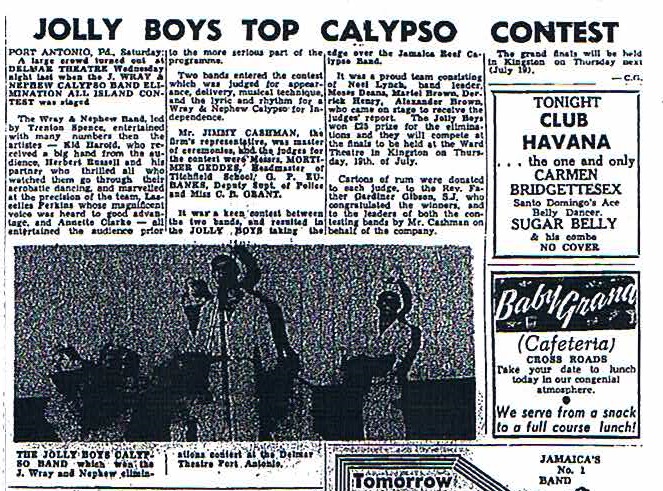
On July 17, 1962, the Star Newspaper wrote in an article titled, “Jolly Boys Top Calypso Contest,” their success was profiled. The article stated, “Port Antonio, Saturday. A large crowd turned out at Delmar Theatre Wednesday night last when the J. Wray & Nephew Calypso Band Elimination All Island Contest was staged. The Wray & Nephew band, led by Trenton Spence, entertained with many numbers then the artistes—Kid Harold who received a big hand from the audience, Herbert Russell and his partner thrilled all who watch them go through their acrobatic dancing and marveled at the precision of the team, Lascelles Perkins whose magnificent voice was heard to good advantage, and Annette Clarke—all entertained the audience prior to the more serious part of the programme. Two bands entered the contest which was judged for appearance, delivery, musical technique, and the lyric and rhythm for a Wray & Nephew Calypso for Independence. Mr. Jimmy Cashman, the firm’s representative, was master of ceremonies, and the judges for the contest were Messrs. Mortimer Geddes, Headmaster of Titchfield School, G. P. Eubanks, deputy supt. of Police, and Miss C. N. Grant. It was a keen contest between the two bands and resulted in the Jolly Boys taking the edge over Jamaica Reef Calypso Band. It was a proud team consisting of Noel Lynch, bandleader, Moses Deans, Martel Brown, Derrick Henry, Alexander Brown, who came on stage to receive the judges report. The Jolly Boys won £25 prize for the eliminations and they will compete at the finals to be held at the Ward Theater in Kingston on Thursday 19th of July. Cartons of rum were donated to each judge, to the Rev. Father Gardiner Gibson, SJ who congratulated the winners, and the leaders of both the contesting bands by Mr. Cashman on behalf of the company. The grand finals will be held in Kingston on Thursday next (July 19).”

jolly-boys1

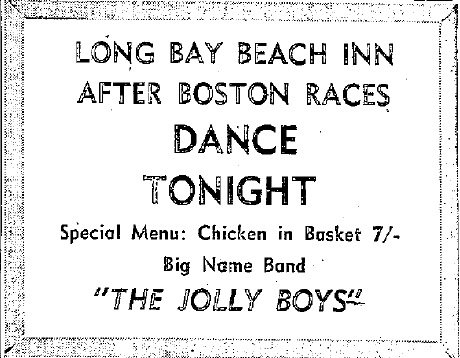
Here’s another advertisement that ran in the Daily Gleaner on the day of the big event, July 19, 1962:

Jolly-gleaner-7-19-1962

I can’t find any article or write-up on who won this contest, but I did find a few more articles and advertisements for the Jolly Boys, which I post here.

jolly-9-30-67

jolly-9-30-67-300x233

jolly-4-11-77

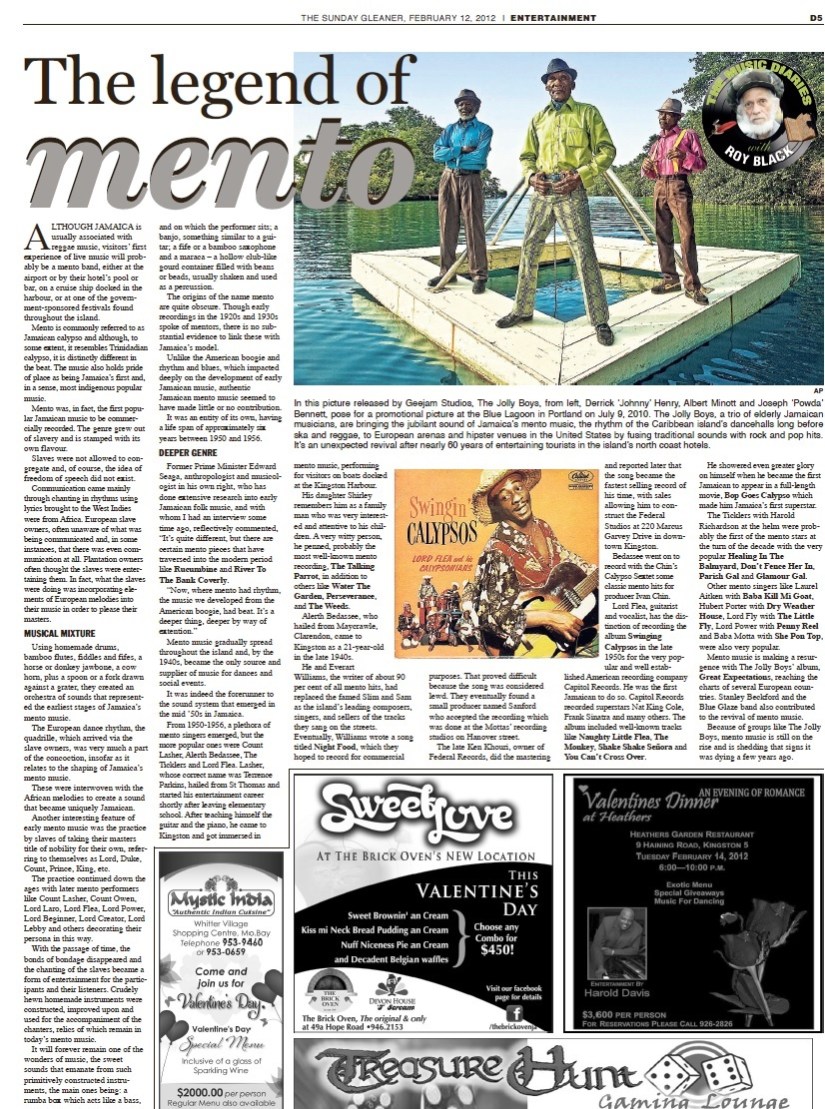
And here is an article on mento which features The Jolly Boys written by Roy Black.

mento

To hear a little of the Jolly Boys, check these links out to three of my favorite songs.

Here are the original members, or a few of them, recorded in 1989 with No Rice, No Peas, No Coconut Oil:

Rehab:

The Passenger:

Blue Monday:

Uncategorized

A Young Sister Ignatius

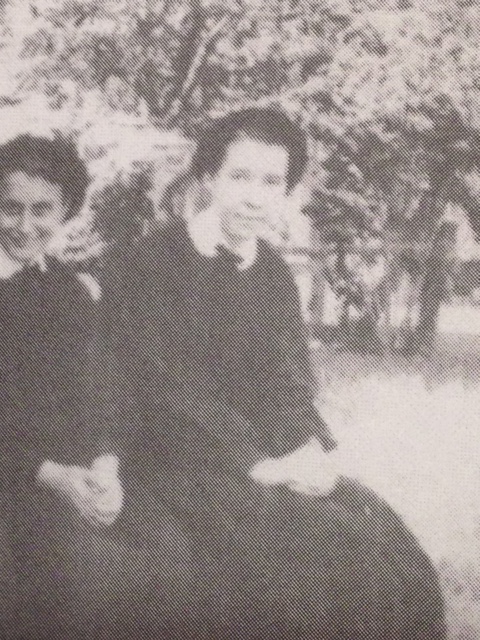
When we see photos or even some video of Sister Mary Ignatius Davies, we typically only see her in her later years, frail, old, in her habit. But I recently found a photo of Sister Iggy from 1940 when she was just 19 years old. The photo appears in Sister Mary Bernadette Little’s massive book, You Did It Until Me: The Story of Alpha and the Sisters of Mercy in Jamaica. The book is full of wonderful information, although very few of its more than 500 pages are devoted to the music program at Alpha. Instead, it is a book more on the Sisters, and rightly so, since Little herself was a member of the Sisters of Mercy and a principal at Alpha Academy for 30 years. She died last year.

IMG_0297

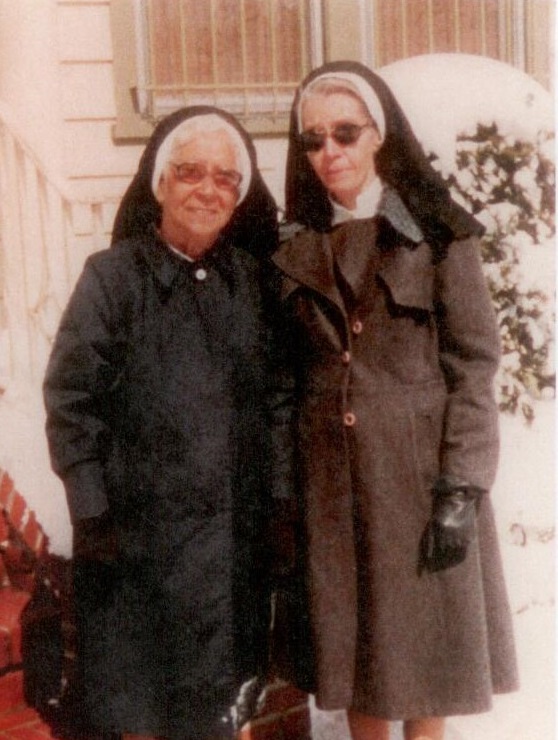
I also included a photo of Sister Ignatius in my book, Songbirds: Pioneering Women in Jamaican Music that pictured her in March, 1984 when she traveled to New York and saw snow for the first time. Here she is pictured on the right with Sister Mary Theresa, and this photo was graciously given to me by Charles Simpson, an Alpha Old Boy who is still very involved with the school.

sister-ignatius-and-sister-mary-theresa-march-1984-first-time-seeing-snow-from-charles-simpson

Simpson was a student at Alpha Boys School from 1953 to 1960 and a trombonist in the band. Although we know Sister Iggy’s affinity for music and nurturing musical affinity in her boys, she also encouraged young athletes, says Simpson. “The ability about her, and maybe why she is loved by all the boys, is that if boxing is going on, she’ll be a part of it. She would put on her gloves while in her habit. She was never in any other thing but her habit. Earlier in the day it was black and white, full black all the way down to the ankles and shoes. They had a white breast plate that ran across the chest. She was always playing. She was a complete sports person. She was a fan of the great Sugar Ray Robinson and they were pen pals. She was a tremendous cricket fan. She loved Collie Smith and love Garry Sobers, but when it came to cricket, Collie Smith was her favorite,” says Simpson. He says that as a result, the school excelled at sports like cricket, boxing, soccer, and baseball, winning many national championships. She nurtured a number of Jamaican boxing champions that came from Alpha including Alan Harmon, Roy Lee, and Kid Bassey and soccer player Owen “Ital Stew” Stewart. She founded a baseball and cricket associations for the private school league. “The boys know me because I talk to them a lot about sports and other things,” said Sister Ignatius. She also had a love for world affairs, reading, and history and she was especially fond of Nelson Mandela, Martin Luther King, Jr., and Jomo Kenyatta.

Uncategorized

Satchmo, Girl Satchmo, and Jamaica

I had the pleasure of attending the annual Chicago Architecture Foundation’s open house on October 17th and visited a number of fascinating sites, but none as incredible as the site of the former Sunset Cafe. According to the WBEZ website (that’s Chicago’s National Public Radio station), “The Sunset Cafe, also known as The Grand Terrace Cafe, was a jazz club in Chicago, Illinois operating during the 1920s, 1930s and 1940s. It was one of the most important jazz clubs in America, especially during the period between 1917 and 1928 when Chicago became a creative capital of jazz innovation and again during the emergence of bebop in the early 1940s. From its inception, the club was a rarity as a haven from segregation, since the Sunset Cafe was an integrated or “Black and Tan” club where Afro- and Euro- Americans, along with other ethnicities, could mingle freely without much fear of reprisal. Owned by Louis Armstrong’s manager, Joe Glaser, the venue played host to such performers as Louis Armstrong, Cab Calloway, Johnny Dodds, Bix Beiderbecke, Jimmy Dorsey, Benny Goodman, Gene Krupa and, above all, Earl “Fatha” Hines and his orchestra’s members: Billy Eckstine, Dizzy Gillespie, Charlie Parker and Sarah Vaughan.”

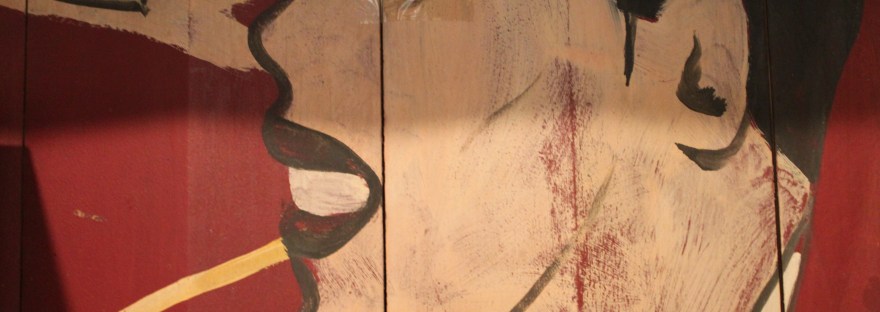
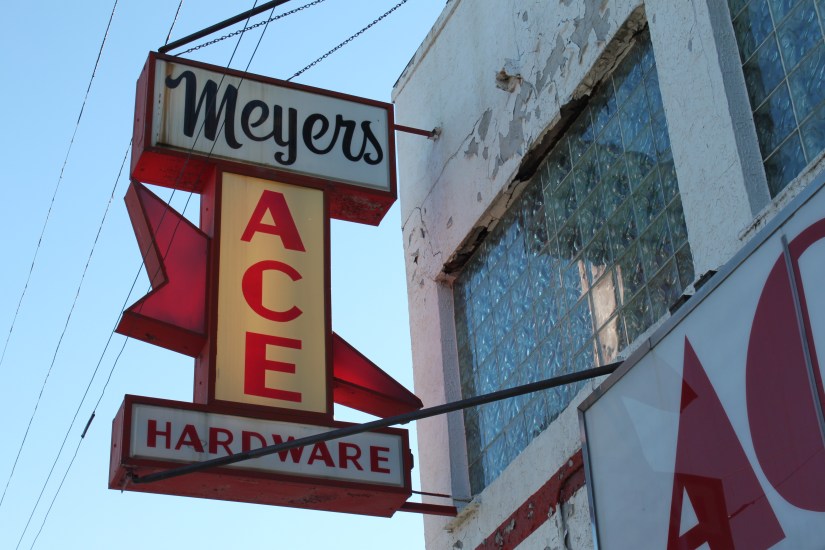
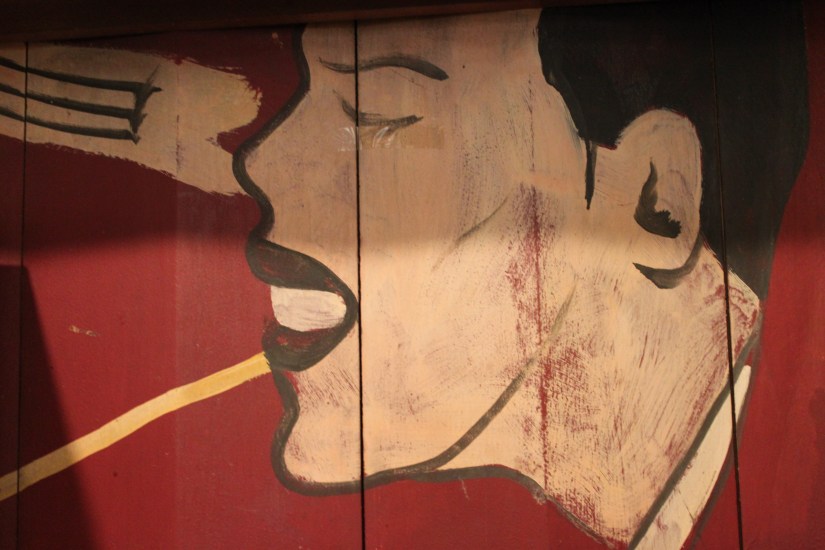
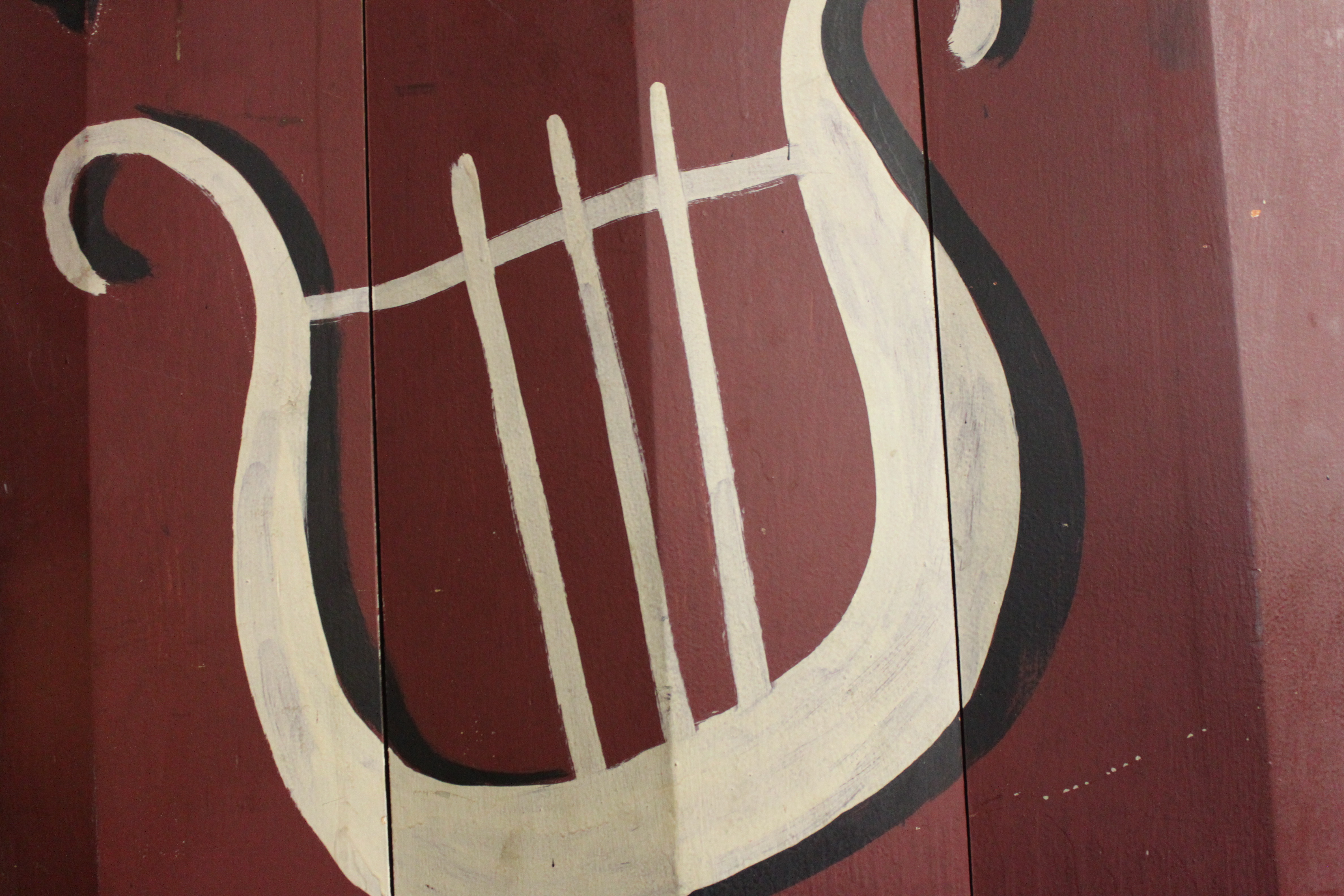
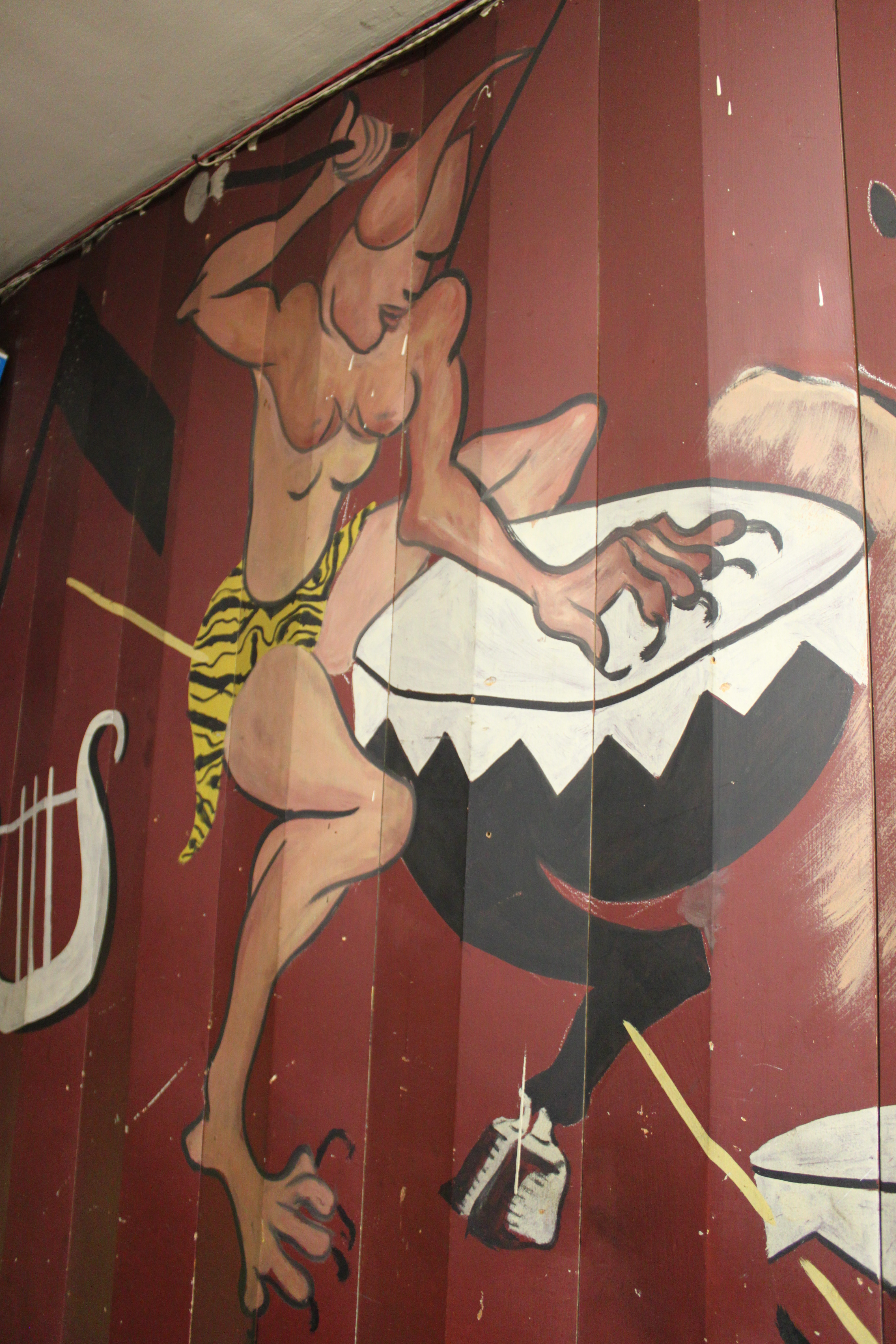
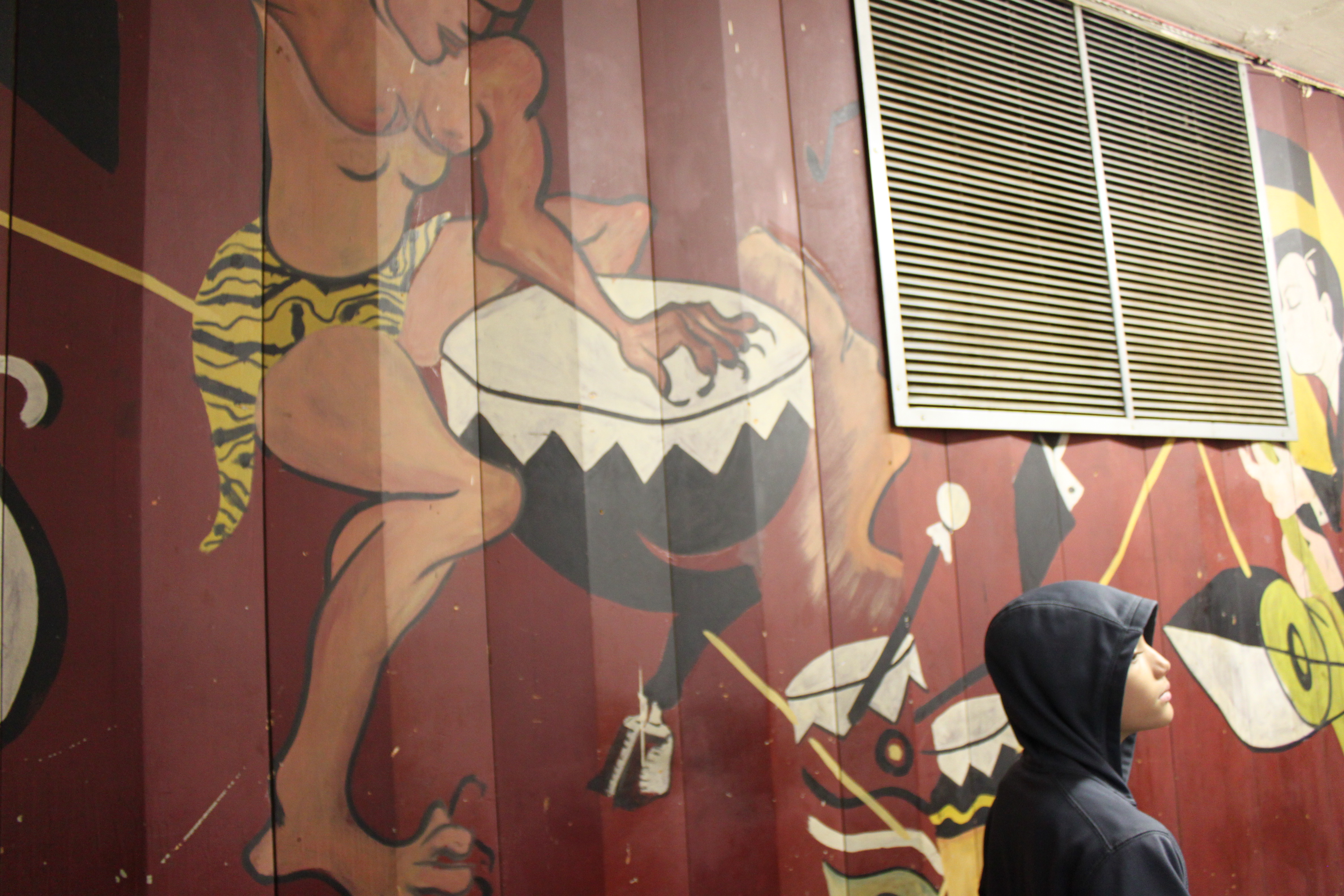
As I stepped up into the area that is now the manager’s office at the Ace Hardware that inhabits the building, I realized that this was the stage, the exact same stage where Satchmo had performed, along with these other jazz heroes and heroines. Chills. Here are a few photos that show what it looks like today. The original artwork that appeared on the back of the stage wall is still there, although it has been covered in places with fixtures, like a vent and cabinetry.

IMG_5774

IMG_5782

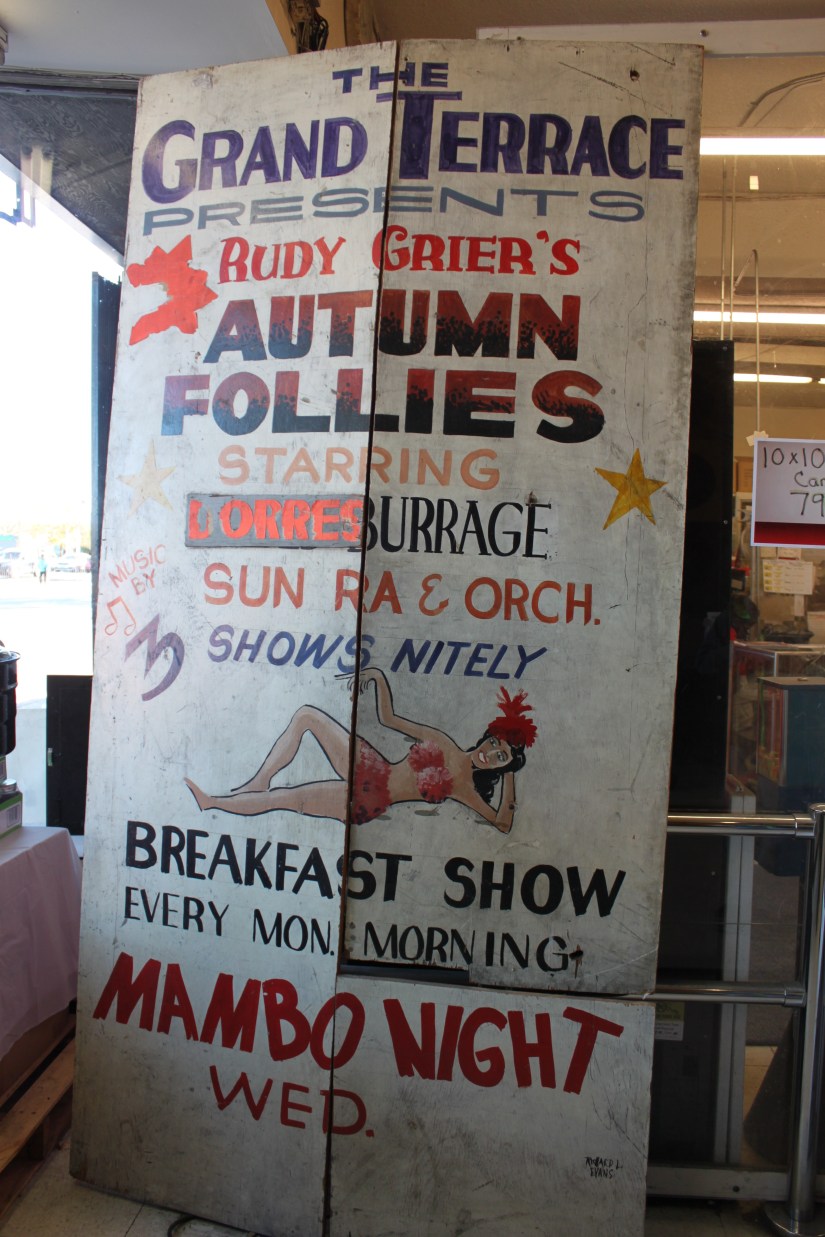
There was also a large sign in the front of the store that they had removed from storage for the open house, a sign that advertised the brunch at the Grand Terrace, which was the second incarnation of the Sunset Cafe. My jaw dropped when I saw the musical performer advertised as Sun Ra. I asked the docents on duty at the site, but they had no idea who Sun Ra even was! Herman Poole “Sonny” Blount (he wasn’t known as Sun Ra until 1952), settled on Chicago’s South Side in 1946. He performed at “Chicago clubs such as Kirk’s Grand Terrace, the Vincennes Lounge, Parkway Ballroom and Budland,” according to the University of Chicago.

sun-ra

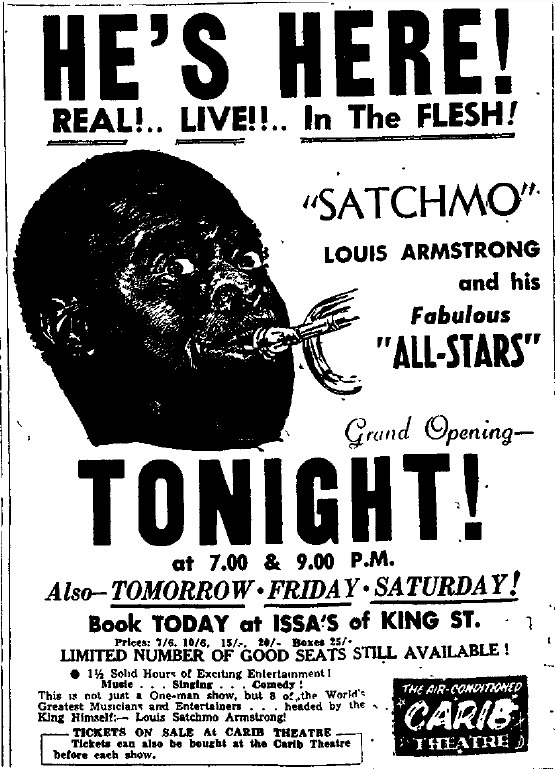
Anyway, back to Satchmo. Having just combed through Star Newspaper archives all summer long, and having written about Girl Satchmo (Kentris Fagan) for Songbirds: Pioneering Women in Jamaican Music, I thought about Louis Armstrong in Jamaica. I knew he had performed on the stages in Kingston and throughout Jamaica, just as he had on this stage in Chicago, although in Chicago his manager owned this stage so Satchmo was more of a regular here instead of a visiting musician. I went back through some of my records and found that Satchmo indeed did visit Jamaica, a number of times, and because Satchmo was born in New Orleans, and Jamaicans were able to receive radio transmissions from New Orleans radio stations on a clear night, and because jazz was prevalent throughout Jamaican clubs, Satchmo was very popular in Jamaica. His films, like High Society, were screened at theaters like the Rialto.

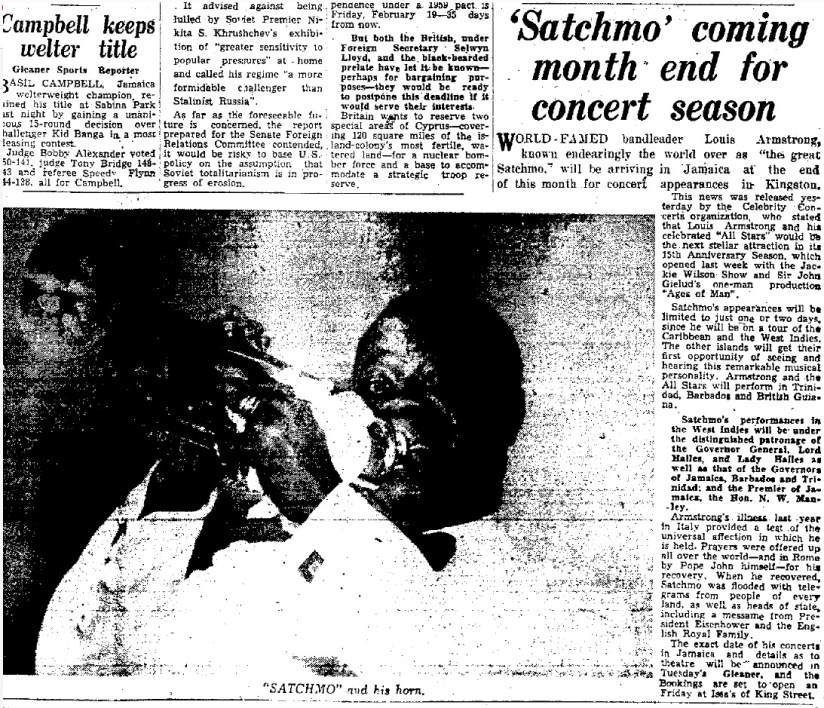
When Satchmo first visited Jamaica in 1957, it was big news. The Daily Gleaner ran stories on his every move–when he came into Palisadoes Airport, where he would appear, etc. He stated in the article below, “I have met several Jamaican musicians in the United States and it’s a pleasure to be here.” One of the greeters at the airport was none other than Ken Khouri of Federal Records.

satchmo-may-15-1957

Satchmo and his wife Lucille were greeted by the mayors of Kingston and Montego Bay, gossip columnist Kitty Kingston revealed that he was serenaded at the airport by a calypso band and hounded by fans for autographs at the Myrtle Bank Hotel where he stayed, and after his last performance during his 1957 visit, the ambassadors to the American consulate on the island, gave him a private party at their Barbican Heights home.

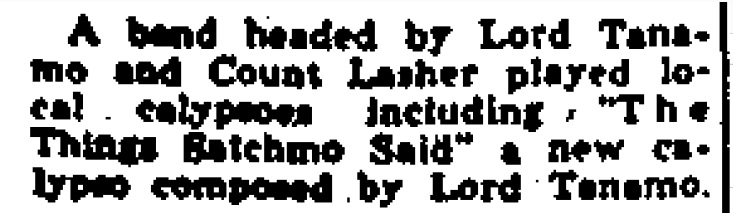
That calypso band who regaled Satchmo with Caribbean tunes? None other than Lord Tanamo and Count Lasher!

satchmo-tanamo

Satchmo returned to Jamaica in 1960 to perform again, and he always remained popular.

satchmo-jan-17-1960

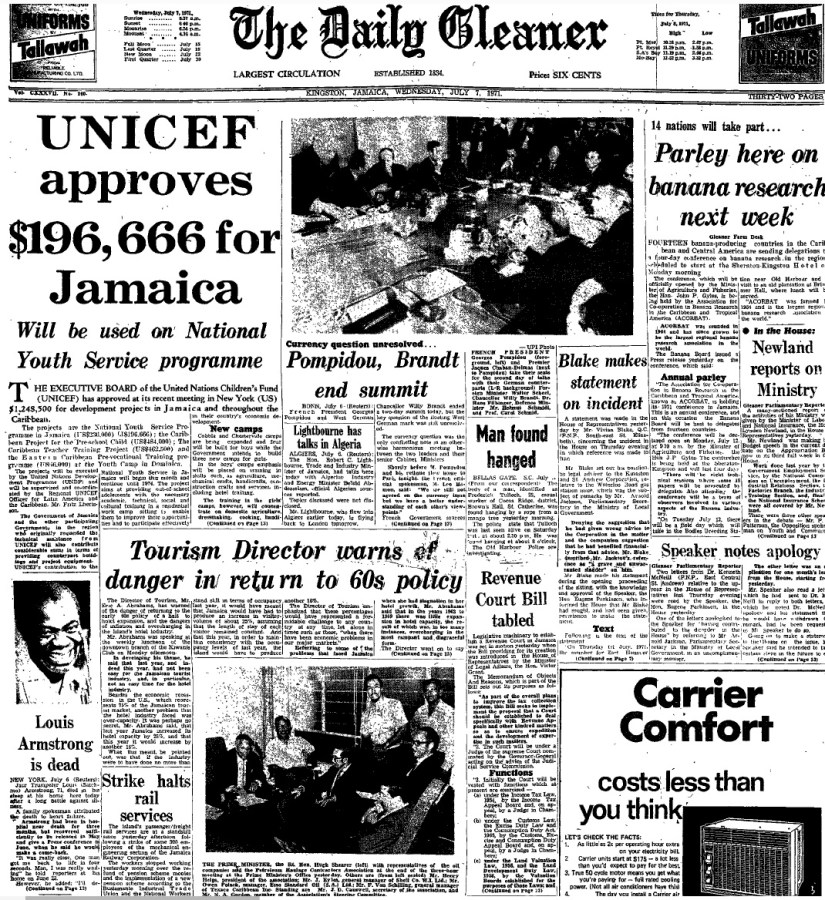
When Louis Armstrong died, it was front page news in Jamaica.

satchmo-dead

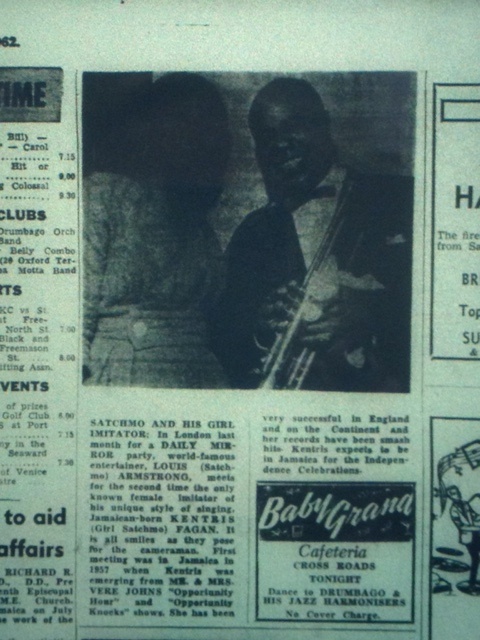
It was in 1962 in London that Louis Armstrong met Girl Satchmo, Kentris Fagan, but it wasn’t the first time. A caption in the Star Newspaper on June 28m, 1962 beneath a photo of the two together states, “Satchmo and his girl imitator: In London last month for a Daily Mirror party, world-famous entertainer Louis (Satchmo) Armstrong meets for the second time the only known female imitator of his unique style of singing. Jamaican-born Kentris (Girl Satchmo) Fagan is all smiles as they pose for the camerman. First meeting was in Jamaica in 1957 when Kentris was emerging from Mr. and Mrs. Vere Johns “Opportunity Hour” and “Opportunity Knocks” shows. She has been very successful in England and on the Continent and her records have been smash hits. Kentris expects to be in Jamaica for the Independence Celebrations.”

girl-satchmo-with-satchmo

You can read all about Girl Satchmo in my book. She was quite a phenomenon and after her career imitating Satchmo, she used her vocal abilities to record a number of gospel records. Here’s a small excerpt:

In the late 1960s, Girl Satchmo then turned to a different label for her recordings and she partnered with Tommy McCook and the Supersonics for producer Duke Reid on Treasure Isle in Jamaica, and Fab and Trojan in the U.K. The songs, “I’m Coming Home” and “Take You For a Ride,” still featured her gravely growl that punctuated her natural singing style. But Girl Satchmo was more than a novelty act—she had real talent, real business acumen, and a real conversion. In 1971 she founded her own record label, Kangaroo, and released her own single, “Crazy But Good” as Girl Satchmo and Reggae Kings. She produced the song as well. The same year she put out the song “I Found Out Pt. 1” with the B side, “I Found Out Pt. 2” as Girl Satchmo which she also produced.
Girl Satchmo toured Germany and had immigrated to England by the end of the 1960s. She had been traveling there since the mid-1960s when Vere Johns paid her way to England since she was very close with Johns and his wife. She once wrote them a letter saying, “Thanks to you and Mrs. Johns for all I am today. You brought me up and made me an artiste.” Girl Satchmo traveled back and forth between England and Jamaica to perform. She performed in London at the St. Pancras Town Hall and numerous nightclubs, but she returned to Jamaica in the early 1970s as noted in a Daily Gleaner article on August 1, 1971 with the headline “Girl Satchmo for Independence jump up.”

Anita Mahfood - Margarita, Don Drummond

Margarita Dreams of Stardom

margarita-vere-johns-jr.

Anita Mahfood, stage name Margarita, had aspirations of one day traveling to the United States to pursue a career in show business, according to her sister Conchita. Here is a photo from the Star Newspaper in 1961 that shows Margarita in her attempt to fulfill her dream of life on the stage. She was not only a rhumba dancer, but she was an actress as well and a performer extraordinaire. Here she rehearses for a performance with Vere Johns Jr., son of Vere Johns and Lucille Johns who were not only both impressarios of the Vere Johns Opportunity Hour (the talent show that launched so many musical and comedy careers on the island), but were actors themselves. This caption reads, “Money Talks Soldier–The curvesome Margarita (noted Jamaican dancer) and Vere Johns Jr., American-born son of Mr. and Mrs. Vere Johns, have teamed to form the latest dancing combination. They are here seen rehearsing the sequence entitled ‘The G.I. and the Girl.’ Junior served three years in the U.S. Armed Forces.”

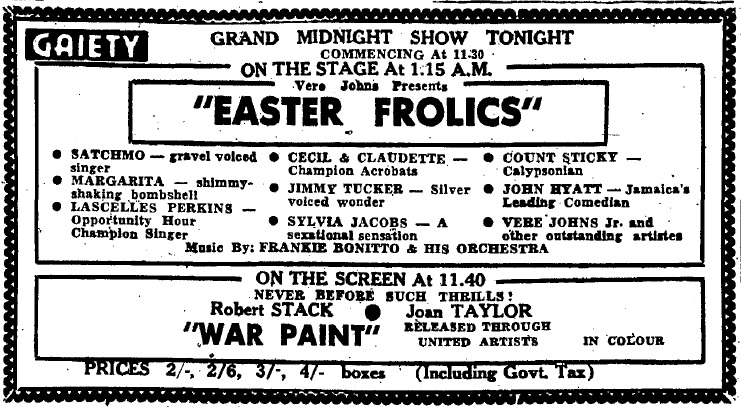
It wasn’t the first time that Vere Johns Jr. and Margarita had teamed up for performances with a Vere Johns Production. The following advertisement ran in the Daily Gleaner on April 1, 1956 for the Vere Johns Production of “Easter Frolics” where Margarita is billed as the “shimmy-shaking bombshell” and Vere Johns Jr. appears in the same performance.

margarita-april-1-56

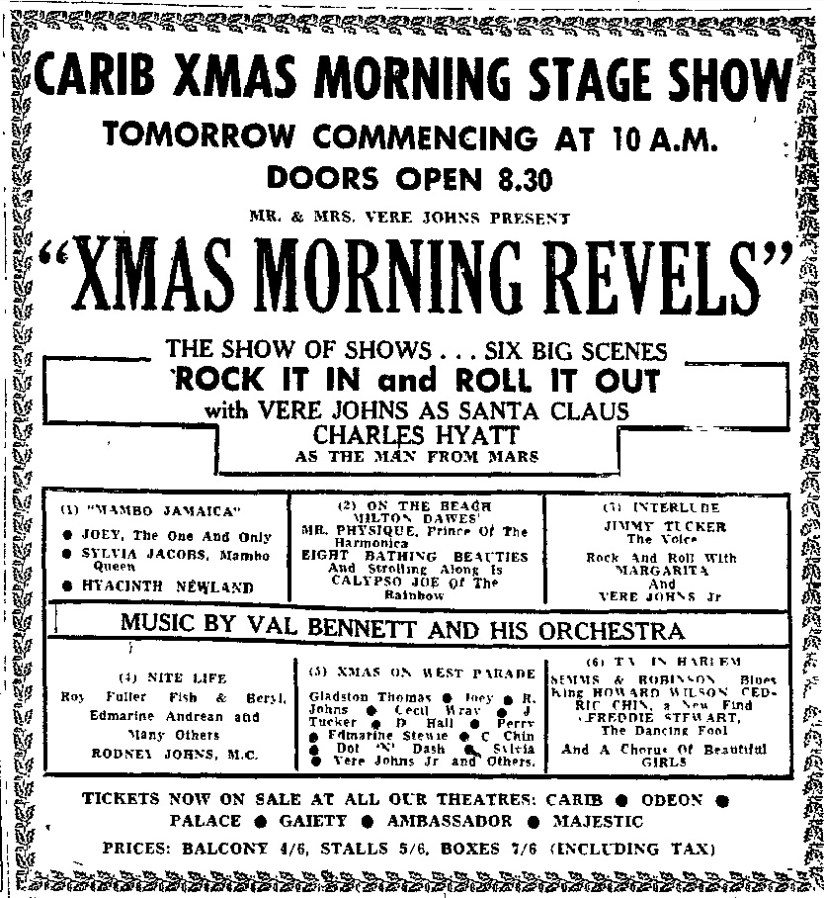
That Christmas season, Margarita also performed during a Vere Johns Production with Vere Johns Jr. in “Xmas Morning Revels” and the two performed a “Rock and Roll” scene.
margarita-dec-24-1956

In fact, Margarita was so much a part of the Vere Johns Production team, she played the role of a dance club dancer in the documentary, “It Can Happen to You,” which was filmed by the Jamaica Film Unit in the 1950s. In the film, which I was finally able to find last year after many years of searching, Margarita tastefully dances the rhumba in a costume full of ruffles that she herself designed and sewed, and among her are bar patrons enjoying the band and dance. One of the main extras in the film is none other than Lucille Johns herself. Below is a photo of Vere and Lucille Johns, who is wearing the same dress in which she appears in the film.

vere-johns-and-lucille-johns

The following is an excerpt from my book, Don Drummond: The Genius and Tragedy of the World’s Greatest Trombonist: [Margarita] began dancing at clubs all over Kingston and she made her own costumes since she was skilled at sewing. Faye Chin says, “We danced together. We were in a group on stage. She used to do rumba; I do creative dancing, limbo dancing. It’s Alan Ivanhoe Dance Troupe I was in. She was an individual dancer and whenever they’re having performance like pantomimes or the theater used to have opportunity hour, she would dance there. She was a terrific dancer and she taught herself to dance. We became friends and we really became close and we were friends for a long long time until she passed.” Saxophonist Herman “Woody” King knew Margarita in those early days and says the clubs were her calling. “She was a great rumba dancer. The clubs would want her. Of course she had to go. That’s how she earned her living and she enjoyed it too,” King says.
Margarita always began her dance the same way with the same air of anticipation, the ultimate show-woman. As the spotlight hits one spot on the center of the dance floor, the music begins and Margarita is in the corner of the room, out of view. She saunters to the center, ruffles rushing through the tables of men, women, who turn their heads to see her passage to the light. When she comes into full view, the rhythms of the drums at their height, the audience is captivated, fully immersed in her powerful magic. She was auditioning for her dream. One day she wanted to dance on the stages in the United States, but she had to make a name for herself.

Margarita performed with the same circuit of performers, as did most Kingston entertainers of the day. She first met Don Drummond in the 1950s at the Bournemouth Club when they appeared on the same bill together. Ads appear in the Daily Gleaner in June, 1955 for Drummond and “Marguerita (Rhumba Dancer)” together on the same bill with others, including Pam Pam & Gloria, jitterbug dancers, with whom Margarita frequently performed. Margarita performed at the Ward Theatre, Club Havana, Club Baby Grand, Club Adastra, Carib Theatre, Glass Bucket, Rialto Theatre, Ritz Theater, and Queens Theatre, among others where she frequently received top billing. She played the role of a dance club dancer in the documentary, “It Can Happen to You,” which was filmed by the Jamaica Film Unit in the 1950s. On November 23, 1955 she performed in a show called the “Sundown Serenade” at the Ritz Theater with Bim & Bam, Danny Hyacinth Clover, Wonder Brothers and Did & Don’t. This type of billing with a theme for the show was a common feature for clubs in an attempt to attract tourists. Another was at the Ward Theatre on Christmas morning 1959 for a show called “Chrismania” which featured, among others, The Jiving Juniors, Lascelles Perkins, and music by Ken Williams and his Club Havana Orchestra. She also performed that same morning at the Carib Theatre for a show called “Xmas Morning Revels” featuring a similar line up with the addition of Vere Johns and Mrs. Vere Johns, music by Frankie Bonitto and his Orchestra. Artists frequently performed in multiple shows all over the city for Christmas. The clubs themselves also tried to capture themes, and Club Havana, where Margarita frequently performed, advertised itself as “Jamaica’s Latin Quarter.”

Uncategorized

Dance the Hully Gully

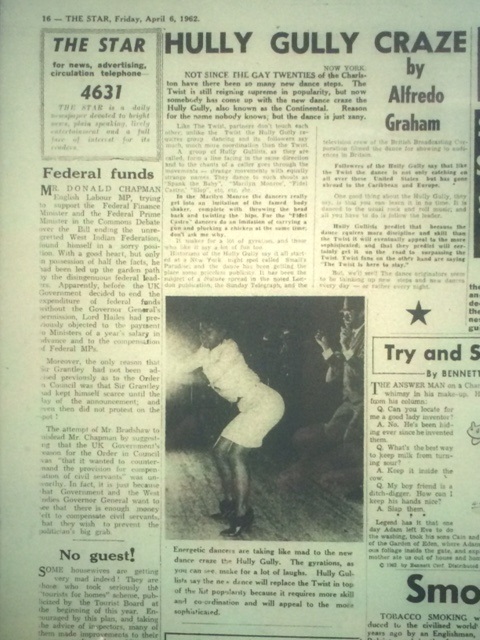
Before the dance known as The Ska, there was The Hully Gully. It was a time of dances, Land of 1000 Dances, dances like the Twist, the Mashed Potato, the Pony, the Frug, the Jerk, and others. It was in this era that The Ska was created by Ronnie Nasralla, of which I have extensively written on this blog. But the Hully Gully got plenty of attention in Jamaica newspapers, including this article from the Star Newspaper, April 6, 1962.

hully-gully-dance

The article reads: “Not since the gay Twenties of the Charleston have there been so many new dance steps. The twist is still raining supreme in popularity, but now somebody has come up with the new dance craze the Holly Gully, also known as the continental. Reason for the name nobody knows, but the dance is just zany. Like the twist, partners don’t touch each other, unlike the twist the Holly Gully requires group dancing and its followers say much much more coordination than the twist. A group of Hully Gullists as they are called form a line facing in the same direction and to the shouts of a caller goes through the movements – strange movements with equally strange names. They dance to such shouts as “Spank the Baby,” “Marilyn Monroe,” “Fidel Castro,” “Slop,” etc. etc. etc.
In the Marilyn Monroe the dancers really get into an imitation of the famed body shaker, complete with throwing the head back and twisting the hips. For the Fidel Castro dancers do an imitation of carrying a gun and plucking a chicken at the same time; don’t ask me why.
It makes for a lot of gyration, and those who like it say a lot of fun too.
Historians of the Hully Gully say it all started at a New York nightspot called Small’s Paradise; and the dance has been getting the place some priceless publicity. It has been the subject of a feature spread in the noted London publication, the Sunday Telegraph, and the television crew of the British Broadcasting Corporation filmed the dance for showing to audiences in Britain. Followers of the Hully Gully say that like the Twist the dance is not only catching on all over these United States but has gone abroad to the Caribbean and Europe. One good thing about the Hully Gully, they say, is that you can learn it in no time. It is danced to the usual rock ‘n roll music; and all you have to do is follow the leader. Hully Gullists predict that because the dance requires more discipline and skill than the Twist it will eventually appeal to the more sophisticated and that they predict will certainly get it on the road to surpassing the Twist. Twist fans on the other hand are saying the “Twist is here to stay.” But we’ll see! The dance originators seem to be thinking up new steps and new dances every day – or rather every night.”

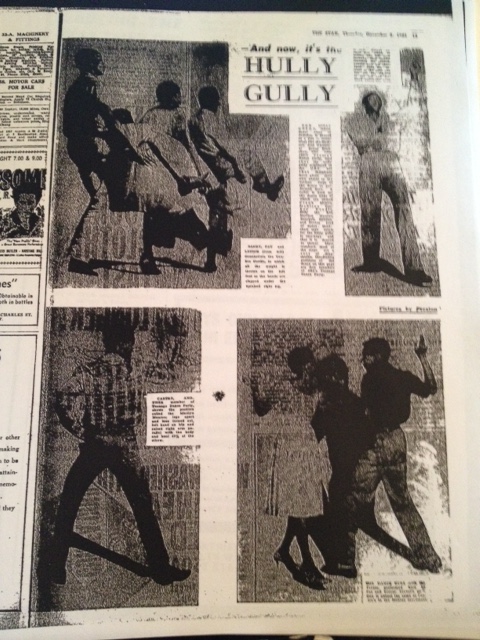
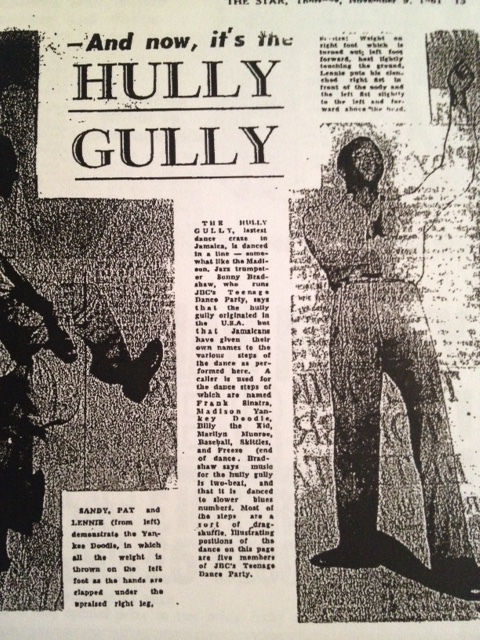
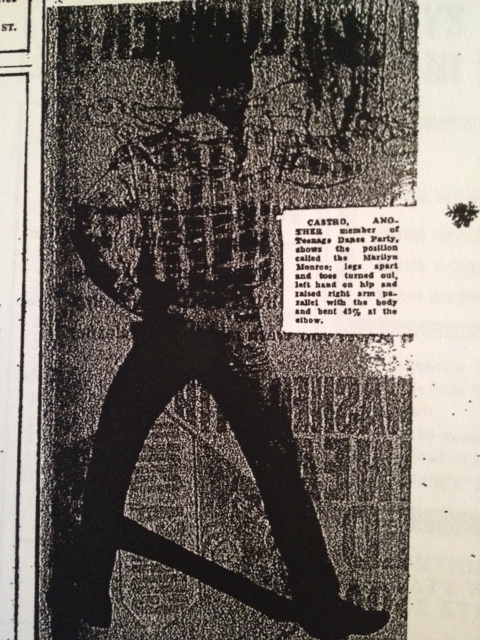
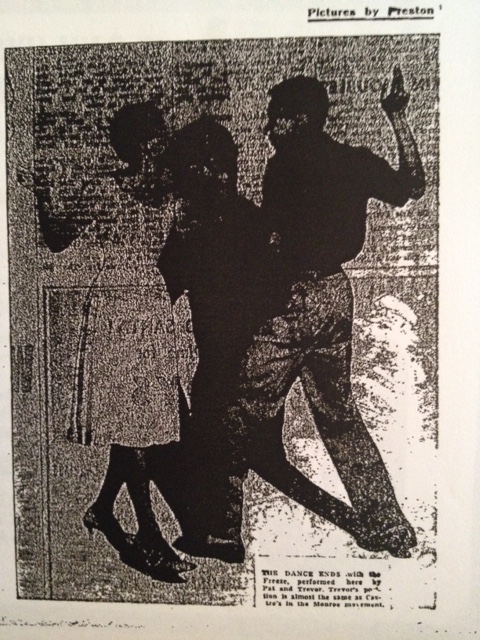
The Star newspaper on November 9, 1961 ran a full-page spread on the Hully Gully in Jamaica, with Alphanso Castro, better known as Boysie, photographed doing the dance. He still dances today, of course, and can really cut a rug! Text from the article’s captions are below.

IMG_0252

The Hully Gully, latest dance craze in Jamaica, is danced in a line – somewhat like the Madison. Jazz trumpeter Sonny Bradshaw, who runs JBC’s Teenage Dance Party, says that the Hully Gully originated in the U.S.A. but that Jamaicans have given their own names to the various steps of the dance as performed here. A caller is used for the dance steps of which are named Frank Sinatra, Madison, Yankee Doodle, Billy the Kid, Marilyn Monroe, Baseball, Skittles, and Freeze (end of dance.) Bradshaw says music for the Hully Gully is two-beat and that it is danced to slower blues numbers. Most of the steps are a sort of drag-shuffle. Illustrating positions of the dance on this page are five members of JBC’s Teenage Dance Party.

IMG_0253

The Frank Sinatra: weight on right foot which is turned out; left foot forward, heel slightly touching the ground. Lennie puts his clenched right fist in front of the body and the left fist slightly to the left and forward above his head.

IMG_0254

Castro, another member of teenage dance party, shows the position called the Marilyn Monroe: legs apart and toes turned out, left hand on hip and raised right arm parallel with the body and bent 45° at the elbow.

IMG_0255

The dance ends with the Freeze, performed here by Pat and Trevor. Trevor’s position is almost the same as Castro’s in the Monroe movement.

IMG_0256

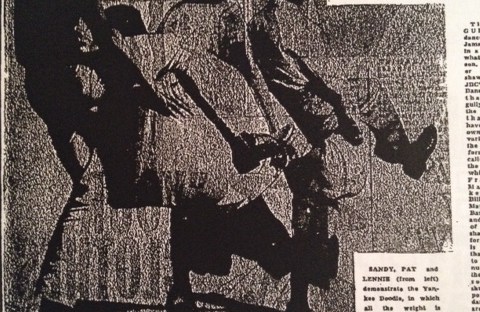
Sandy, Pat and Lennie from left demonstrate the Yankee Doodle in which all the weight is thrown on the left foot as the hands are clapped under the upraised right leg.