Uncategorized

Stranger and Patsy, Together on Stage Again!

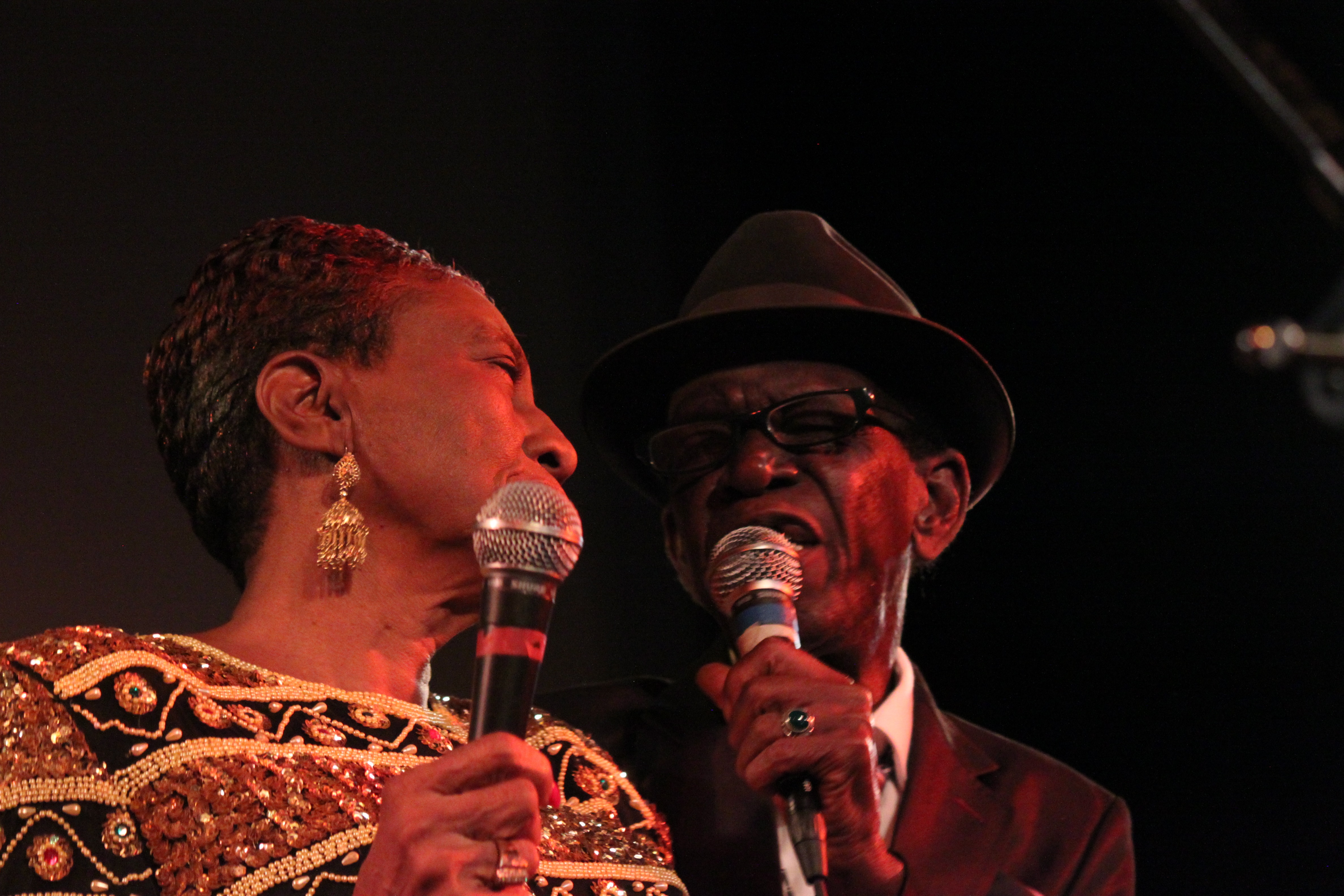
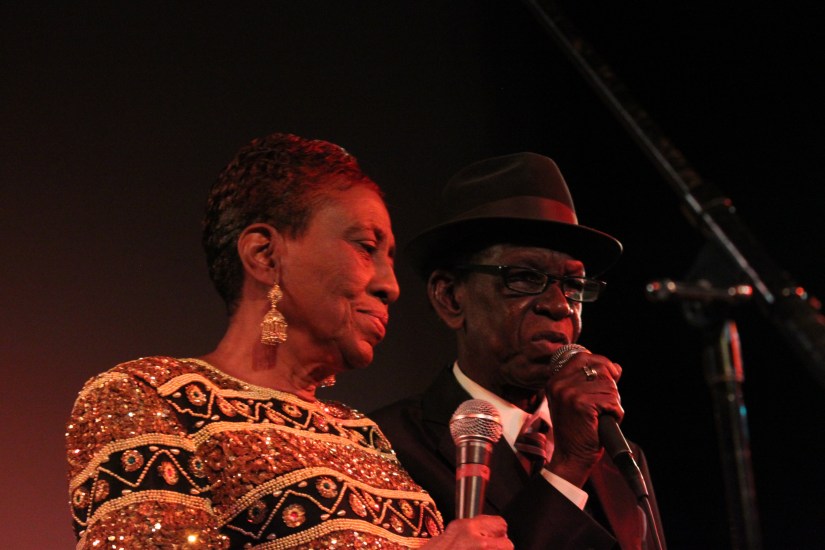
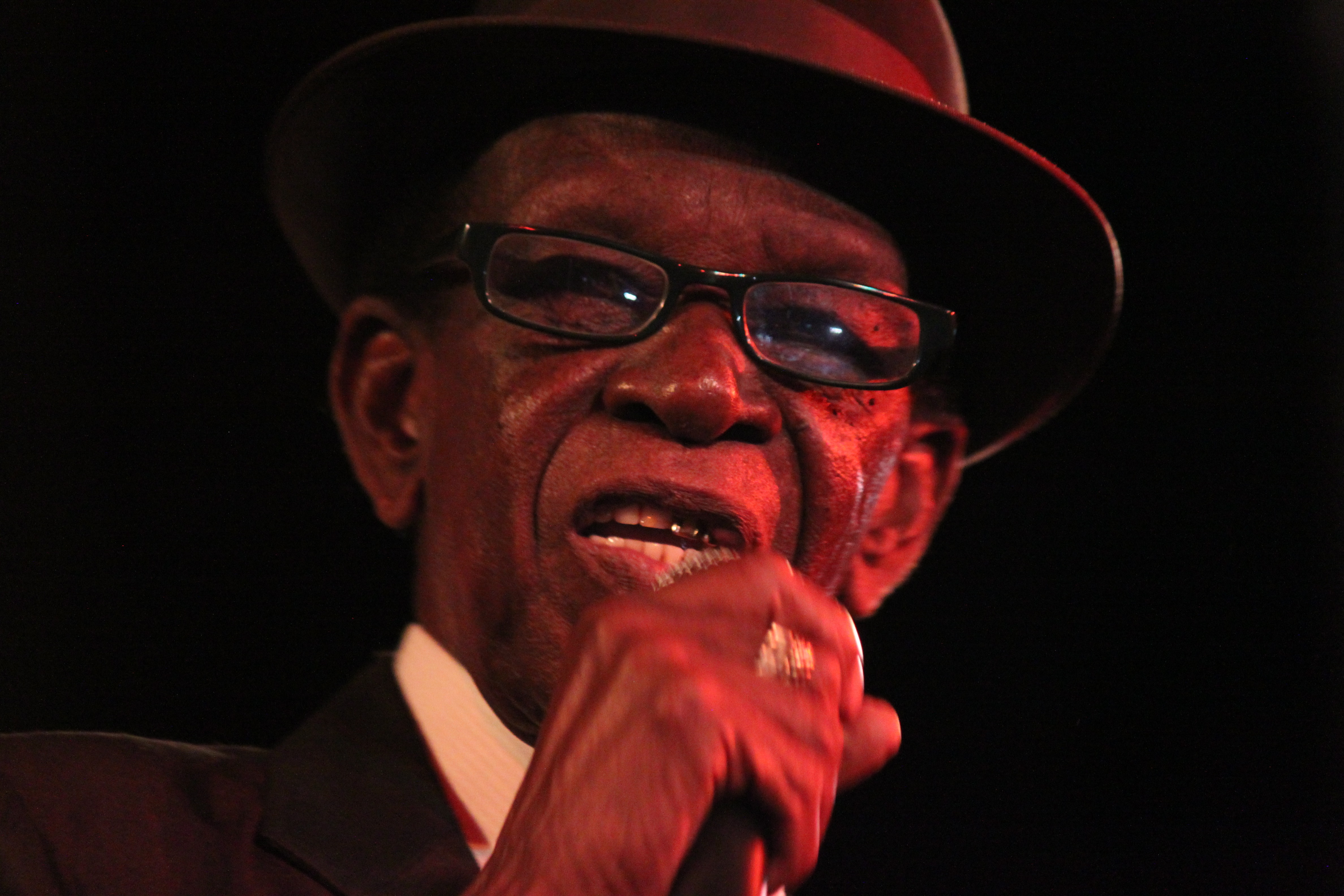
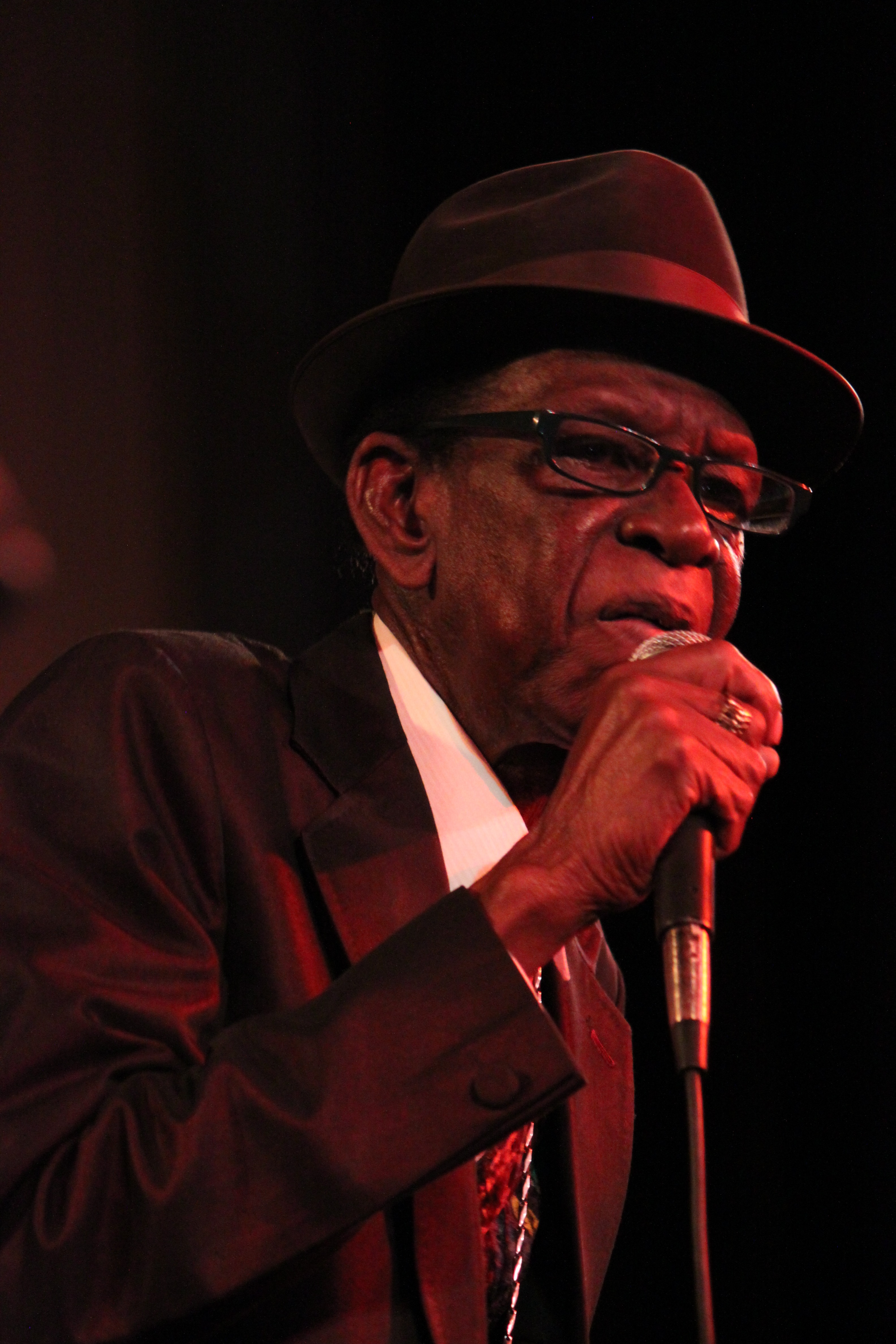
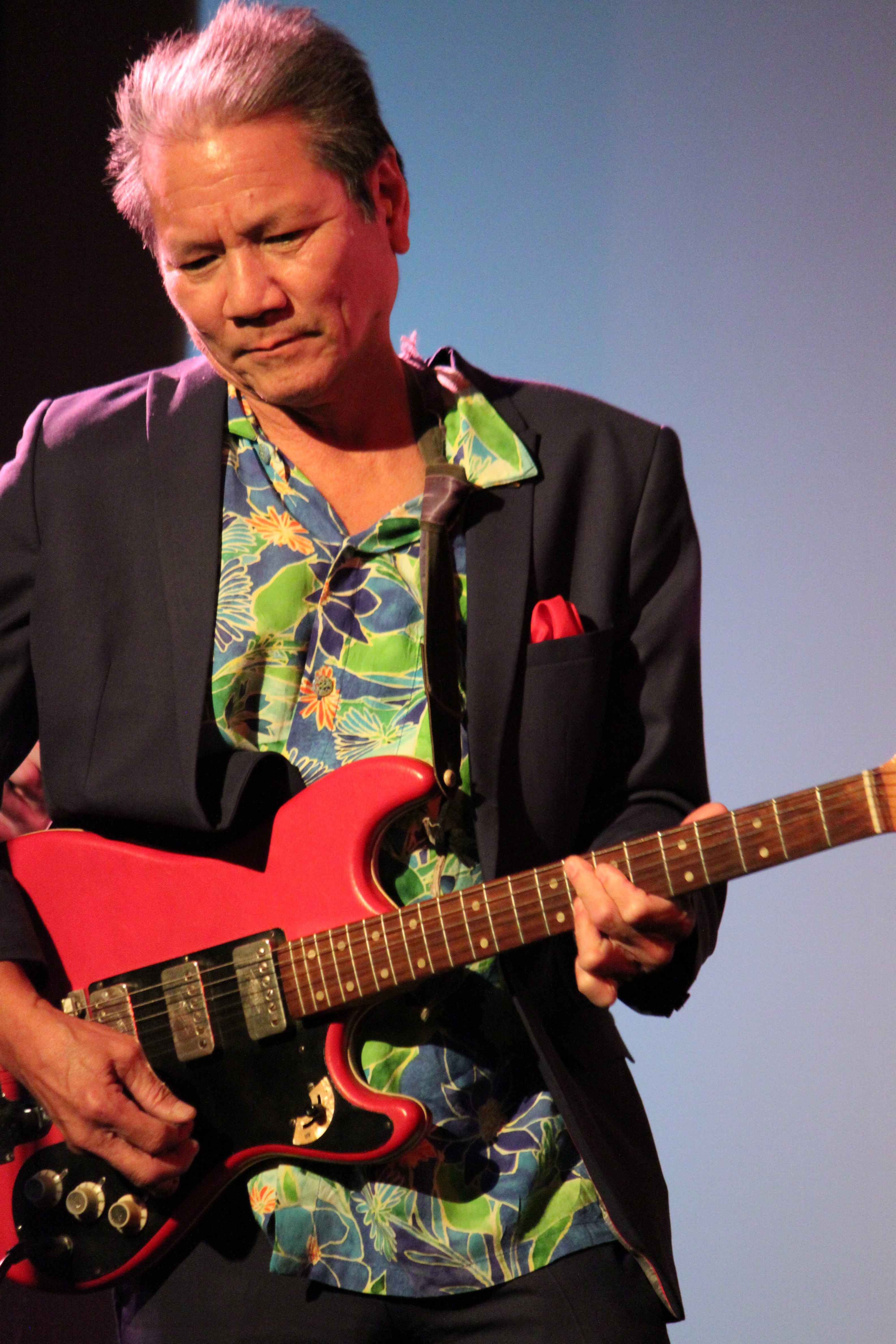
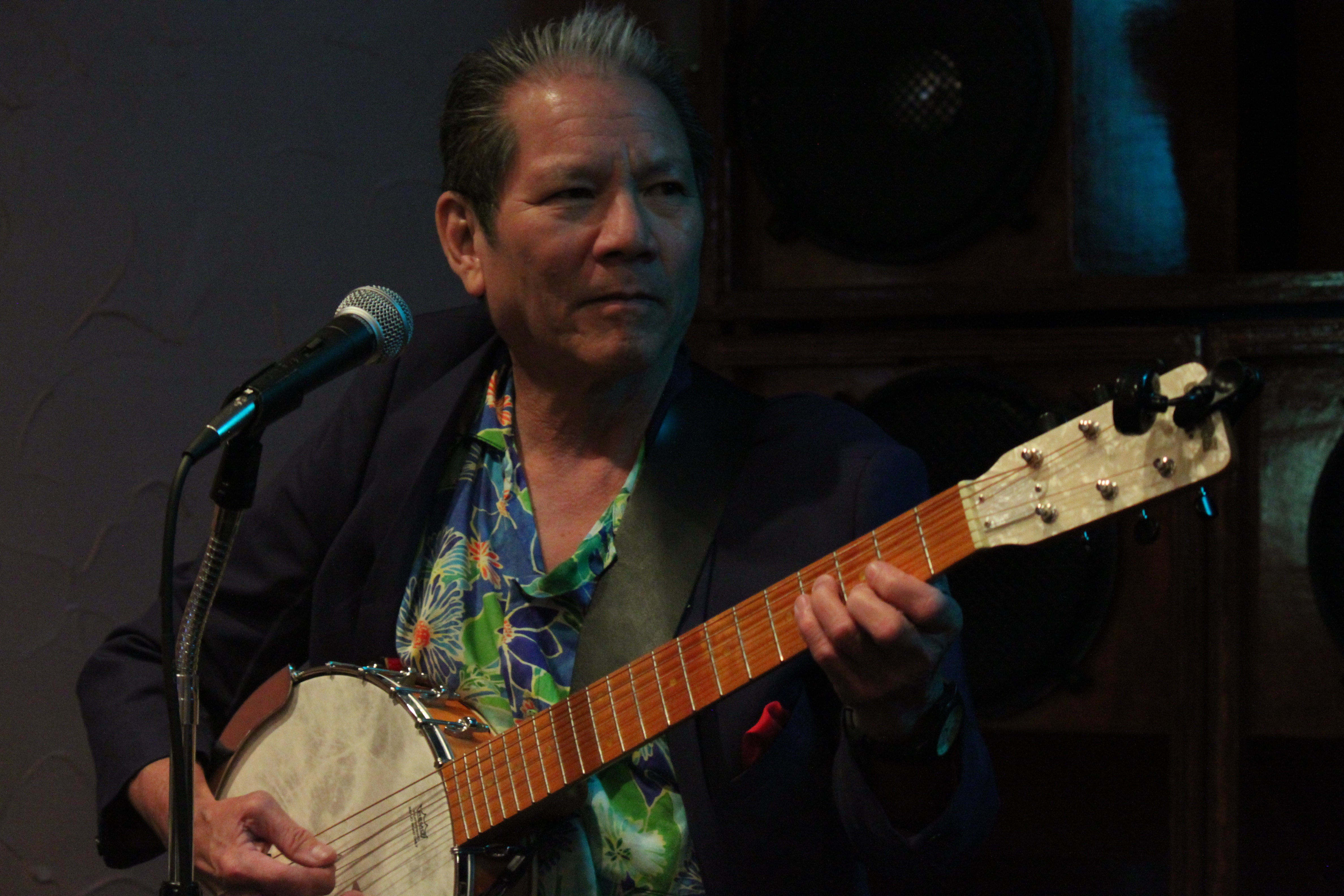
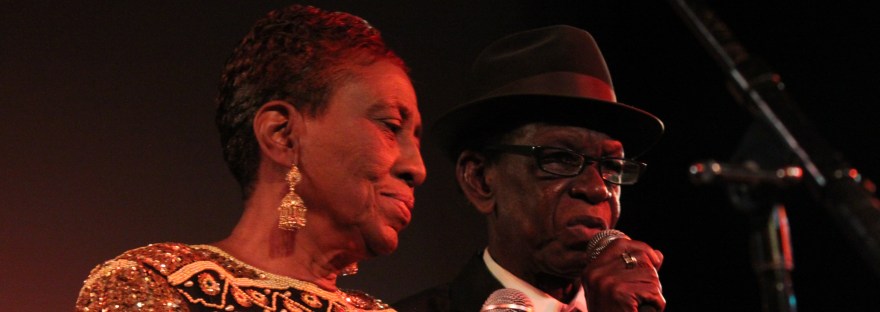
I had the honor and pleasure of seeing Stranger Cole take the stage again with his performance partner Millicent “Patsy” Todd in Minneapolis on May 13th. I spent the entire weekend with this classy couple and enjoyed sharing a drink and hearing their stories of touring, recording, and even how to properly say, “Rahtid!” Stranger said his favorite song to perform with Patsy is “Yeah Yeah Baby,” while Patsy said her favorite duet is “Come Back.” Stranger is warm, vivacious, full of positive energy and Patsy is centered, calm, and full of strength. The two of them together are the perfect combination–in their music, their performance, and in their friendship. Below are some photos I took during the weekend and their performance. Click HERE TO SEE THEM PERFORM DOWN THE TRAIN LINE from this show, HERE TO SEE THEM PEFORM TONIGHT and HERE TO SEE PATSY PERFORM PATA PATA ROCKSTEADY. Also performing during the weekend event was Phil Chen of the Vagabonds who went on to perform guitar with such legends as The Who, Rod Stewart, Traffic, and countless others. Click HERE to read my prior post on Stranger Cole, and HERE to read my prior post about Patsy.

stranger-and-patsy4

Uncategorized

Jamaican Rock–Big Sound on U.S. Pop Scene

ja-on-us

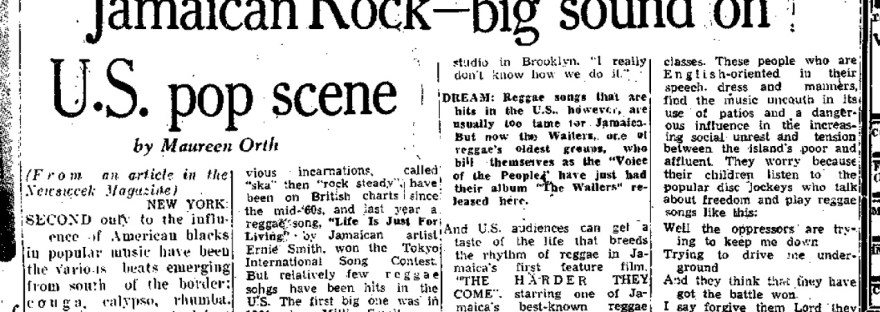
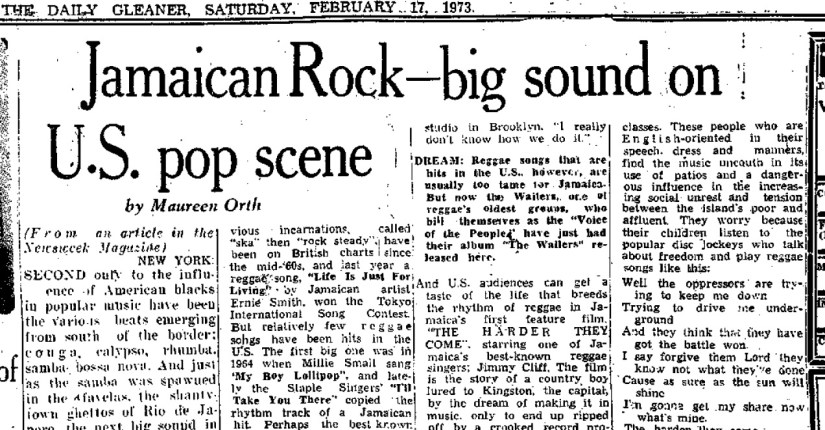
We may be aware that music from the United States in the 1950s and 1960s had a profound influence on Jamaican music, but sometimes we forget about the impact that Jamaican music had on United States popular music. Sure we know that Millie Small hit U.S. charts in 1964 (as she did charts all over the world) in conjunction with the promotion of ska at the World’s Fair that same year, but those were merely sparks that never really took flame. And sure reggae music grew in popularity through the passion and poignancy of Bob Marley in the late 1970s, and ska music became hugely popular in the 1990s (largely through the popularity of bands in the U.K.) but here is an article that shows that as early at 1973, Jamaican music was starting to pick up steam in the U.S. This article originally ran in Newsweek Magazine and was then published in the Daily Gleaner on February 17, 1973. It is an interesting look back at this critical time in history from the perspective of an American in the era.

The article, by Maureen Orth, states: Second only to the influence of American blacks in popular music have been the various beats emerging from south of the border; conga, calypso, rhumba, samba, bossa nova. And just as the samba was spawned in the favelas, the shantytown ghettos of Rio de Janeiro, the next big sound in American may well emerge from the zinc and tarpaper shanties of Jamaica. The music is called reggae (rhyme, with leg-gay), an infectious, up-tempo ‘body music’ meant to be danced to. Blaring from jukeboxes, record stores, transistors strapped to bicycles, and, from the travelling open-air- discotheques called “sound systems”, reggae’s pulsating rock beat saturates the island and propels a growing record industry that is making Jamaica the ‘in’ place for British and American stars to record. Reggae owes its origins to a fortuitous combination of calypso and the blues and, like the blues, reggae lyrics frequently record the suffering and anger born of a long history of slavery, poverty and powerlessness. “Reggae is a music of rebellion,” says Prince Buster, a Jamaican disc jockey and record producer. “It is the music of a people who were not given their fair share, a people who have to fight against society for their rights.” Just as often, however, the reggae beat is
sensual and happy, as much a means of escape as an instrument of protest.

SKA: Reggae and its two previous incarnations called “ska” then “rock steady” have been on British charts since the mid-’60s, and last year a reggae song, “Life Is Just For Living” by Jamaican artist, Ernie Smith, won the Tokyo International Song Contest. But relatively few reggae songs have been hits in the U.S. The first big one was in 1964 when Millie Small sang “My Boy Lollipop”, and lately the Staple Singers’ “I’ll Take You There” copied the rhythm track of a Jamaican hit. Perhaps the best known reggae song is Paul Simon’s “Mother and Child Reunion” and currently Johnny Nash’s “I Can See Clearly Now” has neared two million sales. Jamaica received the ultimate cache when the Rolling Stones came down to record their forthcoming album. Rock stars Leon Russell, Elton John and Cat Stevens are putting reggae rhythm tracks on their latest LP’s, and Harry Belafonte is putting out a number of pure reggae albums. U.S. record moguls are sending scouts to Jamaica but they often pen outside Jamaica. “Americans are amazed we can get so much bass on our records,” says Hugh Hendricks, a young reggae musician who’s just opened a studio in Brooklyn. “I really don’t know how we do it.”

DREAM: Reggae songs that are hits in the U.S., however, are usually too tame for Jamaica. But now the Wailers, one of reggae’s oldest groups, who bill themselves as the “Voice of the People” have just had their album “The Wailers” released here. And U.S. audiences can get a taste of the life that breeds the rhythm of reggae in Jamaica’s first feature film, “THE HARDER THEY COME”, starring one of Jamaica’s best-known reggae
singers, Jimmy Cliff. The film is the story of a country boy lured to Kingston, the capital, by the dream of making it in music, only to end up ripped off by a crooked record producer, forced to deal in ganja (pot) to keep from starving and ending up an infamous criminal. Like the character he plays, Cliff is a country boy who was never paid for his first record. Even today young Jamaican singers sometimes are forced to take a pittance for the chance to record one of their own songs, frequently receiving no royalties if it becomes a hit. Despite these obstacles, making a reggae record is one of the few ways a poverty-stricken Jamaican can make it, and lines of people patiently stand outside recording studios waiting for a producer to listen to their tunes.

Reggae is not popular with Jamaica’s upper and middle classes . These people who are English-oriented in their speech, dress and manners, find the music uncouth in its use of patios and a dangerous influence in the increasing social unrest and tension between the island’s poor and affluent. They worry because their children listen to the popular disc jockeys who talk about freedom and play reggae songs like this:
Well the oppressors are trying to keep me down
Trying to drive me underground
And they think that they have got the battle won.
I say forgive them Lord they know not what they’ve done
Cause as sure as the sun will shine
I’m gonna get my share now what’s mine.
The harder they come
The harder they fall, one and all

Uncategorized

Pata Pata Patsy

patsy

So thrilled to see that Pasty Todd will be performing with Stranger Cole, her longtime vocal partner after Derrick Morgan, in Minneapolis May 13-15th accompanied by Phil Chen, Dennis Sindrey, and the Prizefighters! I will be there for sure! More information on this show is located here. So today let’s celebrate that talented woman who was one of the few, along with Millie Small, Yvonne Harrison, Hortense Ellis, and a small handful of others, to break the gender barrier in the 1960s. I found the lovely photo above of Millicent “Patsy” Todd in a 1969 issue of Swing Magazine in the National Library of Jamaica archives in Kingston this past February. And the following is the chapter of my book, Songbirds: Pioneering Women in Jamaican Music, which I have written on Patsy, which you can purchase here:

Pata Pata Patsy:  Millicent Todd

Millicent Todd was just a teenage girl when ska hit the town. She was born on September 23, 1944, grew up in Fletcher’s Land in West Kingston and was Prince Buster’s next door neighbor. She attended All Saints School and left at age 14. Although she wasn’t raised in a particularly musical home, and the Catholic Church she attended didn’t have much to offer in the way of music since the program was still presented in Latin in those days, she did listen to the music coming from America. “I’m somebody who liked to listen to the radio, and I really got interested in this group, Frankie Lymon & the Teenagers. I used to hear them singing and I used to sing after them,” she says.

Her mother, Miss Kitty, realizing Millicent’s talent, helped to get her daughter’s start. Miss Kitty approached Derrick Morgan on Orange Street and told him of her daughter’s talent although today Patsy says she has only heard the story from Morgan and didn’t know the details. “Derrick told me the story because I didn’t know anything about it. He said he saw this woman and she told him she had a daughter that could sing. And I saw this guy came to my gate, knock on my gate. I’m looking at him and he’s saying he’s Derrick Morgan, and I say to myself, ‘So?’ And he said, ‘I heard you can sing,’ and I’m looking at him wondering what he’s talking about. And he said, ‘Could you sing something for me?’ and I said, ‘Why?’ And he said, ‘I just want to hear something.’ And I did. But as far as I’m concerned, I didn’t know who this guy was, what he wanted. Somebody just come appear to you, telling you he hear you can sing and if you would do a song with him. And at first I was kind of, something ain’t right here. But then he told me a story about another artist that the song was about, and this guy, I hated him, still do. And when he said that, I was ready to sing that song. And I did. And we have this producer, Duke Reid, God rest his soul, a nice man, and he start shooting up the place. My God! I was so scared! I ran! And they said, ‘No! That’s a good thing! When he hears something that he likes that’s going to make a hit, this is what he does!’ So that experience was great for me and after that it was history. The song was ‘Love Not To Brag,’” says Patsy. The man who inspired the song was Eric “Monty” Morris who grew up with Morgan and was known to be boastful. He and Morgan were vocal competitors. Millicent recalls the scene after the take, “We have this producer, Duke Reid, God rest his soul, a nice man, and he start shooting up the place. My God! I was so scared! I ran! And they said, ‘No! That’s a good thing! When he hears something that he likes that’s going to make a hit, this is what he does!’ So that experience was great for me and after that it was history.”

patsy1Derrick and Patsy in their early years.

            Millicent was young and the music industry could be an unkind environment, especially with so much skilled talent, professional musicians in the studio and producers wanting to get one take down on acetate for play at the sound system days later. “It was hard. Very hard,” says Millicent. “I was 15, 16 years old. And it was hard because you didn’t have a say. I didn’t get the chance to go to rehearsal and things like that. I would go to the studio and my partner would tell me, ‘This is so-and-so and so-and-so,’ and I would write it down, and I would sing from the paper, that was it. I don’t remember what it was, what I did or how much record I did. I didn’t have a say, to say to the musicians, ‘Would you play this,’ or “Would you play that.’ They would kill me. You just take what they give you and that’s it. The musicians that we had were great musicians. I think they could play with anyone in this entire world. They knew music, they knew what they were doing. They were absolutely fantastic. But they were very egotistical. You know, it was either just them or nothing. The problem when you have a band that every musician in that band could be the leader, it’s very hard. That’s how great they were,” Patsy says.

patsy2

Millicent Todd

            She was young, innocent, naïve, but her talent transcended. Graeme Goodall recalls her work in the studio. “I loved her dearly. She was a very nice person, very pleasant to work with, very polite. She was not so much a leader, but she was very very good and she, like most of the vocalists of the day, understood that this was her big break,” Goodall says. Derrick & Patsy continued to record hit after hit as a duo, including “Feel So Fine,” “Are You Going to Marry Me,” “Crying in the Chapel,” and countless others. Perhaps the most well-known song the duo recorded was “Housewife’s Choice” in 1962 for producer Leslie Kong. This song was originally named “You Don’t Know How Much I Love You,” but Marie Garth, legendary radio host, had so many housewives call in to the station to request the tune that she renamed it and future pressings reflected this name change. The song also became popular in the United Kingdom as West Indian immigrants played the tune which was released on the Island Records label. Derrick & Patsy were a hit. They were the perfect boy-girl duo singing sweet songs of love and romance. They were so big that when popular American artists came to perform in Kingston, so too did Derrick & Patsy as part of the Jamaican spectacular. They performed at shows with Ray Charles, Ben E. King, and Sammy Davis Junior. Derrick would record with a number of female vocalists in duets including Gloria Franklin (who also performed as Gloria & the Dreamlets), Naomi Phillips (who also recorded with Doreen Shaffer), Hortense Ellis, Paulette Morgan (Derrick’s sister), Yvonne Harrison (also called Yvonne Adams), and Jennifer & the Mohawks (Jennifer Jones).

patsy3Derrick Morgan performs in Chicago in 2013. Photo by Heather Augustyn.

            When Derrick Morgan left to go to England to try his hand at success overseas, Patsy was approached by another singer with the offer to perform duets. She recalls, “Stranger [Cole] came to talk to me. He said that Duke Reid sent him and he said he wanted to do some record and the only way that Duke Reid would record him if I sang with him. And it kind of hit me off guard because Derrick was in England, and I said to him, ‘I don’t know about that, I have to think about it,’ and then I saw this guy really needed to do this. He believed he could make himself better and do something that he love and getting paid for it, you know, a charge was in him. And I said okay, I tell him yes. And that’s how Stranger Cole and I came about.” One of their biggest hits was the song, “When I Call Your Name,” which they recorded for Duke Reid. Other classics include, “Down the Train Line,” “Yeah Yeah Baby,” “Give Me the Right,” “ Love Divine,” and plenty more. The tunes were also classic boy-girl duets, inviting and harmonious. Most were recorded in 1964 for Sonia Pottinger and Duke Reid. Stranger remembers his days with Patsy. “Mr. Reid was the one who asked me to sing with her. He told me to go to her and asked me to sing with her. So ‘When I Call Your Name’ we recorded and we do many many more songs together. She was not shy, she was much braver than I. She make hit record before I do, with Derrick Morgan, so she was a more limelighted artist than I was. I think that was a blessing for me to have a lady with more hit songs before me. I am very lucky to sing with her, and I think she is very lucky to sing with me,” says Stranger.

            Patsy wasn’t just a duo artist. She was also an artist in her own right—Queen Patsy. At a time when women weren’t doing much solo work at all, Patsy paved the way for strong female vocalists. One of these tunes, “A Man is a Two Face,” is not a ska or rocksteady song, but true to the American R&B tradition with soulful vocals, music by Lynn Taitt & the Jets. The lyrics offer advice from a mother to a daughter that she shares with other women about how a man will smile and sweet talk but leave you singing the blues in the night. It was not the submissive songs of innocent love she sang with Stranger and Derrick. It was a song of empowerment and knowledge and sisterhood. It was Patsy’s take on “These Boots Are Made for Walkin’,” both in sound and in spirit. She was physically without a man by her side as in her duos, and she, as a solo artist, was all woman. Her voice transforms in this song from her duos. She is no longer the little teenager—she is informed, guiding, warning. The flip side of this recording on Sonia Pottinger’s Gay Feet label is “It’s So Hard Without You” where Patsy sings that there is nothing she can do without her man, so what do we make of this paradox? Certainly these songs reflect the emotions women feel in relationships—the phases and complexities.

patsy5

Stranger Cole performs in Chicago in 2012. Photo by Heather Augustyn.

            Two of the other solo songs that Patsy recorded for Producer Sonia Pottinger were “Fire in Your Wire” and “Pata Pata Rock Steady” which were unique in their content. “Fire in Your Wire” is a soca tune originally written by Calypso Rose of Tobago, another pioneering woman, whose lyrics are the typical sexual innuendo of calypso and soca, but certainly not typical of those sung by a female up to this point. “Pata Pata Rock Steady” was also a song written by a female artist in 1957 by Dorothy Masuka for singer Miriam Makeba, both South African artists. “Fire in Your Wire” and “Pata Pata Rock Steady” were songs that showed Patsy’s take-charge side and celebrated the creativity of other women. Of “Fire in Your Wire,” Patsy says, “I wanted to prove a point that I could do other styles. I would take chances to see what I could do. I never had a say in any of the songs I sang with the duets, so this was an opportunity to try different things.”  “Pata Pata” was not the only Miriam Makeba song Patsy covered. She also recorded “The Retreat Song,” also titled Jikele Maweni, which had a distinct African feel, especially since it was sung in the Xhosa (KOH-suh) language whose lyrics tell of a vicious stick fight. Not the typical teenage love song.

Patsy traveled overseas to share her talent, to the U.S. with Byron Lee & the Dragonaires and to Belize. She sang on over 100 recordings. But she left it all behind in 1969, as the music left ska and rocksteady behind. She simply grew tired of the industry and moved to New York to start a new life. Since the Legends of Ska Concert, organized by Brad Klein in Toronto in 2002, Patsy has occasionally returned to the stage to perform, alongside her duo partners, Stranger and Derrick Morgan, as well as on her own.
Uncategorized

Happy 82nd Birthday Don Drummond

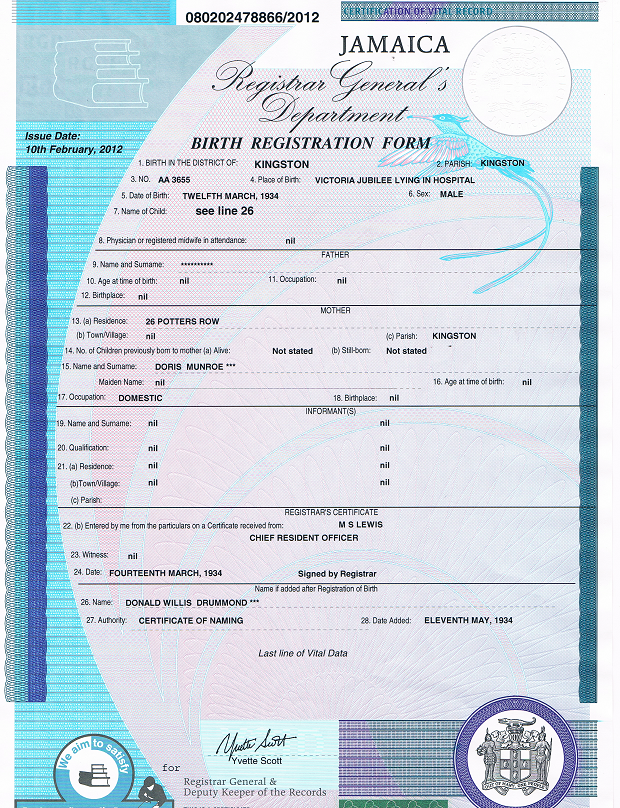
Birth-CertificateDon Drummond’s birth certificate.

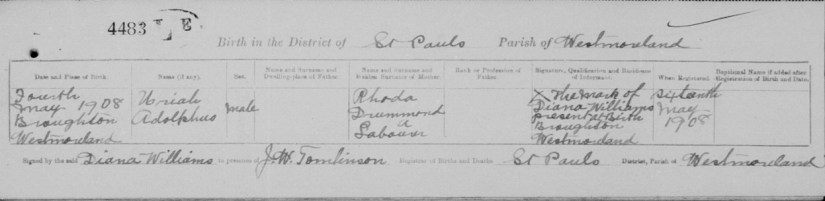
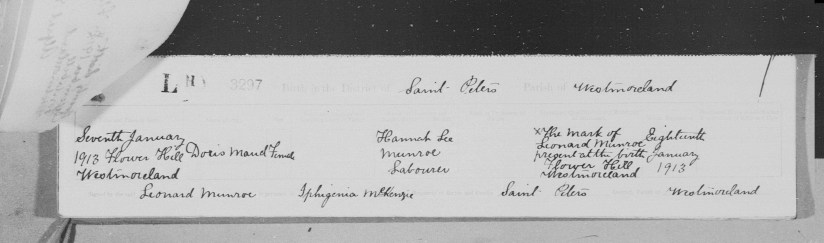
Donald Willis Drummond was born on this date, March 12, 1934. He would have been 82 today, had he not died on May 6, 1969 at Bellevue Mental Hospital. The above birth certificate took me about two years to secure from the Registrar General in Kingston but I wanted to prove once and for all when he was born, as the record from Alpha Boys School has him born in 1932. This is a mistake, for whatever reason. He first lived at 26 Potters Row in Kingston, and his mother, Doris Munroe, was a domestic. You can read more about that in my book, Don Drummond: The Genius and Tragedy of the World’s Greatest Trombonist by going to skabook.com. I was even able to find classified ads for her domestic services and more information about her, but little on his father, Uriah Adolphus Drummond, though I did find his birth record, as well as Doris’s birth record, pictured below.

uriahUriah Adolphus Drummond’s birth record.

Doris-Munroe-birth-recordDoris Maud Munroe’s birth record.

To celebrate Don Drummond’s birthday, I would like to offer the foreword that Delfeayo Marsalis wrote for my book. Marsalis, as you may know, recently performed at one of the Grounation events last month at the Institute of Jamaica courtesy of the Jamaica Music Museum. Carter Van Pelt wrote an extraordinary summary and review of this performance for his blog that you most definitely need to read HERE. Delfeayo Marsalis is one of the top trombonists, composers, and producers in jazz today. He is a member of the distinguished Marsalis family, father Ellis and brothers Branford, Wynton and Jason who earned the nation’s highest jazz honor, a National Endowment for the Arts Jazz Masters Award, in 2011. He considers Don Drummond to be a masterful trombonist. The following is his foreword, for which I am very grateful and feel it is a perfect homage to the great Don Drummond on the day of his birth:

In 1985, I was returning to the Brooklyn residence of my eldest brothers Branford and Wynton from a sojourn in Manhattan late one evening. As fate would have it, the Jamaican taxi driver recognized my slide trombone and proclaimed, “You know about Don Drummond and the Ska-talites?” At that point it occurred to me that I had indeed seen in Branford’s collection several albums by this particular group, but—not being interested in Ska music at the time—had not checked them out. The driver continued to rave about Drummond being one of the greatest in history, which I basically accepted with a few grains of salt until he asserted, “J.J. Johnson went to Jamaica just to hear Drummond his legend was so strong!” The matter had suddenly become serious business with the utterance of such a proclamation. Johnson was not only my primary jazz influence, but he was also one of America’s great jazz masters, known for his precision and profound command on the trombone at all tempos and volumes. Would J.J. have traveled to Kingston, Jamaica solely to hear Don Drummond?

I immediately scoured the library and discovered three Ska-talites albums. I listened and was overcome by the pathos and immediacy of Drummond’s improvisations, his melodies expressing an adolescent innocence undergirded with the knowledge of an elder. Extroverted, eccentric and self-taught, Don Drummond’s trombone style has an earthiness and songlike quality that makes it immediately identifiable. His melodies are so simple, perfectly constructed and memorable that they are reminiscent of children’s songs; each note placed in exactly the right place at exactly the right time. He managed to consistently maintain certain qualities not steadfastly present in Johnson’s style.
My interest in Drummond led me to the Brooklyn storefront studio of Mr. Coxsone Dodd at some point in the mid 1990s and eventually to a few trips to Kingston, Jamaica. I found that many of the older people were aware of Drummond and his music. His celebrity was such that stories were shared with equal aplomb about his extraordinary musicianship as well as his peculiarities. He not only worked the women into frenzies with his aggressive rhythms, but he also would cause many to weep at the sorrow he expressed on ballads. During the 1950s-60s, Jamaica was a hotbed of musical talent featuring the likes of Roland Alfonso, Johnny Moore, Lenny Hibbert and Tommy McCook. Don Drummond, it turns out, was able to channel emotions from gentility to absolute rage through his music with as much authority as anyone to ever play trombone.

Trips to Jamaica were learning experiences on many levels; however, the greatest single lesson for me concerned understanding and accepting the traditions of the Jamaican people. Although they were respectful towards me and happy to assist in my efforts to learn about this musical giant, they still let me know in subtle ways that they were Jamaican and I was not. When they wanted to have private conversations, the language became unrecognizable. If there were even a hint of impatience from me, actions slowed down to a snail’s pace. These quirks gave me a sense of how strong nationalism and pride was in the Jamaican people. As a whole, the individuals I encountered had a way of thinking that was centered on honesty, integrity and good old common sense. While they would never admit to the reality as such, these unique qualities of a people, when codified properly, can form the backbone of their art.

Bob Marley gave a voice and hope to all Jamaicans during the 60s and 70s with his songs of political awareness and protest. The individual who influenced Marley the most with songs that celebrated Jamaica and its unique characteristics was Don Drummond. Marley spent a period of time performing with Drummond and clearly knew of his brilliance. Marley’s voice covers the same basic range of Drummond’s trombone and as further proof, his “Crazy Baldheads” is pretty much Drummond’s “Eastern Standard Time” in a minor key! Even without lyrics, the trombonist displayed his socio-political awareness with songs entitled “Man In the Street,” “President Kennedy,” “Lee Harvey Oswald” and “Reload.” Marley was able to take Drummond’s music to the ultimate level, internalizing its strongest characteristics and incorporating them in his own style to great advantage.

Whether by Drummond’s own design or that of producer Coxsone Dodd, the Skatalites performed all of their songs with the famous guitar-led ska (boom-chick, boom-chick) beat. Certainly, a studied and adventurous musician like Drummond was capable of creating less formulaic compositions, and his desire to do so is evidenced in at least one example, “Far East.” This song highlights an awareness of other cultures and musical contributions as it is a tribute to Eastern music in Jamaican terms. One captivating aspect of ska is the degree to which it is specifically localized (from the people) and universal (for all people) simultaneously. While Don Drummond’s distinctive sound was strengthened by consistent performance with the same Jamaican musicians, if he had been afforded the opportunity to share experiences with musicians from different cultures as is customary today, his music could have expanded to even greater heights.

Speculations aside, we celebrate all that Don Drummond accomplished as a great musician and representative for the Jamaican people. Thanks to his ingenuity, ska remains the only music in the world in which trombone plays the lead voice with trumpet and saxophone playing the secondary harmonies. Don Drummond was a soft-spoken introvert whose life was defined by the trombone and the great music he created with it. Trombone provided his voice in a way words could not. Don Drummond played music as though it was all he had; or perhaps as though he felt it was all he had. As listeners, we have benefited greatly from his immense talent and unique ability to touch human souls around the world.

This is the definitive documentation of a seminal figure in the history of Jamaican music which is long overdue!

Delfeayo Marsalis

Perhaps an even better way to celebrate is by listening to his music. Here are links to a few of my favorites. Roll on Sweet Don.

Don Cosmic

Confucius

Addis Ababa

Cleopatra

Chinatown

Occupation

Uncategorized

Memories of Chocomo Lawn

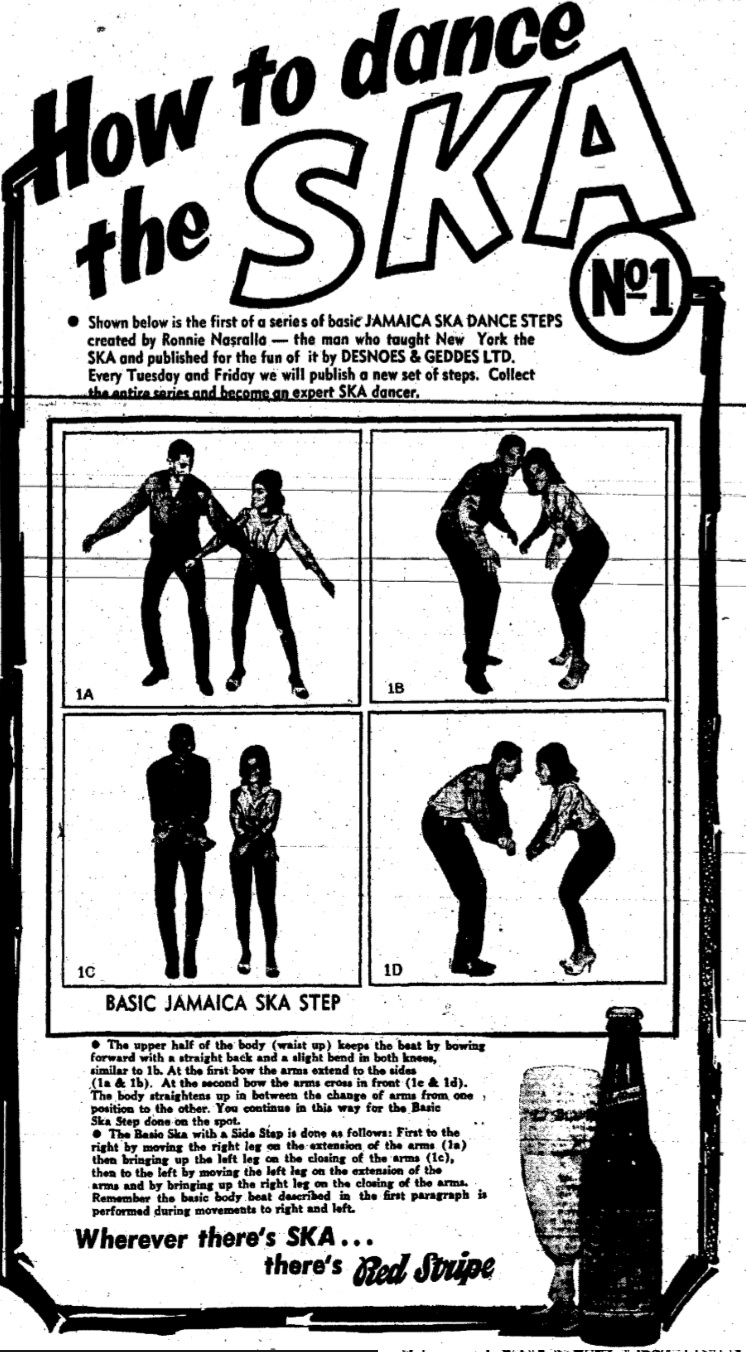
ska-no-1-june-23-1964

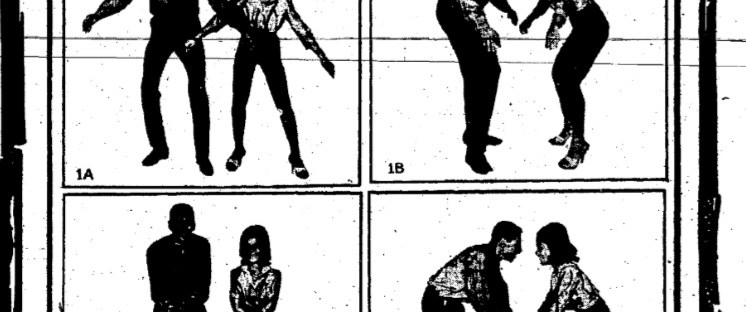
This week I am asking for you, the reader, to share your memories of Chocomo Lawn, should you have the experience in your past. Even better, if you have photos of Chocomo Lawn, then or now, I would be very interested in hearing from you. This site was a “ground zero” of ska, as were other sites such as Forrester Hall, Orange Street, Brentford Road, and many more. Chocomo Lawn was/is in West Kingston and was the headquarters for Edward Seaga during his early years in politics. In a Daily Gleaner article on December 23, 1967, Seaga held a holiday party for thousands of children in West Kingston, and he held the fete at Chocomo Lawn. The article read, “About 4,000 children were given a Christmas treat at Chocomo Lawn, Wellington Street, on Thursday afternoon sponsored by the West Kingston Constituency Committee and the Hon. Edward Seaga, Minister of Finance and Planning. This was the fourth Christmas treat for children of the area since Monday. Mr Seaga assisted by Miss Veronica Carter handed out the gifts at all the treats. Mr. Seaga announced that a special feature of this year’s Christmas treat for the constituency application forms for admittance to two youth camps for boys in the area
between 15 and 16 years were available at the constituency headquarters. To close the series of treats a special dinner for 1000 old people of the area was given yesterday afternoon, Supt. Joe Williams of the Denham Town Police was special guest.”

Years before this charitable gathering, Seaga, had come to West Kingston as a site of culture where he would study and cultivate the music–music of the revivalist religions (kumina, pukumina) and ska. In a Jamaica Observer article on March 21, 2004, former Kingston mayor Desmond McKenzie recalls this era at Chocomo Lawn. The article states, “A decisive turning point in the lives of the residents, particularly the young people in Western Kingston, came with the arrival of Edward Seaga, McKenzie remembers. He would make an awesome impression on them and under his tutelage some would rise to national prominence, notably “Babsy” Grange, Daphne Hurge, Samuel Dreckette, the late reggae superstar Dennis Brown, Winston Bopee who was lead guitarist for We the People band, the Techniques, among others. Seaga had entered West Kingston on grounds that he was researching culture and revivalism in the area. . . .  They were also thrilled by the way Seaga could move to the beat of the revival drums. Seaga eventually bought out Victor’s Pop Band that gave birth to the Techniques. Many young Jamaican talents were nurtured there. Young upcoming stars such as Jimmy Cliff, Marcia Griffiths, Delroy Wilson, Count Prince Miller and the like played at Chocomo Lawn, the cultural centre that Seaga developed. Such was the reputation and prestige of the place that ‘anybody who was anybody played the Chocomo Lawn.'”

One of these “anybodys” was Byron Lee & the Dragonaires who came to Chocomo Lawn, along with Ronnie Nasralla, to learn about the ska. Until then, like most other bands on the island, Lee and his group were playing in the American rhythm and blues styles that were popular at dances and in clubs. Other bands, like Carlos Malcolm, performed jazz. Each club, each studio, was an incubator of sounds from the Caribbean, America, and Africa, but at Chocomo Lawn, the scene was ska and Seaga encouraged his friends to come for a listen, to help spread this new sound. In a Daily Gleaner article, October 25, 1980, the writer chronicles a celebration of Seaga’s imprint on the culture. “Mr. Seaga mentioned such names as Jimmy Cliff, Ken Boothe, Stranger Cole, Toots and the Maytals, Hortense and Alton Ellis who he said always frequent Chocomo Lawn in Western Kingston — the place where ska was born. He said that as Minister of Finance and Planning in the JLP government, he tried to popularise ska internationally allowing Jamaica to be known as a country of creative people. After the ska, he said,
there was the rock steady, then reggae from which super stars like Bob Marley were born. Mr. Seaga said that Jamaican music today was acclaimed internationally, ‘It began as a little seed planted at Chocomo Lawn in Western Kingston, nurtured into a bigger tree and blossomed so that the entire world can see its beauty,’ Mr. Seaga said. Mr. Seaga paid tribute to Byron Lee and the Dragonaires who were celebrating 25 years in the music field. He said they have helped to spread Jamaican music abroad more than any other artistes in the country.”

Though I’m sure the above text will cause some debate. For every person who claims they are the one who started ska, there are an equal amount who feel they know who started it. This is good! This speaks to the passion of the music! There is ownership and pride! So those who may have memories to share of one of these sites of creation, Chocomo Lawn, please share your thoughts here and if you have photos, please contact me at haugustyn@yahoo.com. I am researching this time period and would very much like to hear your oral histories!

You can read more about the connection between Chocomo Lawn and ska here.

Prince Buster, Uncategorized

Prince Buster on His Persecution as a Muslim

prince-buster

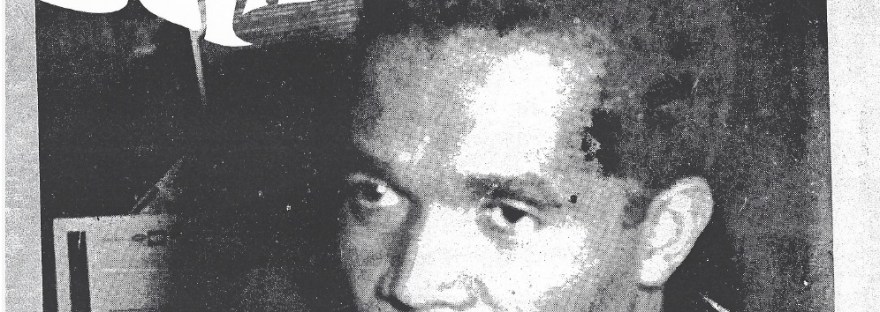
What better way to celebrate an election in Jamaica than with the ruler of them all, Prince Buster?! I recently came across this Swing Magazine dated January 1969 in which Prince Buster appears on the cover of the digest-sized magazine and the small feature cover story details, among other subjects, his recent rise to the top of the music charts, the characteristics of ska and rocksteady and the potential of Desmond Dekker & the Aces, and his brief boxing career (read more on Prince Buster’s boxing career here). Perhaps most interesting in this short article, however, is the discussion of Prince Buster’s conversion to Islam and troubles with the Jamaican authorities in becoming a member of the faith. When we think of religious persecution in Jamaica during this time, we tend to think of the Rastafari oppression at the hands of the government and colonial people, but little do we think of those members of other religions as well, such as Nation of Islam, to which Prince Buster converted after meeting Muhammad Ali during his travels to the 1964 World’s Fair in New York with the Jamaican delegation. Here Prince Buster had gone to promote his country’s culture and celebrate his dedication and pride in his country, yet the authorities in that country in turn harassed him for his own culture. I in no way single out the Jamaican government for being at fault in this, as I recognize any group or authoritative body is likely to persecute the unknown until there is enlightenment. Let us hope that we as a society evolve closer to a sense of humanism and acceptance within our lifetimes. The article is below:

prince-buster-2More on Prince Buster in Foundation Ska can be found on the links below:
Prince Buster Interview

Prince Buster Boxing

Prince Buster and Federal Records

Prince Buster Takes on the Beatles

Uncategorized

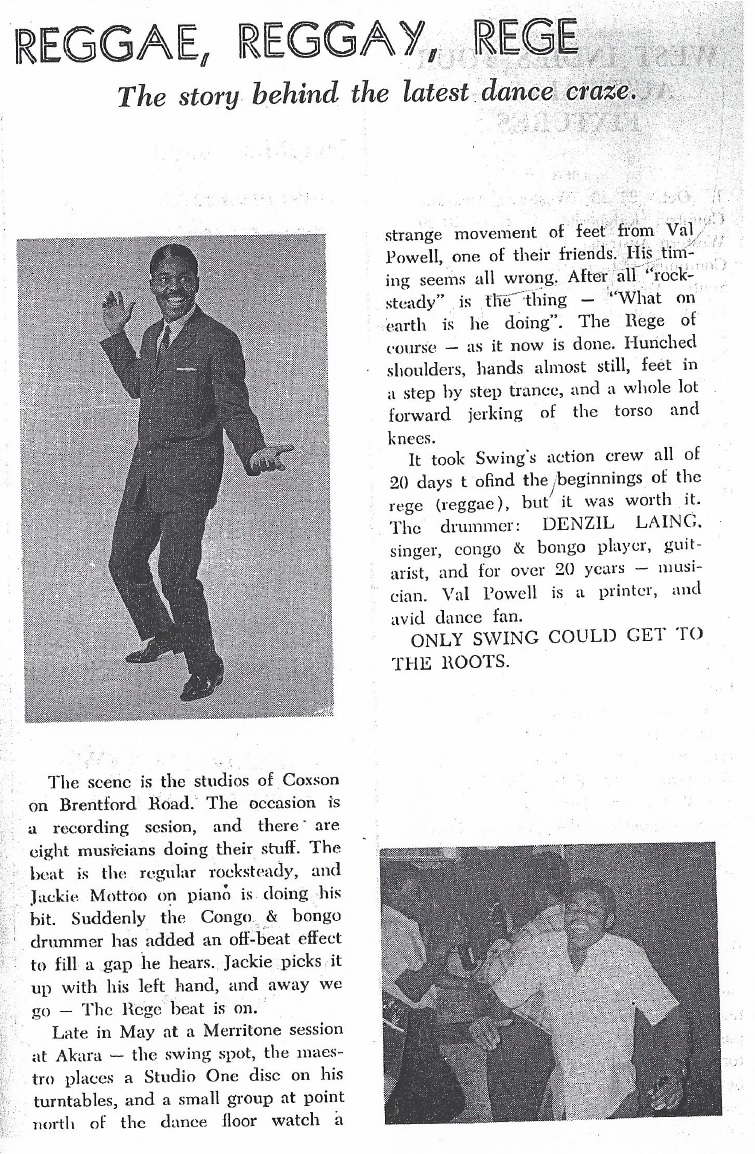
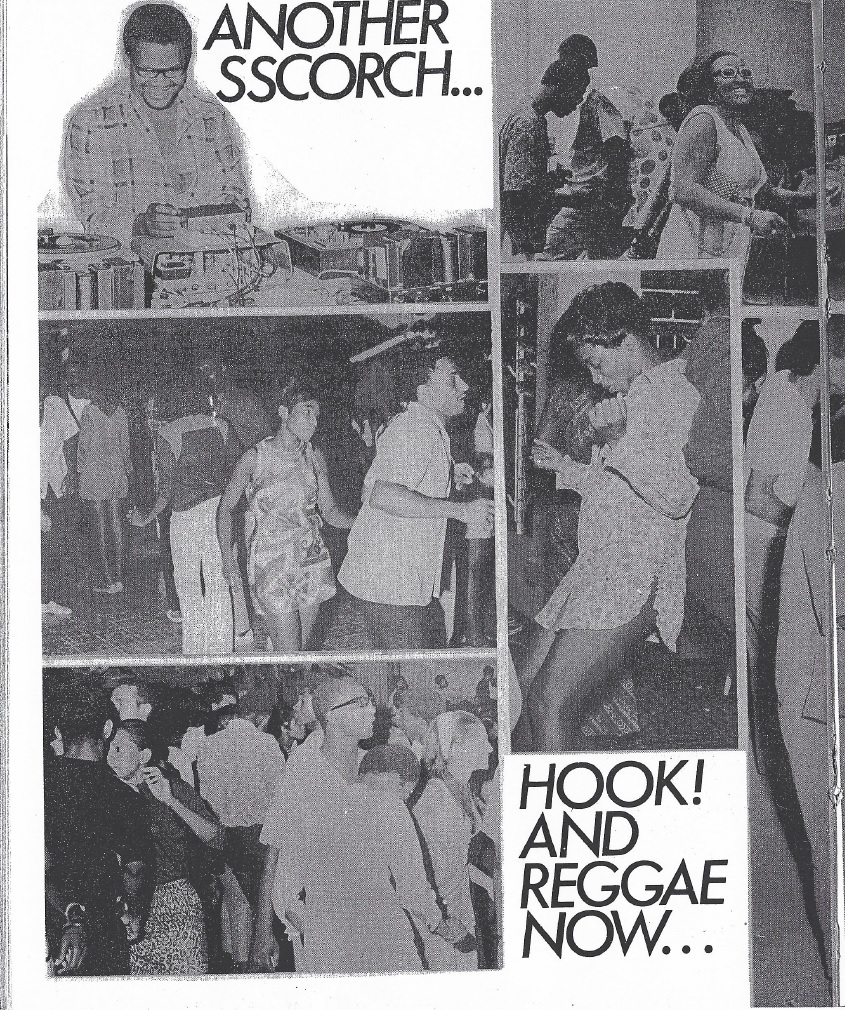
Dance the Reggae, Reggay, Rege?

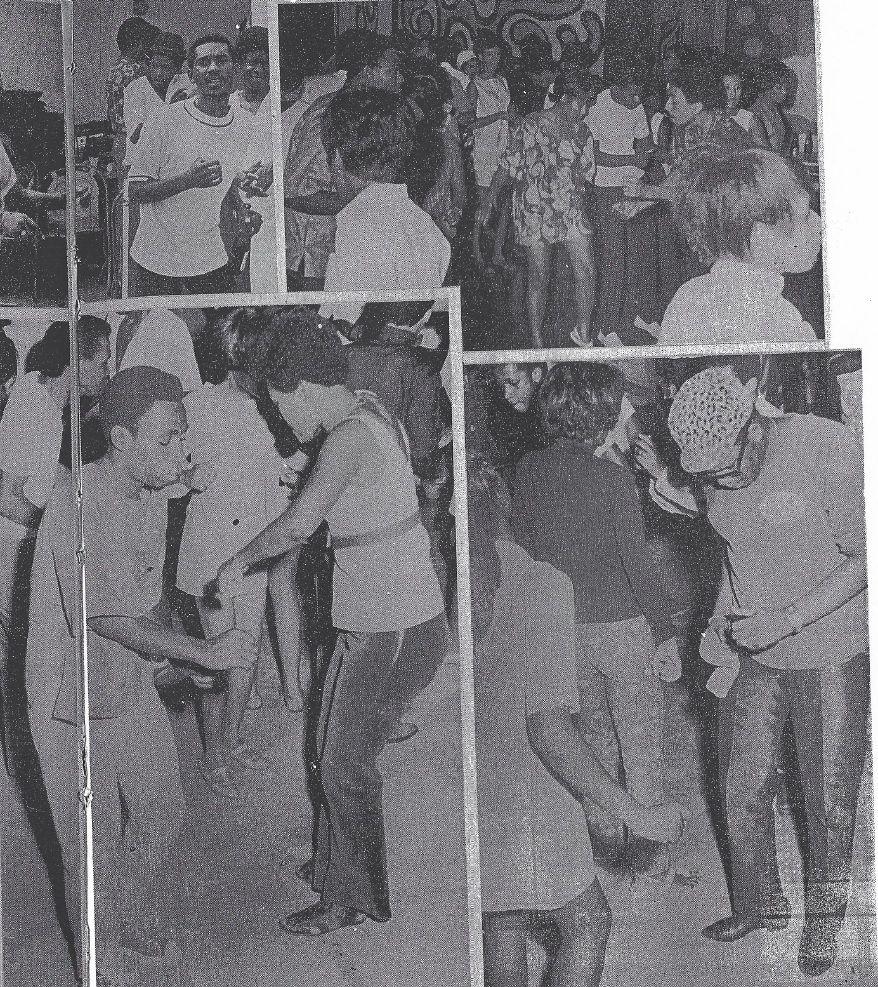
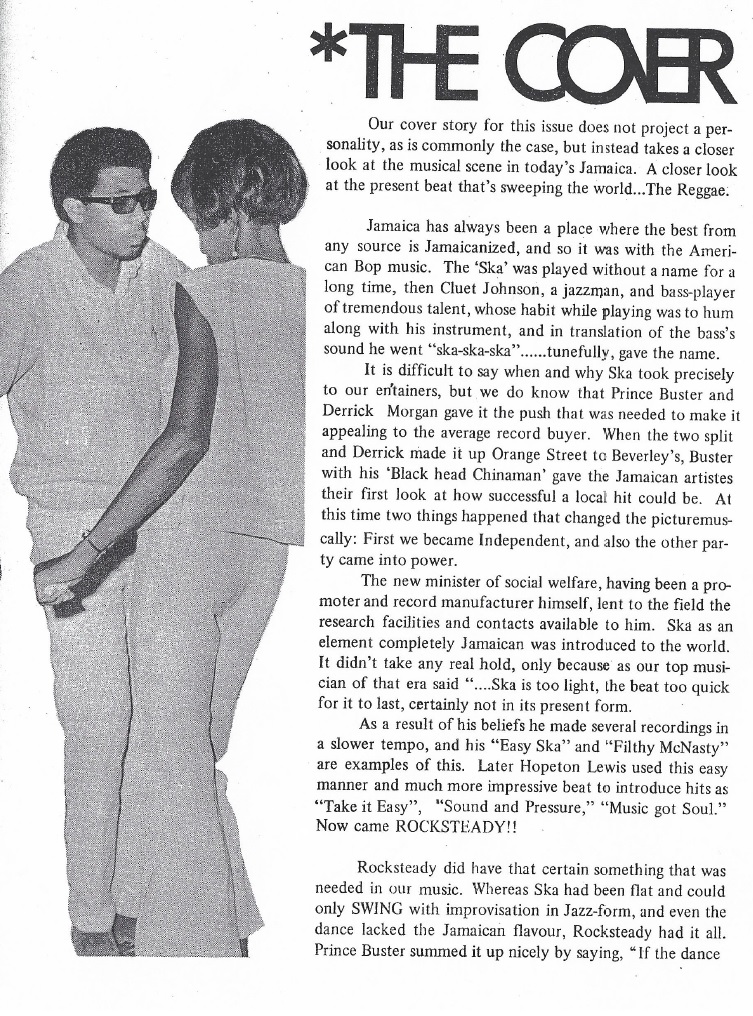
During my recent visit to Kingston, I conducted some research at the National Library of Jamaica with my good friend and colleague Roberto Moore who has an excellent knowledge of the holdings there at the library. He introduced me to the rare books room where we went through a few bound collections of Swing Magazine from 1968, and therein we found the following articles and photo spreads on the reggae as a “dance craze.” The dance is done with “hunched shoulders, hands almost still, feet in a step by step trance, and a whole lot forward jerking of the torso and knees.” The article cites Studio One as ground zero for reggae music as Jackie Mittoo’s rocksteady keyboard blends with the “congo and bongo” drums of Afro-Cuba. The article below traces the evolution of reggae from ska and rocksteady, from Clu J, to Prince Buster and Derrick Morgan, to the World’s Fair, to Hopeton Lewis and Carlos Malcolm. Enjoy and kick up your heels this weekend!

Uncategorized

Skatalites Go Into Orbit

skatalites1

The following article appeared in the June 27, 1964 issue of the Star Newspaper with the headline, “Skatalites Go Into Orbit.” The article by Lloyd Davis states, “Whether it was ska-ing ‘On Broadway,’ painting a ‘Ska-trait of my love’ or just plain ‘I’m in the mood for Ska’ there was something for every taste at Bournemouth on Wednesday night when Tommy McCook and the Ska-Talites went into orbit. It was just the shot in the arm the Bournemouth needed to revive this once popular night spot. The dance floor was a sea of heads bobbing up and down in ska tempo. Any physical training instructor would have been proud of the hand movements. It seems as if diets will be out soon, for the Ska could well pull that extra pound from the tummy area. Jamaicans all know of ‘Carry go, bring come’ but wait until you hear it set to music in the Ska beat. It’s a different kettle of fish. For the past few weeks, the band have taken over Bournemouth and have kept the place alive. Roland Alphonso on tenor sax, Don Drummond on trombone (when he sits in), leader Tommy McCook on tenor sax, Lloyd Brivett [sic.] bass, Lloyd Knibbs [sic.] drums, Johnny Moore trumpet, and Lester Sterling, alto sax and trumpet combine to produce a sound that’s great.”

Tommy McCook is the man who launched them:

“In 1962 a young musician returned to his island home after spending a few years in England and the United States. This young man, having wide experience in jazz music, linked up with a local group of jazzmen and started to make a name for himself. He was Tommy McCook. Tommy, who was then an authentic jazz musician and an increasingly popular artist, was invited by Messrs. Coxon [sic.] and Randy, to do recording for them, but for McCook, jazz was not to be given second place for SKA (which at the time was of very little significance). Roland Alfonso [sic.], who was doing recording for Coxon [sic.] and Randy left the island and also a vacant space for a recording artist which could only be filled by someone as proficient as Tommy McCook. It was at this stage that he decided to enter the recording scene and he did so with terrific force. One of his first record releases was ‘DOWNBEAT’ which was a hit, and he then went on to make his next hit ‘Road Block,’ a Ska instrumental. This release projected McCook to the front rank of leading recording artists where he was in constant demand by Ska Lords like Randy, Tip Top, Duke Kid [sic.], and Prince Buster. Today Ska as it should be played is produced by the talented musicians who are not attached to any particular band. Tommy McCook is one of these musicians. He realised that the Ska boom was being heard all over Jamaica and in other parts of the world and he organised his fellow musicians and formed a new Group called the SKATALITES. The SKATALITES have made four public appearances so far and have made a good impression.”

skatalites-at-uwi

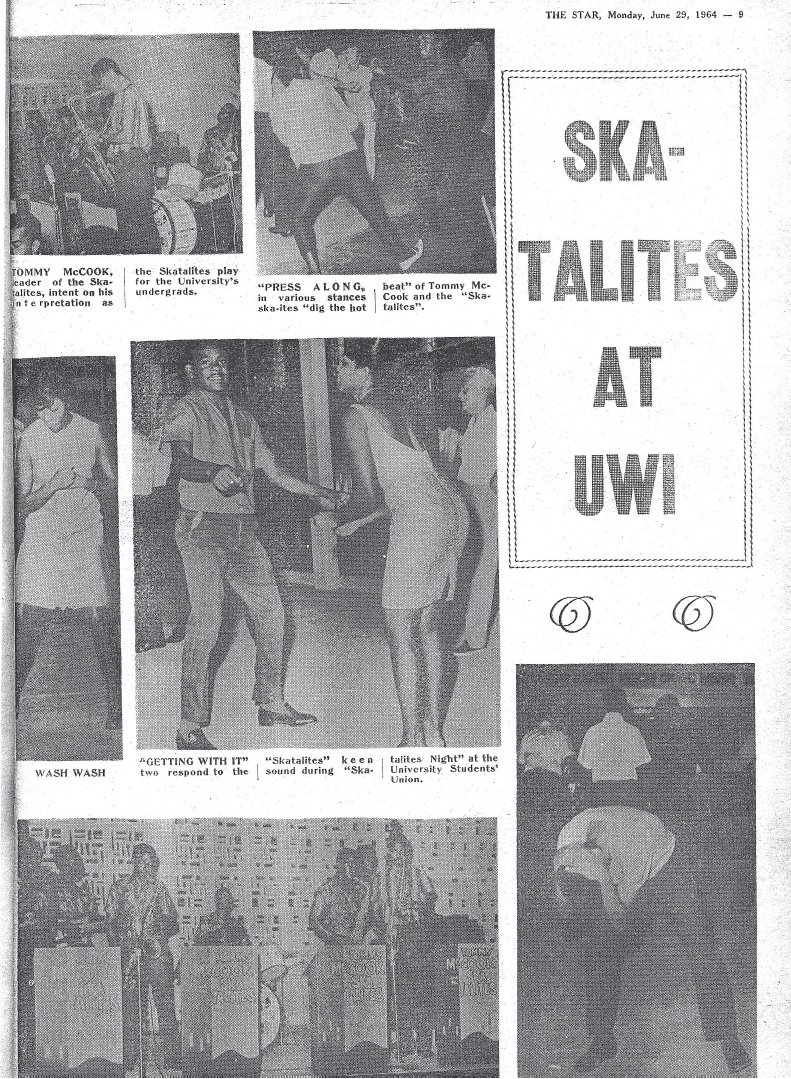
This article, which appeared in the Star Newspaper just two days later on June 29, 1964, provided a photographic account of one of those performances that the Ska-Talites made at the University of the West Indies, presumably at Mona. The top left photo shows Tommy McCook performing with the caption, “Tommy McCook, leader of the Ska-Talites, intent on his interpretation as the Skatalites play for the University’s undergrads.” The next photo bears the caption, “Press along, in various stances, ska-ites ‘dig the hot beat’ of Tommy McCook and the ‘Ska-talites.'” Below a photograph of a woman doing the “Wash Wash” appears, the song that Prince Buster made famous at the 1964 World’s Fair with the dance moves to correspond. Two ska dancers appear above the caption, “Getting With It, two respond to the ‘Skatalites’ keen sound during ‘Ska-talites Night’ at the University Students’ Union.” The two photos at the bottom feature a group shot of the band with the caption, “The men with the big sound: ‘The Skatalites’ at the Students’ Union of the University of the West Indies on Wednesday night last ‘Skatalites Night’ during the University’s ‘Festival Week.’ From left Johnny Moore (trumpet) Lord Tanamo (guitar), Roland Alphonso (Tenor Saxophone), Loyd Knibbs [sic.] (drums), Lester Sterling (alto saxophone), Lloyd Brevet [sic.] (bass), and leader Tommy McCook. Absent on the night was Don Drummond.” The next photo features a dancer with the caption, “‘Oh, Ah Can’t Take No More,’ this ska-ite seems to say.”

Don Drummond’s absence, incidentally, could be due to a number of circumstances. One, he could have been struggling with mental health issues, though he was not likely in Bellevue at this time, but more likely is a second scenario–while Don Drummond was certainly a member of the Skatalites, and a crucial member at that, he was also a widely recognized solo performer as well. In fact, that same month he headlined as a solo performer at Johnson’s Drive-Inn where he was billed as “Mr. Ska himself.” He appeared that same night with Margarita “Rhumba Queen,” so the point is that it is possible that Drummond may have had another engagement, or he simply turned this engagement down. We can only speculate with educated guesses at this point. Six months after this performance, Margarita would be dead, murdered at the hands of Don Drummond.

skatalites-tour

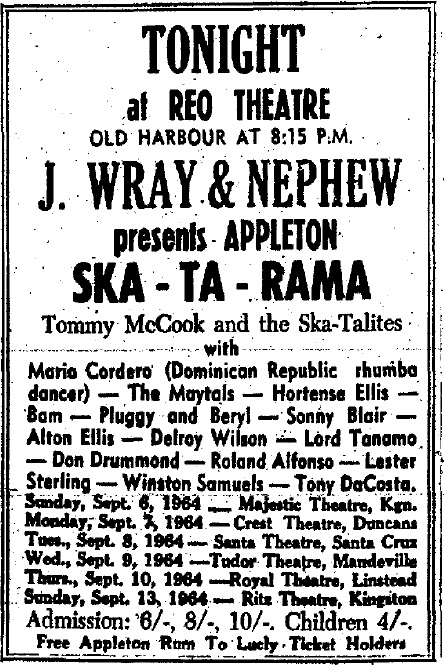
The following article appeared in the Star Newspaper the following month on August 20, 1964 with the headline, “The Ska-talites to tour Island.” The article reads, “Tommy McCook and the Ska-Talites will be performing in a series of stage shows at the Appleton ‘SKA-TA-RAMA’ presented by J. Wray & Nephew Ltd. at certain theatres. The Ska-Talites will be accompanied on the tour by The Maytals (with their theme song ‘Pain in My Belly’) and Maria Cordero, Dominican Republican rhumba dancer. Opening in St. Ann’s Bay in the Seville Theatre Monday August 31; Highgate, Movies Theatre, Tuesday, September 1; Port Antonio, Delmar Theatre, Wednesday, September 2; Old Harbour, Reo Theatre, Thursday, September 3. Kingston, Majestic Theatre. Sunday, September 6; Duncans, Crest Theatrem, Monday, September 7; Santa Cruz, Santa Theatre, Tuesday, September 8; Mandeville Tudor Theatre, Wednesday, September 9; Linstead, Theatre Royal, Thursday, September 10; and into Kingston at the Ritz Theatre Sunday, September 13. Other supporting artistes will be Hortense Ellis, Pluggy and Beryl, Ranny Willians, Alton Ellis, Don Drummond, Roland Alfonso [sic.], Sonny Bair, Delroy Wilson and other top local artistes. There will be free bottles of Appleton Rum given away to lucky ticket holders at each theatre.”

Below are two advertisements from these Ska-Ta-Rama shows.

Daily Gleaner, September 2, 1964:

skatarama2

Daily Gleaner, September 3, 1964:

skatarama

Uncategorized

Real Dance Crasher

dance-crasher

This article from the Daily Gleaner, Septemner 20, 1961, tells of a real dance crasher. It was uncovered by my friend and colleague Roberto Moore, an extraordinary historian of Jamaican music. We’ve heard the stories of the violence and pilfering at the hands of opposing thugs, rude boys associated with competitive sound system operators. Lloyd Bradley in his brilliant book, This is Reggae Music: The Story of Jamaica’s Music, writes about these dance crashers and the ones assembled by Duke Reid. “They were there, he maintained, for his protection as he claimed he’s made so many enemies as a policeman that his life was permanently under threat, but really it was anybody else’s set who needed protection from his crew. Their main function was one of aggression, storming rivals’ lawns punching, stabbing and kicking indiscriminately, frightening off the crowd and aiming to get to the rig and cut wires, smash amplifiers, hack at speaker boxes and upend turntables. Maybe even snatch the box of records.”

Here is what appears to be evidence of one of those examples of thievery, a real dance crasher who stole three of Coxsone Dodd’s exclusive tunes where they were played at a competitor’s dance. The article reads: “A young man who heard a sound system playing records he had reason to believe were the property of his employer, told his employer, who brought in the police. In consequence, Herman Moore, 48 of 66B Love Lane, was arrested by Cons. A.D. Redley of the Fletcher’s Land Police and charged with the theft of three records valued at 15 pounds, the property of Clement Bodd, [sic. Dodd], owner of the Coxson Sound System of 22, Beeston Street, Kingston. The police said the Bodd [sic. Dodd] missed the records on September 3. Chancellor Eccles of 155 Church Street, heard the records being played the following day and informed his employer, knowing that the records were the only ones in use in the island. They had not yet been released for sale to the public.”

Could this Chancellor Eccles be Clancy Eccles? It is likely since Clancy worked with Coxsone Dodd during these years. In David Katz’s outstanding book Solid Foundation, Eccles states, “In early 1960, Coxsone had a talent hunt. It was sixty of us and I was a runner-up by I was the first one that Coxsone recorded out of that crop. I did ‘Freedom’ and ‘I Live And I Love.’ Around eight months later I did ‘River Jordan,’ ‘More Proof’ and quite a lot of other tracks.” Katz says that Eccles recorded with Coxsone until late 1961 and that he didn’t record anything for three years after that because he was under contract with Coxsone and, unlike all the other artists, didn’t want to break the contract and incite trouble.

It is fascinating to imagine the scene, what records were stolen, who may have spun the spoils. What are your thoughts?

Uncategorized

Skatalites Reorganized in 1975

skatalites3

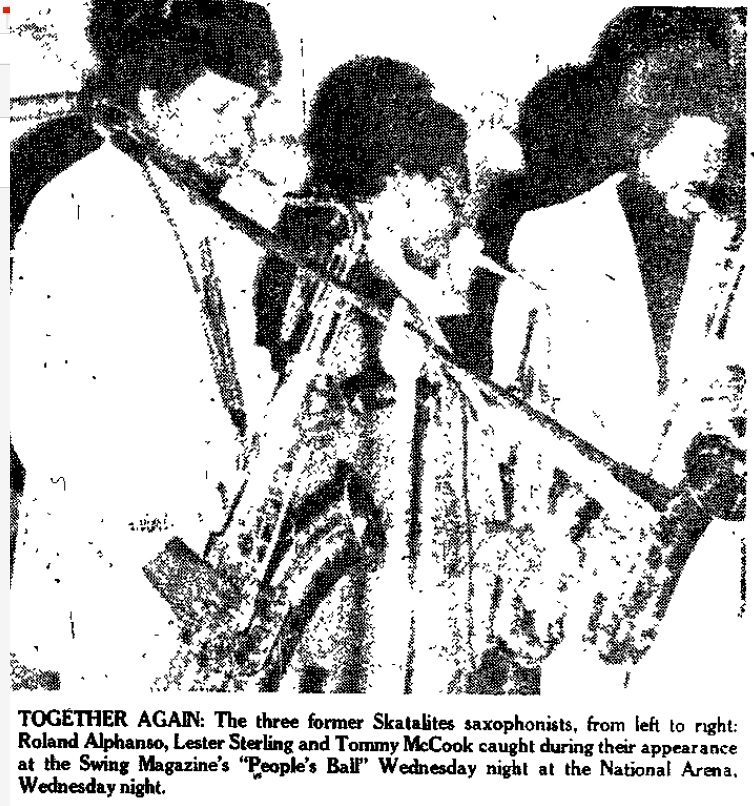
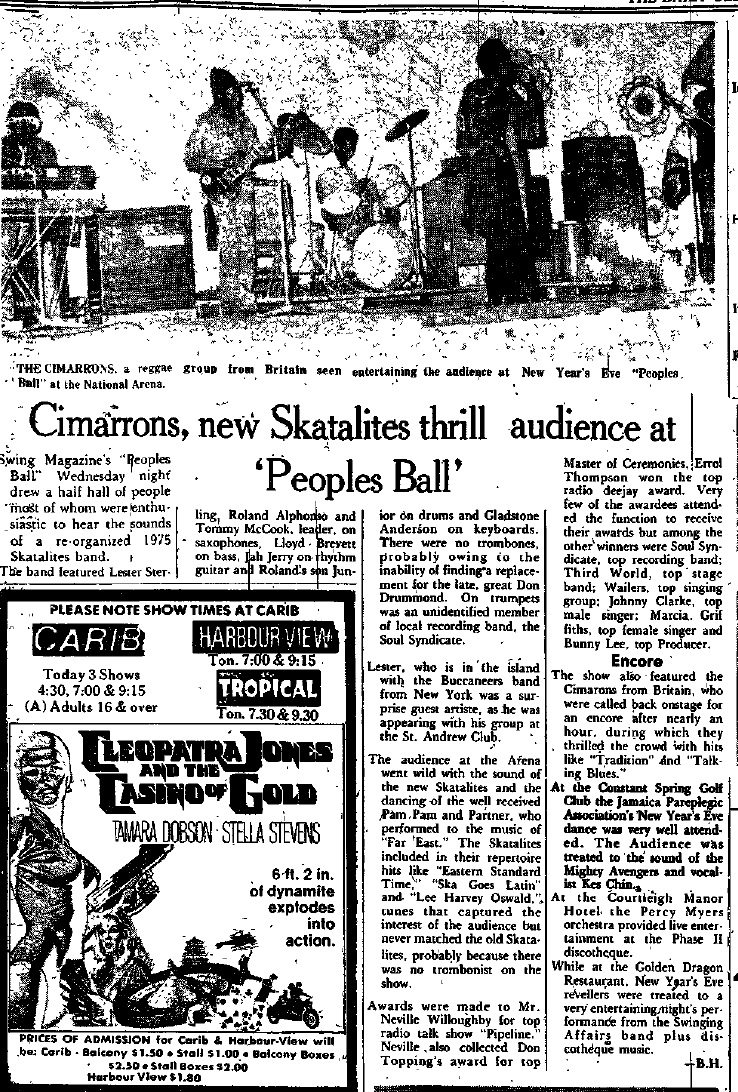
It is well known that the Skatalites disbanded in 1965 despite their trying to stay together for a few months in the wake of Margarita’s murder at the hands of Don Drummond. They came back together briefly in 1975 to support bass player Lloyd Brevett in the studio for his African Roots album which was finally released in 1997 by Moon Ska Records and it is a fine body of work. But I was surprised to find that they not only came together this year to record, but they also performed live at a public event called the Peoples’ Ball along with the Cimarons. The event took place on New Year’s Eve, December 31, 1975 at the National Arena.

skatalites1

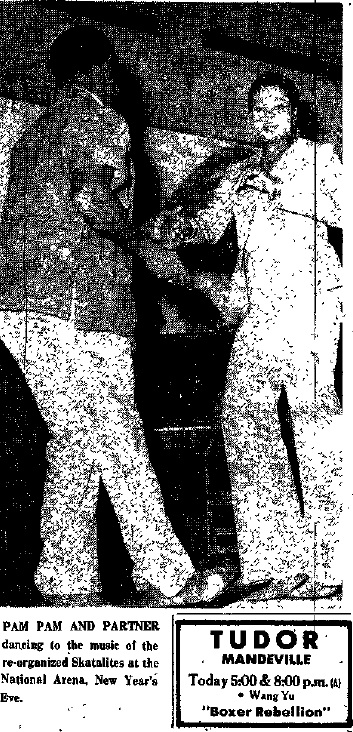
The article in the Daily Gleaner on January 3, 1976 reads: Swing Magazine’s ‘Peoples Ball’ Wednesday night drew a half hall of people, most of whom were enthusiastic to hear the sounds of a reorganized 1975 Skatalites band. The band featured Lester Sterling, Roland Alphonso, and Tommy McCook, leader, on saxophones, Lloyd Brevett on bass, Jah Jerry on rhythm guitar, and Roland’s son Junior on drums and Gladstone Anderson on keyboards. There were no trombones, probably owing to the inability of finding a replacement for the late, great Don Drummond. On trumpets was an unidentified member of local recording band, the Soul Syndicate. Lester, who is in the island with the Buccaneers band from New York was a surprise guest artist, as he was appearing with his group at the St. Andrew Club. The audience at the Arena went wild with the sound of the new Skatalites and the dancing of the well received Pam Pam and Partner, who performed to the music of ‘Far East.’ The Skatalites included in their repertoire hits like ‘Eastern Standard Time,’ ‘Ska Goes Latin,’ and ‘Lee Harvey Oswald,’ tunes that captured the interest of the audience but never matched the old Skatalites, probably because there was no trombonist on the show.” The article continues with discussion of the award ceremony at the event and other holiday performances.

The Skatalites went on to reform again for that now historic show in 1983 at Sunsplash. Journalist Richard Johnson writes in the June 15, 2012 issue of the Jamaica Gleaner about this reunion. “The group disbanded in 1965, some members have died, there is no direct contact for the living members and some of the surviving bandmates don’t even speak to each other. However, for Syngery director Ronnie Burke, it was the ultimate challenge, and he thought: ‘Why not?’ ‘For our fifth anniversary we wanted to do something really special for our patrons. So we arrived at the idea of presenting the old and new faces of Jamaican music,’ Burke tells Splash. For the new, Synergy brought in Musical Youth — the young band of second-generation Jamaicans based in Britain, who had hit the airwaves with Pass The Dutchie, their rework of the The Mighty Diamonds hit Pass the Kutchie, as well as their collaboration with disco diva Donna Summer on Unconditional Love. The ‘old face’ of the music would be represented by the disbanded Skatalites. So Burke and his team, with the help of music insider Herbie Miller, set about trying to locate the members of the band, one by one, to convince them to get together for the event. ‘I first made contact with the drummer Lloyd Knibbs [sic.]. He was very enthusiastic about the prospects of taking to the stage as the Skatalites once again,’ Burke remembers. ‘It was then on to meet with Jah Jerry and then Lloyd Brevett,’ he continues. Burke clearly remembers his meeting with bass player Brevett, who died on May 3 [2012]. ‘We got word that he was working as a mason on the construction of the Conference Centre in downtown Kingston. We found him covered in cement on the site, and he put paper on my car seat before he sat down for us to talk. We told him about the plans and immediately he was on board.’ Synergy would soon hit a bump in the road to having the Skatalites on the Sunsplash Stage. It was realised that one of the major problems with reuniting the Skatalites was the fact that Tommy McCook and Johnny Moore had not spoken to each other in nearly 20 years. Burke recalls: ‘I was familiar with Dizzy Johnny (Moore) and took him to meet McCook at his house in Harbour View. Both men just sat staring at each other for what seemed like hours before the ice was finally broken and all agreed that they were getting old and should just go ahead and stage the reunion for Sunsplash.’ The Skatalites were booked and took to the stage at the Bob Marley Performing Centre at Freeport in Montego Bay. If Burke and his team have any regrets it is that the band was scheduled to perform too late and the audience was already somewhat weary and looking forward to the headline acts. ‘They gave a fantastic performance. It was well worth the effort it took to put them back together. What is great is that based on the Sunsplash performance it brought the group back together and they are still touring. It was a landmark for us at Synergy and if anyone should ask what am I most proud of it would have to be bringing the Skatalites back together.'”

Doreen Shaffer told me of this reunion as well. She remembers, “I was still living in Jamaica and I think it was the Sunsplash organizers, they were the ones who got in touch with them (the members of The Skatalites) in some way and I was informed that they were going to come down for Sunsplash and they wanted me to be a part of it. But everybody was away. I hadn’t seen them for a good while. So that was quite exciting, meeting everybody again. But I didn’t get back with them until I got to the U.S. Sunsplash was in ’83, but they went on to London and I wasn’t a part of that.” Shaffer moved to the U.S. in 1992 after living in Jamaica her entire life. When Shaffer arrived in the U.S., word of her presence quickly spread to the members of The Skatalites and Coxsone’s wife facilitated the reunion. “Ms. Dodd took me down to Central Park. They were having some concert. They were part of this festival and she took me directly because she knew where to find them and she was the one who took me there. So I was happy, meetin’ and greetin’. So we decided, they said, ‘Well, you are here now, you’ve got to work with us,’” Shaffer says.

The Skatalites continue to tour together under the management and tireless dedication of Ken Stewart. And a new generation of Alpha Boys School alumni under the direction of Bandmaster Sparrow Martin continue to perform the Skatalites music under the name Ska Rebirth. See info on this group HERE .