Uncategorized

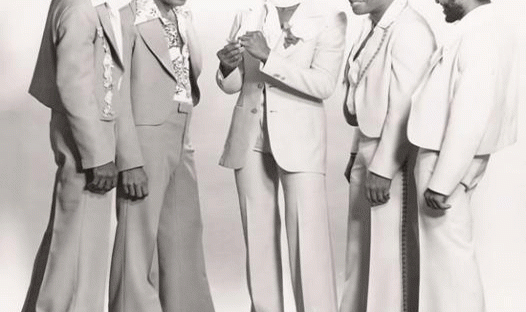
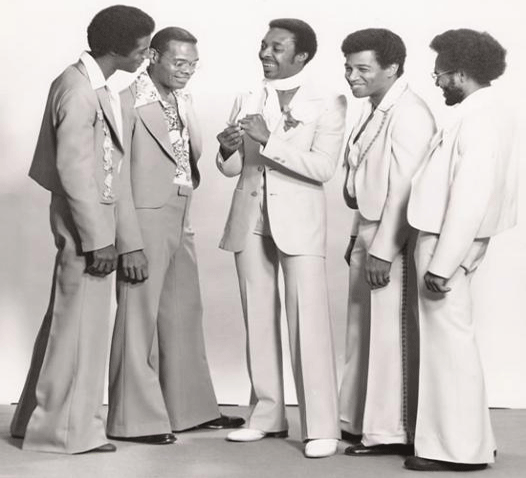
Charley Organaire–Master of the Harmonica

charley1

You may know Charley Organaire best from his harmonica solo in Stranger Cole’s classic “Rough and Tough,” (listen to it here: Rough and Tough), or over 1,000 other Jamaican recordings over the years, but did you know that Charley is still going strong, singing and harmonizing all over the world? His song, “I Never Stop Loving You” was featured in the classic movie “Love Jones.” And Charley Organaire is performing tonight in his hometown since the mid-1970s, Chicago, to kick off his European tour with the Prize Fighters, a stellar band from Minneapolis. Charley Organaire, along with Roy Richards, was responsible for pretty much all of the harmonica in ska and rocksteady, even reggae, during the 1960s and 1970s in Jamaica (unless you count Lee Jaffe on Bob Marley’s “Talkin’ Blues,” because we all know, he sure likes to count himself!). The harmonica is an important but overlooked instrument in Jamaican music. But the harmonica not only provides lyrical musical harmonies—it also gives Jamaican music its spine, the essential rhythm that makes ska ska, rocksteady rocksteady, and reggae reggae.
charley2

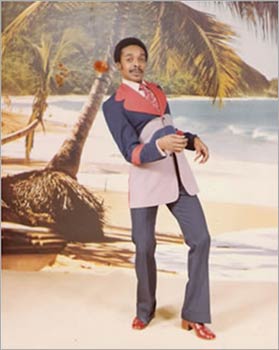
Charley not only performed the harmonica back in Jamaica, but he also sang. In fact, in 1967, at a New Year’s Day show, a three-hour show at the Ward Theatre, Organaire was touted for his vocal performance. The Daily Gleaner article on January 3, 1967 stated, “One of the featured singers, Charlie Organaire, brought down the house with such popular hits as ‘Goodnight My Love,’ and ‘Stand’ By Me’ and was called back to give another performance.” As Rico Rodriguez would say, “Nice!”
charley-organaire

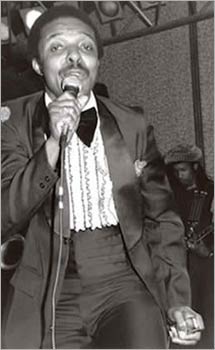
According to the Jump Up! Records website, which is the label founded and operated by Chicago ska, rocksteady, and reggae authority Chuck Wren, Charley Organaire has a rich history as a musician and entertainer. The Jump Up! website states, “Charles Cameron was born in Kingston, Jamaica on March 20, 1942. He was inspired by the singing of his mother Louise, and his neighbor Mr. Randolph, a mean harmonica player. From the early age of 5, Charles started performing in neighborhood concerts, churches, and lodge halls – reciting poems, singing and playing his plastic harmonica. At the age of 9, a talent scout named Vere Johns had Charles performing on the “Opportunity Knocks” radio program and at various theatres in Kingston, such as the Palace, Ambassador, Gaity, and Majestic. He performed with all the big singers like Jimmy Tucker, Winston Samuels, and Laurel Aitken, plus was a side-kick to Bim and Bam, Jamaica’s leading comedians at the time. In his teens, Charley “Organaire” Cameron performed with big bands lead by Carlos Malcolm and Sonny Bradshaw. Then Charles teamed up with Bobby Aitken and formed a band called the Carribeats, recording the hit track “Never Never” with Bobby on vocals, Charley on harmonica. Charley “Organaire” was now unstoppable, becoming a well known studio musician performing on sessions with Bob Marley, Jimmy Cliff, The Tenors, Derrick Morgan, Millie Small, Toots and the Maytals, Phyllis Dillon, Stranger Cole, and Lord Creator. The “Organaire” worked for the biggest labels in Jamaica: Prince Buster, Studio 1, Beverly’s, Duke Reed, Treasure Island, Highlights and King Edwards. Charley also started producing hits for his Organaire label, most notibly “Little Village/Little Holiday”, “London Town”, Illusive Baby”, “Sweet Jamaica”, “Your Sweet Love”, and “Let me Go”. Being one of the most popular entertainers in Jamaica, he moved to the north coast and worked in the tourist industry. Playboy, Hilton, Holiday Inn, Intercontinental, Yellow Bird, you name it, he played there. Charles moved to Chicago in the late 70’s, eventually forming his own band called “The Charles Cameron & Sunshine Festival”. The “Organaire” band played in various night clubs, for major corporations, and political functions throughout Chicago including events for former Mayors Harold Washington and Jane Burn. Charles also played at Chicago Fest, Festival of Life, Taste of Chicago, and the African Fest. Charley “Organaire” Cameron continues to write and record to this day, the title track from his “Never Stop Loving You” CD appeared in the movie “Love Jones” starring Nia Long and Lorenzo Tate, and his newly released “Friends” CD features collaborations with Charlie Hunt and Steve Bradley. In 2012/2013 Charlie Organaire became a regular fixture at Chicago’s Jamaican Oldies productions at Mayne Stage, performing with Stranger Cole, Roy Panton & Yvonne Harrison, Eric Monty Morris, Derrick Morgan, Derrick Harriott and Dennis Alcapone.”
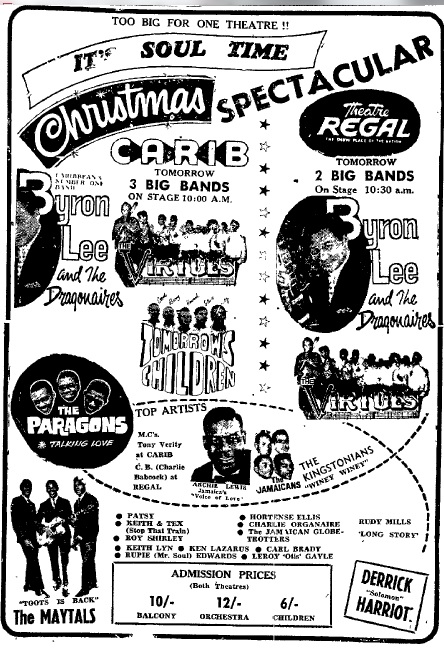
charley-organaire-dec-24-1967

My friend Aaron Cohen wrote a fantastic article on Charley Organaire in Thursday’s Chicago Tribune. Here is the text from that article:

“Charley “Organaire” Cameron is a harmonica player and singer, but sitting in the Good To Go Jamaican restaurant in Rogers Park, he is regarded somewhere between a celebrity and favorite uncle. He deserves both roles.
More than 50 years ago, Organaire performed in the instrumental section on a plethora of pivotal early Jamaican ska and rocksteady recordings. Since 1976 he has lived in Chicago, where he’s worked in different musical idioms; until relatively recently only a few fans knew about his historical role. But his upcoming first European tour will focus on the music that he helped originate.
“Charley was the harmonica sound of ska music, as well as an important arranger,” said Chuck Wren of Chicago’s Jump Up Records, which released three new Organaire ska singles this month. “He was on so many sessions; that Wailers tune you hold closest to your heart could have been 90 percent arranged by him.”
All of which began simply enough. Organaire listened to his mother sing and a neighbor play harmonica while he was growing up in 1950s Kingston. He heard different music through Radio Jamaica and from signals farther away.
“That one radio station in Jamaica would play country, blues, jazz and classical music,” Organaire said over glasses of Caribbean ginger beer. “A Cuban station would play Latin music. But where all music came from is basically the R&B from New Orleans.”
When Organaire was a teenager, he picked up a chromatic harmonica, which could play all 12 notes on a scale, as opposed to the more typical diatonic model that covers eight. His colorful tone and dexterity throughout shifting tempos made him valuable on pioneering ska and rocksteady recordings by the Wailers, Prince Buster and Jimmy Cliff. He owned his own record label, also called Organaire, which released his locally popular “Elusive Baby.”
“Back then we’d start every day at 9 in the morning and do no less than eight songs for each session,” Organaire said. “I had a great time working with (saxophonists) Tommy McCook and Roland Alphonso. Since they were jazz guys, I learned so much from them.”
Those lessons proved helpful when Organaire got fed up with the Kingston record industry’s often desultory (at best) payment system, and he left to work in hotels and resorts on the country’s north coast. He’s still amazed that tourists preferred hearing him sing jazz standards instead of Jamaica’s own music.
After Organaire accepted an invitation to play in a Greek venue in Chicago in 1976, he stayed here. That gig turned into engagements at the Latin clubs that thrived here decades ago, including El Mirador and Las Vegas in Humboldt Park.
“I would play salsa and a little jazz,” Organaire said. “I’d also sing ‘My Way.’ It didn’t matter if you were from China; everybody knew ‘My Way.'”
A show at the reggae club the Wild Hare led to Organaire’s appearance singing his ballad “I Will Never Stop Loving You” in the 1997 film “Love Jones.” But for the past 27 years, his contributions have not just been musical. He has also worked on behalf of Chicago Concerned Jamaicans, a foundation that raises money to provide scholarships to needy students on the island.
“One student’s mother had six children and couldn’t afford a home,” Organaire said. “We helped her through a scholarship, and now she’s an engineer.”
Organaire’s generosity also emerged two years ago when he began participating in the Jamaican Oldies concerts that Wren has organized at Mayne Stage. Along with performing, Organaire helps the veteran artists feel more at ease working with much younger American backing ensembles. The musicians in one such group, the Minneapolis-based Prizefighters, have been fans of Organaire’s early ’60s sessions and perform on his new recordings. He does not expect this to be the last generation to rediscover his legacy.
“When the right time comes, all you have to do is be ready,” Organaire said. “If you stop, it’s over, and I will keep going on until I drop.”

Read even more about Charley Organaire here: World of Harmonica article

Read an interview with Charley here: Reggae Vibes interview

And visit Charley’s website: Charley’s website

And see Charley with the Prize Fighters on tour: Tour

Here’s a great blog post on the harmonica in Jamaican music: Harmonica

Uncategorized

Goodbye Mr. Goody

goodall1

It is with heavy heart that I dedicate this week’s Foundation Ska blog post to Graeme Goodall who died this past Wednesday, December 3rd. Graeme was a good friend who had generously provided me with numerous interviews over the years and was always ready to answer any question I had. He had a terrific sense of humor and deeply loved his wife Fay, recalling their days together at dances when she was pregnant, her little bun in the oven jumping to the bass of Downbeat’s sound system. Graeme was crucial to Jamaican music in so many ways it is almost daunting to write a blog post about him—he deserves so much more. But I shall give it a go and hope you will all chime in with your memories and thoughts in the comments section below.

Graeme Goodall was known affectionately as Goody. He was born in Melbourne, Australia in 1932 and died at the age of 82, although you’d never guess he was that old. His spirit and lucidity could trick you into thinking he was at least two decades younger, and his memory of minute details was sharp as a tack. He was a studio engineer for Ken Khouri’s Federal Records an in July, 2011 he told me in an exclusive interview how that came to be.

“I went from Australia to England in 1932 mainly to study more than anything else. In 1954 I was working for a commercial broadcasting station in Melbourne but I looked around and everybody older than me looked very very healthy, including the chief engineer and I figured, I better do something to leap frog over them. At the time the Australians were very into going overseas because they had been restricted through the Second World War and so I went to England, dead broke. I needed to send enough money for my ticket I suppose so I worked selling appliances that that didn’t last long so I worked my way into a company called IBC-UPC, International Broadcasting Company, Universal Program Corporation, and they did programs for Radio Luxembourg and they also did recordings and were probably the largest independent recording studio in Great Britain and so one way or the other I was trained as an engineer and they got me into doing remote broadcasts, or remote recordings actually, of shows like ‘Shilling A Second,’ ‘People Are Funny,’ ‘Strike It Rich,’ and during the week we had to make recordings of people like Petulla Clark. During that time, one of the girls who worked there in a sort of secretarial position said why don’t you go down there and see R.P. Gabriel who is chief engineer of a company called Rediffiusion, and Rediffusion, of course, had commercial broadcasting stations throughout the British Commonwealth, specifically the British Empire, countries that had not achieved independence. It was sort of funny because in the land of the blind, the one-eyed man in king. They had no commercial broadcasting engineers in the U.K., so it was down to the Canadians and the Australians. So I guess I passed with flying colors at the Rediffusion house in London and they said we’ve got two positions going—one in Nigeria, one in Jamaica, and I thought about that for a while and to be honest with you, I’d been so much an engineer that I forgot about geography, so I called an uncle of mine and he said, ‘Come out old chap and have tea with us,’ so I went out to his house and he said, ‘I thought the Goodalls were smart, and they offered you a job in Nigeria and Jamaica? My cousin Tom,’ who was my father, ‘I didn’t think he’d breed an idiot! What are the times?’ and I said, ‘Well, Nigeria is 18 months and Jamaica three years,’ and he said, ‘Well shouldn’t that tell you something?’ I said, ‘Well not really.’ He said, ‘We send British people down to Nigeria,’—he worked for the British government, he said, ‘They’ve had enough after 18 months!’ I said, ‘Oh! Okay, thank you!’ So I went to BOAC and I got a map of the place and it was a tourist brochure that was obviously 30 or 40 years old with voluptuous-looking ladies walking around and I said, ‘Well that sounds good,’ and so I signed up for three years for Radio Jamaica. I was always a studio person, an audio man plain and simple.

We designed and put on the island’s first commercial FM service in the British Commonwealth in 1954 in Jamaica, in a time when you couldn’t buy FM transmitters and we put it in basically as a studio transmitter link, and STL from Kingston, which is where the studios were, into Montego Bay. It was a double hop across the island and it just worked out that it was a wonderful system and people started buying FM radios from the United States that were definitely better quality and at the same time, they had a network of amplifiers made by the parent company. So that’s kind of how it all sort of started.

This went very well for three years and my three-year contract was up and I had three months of fully-paid vacation and the equivalent of paid airfare back to England, so I said, well that’s good, I’ve got three months paid for, so I cashed in my return ticket to England, flew to Miami, went Greyhound across to San Francisco and got a ship from San Francisco back down to Sydney, a train down to Melbourne and used all of my fare allowance on betting back to Australia. That went very well, everything was fine, but after about two weeks I got bored to tears and I talked my way into working in television in Melbourne. I worked there for about four months and Jamaica started calling me, the government started calling me, saying they were putting in a government broadcasting, not just as a competition, but as an adjunct to Radio Jamaica—we need you back here to put it all in and by the way, there’s a ticket on the way if you need it. I was 25 or 26 and all of my friends were settled down and I was the last person they wanted to see around the house. I’m a single bachelor, making good money, wearing American clothes, and they didn’t want me around, so I was short of friends and all of my other friends were back in Jamaica, so I said okay, back I go! I flew Pan Am back to Jamaica and that was my second stint with RJR, and that time it was for JBC Broadcasting, which was exciting because it was a new approach.

Out of the RJR concert studio, which I’d already built, I utilized all sorts of things like outside broadcast equipment to get extra mic input, and the famous story that goes down in history is that I converted the men’s lavatory into an echo chamber, which was quite interesting. So that’s all the original Island Records, the Caribs, Laurel Aitken, Wilfred Edwards, people like that, we recorded them all at Radio Jamaica Studios. I’d go home and relax a bit, maybe go out and dance with the Caribs a bit and we’d all go back into the studios around midnight and record until about four or five o’clock in the morning, go home, get a couple hours sleep, and come back and work at Radio Jamaica all day. How I survived, I don’t know.

I built a studio, a very primitive studio up on King Street in the back of Ken Khouri’s furniture store. The only person who was making records at that time was Stanley Motta and you couldn’t really call it making records, although I guess it was making records because he was cutting the record disc, but Ken Khouri wanted to do something a little bit better, so I advised him. He got a mic recorder, a tape recorder, some microphone and I threw a studio together for him and so he started making records. And that was progressing and people don’t realize that Ken Khouri and his wife, Gloria, they were the principal owners of Federal Records. Actually it started off as Records Limited up on King Street and one of the big shareholders in Records Limited was Alec Durie who owned Times Records. And Time Store is probably the biggest retailer of phonograph records, so this is how it all came about. Ken started pressing records. I know he had the Mercury franchise and he started pressing Mercury Records so when he got more into it and it was obviously a money-making venture, he built this studio that became Federal Records, and it was rather primitive and I don’t know how it all came about, but all of us started talking and I said, the hell with Radio Jamaica. I quit Radio Jamaica, went down there and literally took the studio under my wing and also the cutting system and we could do everything when they walked into Federal Records. They make a noise and they would end up with a finished product. And that was the secret. Ken Khouri literally saw it as I saw it. There’s no point in making a disc and sending it away, because it has to go through several processes and then it would come back, you’d have to order the labels and it was restrictive because if it took off you’d have to wait for product to come back from England and it did not make any sense. So Ken had the foresight and I had the technical knowledge and we managed to pull it all together and everybody came to Federal Records.

I remember when I said to Ken, we got a problem here. We’ve got to get some echo in here somehow. He said, what does that require? I said, well I could design an echo chamber. I could modify the equipment, which I did. I rebuilt a lot of it to make it a lot more professional and I said I’d design an echo chamber and tag it on the back there. He said, that sounds good. All the walls were a different angle from one another. The Jamaicans that we got to build it refused totally to build it. And I remember one of them talking to Ken and they didn’t figure that I could understand. They said, ‘It’s not right, Mr. Khouri, it’s not right. We cyaan build it because all the walls dem different,’ (laughs). I figured it all out, these guys were used to putting up walls vertical, floors and ceilings horizontal, and everything at 90 degree angles from one another. And Ken said, ‘I don’t know what he’s doing but trust me, you’ve got to do it his way.’ So we built it that way and I think that was one of the primary things because then when we started adding reverb, it brought it into a completely different area. And that was the start of Federal Records.
I went down to this horrible place in Trench Town in my little Mini Minor and I went up to Coxsone’s dance on a Friday night and I went up to the guy at the door and I said, ‘Where’s Downbeat?’ and they all sort of looked at me and said, ‘Just a minute,’ so he said, ‘Come on in,’ and it was amazing, all these people, there was probably a couple hundred people or more, and they all looked at me, ‘Who is this apparition? Did this guy just fall out of the sky? Is this the fifth coming of Christ?’–this gory-looking white guy in the sound system dance in Trench Town, and this little Chinese girl. And then all of a sudden Coxsone appeared and said, ‘Hey Mr. Goody, yuh make it deh, come, lek me buy yuh a drink.’ So I walked through and when Coxsone came it was like the Red Sea parting and he just walked through and I walked through with him and the crowd parted between us, and then it was the funniest thing because a lot of people that I knew, like Bim Bim and people like that that work for Coxsone, it was different. ‘Let me buy you a drink, Mr. Goody,’ ‘What do you want to drink, Mr. Goody,’—all of a sudden we’re exalted and they’ve got to buy me a drink, and my wife was all upset because this bass boominess was upsetting the baby that she was carrying. The baby started moving because the bottom end was so heavy. I could see the look on her face saying, ‘What’s going on here?!’ And I heard exactly what I had to do to make this record for the people. Because now I could see what they wanted. And I could feel what they wanted. So I went back to Federal the next week and I knew exactly what I had to do, I knew exactly how I had to do it and how exactly I had to weigh it down. And this is the problem that all these other people, including, I have to say it, Eddie Seaga, who I would love to be in there, but he never really understood what he had to get out there to influence the people. So that was it.”

Over the years, Graeme shared with me stories of the artists themselves, the producers, the wives, and tales of life in Jamaica in the 1950s and 1960s which I have included throughout my books. I am forever thankful to Graeme for all he has given me—the history, the music, and most of all, the friendship. We all should be profoundly thankful for all he has given to Jamaican music. You will be deeply missed, my friend. Love to you. To see Graeme Goodall interviewed in the flesh, make sure to catch a screening of Brad Klein’s Legends of Ska film which is now showing at locations all over the globe, including next week in Havana, Cuba!

goodall2

Kola wine

Plenty Bottle of Kola Wine

kola-wine-ad1

The lyrics of the classic song “Sweet and Dandy,” written by Frederick Hibbert, known to us as Toots, tell of a young couple’s wedding day jitters and reassurances from their family, who have spent money on food and refreshments for the assembled guests. As I sing along, I belt out the words, “kola wine,” realizing that I, once again, have no idea what I’m warbling! So I decided to check it out, for those non-Jamaicans like me, so we can know the history of this beverage called kola wine with the hopes that I may someday try a glass and toast to Toots himself.

Advertisements for kola wine first appear in the Daily Gleaner in 1900. One ad describes this new drink:

It is a powerful Stimulant, A Pure Product, Palatable as well as Nourishing, An Agreeable Beverage that is also a Nutritive Tonic. It is tolerated by the weakest stomach and is a substitute for solid food in cases of acute disease and is valuable to digestion in all chronic conditions including mal-assimilation of food. In cases of acute disease in which other nourishment cannot be received, Club Brand Kola Wine is effective and easily bourne. But perhaps its widest usefulness is among chronic invalids, those convalescing from wasting illnesses, those who are constitutionally feeble and those who are temporarily or frequently require a tonic.

kola-wine-ad2

The advertisement goes on to state that it is good for “various ailments” including dyspepsia, asthma, sea sickness, diarrhea, heart weakness, following fevers, brain and nerve ailments, neuralgia and migraines, and as a general tonic to aid circulation. These advertisements are not unlike those of Coca-Cola or Dr. Pepper in the same era in the United States and elsewhere. The “stimulant” found in kola wine is, like Coca-Cola and other popular soft drinks, caffeine, which is found in the cola nut used in production of both Coca-Cola and kola wine. The nuts have been used for centuries as a diuretic, stimulant, cardiac tonic, astringent, and anti-depressive.

coca-cola-advertisement-721253

These sorts of tonics were and are still popular in Jamaica and among Jamaican musicians. Pianist Herman Sang revealed to me that Don Drummond was known to drink a tonic in the studio, although it is unknown exactly what it was. Sang told me, “I noticed that he had this brown bag, a paper bag with something that looked like a one pint little bottle and he would bring it and put it beside the piano, like on the ground where the piano was. And whenever we had a break he would come over and open the bag and nobody really knew what it was. Maybe it was an energy drink! (laughs) But I always remember that.” Kola wine? Perhaps! Drummond’s favorite drink, however, was limeade or a concoction of Ovaltine and clay.

A Jamaica Observer article on September 1, 2003 revealed more information about what is called “root tonics.” Author Gwyneth Harold writes, “There is a variety of roots wines in the supermarkets and on bar shelves. They have names like Zion, Baba, Allman Strength Roots Drink, Lion Brand, Kola Wine, Magnum, Ginger Joy, Ginger Wine with Ginseng, and Pump It Up. They have stiff competition from the ‘small man’ who mixes a batch in his kitchen and sells it unlabelled out of a knapsack under names like Front End Lifter. Some of the roots drinks claim to be specially recommended for those ‘suffering from a run down constitution’ or ‘fatigue.’ Some say that they are number one in their class for enhancing one’s energy level ú taking it to a whole new plateau. The makers of Magnum proudly declare their drink to be with ‘Vigorton 2’ – a popular drink of an earlier time that was immortalised in ska by Lee Scratch Perry and King Stitt. There are also virility claims because some of the natural ingredients contain aphrodisiacs such as peanut root, sarsaparilla and medina. . . . Pump It Up, itself used to be known as Samsons Wine, The modern blend has 27 roots. It is recommended for adults only. A serving size of roots drinks ranges from one to two wine glasses. But while they are a popular part of Jamaican culture, we wondered if there were any standards in place to regulate these beverages. Diane Robertson, registered pharmacist, herbal consultant and author of ‘Live Longer, Look Younger With Herbs’, explained that one of the first distinctions to be made was the difference between roots tonic wine and a roots drink or roots juice. Tonics are for perking up the system, she said, but once the word tonic was on a bottle, it had to be registered by the Ministry of Health (MOH).” The article goes on to advocate regulation and proper labeling.

Below are the lyrics to “Sweet and Dandy” as well as a link to the song. Please post below if you have tried kola wine and share your experiences—for those who are unfamiliar with the beverage, like I am, we’d love to know your thoughts!

Listen to the song here and see Toots & the Maytals perform this classic in the film The Harder They Come: Sweet and Dandy

Sweet and Dandy
By Toots & the Maytals

Etty in the room a cry
Mama say she must wipe her eye
Papa say she no fi foolish
Like she never been to school at all

It is no wonder
It’s a perfect pander
While they were dancing
In that bar room last night

Johnson in the room afret
Uncle say he must hold up him head
Aunty say he no fi foolish
Like a no time fi his wedding day

It is no wonder
It’s a perfect pander
While they were dancing
In that bar room last night

One pound ten for the wedding cake
Plenty bottle of kola wine
All the people them dress up in a white
Fi go eat out Johnson wedding cake

It is no wonder
It’s a perfect pander
While they were dancing
In that bar room last night

Etty in the room a cry
Mama say she must wipe her eye
Papa say she no fi foolish
Like she never been to school at all

It is no wonder
It’s a perfect pander
While they were dancing
In that bar room last night

Johnson in the room afret
Uncle say he must hold up him head
Aunty say he no fi foolish
Like a no time fi his wedding day

It is no wonder
It’s a perfect pander
While they were dancing
In that bar room last night

One pound ten for the wedding cake
Plenty bottle of kola wine
All the people them dress up in a white
Fi go eat out Johnson wedding cake

It is no wonder
It’s a perfect pander
While they were dancing
In that bar room last night

But they were sweet and dandy
Sweet and dandy
Sweet and dandy
Sweet and dandy

Sweet and dandy
Sweet and dandy
Sweet and dandy
Sweet and dandy

They were sweet and dandy

Uncategorized

Remembering Bim Bim

James-Mckenzie

I saw a post by Mark Williams yesterday that Allan “Bim Bim” Scott had just passed away. He died on October 20, 2014 and a service in his honor took place on November 16th. I thought this would be an opportunity to talk about Bim Bim who was Coxsone Dodd’s associate producer, without whom we may not have one of the most impressive set of recordings of Skatalites tunes, for Justin Yap on his Top Deck label.

First, let us read the article that Howard Campbell wrote in the November 20, 2014 edition of the Jamaica Observer on the burial of Bim Bim, whose name was James McKenzie, although most knew him y Allan (sometimes spelled Alan) Scott or Bim Bim:

Dodd’s ally laid to rest

Thursday, November 20, 2014

James ‘Bim Bim’ McKenzie

JAMES ‘Bim Bim’ McKenzie, a close associate of producer Clement Dodd during the 1960s and early 1970s, died on October 20 at the Kingston Public Hospital at age 74.

The St Mary-born McKenzie was also known as Alan Scott. The thanksgiving service for his life took place last Saturday at the Dovecot Chapel in St Catherine.

He was interred at the Dovecot cemetery.

Scott worked with Dodd at his Studio One label when it was transitioning from rocksteady to reggae in the early 1970s. He is said to have been instrumental in introducing singer Winston ‘Burning Spear’ Rodney to Dodd, as well as a group of musicians out of Linstead who ‘changed’ the Studio One sound.

Those musicians were the Soul Defenders band which included percussionist Joseph Hill who later found fame as singer Culture.

McKenzie eventually left the music business and moved to Prospect, St Thomas, where he went into farming.

James ‘Bim Bim’ McKenzie is survived by two children (Anice Scott Mullings-Anderson and Michael Scott), four grandchildren and three great-grandchildren.

— Howard Campbell

In my biography Don Drummond: The Genius and Tragedy of the World’s Greatest Trombonist, I write a few words about Bim Bim, including the following:

The Skatalites also continued to record for various producers but they sought to get better wages than they earned as solo artists. One of the producers they recorded for, who was known for offering fair wages, was Justin Yap and his brother Duke Yap who ran the Top Deck label. Justin Yap was introduced to the Skatalites by Allan “Bim Bim” Scott, Coxsone’s assistant, who knew the musicians personally and suggested Yap record them. During a now-famous all-night recording session using Studio One in November, 1964, Yap recorded some of the Skatalites’ most classic tunes, all written by Don Drummond. He arrived for the session with five songs already written—Confucius, China Town, The Reburial, Smiling, and Marcus Junior. In the liner notes to Ska-Boo-Da-Ba, the re-release of Top Deck’s Skatalites sessions, Yap recalls his thoughts on Drummond. “I admired Don Drummond. I call him maestro. He takes over. He’s in charge. He knows what he’s doin’, he very professional. And when you hear my recordings with Drummond, you listen, you know that he took charge,” said Yap to Steve Barrow. He says it was a little tough to deal with Drummond at first because of his idiosyncrasies. “I remember when I drove Bim down town . . . we drove to his home. First of all, I didn’t go in—Bim Bim went in and talked to him first. I remember one time he took off! Just went down the road and come back with his answer—it’s ok! Whatever he had to do, you know?” Yap told Barrow.

Sure, one can argue that without Bim Bim these songs would have just been recorded for a different producer, perhaps Coxsone himself, but we all know that each producer has his or her own sound, own take on the music, own production and creative interpretation. Without Bim Bim making this connection, ska history would not have been the same. Thank you Bim Bim for your contributions to Jamaican music.

Enjoy these now-classic ska tunes:

Confucius

China Town

The Reburial

Smiling

Marcus Junior

Uncategorized

Enid Cumberland

keith-enid

We may know Enid Cumberland from her duos with Keith Stewart. But few know that Enid was with Studio One for over four decades–not as a performer, but as a studio employee. Of course you can read an entire chapter on Enid Cumberland in my newest book, Songbirds: Pioneering Women in Jamaican Music which is available through this website, skabook.com, but here are a few excerpts from that chapter, to celebrate Enid’s long career in Jamaican music.

Enid Cumberland lives alone today in Stony Hill and she remembers her childhood with a sense of humor. Born on December 11, 1930, Enid is still whip smart, active, and filled with love. “My mom had eleven of us—can you imagine?” she recalls. “My daddy was a soldier in the army and at that time it was King Edward the eighth. When my mommy used to go out she had to leave some of us with grandma or she had to share us with somebody because we were so plenty. My mother was part African and my daddy was Jamaican and part Jewish and we have a mixture, some darker than some.”

Enid was given special opportunities in school—opportunities like singing for the school choir. She also sang in church—her own and others. “We grow up Roman Catholic but I never understood much of that, to be frank. It was in Latin and there’s a lot of Latin. I always go to all churches because I can sing and my friends would have a concert and ask me if I could come and sing and I say you have to ask my mommy and daddy so they give information and come and take me. And I wasn’t a person that was scared. I show off when I’m singing! (laughs) And they say, ‘Oh this little girl! She can sing like a big woman!” But it wasn’t until after graduation from school that Enid really got her start. It was at Vere John Opportunity Hour, the launchpad for so many careers in Jamaican music, that Enid Cumberland also got her big break into the world of show business. “I sing for Vere Johns when I was 20 or 22, something like that, but I found a partner. His name was Keith Stewart and we did a few hits and we were recognized in Jamaica over time,” she says.

Enid also continued to record, primarily as a duo artist, performing songs with Lord Creator at Studio One. Lord Creator, whose real name was Kentrick Patrick, was a calypsonian made popular by his hit song “Independent Jamaica” in 1962. With Enid he recorded “Simple Things,” “Love Lost (Lost My Love),” “I Cried a Lie (I Cried a Tear),” and “Beyond,” all at Studio One in 1963 and 1964. And she also partnered with other artists over the years as they came into the studio, such as Roy Richards and Larry Marshall, but it was all done at Studio One post Keith & Enid breakup and she explains why. “I wanted to have children. Show business I had to leave because you don’t get much. Whatever we did get, it helped up, but that was years ago and it’s whatever they offer you. You cannot survive on it, you know? And I got married and started to have my children and I didn’t bother with the singing outdoors on stage and so on. I started to work at Studio One for Coxsone. Why I did that was because I was sure of my salary and don’t have to wait until someone call me to come do a job. I did supervision. People would come in and backup artists so I show them where they stand and get the microphones and move them up and down. I did that for Studio One for about 40 years. Everybody come here, and some invite me to England, but I think you’re not really suited to that when you have children,” she says.

Enjoy the Keith & Enid classic, “Worried Over You,” a tune in the traditional American R&B style that Jamaican musicians so loved: Worried Over You

“Send Me” was another huge hit for the duo, listen here: Send Me

And here’s an Enid solo, Town & Country Cafe, recorded at Studio One in 1971: Town & Country Cafe

Laurel Aitken

Let me tell you about Sally Brown . . .

Laurel-Aitken-2

So I love me some Laurel Aitken, and I’m singing along in my car to Sally Brown driving down the highway and my son starts laughing. I’ve belted out these lyrics so many times I don’t hear them anymore, but my son’s fresh ears pick up on perhaps the silliest words to ever grace a ska song–yes, the cukumaka stick. What the heck is a cukumaka stick? I decided I’d find out.

The cukumaka stick is actually a coco macaque stick. It was first used by the Arawaks in battle, even though they were largely a peaceful people. The Arawak, or Taino Indians as they were sometimes called, were one of the native people of the Caribbean. They came to the islands of the Caribbean from Guyana or perhaps from other islands in the Greater Antilles and the Bahamas. They were still a Stone Age people whose tools were primitive and they were an agricultural and fishing people.

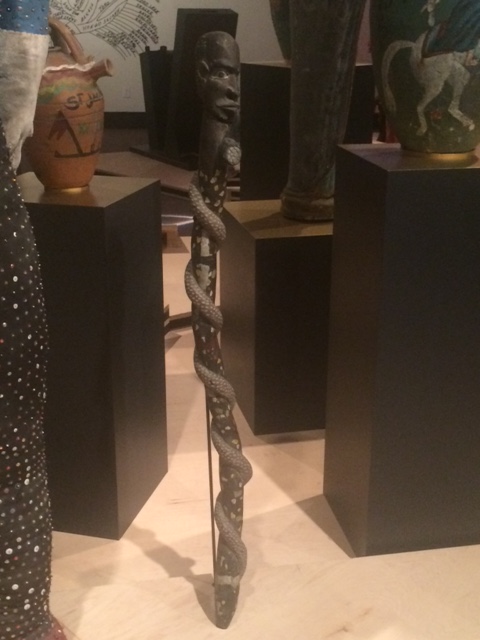
The Arawaks used the coco macaque, a heavy solid strong stick or club, as a tool, but they also used it to bludgeon their victims or enemies in combat. In Haiti, the coco macaque stick was called “the Haitian Peace Keeper.” In Cuba, where Laurel Aitken was born, it was called “the Cuban Death Club.” And in New Orleans, the coco macaque stick is called “the Zombie Staff” or “Spirit Stick.”

cocomacaque2

The coco macaque stick was used in Cuba and Haiti as a weapon and became a part of the cultural vernacular after it was used by the dictatorial regimes in Cuba and Haiti against political activists. During the regime of Papa Doc in Haiti, the coco macaque stick became a symbol associated with the “guaperia,” or his military. According to one article, the “Cocomacaco was the main weapon of the notorious tonton macutes, his the personal body guards.”

The Daily Gleaner on March 1, 1915 wrote of  a coco macaque stick when reporting on a corrupt Haitian dictator who stole money from the country’s coffers. It stated, “He could only find a few thousand pounds to seize, though he sent an army to make the levy: an army strongly armed with superdread-nought cocomacaque sticks.”

Aitken is likely informed by many of these interpretations of the coco macaque stick, but perhaps none as much as the one in his own country which saw the coco macaque stick as a weapon associated with slavery. On the Cuban sugar plantations, slave owners beat their slaves with a coco macaque stick. The weapon later became a “tool of correction” used by men on women, and there was a Cuban proverb that said that wives should be “corrected with cocomacaco hard,” which may also shed light on why, when Laurel Aitken was once asked about this lyric, he hinted at a sexual connotation, as was common in the calypso, mento, and subsequent musical traditions–just think of Jackie Opel’s “Push Wood” for an example with a similar object–wood–but there are dozens if not hundreds of others with different objects–shepherd rods, needles, etc.

The coco macaque stick also had a life all its own. The Taino Indians and Haitians who practiced Voodou believed that the coco macaque stick walked by itself. The owner could send the coco macaque stick to run errands or dirty work, and if the coco macaque stick hit someone on the head, they would then be dead by morning.

cocomacaque3

Here is some information I found in an article on voodoo: “Coco macaque is what many refer to as a very real magical Haitian vodou implement or black magicians helping tool. Made of Haitian Coco-macaque palm wood or what ever wood one has at hand it is basically just simple thick 1 to 2 inch wooden cane, which is supposed to be possessing one of many magical powers, The strangest one is that to be able to stand up and walk on its own. Though it’s appearance of walking is described more like a hopping or bouncing action. This Voodoo Magic walking stick is not bound by gravity and is said to bounce off of houses and homes and even roofs as it travels to it’s commanded destination. Sometimes many people might refer to them as Voodoo Zombie Canes and swear that by all known accounts and means that they or it is possessed by the spirits of the dead. By all old Haitian accounts many will tell you that it is a simple design or sometimes crudely hand carved by a voodoo black magic priest using what ever found wood is available to them at the time. And it is a cursed or controlled by specific spirit that causes the walking stick to appear to move all by itself.”

Here are the lyrics to that classic Laurel Aitken tune, Sally Brown:

She boogey, she boogey, she boogey down the alley
Let me tell you about Sally Brown
Sally Brown is a girl in town
She don’t mess around
Let me tell you about Sally Brown
Sally Brown is a slick chick.
She hits you with a cukumaka stick
Cukukukukumaka stick
Hits you with a Cukumaka stick

Have a listen to this classic tune: Sally Brown by Laurel Aitken

Uncategorized

Eric “Monty” Morris Still Dazzles the Crowds

monty3

I had the honor of seeing Eric “Monty” Morris perform in Chicago last weekend on October 25 2014 as as he performed one of his many hits, “Sammy Dead,” I got chills realizing I was witnessing history come alive. Here was the same song that Morris sang 50 years ago, backed by Byron Lee & the Dragonaires, at the World’s Fair in New York! I couldn’t believe I was hearing it, seeing it, in the flesh, right in front of my eyes! Eric “Monty” Morris is the ultimate performer, giving the crowd all of his hits, dancing like a man half his age, and perhaps even imbibing in a bit of rum off stage, I espied! I thought I would devote today’s Foundation Ska blog post to the legendary Eric “Monty” Morris so we can further appreciate this pioneering vocalist.

Morris was vocal about the World’s Fair and Prince Buster, as I noted in my blog this past January: statement on ska impasse. Morris and Prince Buster must have mended fences, however, because Morris went on to record again for Prince Buster, as he had since 1961. Here is a photo of Eric “Monty” Morris from that article:

eric-monty-morris

And here are a few more photos I took of Morris really cutting a rug!

Below are two excellent articles on Eric “Monty” Morris.

From the Jamaica Gleaner, September 12, 1998:
There was one name which stood out when it came to Ska and that name was Eric ‘Monty’ Morris. Like so many of this compatriots however, Monty left Jamaica’s shores at the height of his career to seek greater fortune overseas. But Monty soon dropped out of sight and much to the consternation of his host of fans, the man who had dubbed ‘Mr. Ska,’ was nowhere to be found when the music he had helped to popularise internationally, started its great resurgence. With the revival of Heineken Startime in 1996, the demand for Monty Morris reached heightened proportions and promoters/producers MKB were besieged with requests to bring home the man who had monster hits like Humpty Dumpty, Sammy Dead, Say What You’re Saving, Money Can’t Buy Life, A Little More Oil In My Lamp, Penny Reel, Solomon Gundy, Muma No Fret and Pack Up Your Troubles. MKB exhausted their farflung list of contracts but carne up with few leads. In fact, at one time there were rumours that Monty had gone to the Great Beyond, but the search continued until just three weeks ago when a call from a Miami source came up trumps – Monty Morris had been located.

A frantic call to California confirmed that Monty was alive and well and was more than ready to end his 25-year absence from the local stage. . . . The uninitiated might ask who is this Monty Morris. Monty, like so many of Jamaica’s musical greats grew up ‘downtown’. He recalls the many hours be spent harmonising with his boyhood friend Derrick Morgan, so it was no surprise that Monty, following successful appearances on the famous Vere Johns talent shows, was backed by Derrick on his very first record, This Great Generation, done for Hilite Records.
He later recorded for Prince Buster, a link which resulted in some of his biggest ska hits. Monty’s talent also extended into the reggae idiom and his recordings included his own original Say What You’re Saying which was not only a personal hit, but was later recorded by Dennis Brown whose version also made it big both locally and internationally and Little John in the mid 80s.
Monty was also in great demand as a stage performer and no list of artistes for the many stage shows which were a feature of the day, would be complete without the dynamic ‘Mr. Ska’. His recordings have continued to thrill lovers of Jamaican music over the years.

From the Sunday Gleaner, May 19, 2013, historian and journalist Roy Black writes the following:
Eric “Monty” Morris seems to be the forgotten ska superstar. This perhaps has a lot to do with his disappearance from the Jamaican music scene somewhat early, as he migrated to the United States. In a relatively short period, between 1961-1969, Morris majestically crafted several outstanding hit recordings in the ska and rocksteady mould. Oil in My Lamp, Humpty Dumpty, Money Can’t Buy Life and Sammy Dead were early pieces that set the stage for what was to follow. Drawing on lyrics mainly taken from traditional nursery rhymes and employing a slowed-down ska beat, Morris’ advent was truly significant. He was the first real ska superstar, pre-ceding others like Delroy Wilson, Stranger (now Strangejah) Cole, Lord Creator and Jackie Opel.

Morris arrived on the scene at 15 years old in 1959, singing with Derrick Morgan on the Little Wonder Smith produced recordings Now We Know and Nights are Lonely. In an interview with Derrick Morgan, he told me “I used to live in a big yard named Orange Lane, off Orange Street. Monty lived there too. We became childhood playmates and began singing and knocking old cans and cars until one day when I went to record what would become my first release – Oh My Love is Gone – I took Monty with me. We recorded those two songs”.
Monty Morris was born in Kingston on July 20, 1944, and grew up at Orange Street and in Trench Town, attending Alvernia Primary School. His meeting and close association with Morgan, four years his senior, was extremely crucial to his future career. When their focus shifted to music seriously, entering a talent competition occurred to them. This led them to the very popular Vere Johns Opportunity Hour talent competition, at the Palace, Ambassador and Majestic theatres in Kingston during the late 1950s.

Morris didn’t win, but the exposure provided the springboard from which he launched his career and precipitated his first set of hit recordings. His next move, to producer Prince Buster, was another important step. Again taken there by Morgan, who was fulfilling a request by Buster for help in setting up his business, Morris seized the opportunity to record the 1961 nursery rhyme based song, Humpty Dumpty. Backed by the Drumbago All Stars, the slowed-down, ska-tempo song rode the higher echelons of the Jamaican charts for that year and set in motion a ska craze that took deep root in Jamaica’s music history. His follow-up, Money Can’t Buy Life, with emphasis on the off-beat, was equally impressive and somewhat changed the whole nature of Jamaican music up to this point.

Morris, an unsung hero of immense musical talent, wrote almost all the songs he recorded, adding his words to the nursery rhymes where required. Every song seemed to have a message, backed by a traditional nursery rhyme, but he somehow lacked the determination and dedication necessary to make it to the top in a competitive music arena. Morris became the first forgotten ska superstar. His songs show a man in various moods. There is Monty the storyteller, expressed in Sammy Dead, Humpty Dumpty and Solomon a Gundy. There is Monty the lover, with songs like the Clancy Eccles produced Say What You’re Saying and Tears in Your Eyes, in which he declares:
It was the tears in your eyes
That made me realise
That a man like me should never
be in love with you

There is Monty the preacher, who warned about “ungodly people” in the recording of that same name, and reinforced it with a Duke Reid produced track:
What a man doeth this day
Stands in his way
What you sew, that’s what you will reap
What you reap, that’s what you will eat

Morris also warned men against falling prey to the guiles of women. On the recording Temptation Monty claimed:
It’s a thing I don’t like
It’s a thing that always stirs strife
Nature provided everything
For man to live like a king
Don’t tempt me to do the things I
don’t want to do

Strongman Sampson was perhaps one of his best-known recordings during the ska era. In it, he depicted Sampson as being:
The strongest man in the days of olden
Until a woman take it from him.
Solomon was wise, (he claimed),
he had seven wives.
Be careful of her lies
She will also paint her eyes
Just to get you in misery

Morris had several other popular ska recordings during that era, which included Pack Up Your Troubles, In and out the Window, Eena Balena, For Your Love and Into This Beautiful Garden. In 1964 Morris was included in a contingent of singers, musicians and dancers sent to the New York World’s Fair to help promote and expose the new dance craze and music, ska, to the American public. The tour was built around Morris and his two big hits with Byron Lee and the Dragonaires, Sammy Dead and Oil in my Lamp. Morris’ contribution was enormous, as he spread ska’s popularity while establishing the foundation for the succeeding genres to build on.

As the 1960s wore on he recorded for a number of other producers, including Leslie Kong, Byron Lee, Duke Reid (who did the bulk of his works), and Lee ‘Scratch’ Perry in 1969. A year earlier, Morris had adjusted his arrangements to suit the new rocksteady beat to record a popular and frequently covered song in Jamaica’s music history, Say What You’re Saying.

However, Morris didn’t survive the transition to rocksteady and reggae, as he migrated in the early 1970s to the USA, returning occasionally in later years to perform on oldies shows in Jamaica. One of these performances was at the Mas Camp Village, then on Oxford Road, New Kingston, on Saturday, June 11, 2005. He also performed at that venue on Saturday, April 24, 2004.

Eric Morris, the man who entertained thoughts of creating something different from the regular fast ska beat, the man who thought he could use simple nursery rhyme lyrics to disseminate his messages but was somewhat disinterested in reaching the highest level, is still alive and lives abroad. He may be the forgotten ska superstar, but with his string of enduring hits, hopefully someday this anomaly will be addressed and Monty Morris will receive the true recognition he deserves.

Uncategorized

Paying Homage to John Holt

JohnHolt1620050718

It is with sadness that Foundation Ska pays homage to John Holt today as he passed away on October 19th. Today’s post is by no means an exhaustive look at the life and career of this legendary vocalist, as that would prove almost impossible since he was a prolific performer, but instead it is a snapshot of a few articles from the archives.

Let us first start with Roy Black, contributor to the Jamaica Gleaner, who wrote the following this week:
Jamaica has lost another stalwart in the field of popular music with the passing of John Holt in England last Sunday, October 19. His passing has left an irreplaceable void in the Jamaican recording industry. Going the full gamut, from rocksteady to reggae and dancehall, Holt proved to be one of the most enduring singers in Jamaican music, packing a voice that has lasted for 51 years.

Taking a different route to success than most of his contemporaries, who began in groups before going solo, Holt did quite the opposite when he recorded for producer Leslie Kong, his debut solo recording, Forever I’ll Stay, on the Beverley’s record label in 1963. Like many others before him, Holt’s earliest exposure came by way of The Vere Johns Opportunity Hour Talent Show, where he won an award in 1962. The win led to an association with record producer Leslie Kong, resulting in his debut recording. Concurrently, Holt recorded for producer, Vincent ‘Randy’ Chin, a cut titled Rum Bumbers.

His next move was perhaps the most important one of his career: That of linking with the Paragons vocal group, which was already in existence. The group actually began with Bob Andy and Tyrone Evans at the back of the Kingston Parish Church, sometime in 1962, before they added a third member, Howard Barrett. In an interview I had with Holt, he explained: “I was on King Street one day with my friend Lloydie Custard, and he told me there were some guys up by the Parish Church doing some singing. So we took a walk there, and that’s where I really got in touch with The Paragons”.

With Holt assuming the role of lead vocalist, the quartet of Andy, Evans, Barrett and Holt, first recorded as The Paragons, for late Studio One owner Clement ‘Sir Coxsone’ Dodd, debuting with I Was Lonely (Love at Last) and Play Girl in 1963-64. The group soon came to their differences and Andy left, reducing them to a trio. A temporary hiatus followed as the group searched to recapture their ‘quartet sound’.

However, the break seemed to have re-inspired and rejuvenated them, and they re-emerged at Duke Reid’s Treasure Isle Studios in 1966, with crisper notes and tighter harmonies, and Holt gradually emerging as the star, with his mellifluous tenor.
Although he had not yet gone solo, many musicologists consider this the brightest period of his career, as he crafted some never-to-be-forgotten gems, beginning with Happy-Go-Lucky Girl, a recording that chided carefree women with the words: “Everyone in town knows about you, happy-go-lucky girl, the life you live isn’t too good, happy-to-lucky girl”

On The Beach, which followed, triggered the ‘hops’ fad, and generated beer sales all over the island. Wear You to the Ball was used to good effect by deejay U-Roy to lay the foundation on which many present-day rappers built. The Tide Is High gained worldwide recognition after a 1980 number one cover by the group Blondie, while Only a Smile, was a big favourite among Jamaicans. All number-one hits, they owed a lot to Holt’s lead vocals. The group tasted further success while working with other producers, including a return to Dodd’s Studio One with several top-class reggae hits.

The departure of Evans and Barrett via the migration route left Holt in limbo, and it is believed that this played a part in his decision to go solo. He was headed in that direction by early 1967 with his solo efforts, Stick By Me, Strange Things and My Heart is Gone, before making his third entry at Studio One with the very successful album Love I can Feel, which contained the hits Fancy Makeup, Do You Love Me, Stranger in Love and the title cut.

Now a solo artiste in his own right, Holt, by the turn of the decade, was one of the biggest reggae stars, making appreciable inroads on overseas charts while continuing to make hits during the 1970s and 1980s. Up to this point, Holt’s voice seemed unscathed by the passage of time. Earlier in 1968, he returned to Treasure Isle Studios with some of his best reggae cuts, which included, Ali Baba, Tonight, I’m Your Man, and the romantically charged ‘I’ll Be Lonely, in duet with Joya Landis.

By the mid-1970s, Holt was in the United Kingdom working with overseas producers who introduced string arrangements to his recordings. Help me make it through the Night, from the cover collection 1000 Volts of Holt, gave him his first UK hit. Returning home, he continued his hit run with Up Park Camp and others while proving his versatility and contemporariness with the dancehall song Fat She Fat. In 1982, he had chart success with If I were a Carpenter and Police Inna Helicopter. Although showing signs of ill health in recent years, Holt continued to compose, record and perform up to the time of his death.

The next interesting bit of John Holt history comes from a Daily Gleaner article, November 21, 1974 with the headline, “John Holt Entrances Cabaret Audiences.” The article reviews his performance at the Top-O-The-Sheraton in Kingston, and the author provides a brief history as well as an interesting projection from Holt on the future of reggae worldwide. The article states:
John started his singing career in the traditional way that so many other Jamaican singers started with the Vere Johns’ Opportunity Show in 1962. Since that John has not looked back but has made hit after hit. Who can forget such memorable songs as On the Beach, Happy Go Lucky Girl, Wear You To The Ball, one that U Roy later did over and many more rockers that placed John Holt in the Hall of Fame of Jamaican Music. . . . John sees Reggae as constantly improving and feels that it will be breaking big internationally any day now. He says Reggae is firmly rooted in England and that the English people as well as Jamaicans are big purchasers of Reggae records. This he feels makes England more encouraging to artistes singing Reggae because there is more, to gain there financially than in Jamaica. To improve the local situation, John suggests that our Radio Stations play more Reggae so that money sent abroad to pay performing rights for foreign artistes could be paid instead to our own local artistes. This, he feels, would allow for a better standard of living for local performers and above all there would be more recognition by foreign stations for our music, especially in the U.S.A. John Holt feels that Bob Marley and the Wailers, Ken Boothe, and Nicky Thomas are making the biggest contribution to our music for they have brought Reggae to the attention of people throughout Europe and the United States and have been constantly bringing about improvement to our music by setting a very high standard, forcing other artistes to do likewise.

The Daily Gleaner on Wednesday, January 28, 1998 stated, “The history of Jamaican music is replete with some fascinating stories of how some artistes came, into the limelight. One such story is that of two of the major players of Jamaican music, U Roy and John Holt. The story is told that it was Holt who heard U Roy ‘kicking up a storm’ at the controls of King Tubby’s Hi Fi and told legendary producer, Duke Reid, about the young ‘toaster’ who was packing in the crowds. The rest is history.”

Add your memories and thoughts about John Holt in the comment section below. Let’s continue the dialogue about this iconic artist whose music will never die.

Here are a few of my favorite John Holt/Paragons tunes:

The Tide is High
https://www.youtube.com/watch?v=AR7n2zILQCA

Ali Baba
https://www.youtube.com/watch?v=iGVLX8GDYA4&list=PLKmYvrDo1_da7SIP3O6vyJVlxazt5NlWj

On the Beach
https://www.youtube.com/watch?v=nDE_O0ZYwok

Stick By Me
https://www.youtube.com/watch?v=dMVmPqmrCzY

Uncategorized

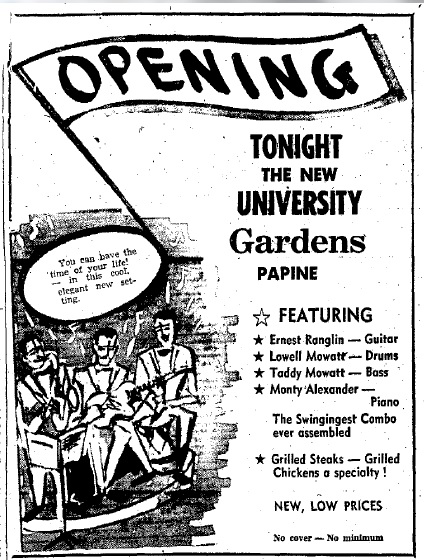
Monty Alexander

monty-alexander-ad-8-19-1961

Monty Alexander’s recent album, Concierto de Aranjuez, was recently named a finalist for a 2014 Soul Train Award for Best Traditional Jazz Performance along with Kenny Garrett, Audra McDonald, Wynton Marsalis and Gregory Porter. The Jamaica Gleaner ran an article in Wednesday’s paper on this honor and stated, “It is the first Soul Train nod for 70-year-old Alexander, who has worked with greats such as Frank Sinatra and Count Basie. In recent times, he has worked with contemporary reggae artistes such as Chronixx. . . . The Soul Train Music Awards have been held annually since 1987. It takes place November 7 at the Orleans Arena in Las Vegas, Nevada and airs November 30 on Centric and BET.”

Monty Alexander was born in Kingston in 1944 and he was privileged enough to begin taking piano lessons at age six. He and his family left for America at the end of 1961, but not before he had already set foot on stage in Jamaica. Two years later he would be performing with the greats in the U.S., including Frank Sinatra, Duke Ellington, Miles Davis, and Count Basie as he was hired to perform as a pianist at Jilly’s in New York City.

I went back through the Gleaner archives and found the first mention of Alexander’s performance in the Sunday Gleaner, December 10, 1961 which was a review from a jazz “jam session” upstairs at the Regal Theater, presented by the Skyline Club on the previous Monday. “There were some more top drawer moments. These came when the personnel was augmented with Carlos Malcolm, trombone; Monty Alexander, piano; Jackie Willacy, trumpet; Sonny Bradshaw trumpet; Jasper Adams, alto; Ansel Johnson, bass; Lennie Hibbert, drums; and Karl McLeod, drums. They ran through four numbers which included “Moanin,” “Walking,” and two originals by Malcolm. It was an exhilarating set that offered spirited solos by Alexander, a young pianist with a lot of up and come, Carlos Malcolm and Jackie Willacy.”

To learn a bit more about Monty Alexander, why not hear it from the man himself as fellow skamrade and author Charles Benoit interview him for the blog Reggae Steady Ska a few months ago: reggae-steady-ska.com/monty-alexander-interview/ and have a listen to some of Monty Alexander’s music as well and watch him play in this fine jazz clip: Monty Alexander. This is a favorite of mine: Monty Alexander Africa Unite and here he is with Ernest Ranglin performing the classic Abyssinians song, Satta Massagana: Monty and Ernest–Satta Massagana.

Uncategorized

First Lady of Song–Hortense Ellis

he

If ever there was a talent worthy of recognition that hasn’t had an ounce of it, it’s Hortense Ellis. This is why I feature Hortense Ellis on the cover and devote a lengthy chapter to her in my book Songbirds: Pioneering Women in Jamaican Music which has just been released and is available at skabook.com. I hope you will check it out, as there are dozens of women featured prominently in this book, which was a labor of love for the past two years.

But on to Hortense Ellis. The following are excerpts from this chapter in my book–a chapter I call, “The First Lady of Song.”

“I’m the very first female singer in Jamaica. I’ve been through the R&B, rocksteady, and ska eras. When I began my singing career, there was no Marcia, no Rita, no Judith, there were only singers like Totlyn Jackson and Sheila Rickards, and they were jazz and cabaret singers. I was the first, whose voice was heard on the radio all over the island,” said Hortense Ellis to Jamaica Gleaner reporter Claude Mills in 1997 just three years before her death. She was born on April 18, 1941 in Trench Town. Owen “Blakka” Ellis, Jamaican comedian and Hortense’s nephew remembers, “I lived on first street with my mother’s family but I’d visit my dad who lived on third street.” His dad was Leslie Ellis, Hortense’s brother. There were also Alton Ellis, the successful vocalist; Irving; Mertlyn; Lilieth, who went by the nickname Cherry; Veronica; and Hortense, who went by the nickname Tiny. Their father, Percival, was a railroad worker, and mother, Beatrice, ran a fruit stall. “It was a musical family, but more of a musical community than household,” says Blakka. “Trench Town was designed with very small houses so everything spilled out into the yard and onto the streets. And Hortense was not so much a singer in those times but was more a comedian. She would be going wonderful spectacles imitating people, doing a belly dance, more a humorist than a singer in the early days. Yes.”

When Hortense turned 18, she decided to try her hand at showbiz, not as a comedian, although there would have been room for that in Jamaica’s pantomime and variety show venues, but as the singer we know and love. She got her start through the same means as so many other great musicians and artists, the Vere Johns Opportunity Hour. Blakka says, “She won Vere Johns. It was like a monthly competition and she won one month and Alton won another month, then she won the grand finals over him.” The song that Hortense Ellis wowed the crowds with in 1959, the same crowd that cheered her on the loudest to win her the championship, was “I’m Not Saying No At All,” by Frankie Lymon, and according to writer David Katz, it was Alton Ellis who chose the song for her to sing. She continued to compete at the Vere Johns Opportunity Hour and racked up six semi-finals and four finals. “I used to perform at the Majestic Palace, Ambassador, and Odeon Theatres in the 50s at the Vere Johns Opportunity Hour, but I began singing professionally in 1961,” she said.

Before she recorded a single tune, Hortense had her first child, Christel, in 1960, but she was already singing on the stages of Kingston. “She had me in 1960 and she told me she sang Saturday night and she had me the next morning at five o’clock. She was 19 when she had me,” Christel says. Then in 1961, Hortense Ellis recorded her first three songs for Coxsone Dodd on his Worldisc label—“Eddie My Love” and “Loving Girl” billed as Hortense Ellis and the Blues Blasters, and “All By Ourselves (All By Myself)” billed as Lascelles Perkins and Hortense Ellis. It was her ability that made her desirable. “She had a massive massive range, a very very high pitch and she could come down to a deep baritone,” Blakka says. Christel says, “She was a beautiful singer. Anybody I tell Hortense Ellis was my mother, they say, ‘That girl could sing!’ I remember one time she got an award, the First Lady of Song.” That award, given by the Jamaica Star, came in 1964, but she had been using the moniker on her advertisements a year earlier while performing at the State Theatre with the Mercuries.

You can read more about the life of Hortense Ellis in Songbirds: Pioneering Women in Jamaican Music, including her struggles of balancing a career and being a mother–she gave birth to nine children (eight girls and one boy)! Hortense Ellis died on October 1, 2000 of a lung ailment from years of smoking. Her funeral was held on November 9, 2000 at the Andrew’s Seventh Day Adventist Church on Hope Road in Kingston. Bunny and Scully, Ken Boothe, Stranger Cole and Alton Ellis gave musical tributes at the service and Desmond Young, president of the Jamaica Federation of Musicians, Marcia Griffiths, and Derrick Morgan were in attendance along with dozens of others. Her legacy lives on in her music and in the spirit of Jamaica.

Enjoy my favorite Hortense Ellis song, “Woman of the Ghetto,” a remake of the Marlena Shaw tune by the brilliant Clive Chin.