Uncategorized

Sound Systems at the Jamaica Festival

JA-street-parade

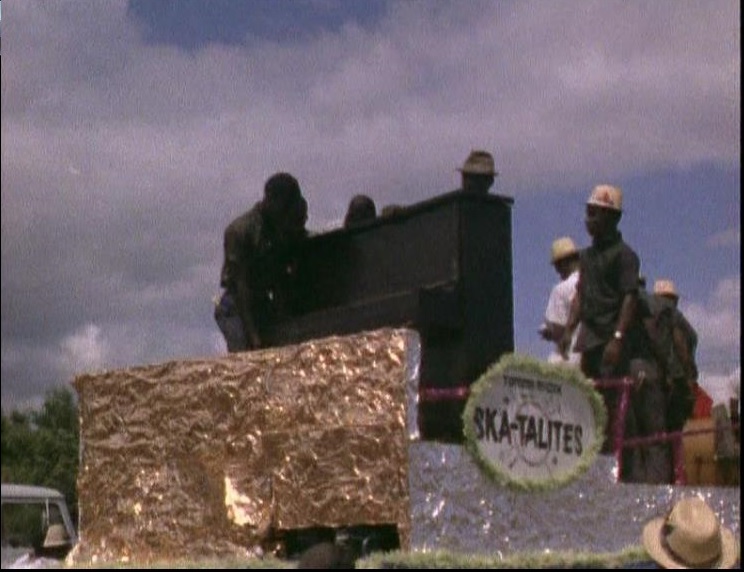
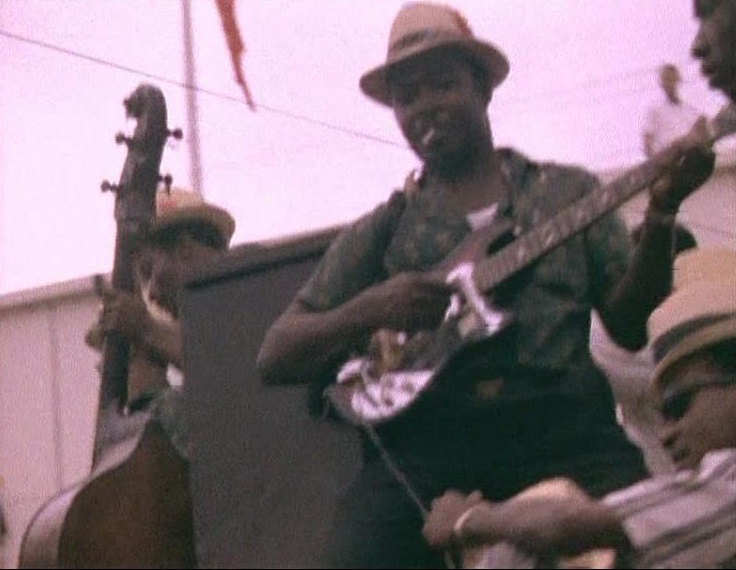
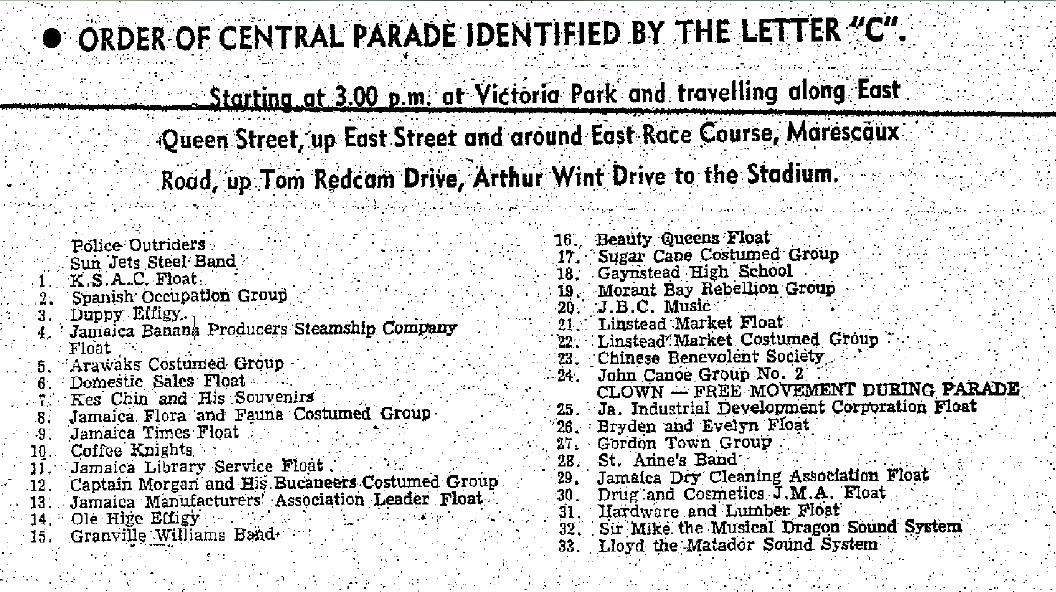
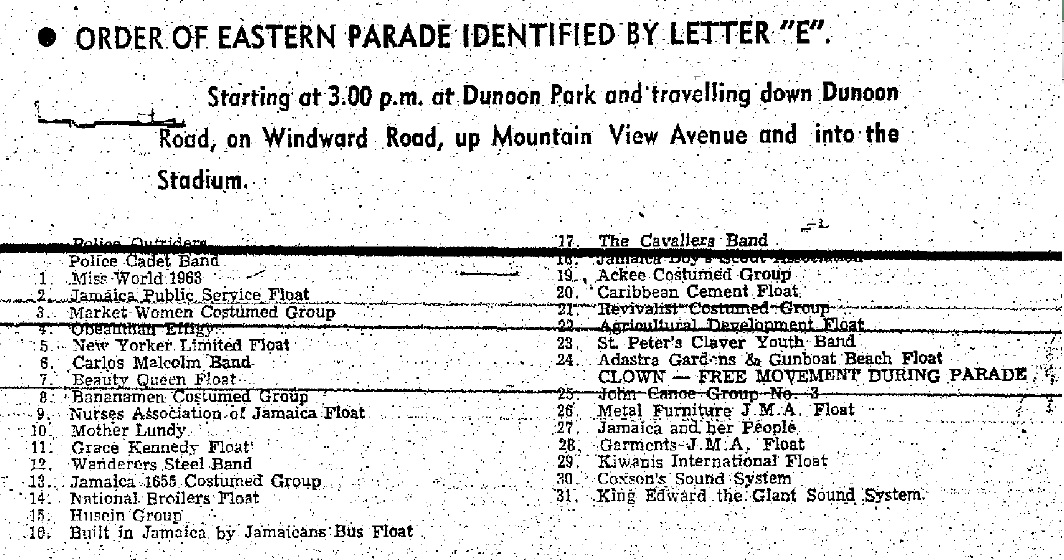
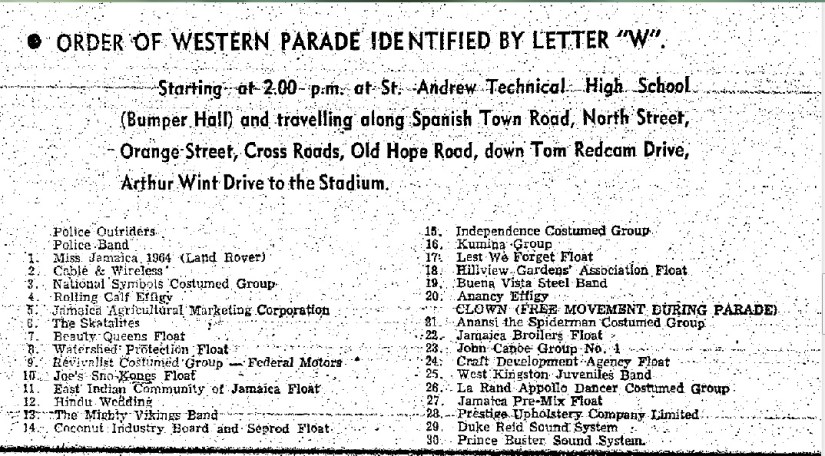
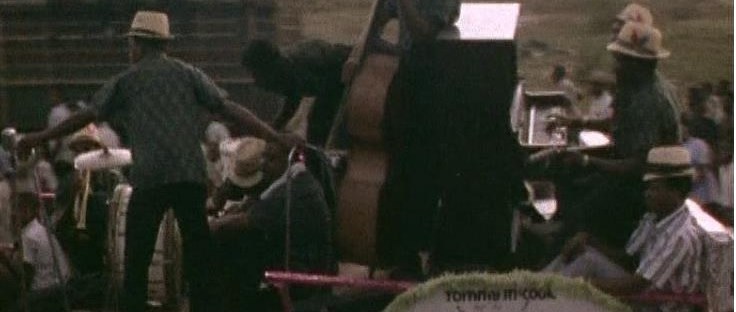
I stumbled across this advertisement from the Daily Gleaner, July 31, 1965 and noticed that a number of sound systems were playing for this celebratory street festival parade, and guests were encouraged to join in the parade at the end. Yes please! Can you even imagine? King Edward “the Giant,” Prince Buster, Lloyd the Matador, and even the Skatalites were in this parade! Geez Louise! If they ever invent a time machine in my lifetime, here’s my first stop! Below are a few stills from that now-famous footage of the Skatalites performing in this parade.

The Festival was founded by Eddie Seaga who pushed hard to promote ska with a deliberate strategy because he saw that ska was connected to the newly independent Jamaica and the nation’s cultural identity, although there are other reasons too. He founded the Jamaica Independence Festival, a showcase of Jamaican arts, which included an all-island ska and mento competition. At the first annual festival, Byron Lee & the Dragonaires performed, of course, and the festival was hosted and funded by the Ministry of Development & Welfare, Seaga’s department. The first festival began in 1962 to celebrate and coincide with the independence. Seaga continued the festival each year after and in 1966 brought the Popular Song Competition into the offerings. Seaga’s meetings of the Parish Festival Committee were broadcast on JBC and RJR so the public was aware of his agenda to promote ska. And he was photographed and appeared in the newspaper as he cut checks to artists like Prince Buster for their help in promoting ska.

In case you don’t have a magnifying glass to see the performers at this Festival, here are the closeups, which I think are immensely interesting:

JA-street-parade3

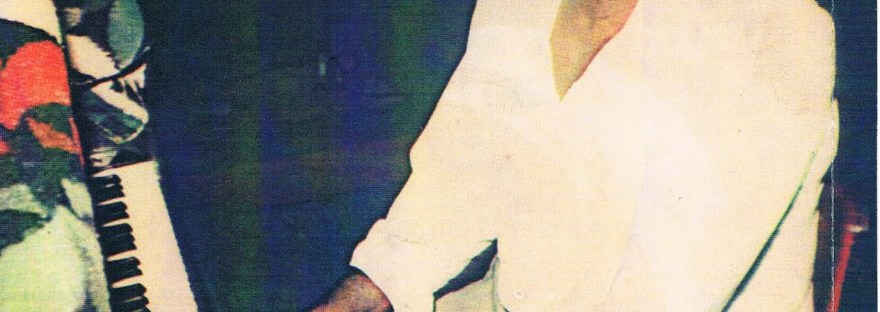
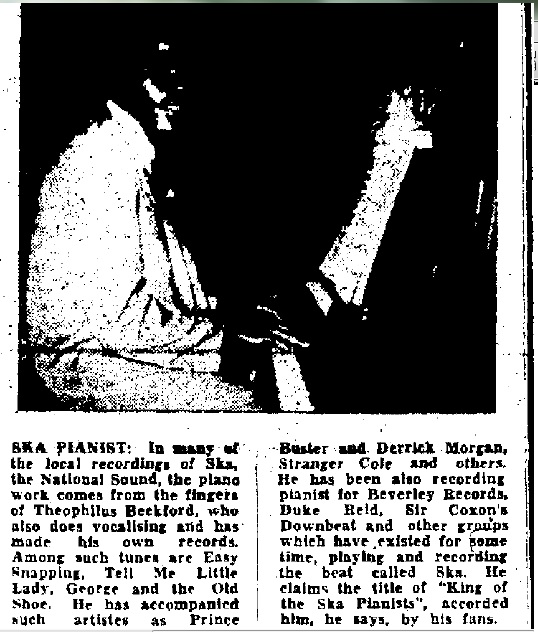
Theophilus Beckford

Easy Snappin’ Theophilus Beckford

theo-photo

I always thought they called him Easy Snappin’, not because his song was arguably the first ska song, but because Theophilus was too hard to say! Kidding of course, but I would like to take some time to look back on Easy Snappin’, or Theo, or Theophilus Beckford, that talented pianist to whom we really owe a debt of gratitude. He helped to launch a genre.

Theophilus Beckford was born in 1939 in Trench Town, the same neighborhood that gave us Bob Marley, Alton Ellis, Hortense Ellis, and even DJ Kool Herc! His father was a skilled pianist but Beckford learned to play piano in school and was also self-taught. He performed in the style of the popular artists of the day—American R&B like Roscoe Gordon and Fats Domino. But he didn’t start recording in this style since the only real recording being done on the island at this point was from Stanley Motta who recorded calypsos. So Beckford recorded for Motta on a number of calypsos and as the recording industry developed when Ken Khouri established Federal Records, Beckford was able to develop the style he loved—American R&B which evolved into ska.

Many will argue that “Easy Snapping” was a boogie shuffle tune, and there is something to be said for that. But Easy Snapping features a more punctuated piano rhythm that is less slippery than the shuffle beat, and it also features brass, so it can easily be argued that it is the first ska song. Some say that it is neither R&B nor ska, it is somewhere in the middle, so it a way it is the Lucy of evolution, the missing link. Whatever your take, it is evident that this song, and this artist, are essential to the creation of ska and the genres that follow.

“Easy Snapping” was recorded for Coxsone at Federal Records in 1956 for Studio One’s first ever recording session. Michael Turner writes in Beat magazine in 2001, “The song was recorded for Coxson Dodd in 1956 at Federal studio, but at the time recordings were pressed onto soft acetate for sound-system use only. Three years later the commercial release of records in Jamaican began . . . ‘Easy Snapping’ was released late in the year and its lazy intonation and emphasis on the offbeat made it a massive hit, and presaged the development of a unique Jamaican sound.”

theo-beckford-nov-20-1960

The song was an immediate hit and stayed on the charts for 18 months. It was also released in the UK on the Blue Beat label. Of course, Beckford received no royalties from this song even though it was used in a European jeans commercial later on. The song on Coxsone’s Melodisc label is credited to Theophilus Beckford, Clue J and His Blues Blasters while the Blue Beat version is credited to Theophilus Beckford, Clue J and His Blues Blasters, Trenton Spence and His Orchestra. The B side of both releases was the tune “Going Home.” He recorded others for Coxsone as well as Simeon Smith who was better known as “Hi-Lite.” He performed piano as a studio musician for hundreds of recordings. According to Mark Lamarr, “As pianist in Cluett Johnson’s Blues Blasters and as a session musician, he played on countless cuts for Prince Buster, King Edwards, Leslie Kong, Duke Reid and Coxsone Dodd.”

theo-5-10-1964

Growing frustrated with receiving no pay from Coxsone and others, Beckford established his own label in 1961, King Pioneer, and he released many of his own tunes—perhaps the first DIY guy! He became producer on his label for artists such as Frank Cosmo, Daniel Johnson, Keith Walker, Lloyd Clarke, Wilfred Brown, the Greenbusters, the Meditators, the Pioneers, Toots & the Maytals, and Eric Monty Morris & Patsy Todd on the duet “Don’t Worry to Cry.” Michael Turner writes, “Approximately 50 songs came out on this label between 1962-66, and most of these were strong works exhibiting the many styles and flavors of ska.”

theo-photo1

In later years, after ska and rocksteady and reggae was considered “oldies music” or “granny music” by Jamaican youth when dancehall took over, Beckford was able to eke out a meager living by performing at gigs anywhere he could find. “Things are rough on my side and I am surviving through the will of God and the love for the music,” said Beckford in a Jamaica Gleaner article in 2000. “Today as I listen to music on radio and sound system and recognise that I created some of these tunes. I feel strongly that I am not given full recognition for my work.” A year later, Theophilus Beckford was dead.

theo-photo2

On February 19, 2001, Beckford went to resolve a dispute with a man in Callaloo Mews. After leaving the residence, the assailant “chopped” Beckford in the back of the head with an axe, according to the Jamaica Gleaner, and he was killed. His son Lloyd stated, “What kind of society is this where a 65-year-old man can be so brutally murdered and to think that it is someone who is well known and has contributed to the development of his country.” Certainly, Beckford has left a legacy. He is to be respected for his contribution to the development of the Jamaican music. The Guinness Book of Who’s Who in Reggae credits Theophilus Beckford with creating “the feel and soul of ska.” Let’s give credit too.

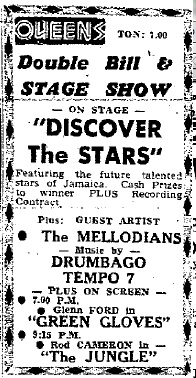
Drumbago

Drumbago

drumbago

Every good musician has a nickname. Well, maybe not every musician, but many of them. And Jamaican culture is certainly known for dishing out some pretty fantastic nicknames, like Bunny and Wingy and Chicken. And I always love Jamaican musician nicknames, like Trommie for the trombonist, Drummie for the drummer, Saxa for saxophonist in the case of the Beat, and other classics—Tan Tan, Ribs, Cannonball, Sparrow, Clue J, Scully, Junior, Stranger, and one I wrote about last week—White Rum. Of course all of the royal monikers like Sir and Duke and Prince and Lord were ways to take back colonial power. Heck, Jamaica itself has a nickname—Jamrock. When I was on the Kingston waterfront one day and saw a huge black bird, I asked my taxi driver what the name of the specie was and he said, “We call them Old Man Joe.” Same thing happened when I saw a fish—“black fish.” Nicknames are so much a part of Jamaican culture, in many cases they take over the birth name.

So it got me thinking, there was a man I always heard of by his nickname and rarely his real name, and I wanted to find out a bit more about him. It’s easy to figure out which instrument he plays, with a name like Drumbago, and it turns out he had quite an important career, helping to shape the ska rhythm.

Drumbago’s real name is Arkland Parkes, although the only two articles that the Daily Gleaner ran on him, when he died, name him as Auckland Parkes. That’s probably not accurate, and perhaps comes from a mix up with Auckland Park, which is a suburb of Johannesburg, South Africa. Either that, or Auckland is just a typo, which is also likely.

Prince Buster asserts that it was he who created the ska style and claims to have asked Drumbago to play a march, a style of song that Prince Buster favored even as a young child, the same march-style of music that was played during carnival and in processions, heavy with drums. Prince Buster says he asked Drumbago to stress the offbeat and asked guitarist Jah Jerry to perform a guitar strum and Dennis Campbell to perform saxophone syncopation to accent the rhythm, thus creating the ska sound. As we know, there are many versions of the birth of ska, but there is no question that Drumbago was there at the beginning. In fact, he performed on what is widely accepted as the first recorded ska song, “Easy Snapping.”

drumbago-jan-14-1967

Drumbago performed drums for a number of musicians in the studios during the early days, including Justin Hinds & the Dominoes, Don Drummond, Jah Jerry, Rico Rodriguez, Deadley Headley Bennett, Baba Brooks, Clancy Eccles, Derrick Morgan, Karl Bryan, Eric Monty Morris, Roy Panton, Roland Alphonso, Stranger Cole, and with the Skatalites. Drumbago even performed with the Gaylettes fronting on vocals—Judy Mowatt, Beryl Lawson, and Merle Clemonson before Mowatt went on to perform with the I-Threes.

drumbago-aug-3-1968

He had his own groups, or whatever producers wanted to call the lineup on the record label, including D Bird and The Drumbago Band, Drumbago and His Harmonizers, Drumbago’s All Stars, Drumbago and Jazz Beat, Drumbago and Prince Buster All Stars, Drumbago and The Blenders, Drumbago and Soul Rhythms, Drumbago and The Dynamites, Drumbago’s Orchestra, Magic Notes and Drumbago, Monarchs and Drumbago All Stars, The Drumbago Ska Band, Raymond Harper with the Drumbago Band, and he also did producing for musicians as well.

drumbago-july-13-1966

The following are the two articles that the Daily Gleaner ran when Drumbago died—one announcing his death and recapping his life, and the other on his burial. Take note of some of the mourners at his funeral which includes many musicians.

Mr. Auckland Parkes, musician, dies

From the Daily Gleaner, January 23, 1969

Mr. Auckland Alvin (Drumbago) Parkes, leader of the Drumbago Orchestra, died on Sunday [January 19, 1969] in the Maxfield Medical Centre Hospital, after a short illness. He was living at 8 Crescent Road, Kingston 13. He was regarded as one of the best drummers in Jamaica and in addition played the flute. Mr. Parkes was also a pioneer in local recording when he began making recorded music back in 1959.

He started his musical career at the age of 15 playing the drums in his brother’s  (Mr. Luther Parkes) orchestra. After leaving his brother’s band he appeared in night clubs and on stages throughout the Island with other top orchestras which included Eric Deans orchestra, Val Bennett and his All-Stars and Frankie Bonitto Combo.

Weekend shows

Sometime in the late 40’s he formed his own orchestra and had regular weekend shows at the then Silver Slipper Club, Cross Roads, where his versatility on the drums earned him the name “Drumbago.”

He then took on a contract at the Baby Grand Club, Cross Roads, and played there on weekends for seven years before leaving and entering the recording field.

He also did a two-year stint in the United States and for a period he was top drummer in orchestras on tourist cruise ships. On his return to Jamaica he continued his performances to many capacity audiences at theatres and night clubs.

After giving up the Baby Grand engagement he continued with the orchestra but concentrated more on records and playing at street dances at all the independence festivals.

Recordings

Some of his earlier recordings were “Second Fiddle,” “Chariot Rock,” “Betrayers Downfall,” “Easy Snapping,” “Humpty Dumpty” sung by Eric Morris; and was featured musician for Prince Buster’s All-Stars.

In the 1962 independence celebrations he was the drummer in Derrick Morgan’s hit tune “Forward March,” and his band figured at the street dances.

He continued making records up to the time of his death and in the latter part of 1968 he recorded tunes such as “Mary Poppins,” “Dulcimina,” and his latest hit which was released a few weeks ago is the current No. 1 tune “Everything- Crash.” He also has a lot of tunes which are complete but not yet released on the recording market.

Survivors are his brothers Luther, and Pastor Arnold Parkes, sister, Olive (Mrs. McCatty), nieces, Mrs. Vera Hanson, Dahlia and Marjorie, adopted daughter, Jennifer, nephews, Ernie, Michael and John, and other relatives. Funeral services for Mr. Parkes will be held on Sunday at Sam Isaacs Funeral Parlour, 44 Hanover Street, at 3 p.m. Interment will be at the May Pen Cemetery.

Mr. Auckland Parkes Buried

from the Daily Gleaner, January 28, 1969

Funeral services for Mr. Auckland (Drumbago) Parkes, leader of the Drumbago Orchestra, who died recently in the Maxfield Medical Centre Hospital after a short illness, were held at Sam Isaacs Funeral Parlour, Hanover Street, on Sunday afternoon. Interment followed in the May Pen Cemetery. The services were conducted by the Rev. S. E. Johnson of the New Testament Church of God, who eulogized Mr. Parkes as a good family man and a person who was loved by all who knew him.

Mr. Parkes, who died at 50, was regarded as one of the best drummers In Jamaica and in addition played the flute. He was also a pioneer in local recording when he began making recorded music back In 1959.

Pallbearers were: Mr. Luther Parkes and Pastor Arnold Parkes (brothers), Mr. Ernest Hanson, Mr. Bill Campbell, Mr. Richard Williams and Mr. Boysie Stewart.

Family mourners were- Mr. John Hanson and C. Hanson (grandnephews). Misses Dahlia Hanson and Majorie Hanson (grandnieces), Olive Parkes (sister). Mr. Albert Parkes, (son) and Master Richard Parkes (grandson).

Among the many other mourners were: Mr. Cleveland Webber, Mr. Stanley Notice, Mr. C. Campbell, Mr. Percival Dillon, Mr. Alvin Wilson, Mr. A. O’Brian, Mr. Claude Gobonrne, Mr. Alphonso Dockett. Miss Shirley Thompson, Miss Monica Paige, Messrs Arthur Lee, Clifton Thompson, Clancy Eccles, C. O Brian, Percy Myers, Val Bennett and Mr. Clifton Bailey. _Mr. Hedley  Walker, Mrs. I. Miller. Mr. Eric Phillips Mr. Mapletoft Poulle, Mr. Alfred O’Brian, Mr. J. Coleman, Mr. P. Cole, Mr. R. Patterson, Mr. J. Thompson, Mr. Cecil Savery Mr. D. Saunders, Mr. V. Anderson, Mr. A. J. Stephenson, Mr. George Tucker, Mr. L. Malabre, Miss P. Anderson, Miss I. Stuart, Mrs. I. Francis, Mr. Ernest McGann and Mr. V. Wallace.

White Rum Raymond

White Rum Raymond: Ska, Rocksteady, Reggae Violin

whiterum1

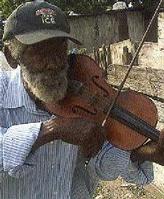
When we think of harmonica, we think of Charley Organaire. When we think of melodica, we think of Augustus Pablo. When we think of violin, we think of “White Rum” Raymond. These are the artists who really were the only ones doing something a little different, a little special, a little spicy with Jamaican music by taking on an instrument that was not a typical piece of brass and they made it their own.


We know plenty about Augustus Pablo and in fact, his record shop, Rockers International Records, is a wonderful store still located on Orange Street that I had the privilege to visit last year. We know plenty about Charley Organaire and in fact he just performed last weekend in Chicago with Susan Cadogan. He lives in Evanston, Illinois. But I always wondered about “White Rum” Raymond. Who was this nicknamed violinist whose stringed melodies peppered The Paragons’ The Tide is High with such catchy skill that even a bombshell like Debbie Harry couldn’t distract us from its absence in her version? I decided to do a little digging.


I found that “White Rum” Raymond’s real name was Raymond Young and he was a member of the Jamaica Military Band in 1959, although I’m not sure for how long he served. He played a variety of Christmas carols on “amplified violin” at a holiday concert at Hope Gardens in December of that year. He also performed “electric violin” at the newly opened Queen of Hearts Club on 28 Oxford Terrace in Kingston in 1964. He performed for the Paragons on The Tide is High which was recorded for Duke Reid in 1967.


But here is a bit more from the man himself from the Jamaica Star, June 9, 2012 in a story by Rasbert Turner:


Raymond ‘Paganilli’ Young is 82 years old, still plays the violin, and says he enjoys it.


“I have played with John Holt and a host of other artistes and bands. I could have done better, but it was not to be,” Young said.


The senior musician was spotted near Rodney’s Arms playing a sweet rendition of Gregory Isaac’s Night Nurse. He then segued into Carpenter, Seven Spanish Angels and a slew of other popular hits.


It was indeed a remarkable feat as the violin was being played with a piece of steel instead of a bow.


“All I really need is a bow for the violin as I am just doing the best that I can as I am still enjoying the music, ” Young said.


He told THE PORTMORE STAR he lived in America from 1950 to 1956 but was sent home as his wife said he was a “girls man.”


The octogenarian, who said he has a daughter, said he sees music as life. “I played with the Merry Knights band and we usually enjoyed the music of the day,” Young said.


Young was born at 29 Regent Street, Kingston. He said he has also played for Martin Luther King and the Mighty Sparrow.


“I was part of the celebration of Jamaica’s Independence in 1962 where I played,” he beamed.


In earlier days, Young said he was among many musicians who would gather at Chancery Lane and discuss music. He said in those days, Prince Buster, Chris Blackwell, and Coxone Dodd were the big men in the business.


“I have an electric violin, so I get work. But although I love the violin, it is still not fully appreciated locally, but it is my instrument,” Young said.


If you have any more information on “White Rum” Raymond, including how he got that fantastic nickname or any memories, as well as any shout-outs for other unique JA instrumentalists, comment below.

Uncategorized

Dissension in the Ska Camp

World-fair1

The premiere of the ska in America was controversial then, as it is now. I recently found an article from 1964 called “Dissension in the Ska Camp” that shows even when musicians were in the thick of it, it was a contested issue of who was included and who was excluded, who created it first and who was following suit. So I today I share this article that appeared in the Sunday Gleaner, April 26, 1964 that shows these topics were just as relevant and talked about then as they are now, even more so. The article has no byline so it is not evident who wrote the piece, but Ronnie Nasralla and Prince Buster chime in with their opinions.

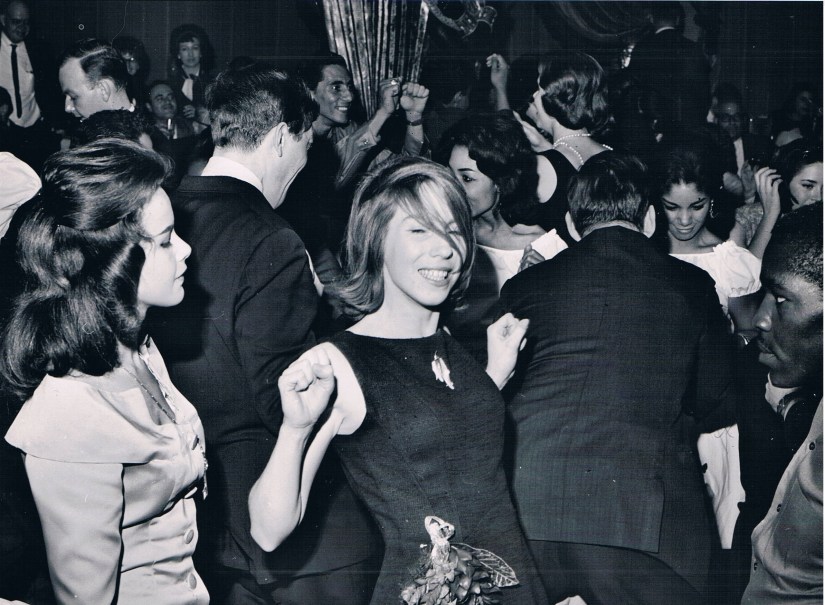
First, let’s set the scene. Referenced in this article is the event at Shepheard’s Club, seen above in the photo. This nightclub was located in the Drake Hotel on Park Avenue in Manhattan. It was a hotspot. It was hip and posh and cool. Big stars stayed at the Drake, including Frank Sinatra and Muhammad Ali and later Led Zeppelin and Slade. But Shepheard’s was also swanky and the hot dances of the day, like the Frug, were not only danced here, but unveiled here. So too was the Ska. Shepheard’s even produced a flyer called, “How to Do the Newest Discotheque Dances at Shepheard’s in New York’s Drake Hotel” with step-by-step instructions to dance the Jerk, Watusi, Frug and the Monkey.

The event at Shepheard’s Club was prior to the World’s Fair. This event was held in April, whereas the World’s Fair wasn’t until August of 1964. However, Jamaica’s tourism efforts began before the World’s Fair in anticipation of creating a buzz and capitalizing on the dance craze trend. You may remember the photo I posted with Arthur Murray’s wife and Ronnie Nasralla from this evening at the Shepheard’s Club, and above is another rare gem.

Without further ado, the article:

National sound hits New York but now the argument flares as to what it is and who started it!

DISSENSION IN THE SKA CAMP

LIKE a raging fire, the promotional tour of the Jamaican National Sound, the Ska, has started a smoldering in the underbrush of the Kingston music world from which this distinctive brand of music was born.

Everyone wants to prove who is the true exponent of the Ska and who originated it? What is the authentic style of the Ska dancing? Successful though the promotional tour to the U.S. was, enthusiastic though the reports which came back treat the appearance of a Jamaican troupe of dancers and artistes at the Shepheard’s Club, there is dissension in the camp.

Some artistes who made the trip say their sound was not promoted as much as certain other sounds. Some of the artistes say that some of the other artistes didn’t have a clue about Ska dancing and in fact did the Monkey, the Wobble, the Twist . . . anything but true Ska.

Reports from the other side say that the moves done at Shepheard’s were moves decided on and rehearsed for several nights, together, before the team left the island.

To the accusation that other records were promoted over others, we discover from Mr. Winston Stona of the Jamaican Tourist Board, a co-sponsor of the promotional venture that:

The junket to the Shepheard’s Ska dancing, backed up over recorded music. Shepheard’s is one of a current crop of New York Clubs called discotheques. In this night spot feature entertainment comes from records played on a large turntable, from an amplification booth much like the Jamaican sound system of the dance halls.

According to the Tourist Board spokesman, the promotional venture for the Ska, as suggested by Henri Paul Marshall and Roland Rennie, the music promotion experts who came to the island last month on the invitation of the Ministry of Development and Welfare, was that Ska records and not personal performances by the artistes, would be projected.

The records which were taken to Shepheard’s therefore, were a selection made on the suggestion of the experts who, on their visit to the island, listened to the work of various Ska exponents. The records chosen for promotion were the ones which the experts deemed most likely to catch on with the American public.

These records included the works of Prince Buster, Derryck Morgan, Eric Morris, and others known to the local Ska followers.

Why should there be dissension? Among the tunes featured at Shepheard’s was “Sammy Dead,” the old Jamaican folk tune restyled as Ska by Byron Lee and the Dragonaires, featuring the voice of Eric Morris. Certain members of the troupe to Shepheard’s say “Sammy Dead” was promoted over other tunes.

According to Mr. Stona, “Sammy Dead” was actually played twice at the beginning and at the end of the programme of Ska records which he presented to the Shepheard’s audience.

It was also revealed that “Sammy Dead” which is to be released on a Capitol label in the States was specifically promoted on the request of Capitol records.

Prince Buster and the other early devotees of the Ska say this should not be so. And they throw in the argument that in their opinion “Sammy Dead” is not a true Ska tune and why should it be played even one more time than any of the others, which are reorganized as real Ska by the real Ska fans?

Prince Buster, who took the Ska to England where it is known now as the Blue Beat, was very expressive about this. He says he is one of the originators of the Ska and sees no reason why he and others, who worked together on the National Sound, should not have got as big billing.

But who really originated the Ska? As Buster tells it, it was back in 1958 that he, Derryck Morgan, Eric Morris and others used to meet on top of an old house situated on Charles Street near Orange Street. The meetings were inspired because “as boys together, we were looking at making a brand.”

He points out that a number of Jamaican musicians had tried adopting American shuffle sounds to their own style, but it didn’t really work. There was need for “our own sound.” So those meetings on top of the house was to find out just how to make things work, how to find a Jamaican sound which the fans would go for.

Down on the ground you might say the big sound system operators Duke Reid and Coxson were evolving their own sound. It was an adaptation of certain American shuffle tunes re-recorded for the sound system dance audiences. It is said that when the experimenters offered Duke Reid and Coxson the new Jamaican sound they would have nothing to do with it.

According to Buster, the new sound when it was evolved was referred to with great disdain by other musicians and by the public as the Boop-Boop. He even earned the name Boop. And when he and Derryck Morgan, for a promotional stunt, launched Boop-Boop songs deriding each other the public really went for their skins.

But out West, the thump of the Boop, later is to be called Sca, then Ska, was catching on. Musicians who had “boxed around” in various musical combos began to be reorganized as “Ska beaters.” Out west and on the east, they could tell you and still tell you about Drumbago who played the drums and Ja Jerry, Theophilus Beckford, and Raymond Harper, Rupert “Blues” Miller, and Stanley Notice.

These according to the fans and on Orange Street and (unreadable) where sound boxes thump through the Saturday night of every week were the original ska men.

As the craze progressed, getting popularity most of all on JBC’s Teenage Dance Party, other musicians joined the parade, cut dies, met for sessions, helped the sound to grow.

The fans began to acclaim Baba Brooks, Roland Alphonso, Lloyd Brevet, Lloyd Tate, Don Drummond, Lester Sterling, Johnny Moore, Lloyd Knibb and the men whose full names nobody remembers but rather a name like Jackie, Charlie, and Campbell. Later they were joined by the acclaimed pure jazz, tenor man, Tommy McCook.

The Ska caught on, spread and grew, most of all in the Saturday night sound system headquarters such as Forrester’s Hall, Jubilee Tile Gardens, Carnival and Gold Coast on Sundays.

Sound system operators worked feverishly to get the latest biscuits on disc. Early on release, they bore no labels, but the dance hall spies got the names eventually and the sound system which didn’t have the new biscuit last week, acquired it this week, to draw the fans.

It is interesting to find a parallel in the discotheques which began in Paris and spread to London and New York.

In the process of finding who should get credit for what, it is eye opening to hear Prince Buster saying that Louise Bennett played her part in the promotion of this peculiarly Jamaican sound and dance. He says that Louise’s life work of keeping alive the folk songs and rhythms of Jamaica is responsible for many of them coming back into popularity, set against the Ska beat.

Many of the musicians and artistes associated with the Ska movement are fairly young men. However, one of the acknowledged originators and Dean of the Sound has been playing music in Kingston for 46 years.

He is Drumbago the drummer who also plays a flute. His real name is Arkland Parks and (unreadable) Mapletoft Poulle and Frankie Bonnitto.

Drumbago, a mild mannered gentleman, says he and Rupert Miller, a bass player for 36 years, were in on the original search to find the sound which came to be called Ska. He explains their best arrangement of the sound as being basically four beats to the bar in eight or twelve measures.

“You get the sound according to how you invert the beats,” says Drumbago.

Another exponent of Ska and its various offshoots feel that the dance called Wash Wash has every claim to being truly Jamaican, for it is inspired by one of the basic Jamaican show dances … the wash day scene. This is a standard with many nightclub rhumba dancers, with many folk lore troupes.

So what constitutes Ska dancing?  According to the fanatics, true Ska motions are the wash wash, the peculiar washing motion of either clothes or the body, the press along, in which the  dancer thumps out the rhythm with his arms at shoulder level, the move (for which we found no

name) of spiraling down to floor level and back up, the one in which you moved the hips and pumped the arms in the opposite direction to the press along.

The fans say that while the extempore movements are allowed dancing the Ska, these are the definite basic movements which one must know to be IN.

Dissenters from the troupe which performed at Shepheard’s say these movements were not used fully or enough and that at one stage they heard a critic saying that what was being done was nothing new, it looked like a first cousin to the Twist. And that the Monkey and the Pony movements which were done were recognized as old hat immediately.

Mr. Stona says this accusation is not true. He found nothing but satisfaction for the presentation at Shepheard’s and is optimistic for the future of Ska promotion in the United States.

We contacted a spokesman for the Byron Lee and the Dragonaires outfit who made “Sammy Dead.”

He told of having heard the feeling expressed by some of the original Ska sound makers that certain orchestras now playing the sound were only cashing in and didn’t know how the sound began.

The Byron Lee spokesman—Mr. Ronnie Nasralla—says:

“For Byron Lee and the Dragonaires it’s not just cashing in. I know Byron feels that it is full time Ska was organized and promoted so that the best can be got out of it for the benefit of the artistes and Jamaica.”

According to Mr. Nasralla:

“Many Ska artistes were not properly protected or organized before Byron Lee has signed up several artistes for recordings and appearances and we’re taking all steps to see that they’re properly presented.”

“I’ve heard that some people say that Byron Lee is just promoting his orchestra. It’s not true. Sure, as a businessman he will look out for his investments, but let us stop quarrelling among ourselves and promote the sound not only for the good of one band but for all Jamaica.”

Whatever comes of it, Ska is going to be a talking point for many more months. Ironically, like most things, it was an art without honour in its own country until it was discovered somewhere else.

Stay tuned for next week’s blog when I will post a response to this article that appeared in the Daily Gleaner the following Sunday. Apparently the comments made by Ronnie Nasralla and Prince Buster struck a chord and a number of musicians responded with their thoughts, including Eric Monty Morris, Roy Panton, Ronnie Nasralla again, Alphanso Castro, Sir Lord Comic, and Roy Willis who respond with comments of their own.
 

Uncategorized

The Voice Winner Tessanne Chin and Ska? Big Time!

carnations

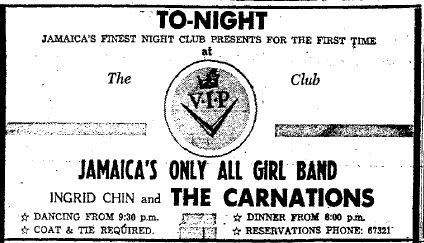
Tessanne Chin’s connection to ska is much more than just her birthplace of Jamaica—it’s her family lineage! Tessanne Chin’s mother (and father) were in world’s first all-girl ska band—The Carnations! I don’t want to disclose all the information that I have uncovered, as The Carnations are featured in my upcoming book Songbirds: Women in Ska. I have interviewed Christine Levy (Tessanne’s mother), Christine’s ex-husband and sole boy in this “all-girl” ska band Richard Chin (Tessanne’s father), Margaret Wong, and Marie Crompton-Nichols and have exclusive photos of this group from family photo albums, but here’s some history that led to the launch of Tessanne Chin’s huge career!


Never heard of The Carnations? That’s because they never recorded and only played live, so perhaps you remember seeing them back in 1966, playing at clubs in Kingston like the VIP Club, the Flamingo Hotel, the Myrtle Bank Hotel, Club Havana, and in Ocho Rios at Club Maracas and the Brown Jug, to name a few. Perhaps you remember when they became The Avengers and added a few men to the lineup and their shows at the Ding-Ho Club (formerly Club Havana) and the Golden Dragon, playing alongside Byron Lee and the Dragonaires. But let’s step back to those early days when Tessanne Chin’s mother, Christine Levy, took up the trumpet and joined her schoolmates to form this interesting group.


Levy was in high school when she began playing the trumpet in the Excelsior High School Band. They performed at school functions, the Manning Cup, an inter-school soccer tournament at Sabina Park, and during independence celebrations throughout Kingston. It was through this school band and through Levy’s knowledge of her instrument that she learned of an opportunity to perform for another new band that was forming—but this one was different than the Excelsior High School Band. In fact, this one was different from any other band that existed. It was an all-girl ska band.


The members of the new all-girl band, The Carnations, included Levy on trumpet and vocals, Ingrid Chin on bass guitar, Jean Levy on steel guitar, Margaret Wong on lead vocals and congo drums, Althea Morais on keyboard, Marie Crompton-Nicholas on guitar, Pam Mosely on guitar, and Richard Chin on drums. Richard was a male in the all-female band and was the brother to Ingrid Chin, the two who put together the entire band. Christine later married Richard. Christine’s mother served as a chaperone for the girls when they played at clubs, but it was Richard who performed alone at times. Why? Because Christine’s mother removed the girls from sets when the exotic dancers performed—dancers like Madame Wasp and Margarita herself. Christine’s mother, Tessanne’s grandmother, found the performances too risqué for teenage girls, although Richard says he didn’t mind them so much!


Richard Chin (Tessanne’s father) had an uncle who helped steer Richard’s career in music. Richard’s uncle was none other than Kes Chin of Kes Chin & the Souvenirs! The ska family tree has many branches and strong roots, my friends! Kes Chin & the Souvenirs was a popular club act, ska with a Latin flavor featuring Chin, Denis Sindrey on guitar, Lowell Morris on drums, Peter Stoddart on keyboard, and Audley Williams on bass and steel guitar. Richard’s father and Kes’s brother, Keyoung Chin, managed The Carnations.


Christine and Richard passed their love of music on to their children, especially Tami and Tessanne, their two youngest daughters. Richard and Christine built a music studio called “The Underground” in their family home and they taught the girls to follow their passion in life. As a result they both have successful musical careers. Tessanne toured with Jimmy Cliff as a backup singer for three years before going solo and opening for Gladys Knight, Patti Labelle, and Peabo Bryson. She has collaborated with Shaggy and on December 17th was crowned the winner of The Voice. Tami, who spells her last name Chynn, has toured with Shaggy as a backup singer and collaborated with Sean Paul, Beenie Man, and Lady Saw. She opened for the New Kids on the Block on their 2008 tour, she has performed on a Pepsi commercial, and she wrote a song that Jennifer Lopez has recorded, “Hypnotico.” She is married to dancehall artist Wayne Marshall and she also designs clothing.


Here comes my shameless plug. My book, Songbirds: Women in Ska, will feature these women along with many other pioneering women who have been gracious enough to share their stories with me—women like Millie Small herself, Yvonne Harrison, Patsy, Janet Enright, Calypso Rose, and numerous others, so stay tuned in 2014 for this book, which is underway. My others, Don Drummond: The Genius and Tragedy of the World’s Greatest Trombonist, Ska: The Rhythm of Liberation, and Ska: An Oral History are available at skabook.com or amazon.com.

Glass Bucket Club

Ska at the Glass Bucket

Glass-Bucket

This is the Glass Bucket Club, a stage that once bore the greats before ska ever existed. This stage helped to shape the musicians who would go on to create the sound that swept Jamaica and the world. Without this stage, it could be argued that Jamaican music would be altered and unrecognizable.

The Glass Bucket Club opened on December 22, 1934 on Half Way Tree Road in Kingston owned by Bob Webster and later Joe Abner. This area of Kingston was a border between uptown and downtown and the club certainly catered to high-class clientele. On opening night, some 700 patrons packed the club to see “the Rhythm Raiders, a new dance orchestra under the direction of’ Dan Williams. These musicians have been carefully chosen. not only to play for dancing, but to accompany the Vaudeville troupe which will be a regular feature of the Glass Bucket dances. Vaudeville acts are to be brought from the United States, each troupe remaining on the island for six weeks beginning January 5th,” read the Daily Gleaner announcing the opening.

Because the club catered to the upper classes and tourists, the entertainment offered was according to established tastes and was frequently dictated by trends in the U.S., such as Vaudeville. But when tastes changed from Vaudeville to the sounds of big band orchestras, the Glass Bucket adapted. It was here, at the Glass Bucket in 1956, that great American jazz singer Sarah Vaughan came to perform in mid July. Don Drummond played trombone as part of Vaughan’s musical backup and Vaughn was so impressed with his playing that she said he likely ranked in the top five trombonists in the world. Other acts included Xavier Cugat and Abby Lane. In the 40s and 50s the people who went the Glass Bucket wore gowns and tuxedos, or suits at least. There were formal shows on Christmas Eve and New Year’s Eve and galas of all sorts.

It was also here that Margarita, who was advertised in Glass Bucket advertisements as “Jamaica’s No. 1 Torrid Rhumba Dancer,” performed her sultry dance. Another advertisement on July 9, 1955 for her performance at the Glass Bucket stated, “Sparkling Native Flooor Show featuring Desir & Rahma in their sensational dance on broken glass, and Marguerita, ‘exotic dancer.'” Margarita’s father, Jad Eid Mahfood, did not approve of her dancing at the Glass Bucket, or anywhere, but she snuck out to do it anyway. When Anita won a competition at the Glass Bucket, her father was there to see it, unbeknownst to her. Her father’s discovery never stopped her though. The Glass Bucket also served as the live broadcast venue of the Teenage Dance Party (TDP) hosted by Sonny Bradshaw which was broadcast on JBC Radio in its early days. Later, Winston Blake played the venue with Merritone Disco, and his moves made him the first King of the TDP.

Byron Lee & the Dragonaires first performed here in 1960. Lee recounted these days for an article in the Daily Gleaner. “When you go to the Glass Bucket you had to have a reputation.  We used to play as an opening act,” for such entertainers as Perez Prado from Cuba and Sammy Davis Junior. Soon they graduated to holding main spots of their own. Lee said the Glass Bucket’s real party days were Fridays, Saturdays, and Sundays, with lunch being served and activities such as rehearsals being conducted during the week. On party nights, when the music was provided by a band before clubs utilized sound systems, the music started at 9 p.m. and by 1 a.m. things were winding down. “By 8 p.m. people started to come in. They expected that you would start at 9 p.m., or they would clap you,” Lee said. Lee remembers that it was also a very peaceful time. “You used to park your car, don’t roll up your windows when you come back everything was inside. Sometimes even the key was in it,” he said. Lee brought ska to the Glass Bucket from what he had seen at Chocomo Lawn, sent there by Edward Seaga to popularize the sound. “Glass Bucket mash up the night. Glass Bucket was for the rich and famous and then for the people. Ska played that role,” said Lee.
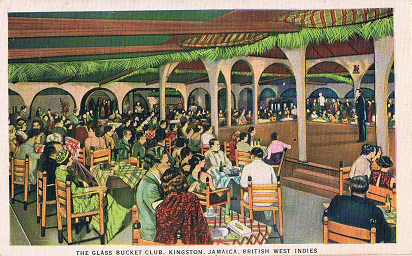
Today, the site of the Glass Bucket, which changed names to VIP during the later 1960s, is a shopping plaza.

Uncategorized

9 Rusden Road

rusden

This is 9 Rusden Road, the house where Don Drummond lived with and murdered Anita Mahfood, Margarita in the Rockfort neighborhood at the foot of the Wareika Hills. I took this photo last February and it was my second time visiting the home which a lovely woman named Carmen still lives in. These are her grandchildren sitting on the front steps, the same steps that Margarita climbed early in the morning on January 2, 1965. Don Drummond had fallen asleep earlier in the night and missed his gig with the Skatalites at the La Parisienne Club in Harbour View, a club near the Palisadoes Airport in east Kingston. He never made it to that performance. It was not the first time he missed a gig. He frequently missed performances or was late for a gig. Tommy McCook has said that he went to pick up Don at 8 p.m., prior to the gig, and found him asleep so he left without him and returned after their first set during intermission to try again. Still, Don was asleep, a side effect of the medicine he took, said McCook.

800×600

I want to take a moment to logically think about an argument that has been made over the years blaming Margarita for giving him his medication late, causing him to fall asleep, and then slipping out to dance against his wishes. How would we know that Margarita did that? She was dead so she couldn’t tell. Could Don have claimed that Margarita gave him his medication late? Not likely as Don was despondent and what talking he did do at the Rockfort Police Station was a lie since he claimed that Margarita stabbed herself and that was proven untrue. It simply defies logic to argue that Margarita administered Don’s medication that night, but it does put the blame on her so it is interesting that those in disbelief over the incident would want to shift the blame.

Margarita’s best friend, Faye Chin, remembers the murder which was easily overheard by the other tenants of the house. That’s right, there were other tenants in this small home. It was split into four rooms with Don and Anita occupying one. It was furnished with two single beds and a desk that contained Don’s compositions on paper. Faye says, “Now this place was like a house and you rent a room and another person rent a room and another person rent a room. So this woman that her room was behind their room, she said she heard when Anita came in and she laid down on her bed, she heard a scream and said, ‘Oh God, Don what are you doing?’ She’s screaming, ‘Don, what are you doing?’ And he stabbed her so badly. There was no blood. The knife stabbed her in the chest. I got a call early in the morning and I phoned Conchita, her sister, I tell her, ‘Okay, I’m coming to pick you up,’ and I drove over to Conchita’s house, pick her up and we went down to identify the body. She had on her jeans (sobbing) and she had on a shirt with a stain in the front at her waist and she was just laying on her bed on her back (sobbing uncontrollably).”

You can read all about the murder from the recollections of many fellow family, friends, and musicians, as well as the trial that ensued in my book Don Drummond: The Genius and Tragedy of the World’s Greatest Trombonist (click the “skabooks” link above for more info). I would love to hear your thoughts on this event that literally changed the course of music in Jamaica forever, for it was after this event that the Skatalites broke up without their master composer and it was after this event that the heat wave that summer ushered in slower rocksteady and subsequent reggae. How important do you think Don Drummond was to ska?

Uncategorized

Spies, Gun Slingers, and Gumshoes. American Film in Jamaican Ska.

guns-of-navarone

Here is an advertisement for Guns of Navarone from the Daily Gleaner, January 19, 1963. Certainly it inspired The Skatalites and Don Drummond to create their classic ska version of the American film’s soundtrack. American movies were incredibly popular in Jamaica during the 1950sand 1960s, as were all types of American culture and media, especially music. Spaghetti westerns with tough cowboy stereotypes, and spy movies were favorites. In addition to “The Guns of Navarone” which was a seminal hit for the Skatalites, so too was the James Bond theme, “Dick Tracy,” and “Lawless Street” which was made after the 1955 western movie, while “007 (Shanty Town)” became a big hit for Desmond Dekker in later years. “Bonanza Ska” was a ska version of the classic television theme song played by Carlos Malcolm and his outfit. “Duck Soup” by Baba Brooks was a song in honor of the Marx Brothers’ 1933 movie of the same name.

Byron Lee & the Dragonaires even appeared in the Bond movie Dr. No, the first James Bond movie, which came to film in Jamaica. The Dr. No soundtrack included Byron Lee & the Dragonaires tunes “Kingston Calypso” and “Jump Up,” which they performed in the film as the house band in a scene set in a club. The club in the Dr. No was known as Pussfeller’s bar but they were actually filmed at a hotel and yacht club at Morgan’s Harbour which was located on the main road to Palisadoes airport (renamed to Norman Manley International Airport).

The Daily Gleaner on January 16, 1962 boasts the headline, “Dr. No Team Arrives.” Ian Fleming had already visited the island as early as 1948 and fell in love with the land and its people, eventually calling it home, so it is no wonder that he chose Jamaica as setting for his first film. The film stared Sean Connery and Ursula Andress. The article stated, “Many Jamaican actors will be used in the film. They Include Reggie Carter, ‘Miss Jamaica’ Marguerite LeWara, Eaton Lee, and others. Monty Norman, who is to write the music for the film, will use local bands as far as possible. Director Terence Young will be interviewing local artists at the Copacabana club tomorrow evening, for the cabaret scene.”

As a side note, the following month, musician and orchestra leader Carlos Malcolm and guitarist Ernest Ranglin filed a monetary claim suit in the Supreme Court against the production team, claiming that “he was engaged to compose and write musical scores and supervise the recordings, while Mr. Ranglin claims he was engaged to look after the arrangements.” It is not known what the outcome of that suit was, but the film was premiered in Kingston at the Regal and Carib Theaters on September 17, 1963.

The role of American film in early Jamaica ska is important. Scholar Joseph Heathcott writes, “Such songs reveal the close affinities ska musicians felt to liminal male characters—tricksters, spies, cowboys, private dicks—as well as the ongoing media and commodity ties between Jamaica, Britain, and the United States.”  The incorporation of such imagery in ska and rocksteady only grew and evolved in the English and American incarnations of ska in the subsequent decades as they were interpreted through new eyes.

Can you think of more Jamaican-era ska or rocksteady references to American film? Comment here.

Uncategorized

Rude Roots

pauline7

Here is a photo I took of the gorgeous and talented Pauline Black on September 14th, 2013 at RiotFest in Chicago where Selecter performed. She is amazing, her vocal range is impressive and what a show-woman! Because my blog focuses on the foundation of ska, I wanted to take this opportunity to talk about the link between bands like Selecter and the others of the 2Tone era with the roots of ska.

During their set, Pauline and Gaps sang some of their classics that brought the Jamaican foundation into the UK in the 1980s, and by performing them on stage today, they still are reminding the next generation of the foundation. “Carry Go Bring Come” was a Justin Hinds original, trombone solo by Don Drummond, of course, and what a masterful one it is! “Too Much Pressure” included a little segue into “Pressure Drop,” the Toots Hibbert classic. Plenty of 2Tone bands paid homage to their ancestors and breathed new life into these tunes.

Why did they do this? Well, first of all, they liked the sound. When the West Indian immigrants ventured over to what they thought were greener pastures on ships like the Windrush, the immigrants brought with them their culture and their music. This music, when played at house parties or clubs in the West Indian neighborhoods, was a way to remember home, a force of comfort in the land where rental signs brazenly stated they weren’t welcome–No Irish No Blacks No Dogs. Unemployment was rampant and white working-class youth suffered the effects. They lived in the neighborhoods where the West Indian immigrants played their songs from home, and so the sound leapt into new ears and was seen through new eyes. The message was the same–pressure, oppression, racism, struggle–but the sound was changed, blended with the British genres that surrounded this era–punk, rock, pop.

Styles were also adopted and adapted–scooters, hats, sharp suits, shortened pants with white socks and black shoes. And the culture was adored too–the rude boy, which was actually a very dangerous and deadly gangster in Jamaica, was turned into a badass in Britain, a character.

The following is a list of either cover songs or interpretations of Jamaican originals released on the 2Tone label. Since the days of 2Tone, the tradition to cover or be inspired by the Jamaican ska greats has produced thousands of songs:

The Specials:

Gangsters, inspired by Al Capone by Prince Buster

A Message to You Rudy by Dandy Livingstone

Too Much Too Young, inspired by Birth Control by Lloyd Charmers

Guns of Navarone by The Skatalites

Longshot Kick De Bucket by The Pioneers

Liquidator by Harry J Allstars

Skinhead Moonstomp by Symarip

Rude Boys Outa Jail inspired by Rude Boy Gone A Jail by Desmond Baker & The Clarendonians

Too Hot by Prince Buster

Monkey Man by Toots & The Maytals

Stupid Marriage inspired by Judge Dread by Prince Buster

You’re Wondering Now by Andy and Joey and later The Skatalites

Enjoy Yourself by Prince Buster

Madness:

The Prince inspired by Earthquake by Prince Buster

Madness by Prince Buster

One Step Beyond by Prince Buster

The Beat:

Ranking Full Stop inspired by Pussy Price by Laurel Aitken

The Selecter:

Everyday (Time Hard) by The Pioneers

My Boy Lollypop inspired by Barbie Gaye and later Millie Small

Carry Go Bring Come by Justin Hinds

Murder by Leon & Owen & Drumbago All Stars

The Bodysnatchers:

(People Get Ready) Lets Do Rocksteady by Dandy Livingstone

Too Experienced by Winston Francis

007 by Desmond Dekker

Rico:

Oh Carolina by The Folkes Brothers

Easy Snappin’  by Theophilus Beckford

Do The Reload inspired by Green Island by Don Drummond

Don’t Stay Out Late by Lord Creator

That Man Is Forward inspired by Joker by The Duke Reid Group

* Source: “Under the Covers.” 2-tone.info/articles/covers2.html