Uncategorized

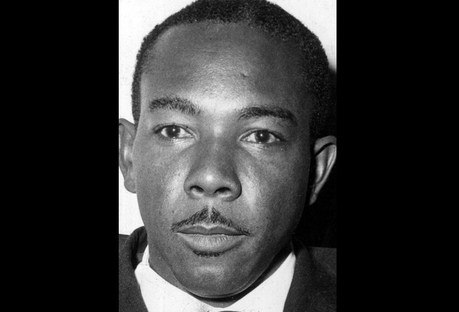
Jazz in Jamaica from Sonny Bradshaw

sonny-bradshaw

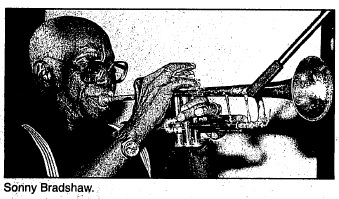
Sonny Bradshaw, the “Godfather of Jamaican Jazz,” wrote an article before he died in 2009 titled “Black History All Jazzed Up.” It ran in the Jamaica Gleaner during Black History Month, on February 10, 2008. Because Sonny lived through so much Jamaican music history, I reprint his words of gold here:

JAZZ-CLASSICAL black music – once taboo in Jamaica and referred to as ‘devil music’ by the churches, was not to be played on Sundays.
We had the popular music of North America and Europe played by what were called road bands in dancing halls like PORA (Prison Officers Relief Association) on Laws Street, The Jamaica Success Club (63 Upper Wildman Street), the Jubilee Tile Gardens (Upper King Street), the Forrestors Hall (North Street), the Progressive Lawns (North & Church Streets) and later Bartleys Silver City on East Queen Street, all in what is now called downtown Kingston.

But things and times changed along the way and the same churches were having fund-raising functions using the music of the day, ‘a little jazz’, now getting respectable, handed down from the North – those same slave-oriented sounds coming out of the brothels in the Caribbean Port of New Orleans in the USA.

The black music was getting white and the technology afforded more widespread dissemination and popularity in the ‘black’ neighbourhoods on the US mainland and in islands like Jamaica.

BRINGING HOME RECORDS
But we in Jamaica, land we love, are a different lot in many ways, culturally and otherwise. So much later and lots of water under the bridge, when the farm work project started, people like jazzman Clement ‘Sir Coxsone’ Dodd spent a lot of his cotton-picking earnings to bring back records (78 rpms) of the music from Florida with the distinctive blues as well as rhythm and blues sounds to play on his box, called a sound system.

In time, these sound systems moved from their local surroundings of Pound Road (now called Maxfield Avenue) and South Race Course (home of Lord Koos) and eventually took over the dancing halls everywhere – and not just in Kingston.
The sound systems began substituting for road bands as they could play very long hours (without tiring) and the music was for both dancing and listening, as they played what could be called jazz and blues (what a term!).

The jazz part really got respectable when bandleader Milton McPherson promoted a two-night concert at The Ward Theatre called Fashions In Jazz (I can’t remember the year). But what gave jazz an extended popular music life was the series of Jazz Concerts – Carnegie Hall Style also at The Ward Theatre, devised by me and piano player civil servant land surveyor, Lloyd Adams. We kept up this series from 1954-58 with no foreign act, just Jamaican musicians and artistes.

It can be remembered that on the day of the first concert of the series only one ticket was booked, that by jazz lover Dudley Ball, but at showtime the 900-seat Ward Theatre was bursting at its seams, including the fowl coop gallery.

Jazz, the classical black music, was at the top of its game, later being included in Stephen & Dorothy Hill’s Celebrity Concert Series which first brought mostly white classical music. But later came international acts like the legendary Louis Armstrong, fantastic piano virtuoso young Oscar Peterson, breathtaking jazz singer Ella Fitzgerald, a new (at the time) sensation, jazz singer Carmen McRae, who reportedly has Jamaican roots and the top of the modern jazz singers, the Divine Sarah Vaughan. These top acts could not be accommodated at The Ward Theatre alone, so the new Russell Graham ran 1900-seater Carib Theatre and even the open air Tropical Theatre on Slipe Road had to be pulled in to satisfy the jazz audiences of the day.

UNDERMINING THE MUSIC
Underneath the music goings-on in North America, ‘the jazz’ as a dancing music was being undermined by the new young set of musicians of bebop as more so listening music (as Perkins would say, for the thinking persons) while in Jamaica a cultural sleeping giant was aroused with the advent of a second radio station, the Jamaica Broadcasting Corporation (JBC).

Disbanding lofty ideas of a studio orchestra, arranger Carlos Malcolm and I were delegated to stay on board, thus promoting Jamaican music on air through the vehicle TADP (Teenage Dance Party), and the Jamaican Hit Parade Top 30 (popular music) from the stage of The Regal Theatre weekly.

The Jamaican recording industry got a real push, having more people being aware of the new cultural music, ska, rocksteady and reggae, on their doorstep. Our early ‘record producers’ also discovered that they could make money not just from royalties (they didn’t pay the artistes)
but also revenues from ‘publishing’ piling up in the outside world.

TAKING A BEATING
Jazz, the classical black music in Jamaica had lost ground and struggles today to stay in its rightful place through the dedication of the handful of musicians who do make their living from live music.

But jazz is taking another beating from persons and organisations, not excluding the church, that promote anything under the name of ‘jazz’ to make what Eric Coverley had described as ‘filthy lucre’, carrying the great masses along with the misleading idea of what this classical black music is. The Caribbean area is fraught with these jazz festivals that are made up of programmes of the popular music of the time of day, and any non-jazz megastar like the US$300,000 troubled Ms. Diana Ross, who recently visited Jamaica in our tourist city, Montego Bay, home of the past Reggae Sunsplash and current Reggae Sumfest.

With Black History Month at hand, it is hoped that the jazz renaissance will be assisted by the series of jazz & blues films being shown through the efforts of The United States: Embassy Public Affairs Division at RedBones the Blues Cafe throughout the month and also that other presentations will reflect, the true meaning of jazz, the black classical music that started its upward climb from the Caribbean port of New Orleans.

Uncategorized

Playboy Jazz All-Stars Minus Don D.

Recently, I read a surprising statement somewhere (won’t say where) that Don Drummond was named to the Playboy All-Stars in 1964. This was the result of a readers’ poll that the magazine conducted annually. I was surprised, one, because I have never heard this or come across this before in my years of researching Don D., and two, because it would go against one of the major premises of my book, Don Drummond: The Genius and Tragedy of the World’s Greatest Trombonists, that a lack of recognition and acknowledgment of his talent, due to a variety of reasons that I outline in the book, contributed to his mental decline. So, I had to find out–was this true? Did I miss something this big? The answer was no.

I obtained a copy of that 1964 Playboy magazine, as well as one from 1965 in case the poll was taken in 1964 and published in 1965, and nada. Not one word about Don Drummond–not in the poll, nor in the excellent article (I was always told that Playboy had excellent articles! Ha ha) about the state of jazz that year in the U.S. and abroad. In fact, the articles give a snapshot, in a paragraph or two, of jazz worldwide and mention a few names, like Hugh Masekla, but no Jamaican at all. There is much editorial about the American jazz musicians overseas, and the jazz scene in Europe and Russia, but no Caribbean jazz is touched.

It is sad that I don’t see Don D’s name in these pages. He should have been here. He saw these lists, he saw the Downbeat articles, and it ate at him. His idols, J.J. Johnson and Kai Winding are here, and those he played with when they came to Jamaica, George Shearing and Dave Brubeck, are here too. Obviously I wanted to see that my argument was correct, that Don D was never treated fairly, but more than any selfish interest like that, I wanted to see that somewhere, sometime, Don Drummond was recognized. At least while he was alive.

Here are a few pages from those articles.

jjjohnson

Uncategorized

Foggy Mullings

SeymourMullings559521969022

Whenever I do research on the early ska musicians, the name Foggy Mullings comes up on advertisements in the Daily Gleaner over and over again, although his days as a musician pre-date ska. It got me wondering, just who was Foggy Mullings and what was his contribution to Jamaican music? Turns out, it’s pretty big, and his contribution to Jamaica itself, even bigger.

Seymour “Foggy” Mullings was pianist and was a classical jazz musician. He was a member of the PNP and served as Member of Parliament, Minister, Deputy Prime Minister and Ambassador between 1969 and 2004. He died on October 9, 2013 and Former Prime Minister P.J. Patterson, who served as Don Drummond’s legal counsel during his murder trial, made the following statement about Mullings:  “We have lost a genuine champion of the people and an exemplary politician who served our nation well. Seymour ‘Foggy’ Mullings was an excellent political representative who was statesman-like in his approach to Ministerial and Ambassadorial duties. He was very much a man for all seasons who ‘walked with kings but kept the common touch’.

Foggy Mullings received his own billing but frequently performed with the other jazz groups of the day, including the Wilton Gaynair All-Stars. This group featured two Alpha Boys, Wilton himself, and Don Drummond after they both had left the Eric Deans Orchestra, and it also featured female guitar legend Janet Enright.

foggy-November-17-1954

foggy-November-17-1954-2

Herbie Miller wrote the following article in the Jamaica Gleaner on October 20, 2013 with the title, “Foggy could have been great – No known recordings of late politician, musician leads to bigger loss:”

Seymour ‘Foggy’ Mullings was first and foremost a politician. For those who knew him, People’s National Party (PNP) and Jamaica Labour Party included, he is remembered not only as someone wholly devoid of spite or resentment but also, as described to the Gleaner’s Gary Spaulding, by his friend, Burchell Whiteman, as a professional and well-known jazz musician with a large measure of versatility.

His music reflected his “temperament, understated, calming and reflective personality”, Whiteman mused.

There was this certain elegance to his touch that was also quite noticeable in his demeanour. Neither in his playing nor his personality did this sophistication resemble the sort of pretentious mannerism associated with those who adopted such attitudes because they thought it increased social mobility and status.

Rather, I suspect Mullings’ qualities were associated with one who had remained true to the family ethics, social values and spiritual qualities of late rural lifestyle that produced and nurtured him.

In that regard, former Prime Minister P.J. Patterson considered him a man for all seasons who walked with kings but kept the common touch.

In other words, Foggy Mullings was not just an exceptional musician, but also a man with a distinguishing personality infused into his music.

As a politician, Seymour Mullings served in many high-profile capacities. He was a senior officer in the PNP, a member of parliament, appointed minister in various portfolios, and after retiring from politics he joined the diplomatic community as ambassador to Jamaica in Washington, DC. In these capacities, he most certainly walked with kings, and indeed queens and other prominent world leaders and personalities.

If we consider Wilton “Bra” Gaynair, Harold ‘Little G’ McNair and Don Drummond kings among Jamaican musicians, then Foggy also stood with kings on the stage.

Taddy Mowatt’s 14-year-old vibraphone student, Marjorie Whylie, with an interest in jazz, encountered Foggy Mullings at Champion House during the 1950s. She riffs on that experience: “Everyone played at Champion House; ‘Little G’ McNair, Sonny Bradshaw, Lenny (Hibbert), (Ernie) Ranglin, Don Drummond, everyone. Even at that young age I detected in Foggy’s playing a George Sharing feel. His solos moved in blocks of chords, between both hands, and when he soloed with the right hand and held chords with the left, there was no doubt he was Jamaican by the way the melody flowed with a nuanced lilt. He was very influential to my development in that direction”.

Foggy Mullings also played in the Wilton Gaynair All-Star band at the Bournemouth Club during the late 1940s.

In adding a chorus of her own, guitarist Janet Enright recalled the line-up. “Wilton on tenor saxophone, Raymond Harper, trumpet, Foggy was on piano, Cluet Johnson was the bassist and Donald Jarrett, the drummer. I remember when members of the band soloed, they were all dynamic. We were all into dynamics; Wilton, Don (Drummond), Raymond Harper and little me, but when it was Foggy’s turn, he just swayed the people and the musicians. Everyone forgot dynamics. A soft aura just flowed over everyone and stilled them. There was nothing foggy about his music, it was angelic. He was much like Errol Garner; playing from the heart to the world, to every musician, everybody loved him. Sometimes when he was finished soloing, Wilton would go over and rest his hands on his shoulder; there was nothing to be said. He was too modest to handle compliments; he would politely change the subject and segue into something else. He was that soulful”.
Describing Mullings’ ballad playing as “powerfully gentle”, Enright counted among his favorite features The Way You Look Tonight, Full Moon and Empty Arms, which also featured Don, and Polka Dots and Moonbeams.

During the 1960s, and for some time after, I occasionally encountered Foggy Mullings at jazz sessions. That he was the musician’s musician was evidenced by the way other pianists would volunteer the bench and join the audience whenever he made a rare and mostly unannounced appearance at the Tit for Tat Club, Andante, Hotel Kingston, the Surrey Tavern or later on at the Blue Monk Jazz Gallery or the Mutual Life basement. At these sessions, I have seen and heard Foggy play with such effortless confidence on velocity charged numbers that were so swinging it elicited from musician and audience ecstatic applause, spontaneous finger snapping, foot tapping, and head nodding.

Unlike many other jazz musicians of his time, Mullings avoided crowd-pleasing roulades; instea opting for nuanced fluidity to produce inventive interpretations of the song’s melody. He infected these up-tempo tunes with splendidly cogent notes that were not only logical, but also superbly intuitive. His compelling harmonies and refined imagination turned well-known tunes into renditions that obscured their identity.

Foggy was no ordinary musician, as can be heard on a half dozen tunes I recorded from my radio some three decades ago. On each song, his sense of time and measure, his beat, remained consistently intelligent and intuitively compelling.

Mullings’ approach to slow tunes is just as engaging; his ballad playing exhibits relaxing lyricism, stable pulse and subtle melodic lines that are at once thrillingly elevating and intimately evocative.

Sensitively introspective harmonies also reflect his characteristic distinguished aura and gracefully illuminate his apparent affection for romantic standards.
On Walter Gross and Jack Lawrence’s Tenderly, for example, he seems to linger on the introduction, interpreting and reinterpreting it in multiple ways — if for no other reason than its utterly delightful tunefulness before exploring harmonic possibilities that seamlessly transform and personalise this well-known romantic song made popular by Nat King Cole.

Foggy’s interpretation of Richard Rodgers and Oscar Hammerstein II’s standard, The Sound of Music, benefits from a lucid empathic reading.

Foggy never departs far from the melody, but by faintly addressing its structure he added a tropical light to the song’s western European pastel hue, providing a sunny and yet cool fusion while maintaining its sense of liberation and optimism.

Mullings’ playing betrays his musical influences. The piano styling of Nat Cole, Errol Garner and Teddy Wilson flow from his fingers. Like fellow pianists Hank Jones and Tommy Flanagan, he inflected infectious humour to sessions without sacrificing the cogent intensity of improvisation.

Utterly lacking a profligate attitude, for those who served with him in Parliament, Foggy was someone whose strong but understated personality was also reflected in his music; a music that portrayed the politician and musician as both statesman and gentleman, one so confident in his abilities that political audacity, personal bravado and musical showboating had no place in how he expressed himself.

While listening to my private recording, the late Harry Graham, on introducing the Leo Wilson Quartet, described its featured artiste, Foggy Mullings, as “one of the best pianists this country has so far produced”.

While there is ephemera attesting to his musical presence, it’s the nation’s loss that there is no known professional recording of Seymour ‘Foggy’ Mullings, the outstanding pianist. Although a politician of impeccable qualities, to those who encountered Foggy, the musician, it was clear he obviously took great joy in the vocation he did not pursue.

Uncategorized

Hullabaloo Ska

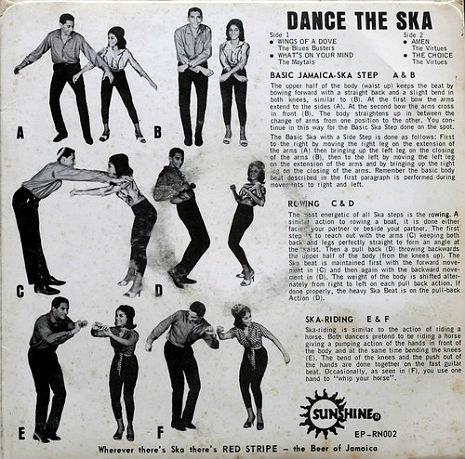
In the mid-1960s, dances like the Frug, the Watusi, the Jerk, and the Swim were all the rage, sparked a few years earlier by the dance of all dances, the Twist. To capitalize on this trend, Eddie Seaga, then minister of culture, many years before he became prime minister, hired his school friend Ronnie Nasralla to study the people at the sound system dances where ska played. Nasralla, who would go on to become an advertising executive, created that now-famous pamphlet that taught the uptown crowds, tourists, and the world at the 1964 Worlds Fair in New York how to do the ska. It was a step-by-step featuring himself and Jannette Phillips.

I was surprised when Nasralla told me he had done a photo shoot with models for Mademoiselle magazine, teaching them to do the ska, and you can find that blog post early in the Foundation Ska archives; but I was also surprised to find this booklet of those popular dances–including the Ska! Here are scans from those pages, so get your dancing shoes on and get ready for a Hullabaloo Discotheque!

Uncategorized

Jimmy Cliff Teaches How to Do the Ska

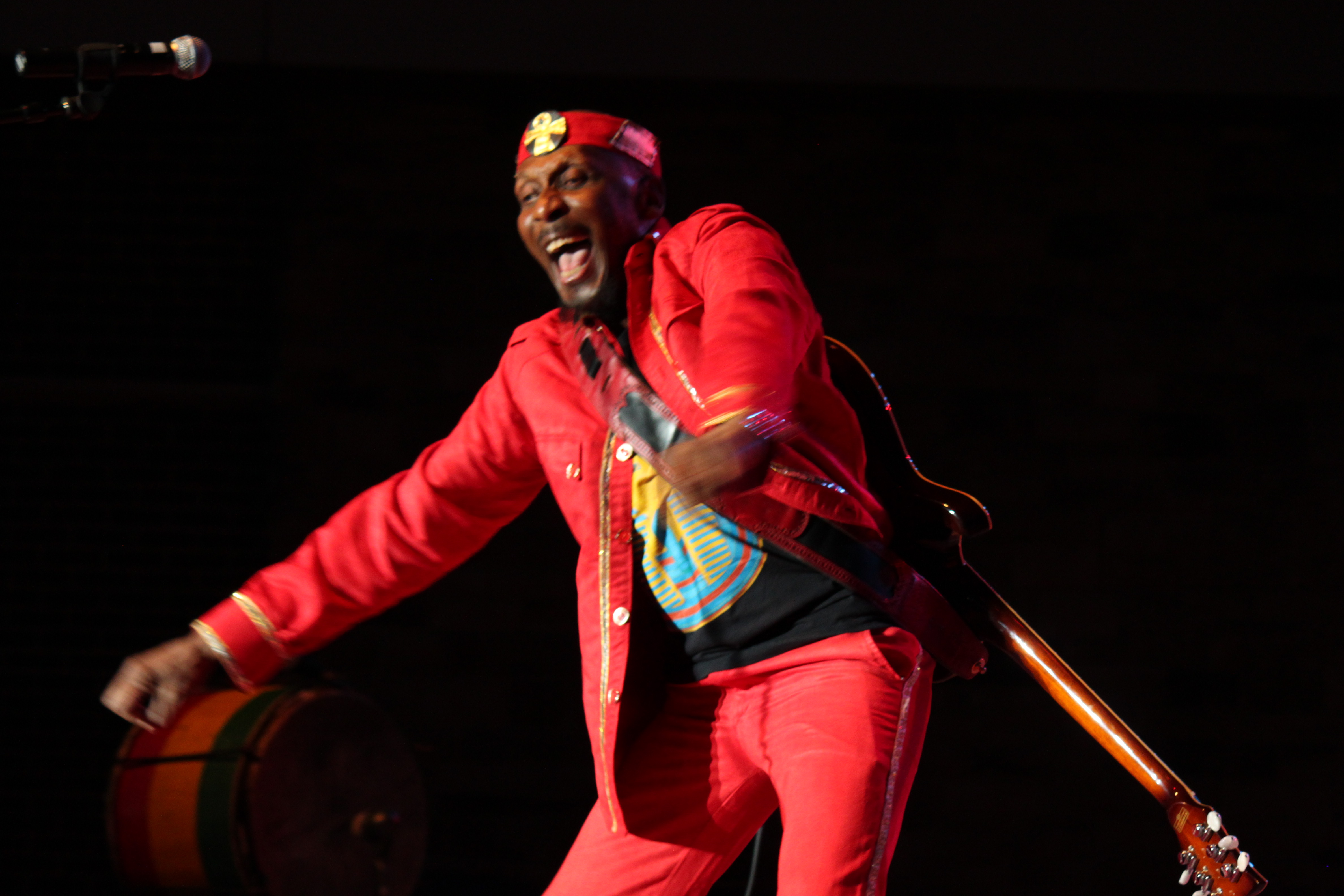
During Jimmy Cliff’s live sets, and on his latest album Rebirth, he sings about his rise through the genres of Jamaican music. Here he shows the audience in Hammond, Indiana on July 16, 2014 how to “do the ska,” moves that were promoted by Ronnie Nasralla. I have written about this section of history before, but it bears repeating.

Ronnie Nasralla told me how he came up with the dance during an interview with him last year. “Let me tell you how it started. One day, Eddie Seaga, who was my close friend, called me. Eddie Seaga was friends with my sister. He was my sister’s boyfriend and he used to come by my house and I help him with his political campaign. Advertising was my forte. So I did all the advertising for the government, Eddie Seaga at that time. I help him with all his promotion. He told me he heard a music that was breaking out in Western Kingston called ska and he asked if I could promote it for him, so I said, ‘Well, I’d like to learn about.’ And we organized and I said, well Byron Lee is the best person to promote it. So we get together with Byron Lee down in Western Kingston and I learned the ska music. Eddie organized a dance at the Chocomo Lawn in Western Kingston—it’s an outdoor nightclub. And Byron played there and all the ska artists performed with Byron and it was a sensation. He [Seaga] said to me, ‘Ronnie, move around the crowd and see what they are doing on the dance floor and see if you can come up with a brochure about how to dance the ska. So I did that, saw the people dancing around and came up with a brochure about a week after, how to dance the ska, give them different steps in the ska, and something that they could use to promote ska worldwide. That brochure was used by the government, they put it in all the record albums and it was sent all over the world and I was asked to go to the states and promote the ska with somebody and I got Jannette Phillips to dance with me. Jannette was a dancer, a belly dancer, a friend of my sister. We took pictures doing the different steps and the brochure was produced and given to the government and it was put in all the ska albums.”

Here is an example of that now-famous how-to that Jimmy Cliff brings to his audiences show after show. Yes, my friends, the history is still alive and well!

skaaaaaaaaa

Uncategorized

Hurricane Charlie

hurricane-charlie-headline

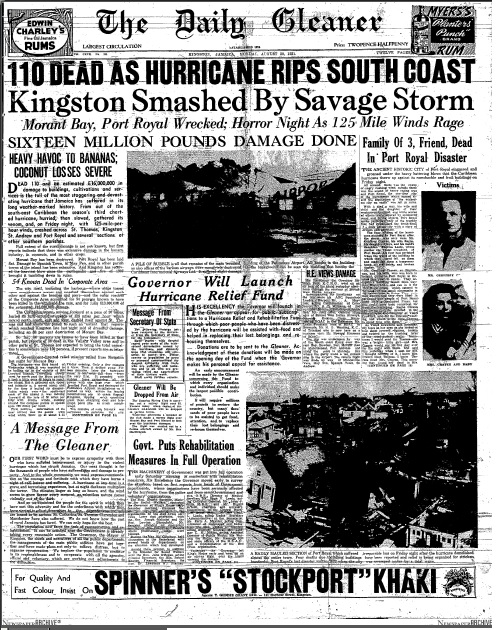
Typhoon Neoguri in Japan this week had me thinking of Hurricane Charlie which swept through Kingston and Jamaica in 1951. Why? Because talking to Eddie “Tan Tan” Thornton, the great Alpha trumpeter two years ago when researching my book on Don Drummond left me with a vision so real that every time I hear of a tropical storm I am reminded of a young Don D. and a young Tan Tan caught in the middle of that ferocious hurricane that spared their lives.

hurricane-charlie-9-4-51

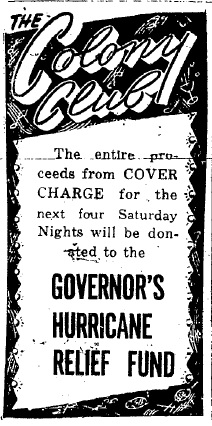
Tan Tan told me his memories of the pre-ska days at the Colony Club performing with the Eric Deans Orchestra and that night that Hurricane Charlie came to pass. “Eric Deans was society. No poor people could come there. It’s just the lawyer, barrister, and tourist, mostly tourist. It’s an exclusive club. You have to have money to go in it. We used to play six nights a week—Monday, Tuesday, Wednesday, Thursday, Friday, Saturday. A lot of American tourist used to come there, every night. In those days a lot of American tourist used to come. It’s the club they come to first, they go to Glass Bucket after. Eric Deans was the best band in Jamaica and we play the same music that was played in America—Count Basie, Duke Ellington, Benny Goodman, Artie Shaw, Harry James, everything. The music we played is America music. There was no ska in those days. Nobody know what was ska or reggae. There was the storm in 1951 in Jamaica. We went to work at the club and we knew the storm was coming. They say, okay, there is no club tonight because the storm is coming, to go home, right? Then we were riding, coming down South Camp Road to go home and then the storm gets worse, but we were lucky, it was just coming, so he ride over to his house and I ride to Alpha.” Not wealthy enough to have phones to notify them not to venture out, both were fortunate to survive the wrath of the deadly storm that killed more than 250 people. The storm even destroyed two buildings at the Alpha Boys School and four students there died.

hurricane-charlie-8-24-51

If you have memories of Hurricane Charlie or thoughts on this event, please comment below—would love to hear input.

The following is an excerpt from the Daily Gleaner, August 20, 1951, which gives an account of the wrath of Hurricane Charlie–pretty dramatic writing too, if I might say:

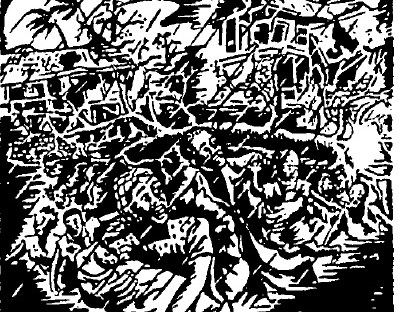
First positive information of its near arrival was the gentle west wind which blew up at about 9.15 Friday evening. Only A few minutes it blew. Then it drifted away. Fifteen minutes later the hurricane came. It hit with full fury from the very first. It pounded with sudden force unleashing all its power with one huge roar which levelled Port Royal and destroyed the Palisadoes Airport installations as it pushed its way across the leaping mountainous sea to crash through Kingston, ripping roots, uprooting giant trees, snapping steel and telegraph posts like so much matchwood. Ten minutes of such ferocity was sufficient to paralyse the city, knocking out electric and communication, blocking transportation. And while the headwinds rushed across and out of the near devastated city touching points here and there in St. Andrew to go pounding through Sp. Town and on across the countryside, the circular winds came in to throw ships off their moorings and up against the Palisadoes road and the airport runway and to complete the damage that had begun.

The hurricane reached its greatest intensity in the first forty-five minutes then kept a sustained and always dangerous strength for the next three hours. After 1.30 on Saturday morning the winds lessened appreciably but the driving rain increased the horrors of the darkened storm-lashed night and women and children huddled screaming in rain-washed wall corners, some thinking of those whom they knew to be dead, while others prayed for the dawn.

The Palisadoes Airport was levelled and such eastern Kingston and lower St. Andrew districts as Springfield, Bournemouth Gardens, Mountain View, Eden Gardens, Blown’s Town, Passmore Town, Franklin Town, Rollington Town, and Vineyard Town were so badly mauled that it appeared as though a giant hand had moved among them during the night ripping the roofs from off the houses and crumbling the weaker ones.

But all other sections of the city from east to west, below and above East Queen Street stretching north to a line passing through Cross Roads from Cockburn Pen to Mountain View Avenue and Old Hope Road there was a concentrated damage which made it impossible for comparisons to be drawn between any sections of the city.

Only in central lower St. Andrew in an area running just above Half-way Tree was damage kept to a minimum. In all other sections of the Corporate Area, few buildings escaped damage and the loss in furniture and home furnishings cannot be estimated.

Most of those dead were killed by collapsing buildings but seven were drowned on land and 16 in the harbor.

Uncategorized

Independence Ska

independence-july-14-1965

Today is the Fourth of July, the day when Americans celebrate their independence from Great Britain. So in keeping with this theme of independence, I would like to devote today’s blog post to Jamaican songs of independence, and what better place to start than the Jamaican National Anthem itself and during a conversation with Graeme Goodall, engineer for Federal Studios, he told me how this song was recorded. The national anthem was first publicly performed by the Jamaica Military Band at the Lyndhurst Methodist Church Hall just a few weeks before the independence ceremonies. The song’s words were written by Father Hugh Sherlock and the music was composed by Mapletoft Poulle and his wife, Christine Alison Poulle, although many accounts have Robert Lightbourne involved in the composition as well and the confusion over the true composer comes down to politics. Goodall recalls recording the national anthem and says that Captain Ted Wade, who was in charge of the Jamaica Military Band, brought the band to the studios in army trucks. “I told him, no problem, we’ll record them in the parking lot,” said Goodall since they couldn’t all fit in the studio. As Goodall began running microphones to the lot and then taking sound levels back in the control room, he noticed a problem. “There was traffic outside on Four Shore Road, Marcus Garvey Drive,” he says. But Wade radioed the military who responded by blocking off each end of the road and the recording went off without a hitch. They recorded the up tempo march version for the A side and a slower vocal version for the B side and worked all night to press 100 copies complete with a label printed with the new Jamaican flag. The records appeared one on each parliament member’s desk the next morning by 9 a.m., as well as a copy for RJR and JBC.

independence-july-31-1964

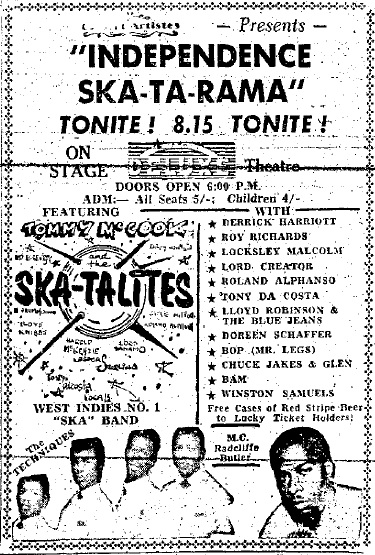
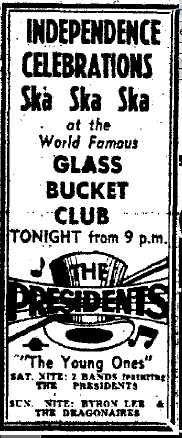
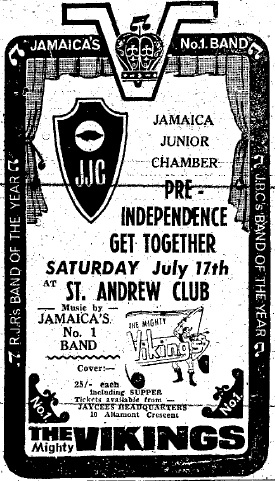
There were plenty of other songs that celebrated independence and plenty of independence celebrations that featured ska music. The Hotel Flamingo hosted Sonny Bradshaw & His Combo for “exciting music for dancing” to “celebrate independence at the poolside terrace.” The Carib Theatre hosted the “Independence Showcase” with such ska musicians as The Blues Busters, Byron Lee & the Dragonaires, Keith ‘N’ Enid, Derrick Morgan; Derrick Harriott, Jimmy Cliff, and Hortense Ellis, among others. The Deluxe Theater was host to the “Independence Ska-Ta-Rama” with the Skatalites, Derrick Harriott, Lord Creator, and lucky ticket holders even won “free cases of Red Stripe Beer”—quite a juxtaposition to the tea served at the uptown celebrations!

independence-july-31-1964

Here are a few Jamaican songs that celebrate independence, for Jamaica and for other countries. This list is compiled using the superb Roots Knotty Roots database and feel free to add your Jamaican songs that celebrate and reference independence all over the world. Oh, and make sure to enjoy a Red Stripe (or two), and a cheeseburger, while you put on a few of these fantastic tunes!

  • Al T. Joe’s “Independence Time Is Here (Rise Jamaica)” in 1962 for Lindon O. Pottinger on his Gay Disc and Dice labels
  • Alert Bedasse and Trenton Spence Orchestra’s “ History and Independence” released in 1962 for National Records
  • Alert Bedasse and Trenton Spence Orchestra’s “Let’s Celebrate” released in 1962 for National Records
  • Baba Brooks’s “Independence Ska (Pussy Cat)” released in 1965 for Duke Reid on the Treasure Isle and Island labels
  • Basil Gabbidon’s “Independence Blues” released in 1962 for Coxsone Dodd on the D Darling label and the same year on the Blue Beat label
  • Joe White and Chuck Joseph’s “One Nation” released in 1966 for Sonia Pottinger on her Gay Feet label
  • Derrick Morgan and The Blues Blenders’ “Gather Together (Jamaican Independence Song)” released in 1966 for Coxsone Dodd on the Studio 1 label and in 1966 on the Island label
  • Derrick Morgan’s “Forward March” in 1962 on Leslie Kong’s Beverley’s label and on the Island label, and in 1972 on the Punch label.
  • Dicky Ranking’s “Nice Independence” released in 1983 on the Typhoon label
  • Freedom Fighters’ “Independence Jump” released in 1961 on the Melodisc label
  • Jackie Opel’s “Independence Anniversary” released in 1963 on the Beverley’s label for Leslie Kong
  • Jimmy Cliff’s “Miss Jamaica” released in 1962 for Leslie Kong on the Island and Beverley’s labels and Phil Laing’s version of the same song in 1980 on SWSK Sound King
  • Junior White’s “Free Up The Collie Weed For Independence” released in 1981 on the Thoroughbred label
  • Kalabash’s “Independence (Take Steps)” released in 1976 for Victor Crichlow
  • Laurel Aitken and Freedom Fighters’ “Guyana Independence” released in 1959 for Dada Tewari on Caribou and released in 1961 on Melodisc
  • Lord Brynner’s “Trinidad and Tobago Independence” released by RCA in 1962
  • Lord Creator’s “Independent Jamaica,” a calypso for Vincent Chin in 1962
  • Lord Rose & the Beachcombers’ “Independent Jamaica” in 1962 for Ken Khouri’s Calypso (Kalypso) label
  • Papa Biggie’s “Jamaica 21st Independence” released in 1983 for HBC Productions
  • Prince Buster’s “Festival (Independence Time)” released in 1966
  • Prince Buster’s “Independence Song” released in 1962
  • Prince Buster All Stars’ “ Independence ’65 (Happy Independence) released in 1965
  • Rico Rodriguez’s “August, 1962” released for Prince Buster in 1962
  • Roy Alton’s “Dominica Independence” released in 1977 for Sonny Roberts
  • Shoc-Wave’s “Dominica Independence Fever” released in 1979 on the Arawak label
  • Skatalites’ “I Should Have Known Better” also known as “Independent Anniversary Ska, released in 1965 for Coxsone Dodd on the Studio 1 label in 1966 on the Island label
  • Stranger Cole and Patsy Todd’s “Love In Independence” released in 1965 for Prince Buster
  • Terry Nelson’s “Welcome Independence” released in 1966 on the Halagala label
  • Winston and Bibby’s “Joy Bells For Independence” released in 1962 for Coxsone Dodd

independence-july-14-1965a

Uncategorized

Happy Birthday Dragon–Byron Lee

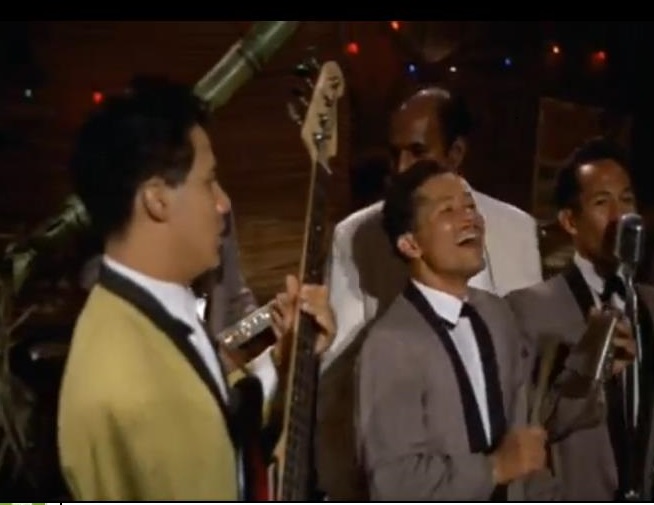
dr-no

In celebration of Byron Lee’s birthday today, I devote today’s blog post to this masterful musician, businessman, marketer, and family man. Byron Lee, through ska, put Jamaica on the map. In an interview with Sheila Khouri Lee, widow of Byron, she said to me, “Byron Lee and the Dragonaires today is more than just a band, it is an institution, it is a part of our culture and a part of our heritage.” I couldn’t agree with Sheila more, and so let’s learn a little more about Byron Lee who passed away in 2008.

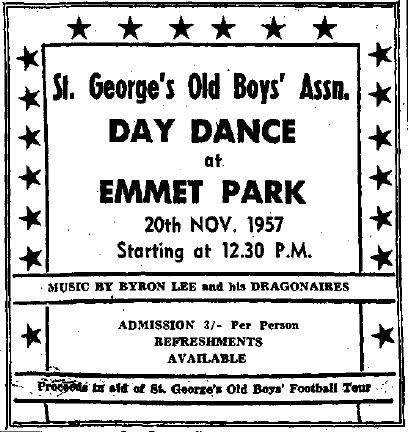
byron-lee-nov-19-1957

I will devote a chapter to Byron Lee’s strong, talented, and business-savvy wife, Sheila, in my upcoming book which is nearly complete, Songbirds: Pioneering Women in Jamaican Music, but for this post, let us read the following article was written by David Katz for the Red Bull Music Academy in March 2013:

Byron Lee was undoubtedly one of the most important figures in the history of the Jamaican music industry. As leader of The Dragonaires, one of the island’s top show bands since the early ’60s, Lee helped build the careers of dozens of vocalists, including Jimmy Cliff, The Maytals and The Blues Busters, and was instrumental in raising the profile of ska. He later established Dynamic Sounds, then the best-equipped recording facility in the Caribbean, where excellent material was recorded by Bob Marley, The Melodians, Junior Byles and countless other Jamaican greats, as well as Paul Simon, Roberta Flack and The Rolling Stones.

As if that wasn’t enough, Lee staged Jamaican concerts with leading calypsonians and soul stars during the ’60s and ’70s, before swapping dancehall for soca in the mid-’80s, and was also instrumental in bringing Carnival celebrations to Jamaica. He received over 120 official awards for his achievements, most notably being granted the Order of Jamaica.

Yet some found Lee controversial. Many of Jamaica’s black ska originators have consistently complained that Lee appropriated their creations, angry that the Dragonaires were chosen to back the ska delegation that performed at the 1964 World’s Fair. Claims of political nepotism have been levelled, and disapproval of his penchant for MOR. Furthermore, most accounts of Jamaican music describe Lee as “Chinese” and dismiss his ability to play “authentic” Jamaican music. Similar criticism has never been directed against Mikey and Geoffrey Chung, renowned roots players of Chinese origin, nor the Hoo-Kim brothers, whose Channel One studio scored huge reggae hits in the ’70s. The Chin family of Randy’s/VP fame have also largely avoided censure.

That “Chinese” label is problematic in Lee’s case: His maternal grandmother was a woman of part-African descent, from the Jamaican village of Auchtembeddie, whose family still practiced traditional forms of African cultural expression such as Jonkunoo and Bruckins during Lee’s youth. Some point to social class as the bigger factor: Lee was definitely “uptown.” Issues of race and social class continue to be fiercely debated in Jamaica. The often privileged social status accorded minority groups with origins in Asia, Europe and the Middle East has naturally resulted in tremendous resentment, yet the complex nature of intertwined class and race elements make these issues difficult to generalise about where Jamaica is concerned.

In any case, the family moved to Kingston when Lee was eight years old and settled in the posh Mountain View Gardens district while he was still attending Mount St Joseph’s, an elite Catholic boarding school. He discovered music there through a nun’s intervention: “I used to torment the girls, so she said, ‘If you promise me that you will not hassle the girls, I will give you music lessons free,’ and that’s where I learned to play the piano. All of a sudden music became more important to me, and then, when I came to Kingston, that gave way to football.”

At St George’s College, he became a star football player, and after one successful match in 1956, Lee created an impromptu vocal group with fellow students to perform at a school victory dance. The following year, The Dragonaires officially formed with Lee as bassist and bandleader. Their recording debut, a version of Doc Bagby’s organ-and-sax instrumental, “Dumplins,” was produced by Edward Seaga at the end of the ’50s.

It was not until the Dragonaires’ appearance in the 1962 Bond film, Dr. No, that Lee felt they had made it, however. “The high point of my life was to be in the first James Bond film. I am proud of that because all the young people who watch the James Bond series can remember seeing us; it goes on forever, and the parents will tell their son or daughter, ‘I danced to that band.’”

Following the Dr. No guest spot, The Dragonaires solidified their reputation as the island’s most prominent band by staging a series of gala concerts across the island, supporting Ray Charles at the National Stadium and Ben E. King at the State Theatre. And after Seaga introduced him to ska, The Dragonaires backed many of the upcoming stars of the day. “Jimmy Cliff, Stranger & Patsy, Prince Buster, The Blues Busters, Millie Small, all these artists worked through the first couple of years of ska with us.”

I asked Lee about the charges laid against him, concerning his alleged appropriation of ska and his supposed initial dislike of the form. “Totally untrue,” he insisted. “We knew nothing about ska until Seaga sent us down there; it was being played on the western [Kingston] sound systems, but it was not played on the radio stations because they wouldn’t accept the quality: the guitars were out of tune, the records were hop, skip and jump, so when I made ‘Dumplins,’ it was the first stereo record that really got played. Ska, I helped to bring it up. I didn’t find it, nor did I originate it, but by bringing it out, we made famous, and gave the market to The Skatalites and all the people who were playing ska. Eddie Seaga was the politician whose constituency ska was in; he knew that the music need help, and he wanted to be the Minister of Culture who said, ‘I have given you a music from the ghettoes of Kingston to celebrate our sovereignity of independence.’ So in 1962, he sent us down there to study the music. Ska was always there before us, but it was sort of kept down in the ghetto. It wasn’t recognised by the people mid-town and uptown who could afford to buy it. So I took it to the people who could afford to support it.”

The music’s status was raised a notch when Atlantic Records’ founder Ahmet Ertegun visited Jamaica, aiming to launch ska in the USA. The result was ska cut for the American market and a chaotic set of live dates in New York, which inspired Lee to build Dynamic Sounds, the studio of choice of the late ’60s and early ’70s. “When my tour went to America, I saw the technical improvements; we saw how eight-track was coming, so I decided to go back and build a studio. Dynamic Sounds was the studio that had 90% of the things happening here: all the stuff when Leslie Kong was alive, Bob Marley, Toots and The Maytals, The Maytones, The Gaylads, The Melodians. We had four A&R people working as in-house production for us: Lee Perry, Bunny Lee, Tommy Cowan, who did Eric Donaldson’s ‘Cherry Oh Baby,’ and Boris Gardiner, and I used to produce with Neville Hinds, who used to co-direct and arrange. Lee Perry had tremendous talent. Out of all the producers we had worked with, his ear for a hit before it was actually recorded, he had that gift in his head. We had in-house engineers…. [and] we trained a lot of engineers too; most of the people came from nowhere, and we gave them the opportunity to learn.”

After the mid-’70s peak, when Lee played on The Maytals’ Funky Kingston album and brokered their contract with Island, rival studios like Harry J, Channel One and Joe Gibbs became more prominent, but Dynamics was never abandoned, with Bob Marley even recording “Blackman Redemption” there in 1979. However, when Jamaican music began drifting towards dancehall, Lee returned to the pan-Caribbean party music he’d promoted in the ’60s. A few years after he was awarded the Order of Distinction by the Jamaican government in 1982, he concentrated on soca almost exclusively, scoring the smash hit, “Tiny Winey” with Montserratian soca singer Hero in 1984, and later enjoying another huge success with “Bacchanal Time,” recorded in 1993 with Trinidad’s Super Blue. He went on to back most of the leading soca performers at concerts held worldwide.

In 1990, Lee brought Trinidad’s Carnival culture to Jamaica by launching the annual Jamaica Carnival. Again, only Byron Lee would have considered such a thing. Carnival is a strictly Catholic beast, and Jamaica’s culture is far more Anglican/Protestant than that of the islands in which Catholicism took hold via extended colonial domination by the French and Spanish. But as noted earlier, Lee was himself the product of a Catholic education, so perhaps the influence helped convince him Carnival would be successful in Jamaica.

Additionally, his long association with the calypso and soca scenes of Trinidad gave him firsthand experience of Carnival’s potential for bringing people together – as well as its prospective income generation. However, Jamaica’s annual Carnival event somehow ended up being aimed at the upper-class elite and foreign tourists, whereas Carnival in Trinidad has been embraced by everyone and is historically more associated with the working class than anyone else.

In Lee’s view, though, Carnival was simply part of the same cultural continuum that gave rise to calypso, soca, reggae and ska. “It’s in our blood,” he told me. “Even today, if you play soca, the people who are really reggae enthusiasts will feel good. That’s why they love Carnival so much, because in their blood and in their heart and soul is the brown bread of the African music, which is the sound of the congas and the rhythm of soca and calypso.”

Regardless of the controversies, Byron Lee’s incredible career remains unparalleled in the history of the Jamaican music industry. Through the ’90s and into the new millennium, Lee continued a grueling tour schedule, even after reaching his 70th birthday in 2005. He was diagnosed with bladder cancer the following year, and, after a partial recovery, he went back on the road, and continued performing until just a few months before his death, at the age of 73, in November 2008. The diverse manner of his involvement in music, as well as the huge number of hits he was responsible for, has left an immense legacy.

Uncategorized

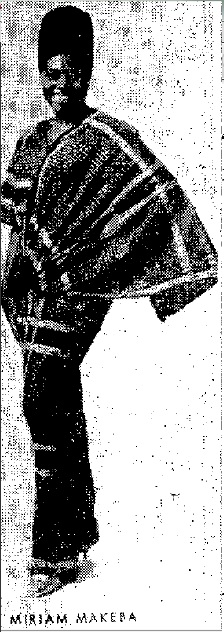
Miriam Makeba–Mama Africa and Jamaica

miriam-makeba

I haven’t blogged in the past two weeks because I have been in South Africa and Swaziland. While there, I picked up some great South African jazz from Zacks Nkosi, Sipho Hotstix Mabuse, the Manhattan Brothers, and Dennis Mpale, and of course some Lucky Dube, but I also found plenty of Miriam Makeba still making the rounds. So I wanted to take this opportunity to talk about the legendary Miriam Makeba and her impact on Jamaican music.

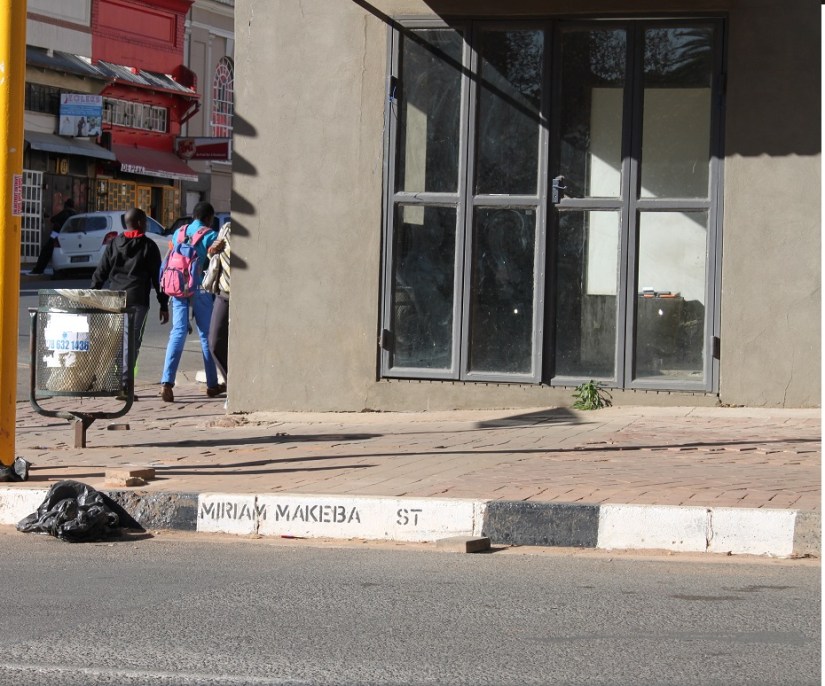
Zensi Miriam Makeba, known as Mama Africa, was born in 1932 in Johannesburg where today there is a street named after her. She was jailed with her mother, a Swazi, when she was an infant and her father, a Xhosa, died when Makeba was just six years old. Like many vocalists, Makeba began singing in her school choir and she started singing professionally with the Manhattan Brothers in the early 1950s before joining an all-female group, the Skylarks.

It was in 1956 that Makeba produced perhaps her most well-known hit, “Pata Pata.” This song, and here is one of the Jamaican connections, was covered by Millicent Todd, better known as Patsy, who recorded it for Sonia Pottinger in 1967 as “Pata Pata Rocksteady.” Patsy also recorded “The Retreat Song,” or Jikele Maweni, another Miriam Makeba song that is sung in the Xhosa language. The lyrics tell of a vicious stick fight.

Like Jikele Maweni, Makeba’s lyrics were typical love songs crooned by women during the 50s and 60s. Instead, Makeba’s songs were political and social commentaries on the Apartheid government in her homeland. They also celebrated Africa with content on culture and folklore, sung in the Xhosa language instead of Afrikaans or English which was a bold move during these years since the government forced the Afrikaans language on its citizens to the point of death (the Hector Pieterson massacre of over 600 school children in 1976) as a way of exerting power over and oppressing the black Africans. As a result, Makeba was banned from her country, forced to live in exile for years. When Makeba traveled to the United States to further her career, her mother died and so Makeba returned home for her funeral. She was denied entry. From 1960 until 1990, Makeba lived in exile. When Nelson Mandela was released from prison in 1990, he encouraged Makeba to return home which she did.

miriam-makeba-street

In an interview with Roger Steffens in 1988, Makeba said, “I’ve always been branded as a political singer. I never set out to sing politics; I just happen to come from a country that is oppressing my people. And I grew up under that oppression. And so I sing about my own life and the lives of my people. . . . So, the strength I get is from my people. And I get if from my mother and my father and my grandmother . . . and I get strength from all the people who have given me their love in different countries.”

Makeba was married five times to such men as fellow South African legendary musician Hugh Masekela and Black Panther Stokley Carmichael. She has won a Grammy Award in 1966 for her work with Harry Belafonte, and she has worked with such artists as Paul Simon, Nina Simone, and Dizzy Gillespie. She has appeared on the Cosby Show (now if that’s not success, I don’t know what is), and she has performed for John F. Kennedy’s birthday, as well as Nelson Mandela’s 70th birthday tribute at Wembley Stadium. She died in 2008.

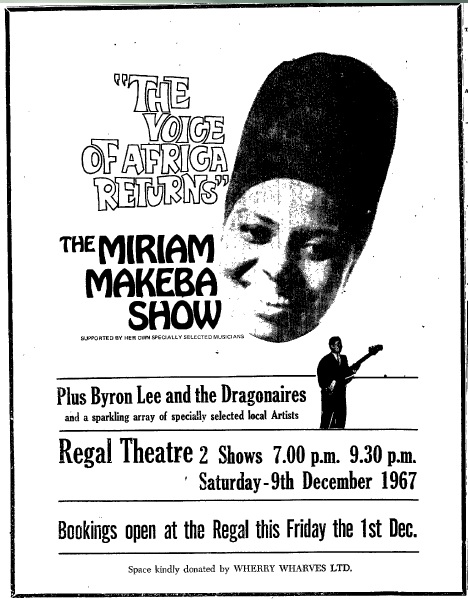
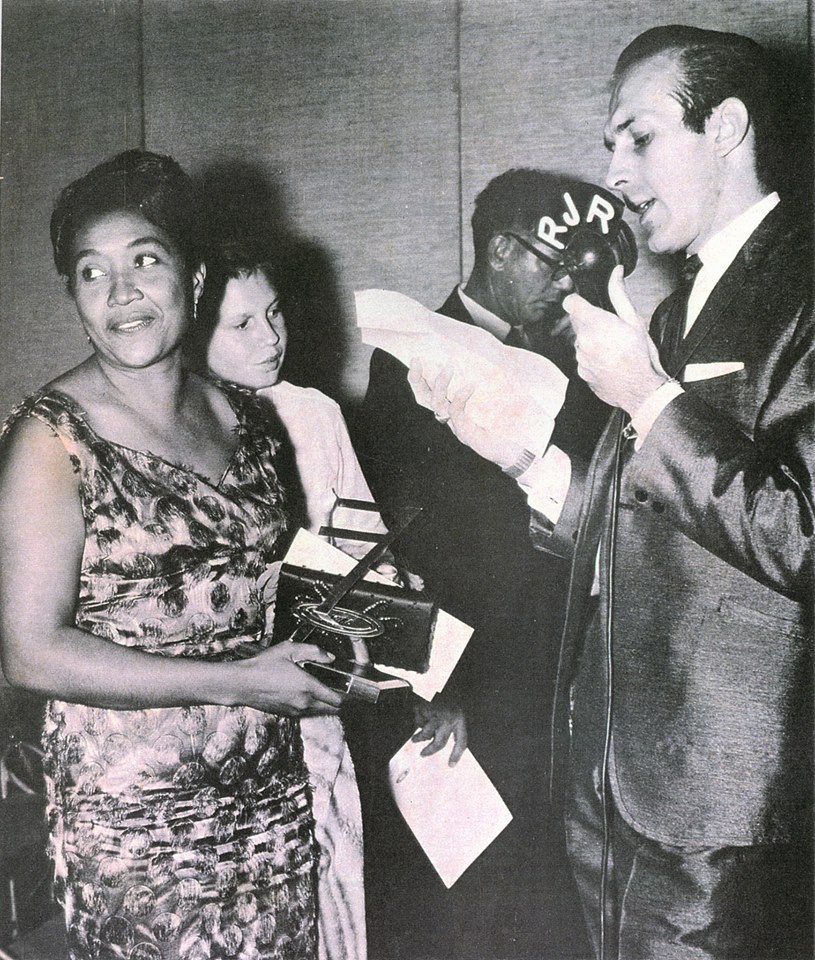
Another Jamaican connection to Miriam Makeba is that Makeba actually came to Kingston to perform for adoring fans in 1965 and again in 1967 and 1973 during her exile. Makeba visited countries all over the world during this time. In 1967 she performed with The Paragons, The Jamaicans, and Byron Lee & the Dragonaires. She also performed at a charity ball at the Myrtle Bank Hotel, invited by Edward and Mitzy Seaga and Byron Lee. She returned in 1973 to perform and met with P.J. Patterson who was the Minister of Industry and Tourism (prior to this he was the attorney who defended Don Drummond in his murder case, and after this he became prime minister). Patterson paid tribute to Makeba for her struggle for the recognition and dignity of her South African people and the excellence of her art. It was at this time that the Jamaican government also revoked the order prohibiting Stokely Carmichael from entering Jamaica, an order that was made in 1967.

miriam-makeba3

Why was Makeba so popular in Jamaica? Perhaps because she sang of common themes—themes of Africa, oppression, struggle, and survival during a time when the message needed to be heard the most. She celebrated her people, and as a result, her people celebrated her back. We all still celebrate her legend today, every time we put on one of her tunes. I am proud to have played her music for my young children who now sing along with her songs, although they may not know the language or its meaning. What they do understand is that universal language of music and so we pass it along to the next generation.

miriam-makeba2

Here is an excerpt from the article from the Daily Gleaner, December 3, 1967 with the headline “Miriam Makeba to Return to the Regal.”
THE EXCITING Miriam Makeba — “The Voice of Africa” — returns to Jamaica with her world renowned troupe to give two performances in “The Miriam Makeba Show” at the Regal Theatre in Kingston this week Saturday. The two shows scheduled for 7.00 and 11.30 p.m. will also include a special contingent of specially selected Jamaican artistes including Byron Lee and the Dragonaires, Hugh Falkner who recently won the coveted Best Singer Award in the 1967 Brazilian World Festival, Archie Lewis, Louise Bennett and The Jamaicans. The fascination of her eloquent voice, the warmth of her quiet humility, and the charm of her personality have combined to make Miriam Makeba the first South African songstress to attain international stardom. She has been referred to as “a high voltage star,” a typical example of the work camps, the bush villages and the city slums,” “a highly disciplined performer with a chic sophisticated style,” “a totally untutored performer with the stark simplicity of a primitive style and a natural feeling for the jazz idiom,” “a deliberate, very refined artiste,” Makeba, it seems, is all things to all people. Her repertoire, ranging from African songs in Zulu, Swazi, Xosa, Sothor and Shangaan languages and dialects to melodies sung in Spanish, Hebrew, Portuguese, Yiddish, Indonesian, and English, often features one of the most spectacular vocal effects in contemporary music, her famous Xosa click songs. In these, the featured sound has been variously described as something like “uncorking a bottle,” “the quick brush of sandpaper on sandpaper,” “two sticks striking against each other,” “the click of castanets,” “a glottal click and tribal panting,” “the explosive sound of a locomotive,” “the quick click of ‘tsk’ of tongue against palate,” and other bits of imagery that fall somewhat short of the actual, sound of the Xosa click songs. The unique star has only one suggestion that might help in categorising her. “When people ask me what I sing like,” she says, “the best I can do is tell them, ‘Come and hear me.’”

Here is columnist Harry Milner’s review of the show in the Daily Gleaner, December 11, 1967 with the headline, “The Velvet Voice of Africa.”
Last time Miriam Makeba came to Jamaica she gave a concert; this time her ”Show” was closer to cabaret….very much more polished, with a greater emphasis on presentation and considerably shorter. She wore two different costumes, both with a Nefertiti-style headdress, the first a glorious white creation in which she was a truly regal presence.
Happily, this time, she was not suffering from the appalling microphone system that marred her last appearance, and her voice came through, using her own “mike” as clear as a bell and as soft as velvet. As before, her programme was sufficiently varied, though this time there was a little more emphasis on songs of protest, such as the lovely “The Answer is Love” and Jeremy Taylor’s exciting song from the South African revue, “Wait a Minute, A Piece of Ground,” (which is a sort of potted history of her country ) and “When I Pass On”; but still her most exciting music remains the Xosa and Transkei wedding and tribal songs that she has made so indisputably her own. She included also her amusing “Poor Old Man” and also a fine Brazilian work. Her performance would have been a complete triumph had there had not been a slight misunderstanding just before the break in her show. Miss Makeba was apparently unaware of the terrible acoustics of the Regal, and she pitched her voice too low when introducing her songs for those in the far stalls or the balcony to hear. A few of the audience called on her to speak up and this she looked upon as a breach of courtesy. It was all very unfortunate as the crowd really loved her, and I think that they were quite as hurt as her by this unfortunate and jarring incident.
Milton Grayson who sang three numbers, whilst Miss Makeba changed came into a rather changed atmosphere, but soon won the audience back with a gloriously strong voice in “A Cuban Lament” and Cole Porter’s “So in Love.” Harmony was restored, while the two artistes brought a real party spirit to the Johannesburg “Patta Patta” urban song and dance . . . so we all parted good friends and Miriam Makeba received the hearty ovation that she deserved.
The first half of the show in which Jamaican artistes and Adam Wade performed was spoilt by bad “miking,” which was particularly hard on Archie Lewis with his “Old Man River” and “Edelweiss.” Archie somehow got hold of the worst one of the two microphones. Adam Wade was luckier, and his three numbers, including “Julie on My Mind” and fast soul offering went over well. Of the local trios The Paragons were much more successful than The Jamaicans, who in one of their numbers sounded abysmally Alabaman. Byron Lee accompanied this half of the show well, but musically Miss Makeba’s threesome was a great deal more pleasant with a very sensitive Brazilian doubling up on guitar and accordion. Miss Lou, as the “Voice of Jamaica,” immediately preceding Miriam Makeba as “The Voice of Africa,” was at her cozy best.

Uncategorized

Sonia Pottinger–Phenomenal Woman

Sonia-pottinger-and-tony-verity1

The death of Maya Angelou this week made me think of a Phenomenal Woman in Jamaican music who will be featured prominently in my book Songbirds: Pioneering Women in Jamaican Music that will be available this summer. Maya wrote, “Men themselves have wondered / What they see in me. / They try so much / But they can’t touch / My inner mystery. / When I try to show them / They say they still can’t see.” These words were personal to Maya, but they were about all of us women, and certainly about this Phenomenal Woman, Sonia Pottinger.

I was amazed when researching Sonia that articles on many of the important men in music appeared in the newspaper archives, but nothing on Sonia. Not unless you count the articles on her wardrobe. There were plenty of articles on the style of dress that she wore to social events, but nothing on her business success. She was a female producer, the first female producer, in a sea of men, in a man’s world. It was ruthless in the fight to establish identify in post-colonial Jamaica, and there were many victims. But Sonia was no victim. When her husband, record producer Lindon O. Potting, was unfaithful to her (certainly not uncommon for a record producer), she left him, divorced him, and took over the business. Phenomenal Woman. She grew the business, she treated artists with kindness and fairness. She heard their talents in a way that was unique to a woman. She had a woman’s touch. This is precisely why many artists, plenty of women but also plenty of men, came to Sonia as a producer. They trusted her. To understand what that really means is impossible without recognizing the climate that existed during this era in the music industry. It was every man for himself. Sonia was a Phenomenal Woman.

I would like to post this article that Howard Campbell wrote when she died. It gives some more biographical information about her. Perhaps to truly know her is to listen to the artists that she produced. You can hear her legacy in the recordings.

From the Daily Gleaner, November 7, 2010, written by Howard Campbell, Gleaner Writer:

SONIA POTTINGER, who blazed a trail as reggae’s most successful female music producer, died Wednesday evening at her St Andrew home. She was 79 years old. David Plummer, the youngest of Pottinger’s four children, told The Gleaner that his mother had suffered from Alzheimer’s disease in recent years. He did not say if it caused her death. Bornin St Thomas, Pottinger was introduced to the music business by her husband L.O. Pottinger, an engineer who had relative success as a producer in the mid-1960s. She went on her own during that period, scoring a massive hit with Every Night, a ballad by singer Joe White. Pottinger had considerable success in the late 1960s with her Tip Top, High Note and Gay Feet labels. She produced Errol Dunkley’s debut album, Presenting Errol Dunkley, and hit songs by vocal groups like The Melodians (Swing and Dine), The Gaylads (Hard to Confess) and Guns Fever by The Silvertones. In 1974, Pottinger bought the Treasure Isle catalogue and operations of pioneer producer Arthur ‘Duke’ Reid. She had even more success in the era of roots-reggae, producing chart-toppers by Marcia Griffiths (Hurting Inside and Stepping Out of Babylon) and Culture (Natty Never Get Weary). Errol Brown, Reid’s nephew, was engineer for many of Pottinger’s productions in the 1970s. He said she was no pushover in the studio.
RESPECT “She loved the music … loved it too much,” Brown said. “She knew what she wanted in the studio, and had a lot of respect for the musicians.” Musicologist and sound-system operator, Winston ‘Merritone’ Blake, said Pottinger was a sharp businesswoman in a male-dominated field. “She did her thing differently. She was always very dignified,” Blake said.
Pottinger is the latest death in local music. Singers Lincoln ‘Sugar’ Minott and Gregory Isaacs, two giants of lovers rock reggae, died in July and October, respectively. Sonia Pottinger is survived by three of her children: Sharon, Ronette and David as well as 11 grandchildren.