Don Drummond, Uncategorized

Don Drummond in the Mid-1950s

My friend Roberto Moore, a researcher and historian who lives in Kingston, was generous to send me a few clips related to Don Drummond from Star Newspaper archives from the mid-1950s. I asked him if I could share these on my blog and he kindly said yes, so here are the fruits of his labor.

Don-Drummond-insurance-0ct-26-1956-Batman-aka-Sonny-Bradshaw


First is this clip from the Star Newspaper on October 26, 1956 in the “Batman” column, rumored to have been written by Sonny Bradshaw which states, “Don Drummond, ace-trombonist is now selling insurance by day.” I had heard this over the years and was never able to confirm it and I find this instance of it in print intriguing. As I discussed with Roberto, Drummond would have recently left Bradshaw’s band in 1956, so Bradshaw, if he is the writer of this column, is not what the journalism world would call impartial here. He may have a bias, who knows. If it is Bradshaw, might be be kind of sticking it to Drummond? How long did this venture last and was it really a foray into a new line of work and why would he pursue this at this point in his life? Who knows, but it should be viewed in context, and it is quite a thought to entertain, Drummond in his suit and boogas, briefcase in hand, peddling paperwork, as Roberto and I mused.
jazz-at-the-carib

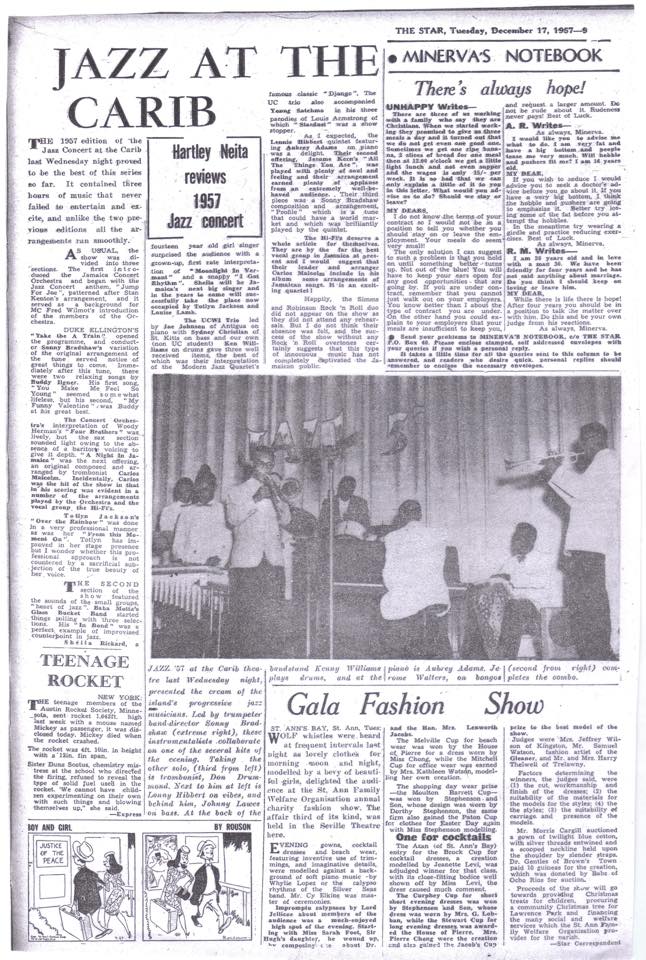
Drummond’s day job was likely short lived, if it ever did amount to anything, because as this clip shows from December 17, 1957, Drummond was back center stage for Jazz at the Carib performing with Sonny Bradshaw. Here is a better photo of the one pictured above in the article.

CaribTheatre3466243545195717-copy

The article, written by Hartley Neita, reads: The 1957 edition of the jazz concert at the Carib last Wednesday night proved to be the best of this series so far. It contained three hours of music that never failed to entertain and excite, and unlike the two previous editions all the arrangements ran smoothly.

As usual the show was divided into three sections. The first introduced the Jamaica concert orchestra and began with the jazz concert anthem “Jump for Joe,” patterned after Stan Kenton’s arrangement, and it served as a background for MC Fred Wilmot’s introduction of the members of the orchestra.

Duke Ellington’s “Take the A Train” opened the program, and conductor Sonny Bradshaw’s variation of the tune served notice of great things to come. Immediately after this time, there were two relaxing songs by Buddy Eigner. His first song, “You Make Me Feel So Young,” seemed somewhat lifeless, but his second, “My Funny Valentine” was Buddy at his great best.

The concert orchestra’s interpretation of Woody Herman’s “Four Brothers” was lively but the sax section sounded light owing to the absence of a baritone voicing to give it depth. “A Night in Jamaica” was the next offering, and original composed and arranged by trombonist Carlos Malcolm. Incidentally, Carlos was the hit of the show in that in his scoring was evident in a number of the arrangements played by the Orchestra in the vocal group, the Hi-Fis.

Totlyn Jackson’s “Over the Rainbow” was done in a very professional manner as was her “From this Moment On.” Totlyn has improved in her stage presence but I wonder whether this professional approach is not countered by a sacrificial subjection of the true beauty of her voice.

The second section of the show featured the sounds of the small group’s “heart of jazz.” Baba Motta’s Glass Bucket Band started things sailing with three sections. His “In Bond” was a perfect example of improvised counterpoint in jazz.

Sheila Rickard, a fourteen-year-old girl singer, surprised the audience with a grown-up, first rate interpretation of “Moonlight in Vermont” and a snappy “I Got Rhythm.” Sheila will be Jamaica’s next big singer and in the years to come will successfully take the place now occupied by Totlyn Jackson and Louise Lamb.

The UCWI Trio led by Lee Johnson of Antigua on piano with Sydney Christian of St. Kitts on bass and our own (non-UC student) Ken Williams on drums gave three well received items, the best of which was their interpretation of the Modern Jazz Quartet’s famous classic “Django.” The UC Trio also accompanied Young Satchmo in his three parodies of which “Standard” was a showstopper.

As I expected the Lennie Hibbert Quintet featuring Aubrey Adams on piano was a delight. Theirsecond offering, Jerome Kern’s “All the Things You Are” was played with plenty of soul and feeling and their arrangement earned plenty of applause from an extremely well behaved audience. Their third piece was a Sonny Bradshaw composition and arrangement, “Profile,” which is a tune that could have a world market and which was brilliantly played by the quintet.

Tthe Hi-Fi’s deserve a whole article for themselves. They are by far the best vocal group in Jamaica at present and I would suggest that their leader and arranger Carlos Malcolm include in his album some arrangements of Jamaican songs. It is an exciting quartet!

Happily the Simms and Robinson Rock ‘n Roll duo did not appear on the show as they did not attend any rehearsals. But I do not think their absence was felt, and the success of the show without any rock ‘n roll overtones certainly suggests that this type of innocuous music has not completely captivated the Jamaican public. 
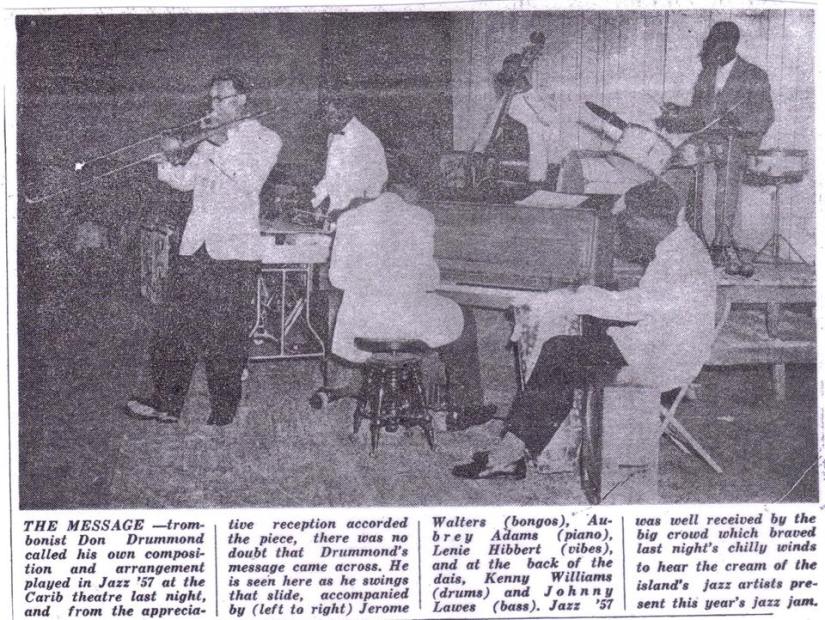
jazz-at-the-carib2

Here is another photo that ran in that same newspaper. The caption reads, “The Message–from trombonist Don Drummond called his own composition and arrangement played in Jazz ’57 at the Carib theatre last night, and from the appreciative reception accorded the piece, there was no doubt that the message came across. He is seen here as he swings that slide, accompanied by (left to right) Jerome Walters (bongos), Aubrey Adams (piano), Lennie Hibbert (vibes), and at the back of the dais, Kenny Williams (drums) and Johnny Lawes (bass). Jazz ’57 was well received by the big crowd which braved last night’s chilly winds to hear the cream of the island’s jazz artists present at this year’s jazz jam.

I write about that song, “The Message,” in my book, Don Drummond: The Genius and Tragedy of the World’s Greatest Trombonist. It was a song that made crowds go wild. Below is a better resolution of the photo above.

don-drummond-Lennie-Hibbert-Aubrey-Adams-Johnny-Lawes-Jerome-Walters-ans-Kenny-Williams

Anita Mahfood - Margarita, Don Drummond

Margarita Dreams of Stardom

margarita-vere-johns-jr.

Anita Mahfood, stage name Margarita, had aspirations of one day traveling to the United States to pursue a career in show business, according to her sister Conchita. Here is a photo from the Star Newspaper in 1961 that shows Margarita in her attempt to fulfill her dream of life on the stage. She was not only a rhumba dancer, but she was an actress as well and a performer extraordinaire. Here she rehearses for a performance with Vere Johns Jr., son of Vere Johns and Lucille Johns who were not only both impressarios of the Vere Johns Opportunity Hour (the talent show that launched so many musical and comedy careers on the island), but were actors themselves. This caption reads, “Money Talks Soldier–The curvesome Margarita (noted Jamaican dancer) and Vere Johns Jr., American-born son of Mr. and Mrs. Vere Johns, have teamed to form the latest dancing combination. They are here seen rehearsing the sequence entitled ‘The G.I. and the Girl.’ Junior served three years in the U.S. Armed Forces.”

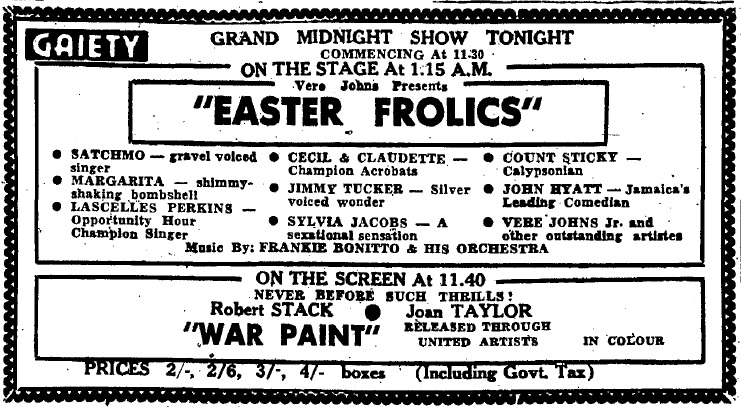
It wasn’t the first time that Vere Johns Jr. and Margarita had teamed up for performances with a Vere Johns Production. The following advertisement ran in the Daily Gleaner on April 1, 1956 for the Vere Johns Production of “Easter Frolics” where Margarita is billed as the “shimmy-shaking bombshell” and Vere Johns Jr. appears in the same performance.

margarita-april-1-56

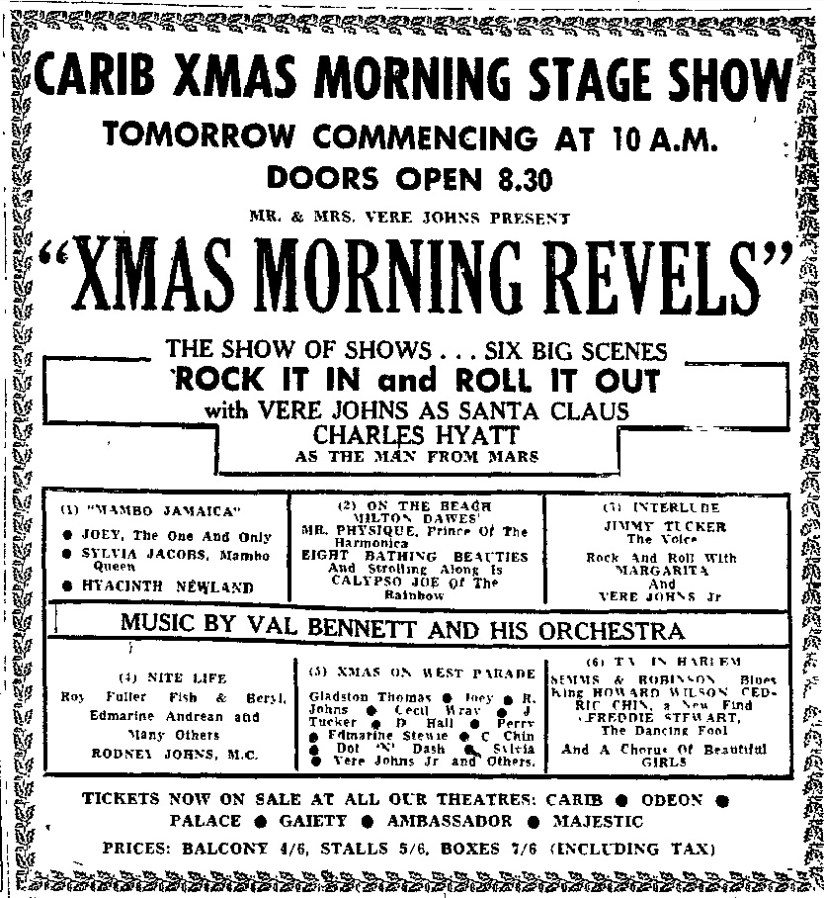
That Christmas season, Margarita also performed during a Vere Johns Production with Vere Johns Jr. in “Xmas Morning Revels” and the two performed a “Rock and Roll” scene.

margarita-dec-24-1956

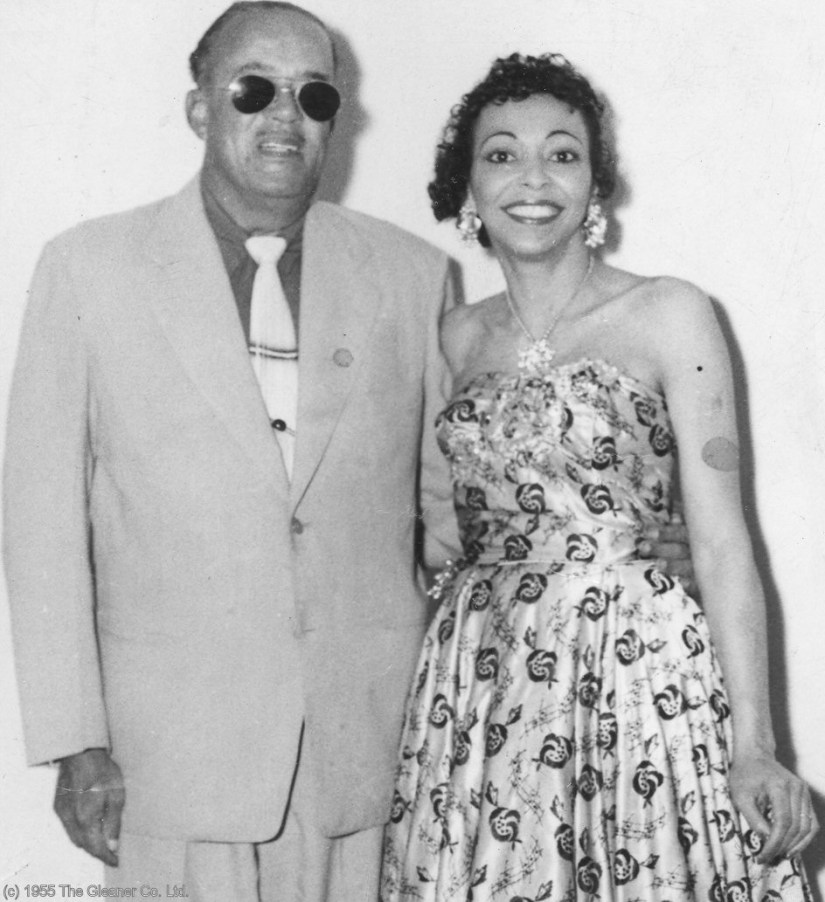
In fact, Margarita was so much a part of the Vere Johns Production team, she played the role of a dance club dancer in the documentary, “It Can Happen to You,” which was filmed by the Jamaica Film Unit in the 1950s. In the film, which I was finally able to find last year after many years of searching, Margarita tastefully dances the rhumba in a costume full of ruffles that she herself designed and sewed, and among her are bar patrons enjoying the band and dance. One of the main extras in the film is none other than Lucille Johns herself. Below is a photo of Vere and Lucille Johns, who is wearing the same dress in which she appears in the film.

vere-johns-and-lucille-johns

The following is an excerpt from my book, Don Drummond: The Genius and Tragedy of the World’s Greatest Trombonist: [Margarita] began dancing at clubs all over Kingston and she made her own costumes since she was skilled at sewing. Faye Chin says, “We danced together. We were in a group on stage. She used to do rumba; I do creative dancing, limbo dancing. It’s Alan Ivanhoe Dance Troupe I was in. She was an individual dancer and whenever they’re having performance like pantomimes or the theater used to have opportunity hour, she would dance there. She was a terrific dancer and she taught herself to dance. We became friends and we really became close and we were friends for a long long time until she passed.” Saxophonist Herman “Woody” King knew Margarita in those early days and says the clubs were her calling. “She was a great rumba dancer. The clubs would want her. Of course she had to go. That’s how she earned her living and she enjoyed it too,” King says.
Margarita always began her dance the same way with the same air of anticipation, the ultimate show-woman. As the spotlight hits one spot on the center of the dance floor, the music begins and Margarita is in the corner of the room, out of view. She saunters to the center, ruffles rushing through the tables of men, women, who turn their heads to see her passage to the light. When she comes into full view, the rhythms of the drums at their height, the audience is captivated, fully immersed in her powerful magic. She was auditioning for her dream. One day she wanted to dance on the stages in the United States, but she had to make a name for herself.

Margarita performed with the same circuit of performers, as did most Kingston entertainers of the day. She first met Don Drummond in the 1950s at the Bournemouth Club when they appeared on the same bill together. Ads appear in the Daily Gleaner in June, 1955 for Drummond and “Marguerita (Rhumba Dancer)” together on the same bill with others, including Pam Pam & Gloria, jitterbug dancers, with whom Margarita frequently performed. Margarita performed at the Ward Theatre, Club Havana, Club Baby Grand, Club Adastra, Carib Theatre, Glass Bucket, Rialto Theatre, Ritz Theater, and Queens Theatre, among others where she frequently received top billing. She played the role of a dance club dancer in the documentary, “It Can Happen to You,” which was filmed by the Jamaica Film Unit in the 1950s. On November 23, 1955 she performed in a show called the “Sundown Serenade” at the Ritz Theater with Bim & Bam, Danny Hyacinth Clover, Wonder Brothers and Did & Don’t. This type of billing with a theme for the show was a common feature for clubs in an attempt to attract tourists. Another was at the Ward Theatre on Christmas morning 1959 for a show called “Chrismania” which featured, among others, The Jiving Juniors, Lascelles Perkins, and music by Ken Williams and his Club Havana Orchestra. She also performed that same morning at the Carib Theatre for a show called “Xmas Morning Revels” featuring a similar line up with the addition of Vere Johns and Mrs. Vere Johns, music by Frankie Bonitto and his Orchestra. Artists frequently performed in multiple shows all over the city for Christmas. The clubs themselves also tried to capture themes, and Club Havana, where Margarita frequently performed, advertised itself as “Jamaica’s Latin Quarter.”

Anita Mahfood - Margarita, Don Drummond

Don Drummond and the Murder of Margarita

rusden-house1

I have heard over the years, read in books, and still hear today that on that fateful night, January 1, 1965, that Margarita did not give Don Drummond his medication, or gave it to him late, thus causing him to sleep through his Skatalites gig and, in anger, stab her when she returned on January 2nd in the wee hours of the morning. I want to take a moment to address this myth because I think what this argument does is very subtly places blame on Margarita for her demise, takes away some of the responsibility from Don, and gives some sort of justification or reason where there is no reason other than untreated insanity.

First on this matter, an excerpt from my book, Don Drummond: The Genius and Tragedy of the World’s Greatest Trombonist.

But many have thought over the years that Drummond became upset when he finally awoke to find he had not only slept through his performance, but that Margarita was gone. His defenders claim that Margarita manipulated his medication dosage or gave it to him late so she could go dance at the Baby Grand on Crossroads for her first show, and at Club Havana in Rockfort where she had her residency to dance the rumba for wealthy gawking men. There is no way to prove such a claim that Margarita somehow altered Drummond’s medicine he took to treat his schizophrenia, nor is there any way that anyone would know such information. Zola Buckland Sergi, Margarita’s niece, feels that many fans, band mates, or Rastafarians are skeptical of the events and merely looking for an explanation, looking to put the onus on Margarita for Drummond’s actions. She dispels this myth saying, “People say she must have given him his medication improperly and so he slept through it. She didn’t give him his medication! He took his own medication! My mom said it was impossible and people are looking for a reason why he killed her. The reason is, he was nuts!”

Now, let’s take a moment to think logically about this argument. How would anyone know that Margarita gave Don his medication late or not at all? Don never showed up at his gig that night, so he never left the house and was asleep. Margarita, the only person involved in the interchange, was dead, so was unable to tell anyone that she had done such a thing. If Don later told someone that Margarita had given him his medication late, that would be an excuse offered by the murderer, so is suspect, and has never been stated by any of the musicians. Instead, what we have are musicians or friends of Don who offer this as a sequence of events, as a way to provide reasoning. It is blaming the victim of abuse and it simply defies logic. But it speaks to the love for Don, that his friends and musicians would want to protect him, give him a reason. The reason, as Zola says, is he was insane and it was untreated properly. That is the reason, the only reason, and it is sad and horrible, but time that we accept it.

Here’s a similar blog post I wrote in October 2013. Still the myth persists, so I write it again.

http://old.skabook.com/foundationska/tag/anita-mahfood/

Anita Mahfood - Margarita, Don Drummond

Margarita and Domestic Violence

margarita

American news has been finally focusing on the epidemic of domestic abuse, particularly in professional sports like football. It always brings to mind, for me, the abuse that Margarita, Anita Mahfood, suffered at the hand of her professional boxer husband Rudolph Bent before leaving him to enter a relationship much worse, the one with Don Drummond that would end in her death at his hand. This past week I traveled to Kingston where I combed through the Star Newspaper archives which are still in original form, never digitized or put on microfilm, and with white-gloved hands, turning the pages of the yellowed and crumbling bound editions of the newspaper, I came across the following article. I picture it here and have transcribed the text below and ask the following question for those who have claimed that Margarita liked the violence, and yes, there are those men who have even spoken publicly about this theory of theirs–tell me how a woman likes this? That is all I will say for fear of letting my anger toward such claims run away with me.

From The Star, Saturday, November 21, 1964

Chopped, hit, kicked by her boxer husband

Repeated beatings by Jamaican and British Honduran middleweight champion, Rudolph Adolphus Bent (now in America), of his dancer wife, led her to seek her freedom from him in the Divorce Court yesterday. The court heard her story, of a number of violent assaults in which the boxer’s fists were brought into play, in her undefended petition.

Petitioner was Anita Bent (nee Mahfood), who is Jamaica’s premier rhumba and interpretive dancer with the stage name of “Margarita.”

Mr. Justice Shelley granted her a decree nisi with costs against her husband. Custody of the two children of the marriage is to be decided in Chambers. Petitioner was represented by Mrs. Margaret Forde, Legal Clerk.

Mrs. Bent wept as she told the Court that her husband had forcibly taken away the children and transported them to his homeland, British Honduras where they now reside with his mother. Mrs. Forde said that respondent entered an appearance only with regard to their custody.

Petitioner said that they were married in St. Andrew on March 15, 1961, but were never happy as he gave her no monetary support and had too many girl friends. She gave her present address as 32 Coral Way, Harbour View.

Assaults

She recounted some of the many assaults made on her by respondent. She said in June, 1961, he came home about 3 a.m. and when she spoke to him he told her, “Why don’t you take your pickney and go and leave me in peace?” Then he hit her with his fist in the right eye and on the mouth, which was cut and started bleeding. He grabbed her by the hair, opened the door and threw her outside. Next he threw their little daughter, Susie, after her.

Shelter

She ran up Slipdock Road to a friend in her nightgown and found shelter. In July, 1961, they quarrelled over money and he said, “You want money. Well, you’re not getting any from me.” He twisted her arm and choked her.

In September, 1961, there was another row over money and a girl and he tore off her dress and punched her down on the bed. He put a pillow over her face and tried to suffocate her. Another boxer in the house came in and rescued her, she said. A further assault was committed in November, 1961, when he choked her and tore off her clothes. She then left him to live apart as she was afraid of him.

In February, 1962, he asked her to return to him and hen she said she would not, he dug his two fingers into her eyes, hit her on the chin with his elbow, chopped her on the side of the neck with his open right hand and kicked her down. This took place while she was alone in her father’s home.

After they returned living, in July, 1963, he dragged her by the hair, thumped her with his fist in the face and tore off her clothes. Her sister came to her rescue.

Blood

Fay Roberts, dressmaker of 2 Glasspole Avenue, gave evidence of the assault committed in June, 1961. She said she was at the Slipdock Road address when Mrs. Bent came screaming into the home with blood flowing from her mouth and her eye swollen. She was in her nightgown and was carrying her baby.