Uncategorized

Ronnie Nasralla

nasralla

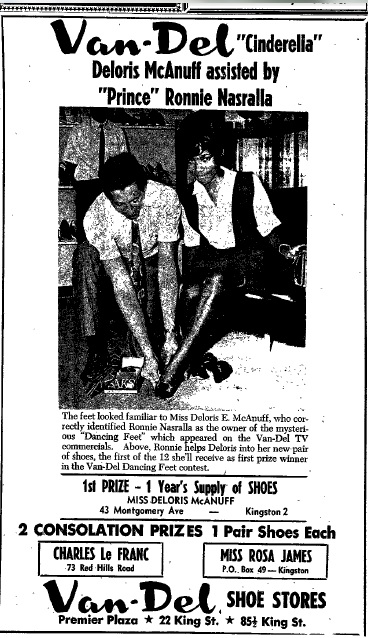
Check this out–Ronnie Nasralla from Ronnie & Jeannette fame, the dancers who taught us how to do the ska through, quite literally, an advertising campaign, is featured on this advertisement for a shoe store. If you read the ad copy, his “Dancing Feet” were featured on the television commercials for the store and this is the winner of the contest to guess whose feet they were. How awesome is this?!

A few words about Mr. Nasralla who is a lovely man and lives today near Atlanta, Georgia and is 83 years old, lucid as ever. He wrote a book called Lessons to Learn that I would HIGHLY recommend. It’s written well and is enjoyable and informative. He talks about his family upbringing, his foray into theater and dance, and, of course, how he helped to promote ska at the request of his good childhood friend, Edward Seaga.

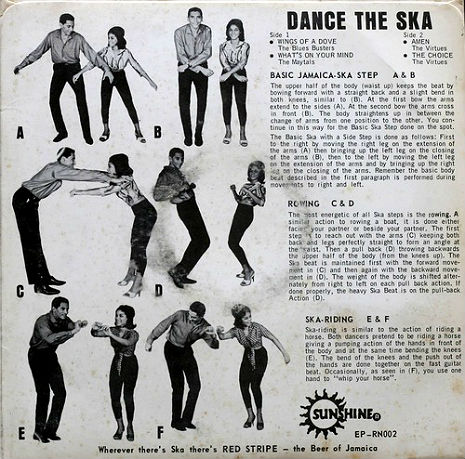
Ronnie Nasralla explained to me a few months ago how he came to showcase the ska with Seaga and Byron Lee. “Let me tell you how it started. One day, Eddie Seaga, who was my close friend, called me. Eddie Seaga was friends with my sister. He was my sister’s boyfriend and he used to come by my house and I help him with his political campaign. Advertising was my forte. So I did all the advertising for the government, Eddie Seaga at that time. I help him with all his promotion. He told me he heard a music that was breaking out in Western Kingston called ska and he asked if I could promote it for him, so I said, ‘Well, I’d like to learn about.’ And we organized and I said, well Byron Lee is the best person to promote it. So we get together with Byron Lee down in Western Kingston and I learned the ska music. Eddie organized a dance at the Chocomo Lawn in Western Kingston—it’s an outdoor nightclub. And Byron played there and all the ska artists performed with Byron and it was a sensation. He [Seaga] said to me, ‘Ronnie, move around the crowd and see what they are doing on the dance floor and see if you can come up with a brochure about how to dance the ska. So I did that, saw the people dancing around and came up with a brochure about a week after, how to dance the ska, give them different steps in the ska, and something that they could use to promote ska worldwide. That brochure was used by the government, they put it in all the record albums and it was sent all over the world and I was asked to go to the states and promote the ska with somebody and I got Jannette Phillips to dance with me. Jannette was a dancer, a belly dancer, a friend of my sister. We took pictures doing the different steps and the brochure was produced and given to the government and it was put in all the ska albums,” says Nasralla.

skaaaaaaaaa

Jannette Phillips, who married business mogul Raymond Miles in November, 1965, doesn’t speak about her days as a ska dancer. She works at her husband’s company, Sun Island Jamaica, but says she doesn’t “want to relive that part of her past. It was a long long time ago.”

Uncategorized

Prince Buster and Federal Records

prince-buster

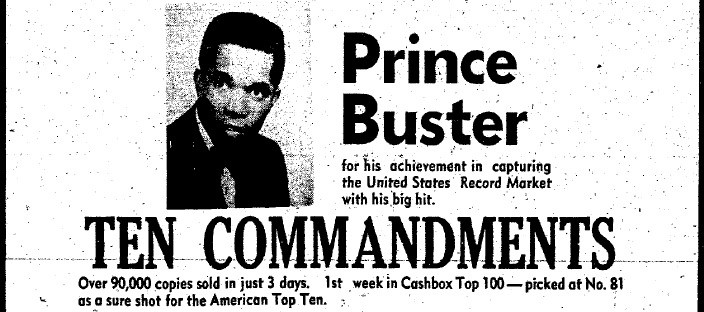
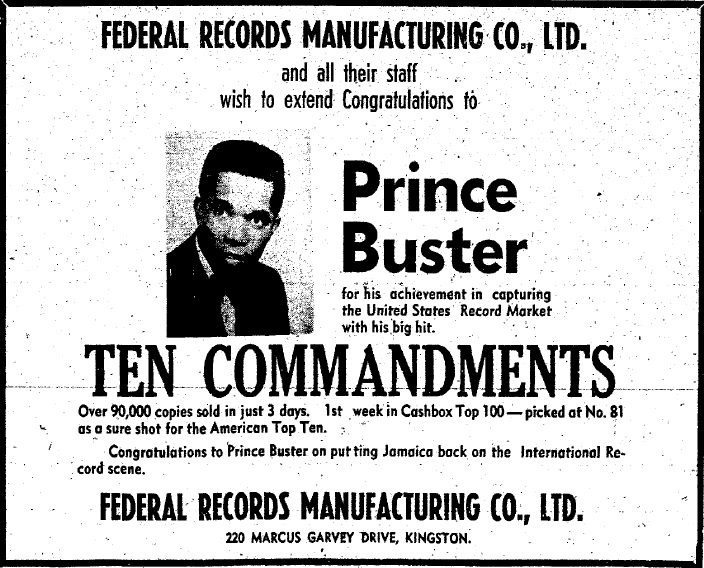
Nothing too pithy this week, just a little advertisement I found while looking through the Daily Gleaner archives. This little gem is from January 23, 1967 edition and is a paid advertisement from Federal Records. It is intriguing on many levels, and I guess it leaves me asking more questions than finding answers.

First, I know that Prince Buster and Ken Khouri had a good relationship. “Prince Buster was always with me in the ska years,” Khouri told David Katz in 2004. And he told Gleaner reporter Balford Henry in 2003, “I liked him [Prince Buster]. He was a Federal man. Nobody could say anything bad about him to me.”

Graeme Goodall, engineer extraordinaire once told me that even though Prince Buster may have had a few idiosyncrasies that may have been common to producers in those days, he was a favorite around Federal. “One of the interesting things was there was a guy, Cecil Campbell (laughs) and he kept on coming into Federal and he and Ken Khouri had this fantastic antagonism (laughs). Prince Buster of course, and he was always owing Ken Khouri money. He’d get soft wax and then he would go see Ken to pay the money. He used to ride on the back of Monty Morris’s Quigley motorcycle. It was a moped. And Monty Morris used to carry Buster around. Buster would go out, sell these records and come back and then he’d want to pay Ken Khouri and he’d want more soft wax and it got to the point where Ken Khouri said, ‘I don’t want him in my place anymore, he’s a samfie man, a con man, I don’t want him near the place.’ But there’s just something about Prince Buster that appealed to me. And I went up to Ken and I said to Ken, ‘He’s alright, he’ll be okay,’ and he said, ‘Samfie man. I don’t want him near the place.’ I said, ‘Ken, please, he’s alright. He’s different, but he’s okay,’ and he said, ‘Alright Goody, I’ll tell you what. He’s yours. He’s yours. If I lose any money I’ll take it out of your pay.’ And I said, ‘Yeah, I’ll take care of him.’ And Prince Buster has never forgotten that. I was the one who stood up for him because I could see something in there,” says Goodall.

The next bit of intrigue for me is that this seems like a lotta lotta records sold in the U.S. Now I’m no collector, I’m the first to admit, but I just find it stunning that 90,000 copies were sold in three days, but that likely includes all markets–JA, UK, and US, although the US is implied. The claim that he captured the United States Record Market is, well, delightful! And that he put Jamaica back on the international record scene! I just chuckle when I read about Prince Buster. I can’t help it. He is such a character! So there is a healthy dose of self-promotion and bravado and boasting going on here for sure, but then there is also, I think, a little stroking and patting on the back from Federal, who no doubt wants his continued business. It is just an interesting piece, don’t you think? What are your thoughts? Please share–I love the dialogue!

Uncategorized

Sound Systems at the Jamaica Festival

JA-street-parade

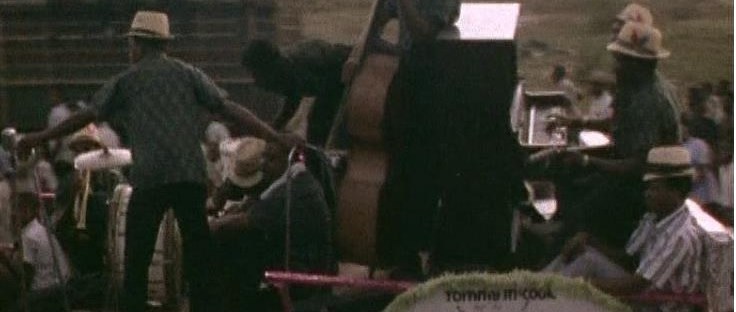
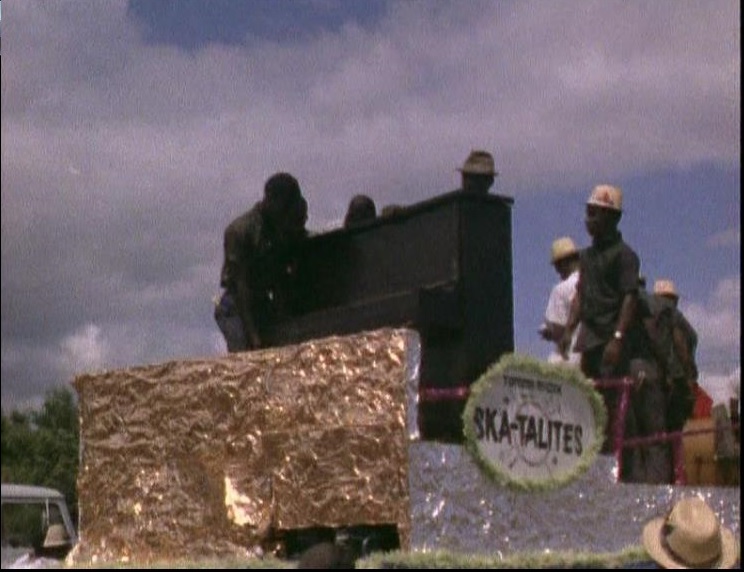
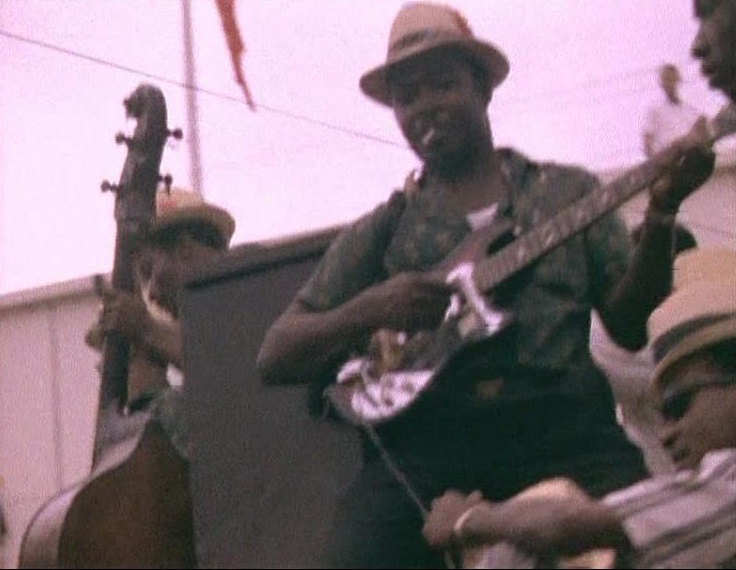
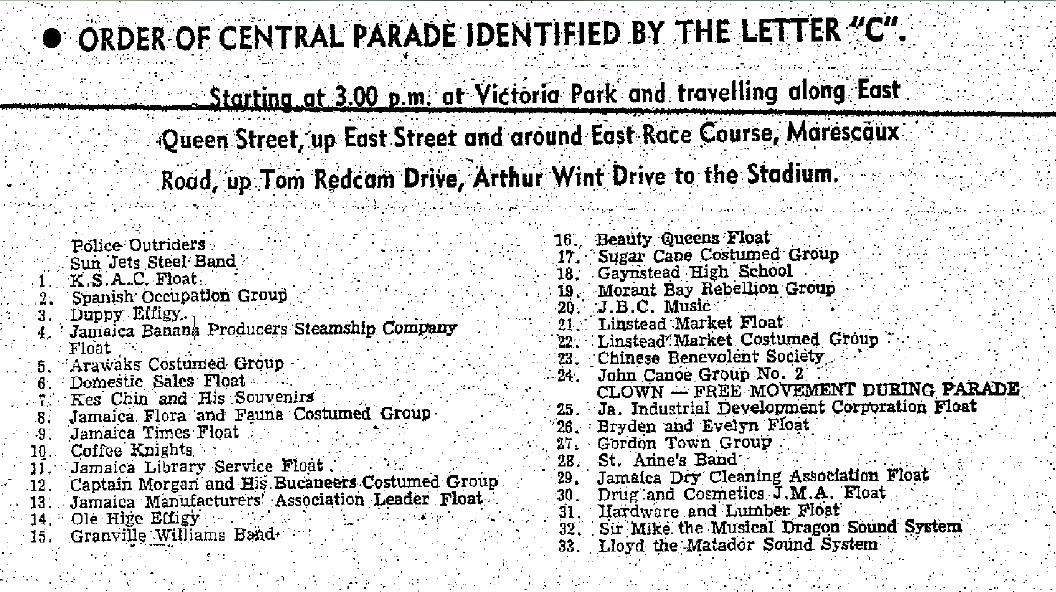
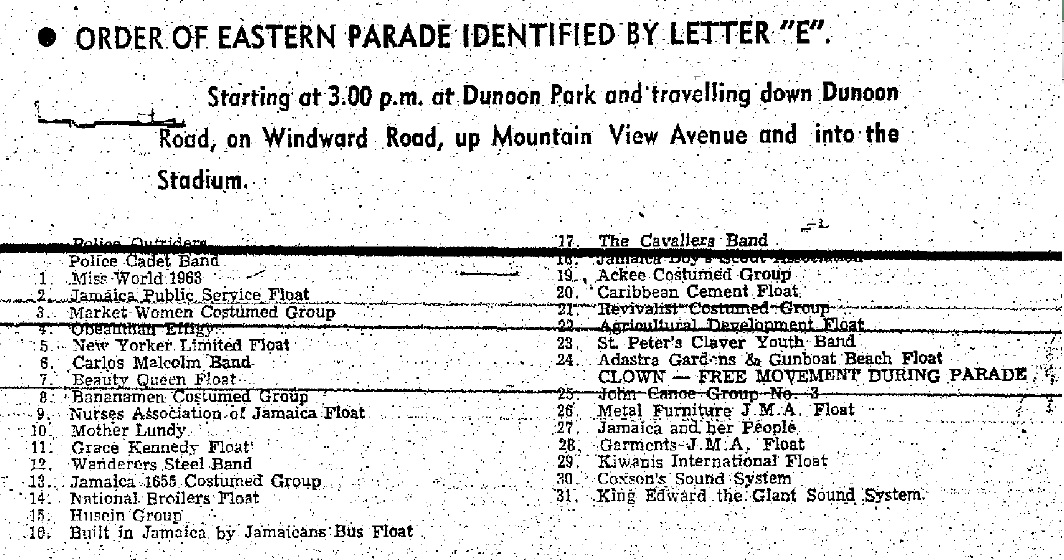
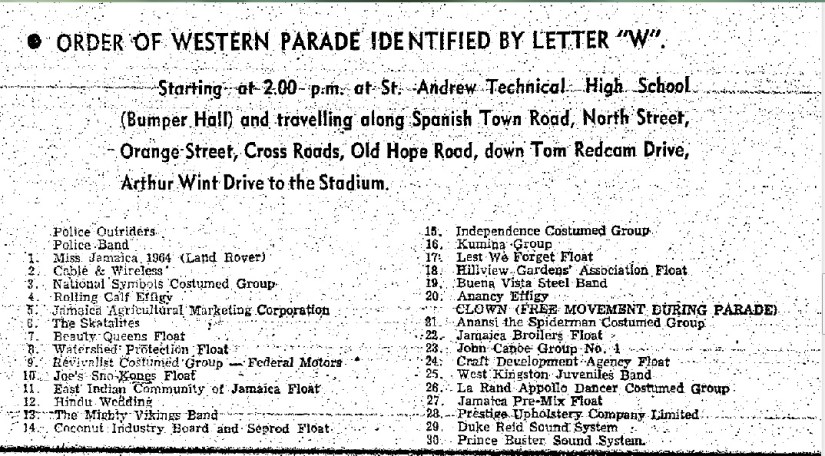
I stumbled across this advertisement from the Daily Gleaner, July 31, 1965 and noticed that a number of sound systems were playing for this celebratory street festival parade, and guests were encouraged to join in the parade at the end. Yes please! Can you even imagine? King Edward “the Giant,” Prince Buster, Lloyd the Matador, and even the Skatalites were in this parade! Geez Louise! If they ever invent a time machine in my lifetime, here’s my first stop! Below are a few stills from that now-famous footage of the Skatalites performing in this parade.

The Festival was founded by Eddie Seaga who pushed hard to promote ska with a deliberate strategy because he saw that ska was connected to the newly independent Jamaica and the nation’s cultural identity, although there are other reasons too. He founded the Jamaica Independence Festival, a showcase of Jamaican arts, which included an all-island ska and mento competition. At the first annual festival, Byron Lee & the Dragonaires performed, of course, and the festival was hosted and funded by the Ministry of Development & Welfare, Seaga’s department. The first festival began in 1962 to celebrate and coincide with the independence. Seaga continued the festival each year after and in 1966 brought the Popular Song Competition into the offerings. Seaga’s meetings of the Parish Festival Committee were broadcast on JBC and RJR so the public was aware of his agenda to promote ska. And he was photographed and appeared in the newspaper as he cut checks to artists like Prince Buster for their help in promoting ska.

In case you don’t have a magnifying glass to see the performers at this Festival, here are the closeups, which I think are immensely interesting:

JA-street-parade3

Folkes Brothers

Oh Carolina: The Folkes Brothers

oh-carolina1

In 1994, Roger Steffens wrote a fantastic article about the Folkes Brothers and their significant song, “Oh Carolina.” He had the opportunity to interview John Folkes who talked about the creation of this song and their origins as a group. Here is the transcript which was written in the middle of the lawsuit over the rights to the song. A judge did finally rule that John Folkes was the song writer.

Folkes’ Tale

falseSteffens, Roger. The Beat 13. 2 (1994): 58-59,82.

 John Folkes raised in Trench Town and holder of a Ph. D. in literature from the University of Toronto, recently surfaced from self-imposed retirement from the music business to speak with The Beat at length about his inspiring history and his current legal battles. On the phone his voice is avuncular, rich and warm, conjuring up the image of a mild-mannered middle-aged mentor, sounding like the professor he is. But physically, he appears half his age, tall, slim and muscular, without a trace of gray. He compares himself to Hemingway’s Old Man and the Sea, battling against powerful forces, undaunted and filled with conviction that justice will be his.

“I was born in Trench Town,” he recalls, “the bedrock of Jamaican music. Number 5 Sixth Street. My father was a minister of religion in the Church of God, a Pentecostal Church. You had problems in terms of just surviving, finding food on the table and so forth, but there was always the music, there was the religion, the sports, and the sense of belonging in a community.”

He made an enthusiastically received public debut at Race Course at the age of 12, imitating Mario Lanza, singing “The Lord’s Prayer.” “I used to imitate Uoyd Price a lot, and Chuck Willis, Elvis Presley and Ray Charles. You’d listen to these people over the Rediffusion or radio and you’d try to imitate them, and you’d get the voice training. I also entered competitions at the nearby Ambassador Theater and Palace Theater, musical challenges which helped nurture the creative forces that brought ‘Oh Carolina’ into being.”

By 1953, at the age of 12, he had begun what he calls “a spontaneous primal kind of vocal expression” in their yard, joined by his two brothers Mico and Junior for informal practices. Derrick Morgan, Alton Ellis, and other local luminaries would come by, offering encouragement. “My first gig, “remembers Folkes, “was on Vere Johns’ Opportunity Hour,’ with a song called ‘Beep-oop-mm-bipe-oop’.”

“Oh Carolina,” destined to become one of the most requested songs in the history of Jamaican sound systems and dances, dates back to 1953 , the year in which Folkes “actually composed it with a pencil in my hand on my doorsteps. The other details of the composition itself I want to remain as an Arcanum at this stage. But I will say this much: A variety of interesting elements conjoined in my creation of the song.” He continues animatedly: “I knew it was going to be a hit. In the yard first, they just say ‘Whoa!’ And this was before the drumming or the background or anything , just the tune itself with the backup with my brothers. When I sang in those days I always got a gathering, and people would do a kind of dip dance to it, not ska, and I realized it was a different kind of song. Even one recording artist who had a big hit previously wanted it. It was that well received then, before I met Count Ossie.”

Living in Trench Town, the Folkes family often came in contact with dreadlocked Rastamen, who at the time were considered the lowest of all social outcasts, and were often objects of scorn and fear. Folkes sought them out for religious dialogue and found them to be “very good people.”

The connection between one of Rasta’s most influential drumming groups, Count Ossie and the Mystic Revelation of Rastafari, and the sons of the preacher man came through a wanna-be producer who met them at an audition at Duke Reid’s liquor store/studio. His name: Prince Buster. “I didn’t know anything about him,” admits Folkes, “he was just a dj at the time with Duke and a bouncer. So he had no name and this is why I say that The Beat magazine article [Vol. 12 #4, 1993] which said that Count Ossie really put the song along, it sort of rode the coattails of fame, it’s not really true. Because they literally had no names at the time. Count Ossie was doing his Nyahbinghi drumming up in the Wareika H ills, and it was pretty well confined there, and the general public knew nothing of Prince Buster. The truth is that the song was so strong that it promoted itself.”

Mico, Junior and John Folkes had spent some time rehearsing their song at Reid’s establishment when by happenstance they met Prince Buster, who showed great interest in the song, so Folkes decided to cut it instead with him. But Folkes is emphatic in alleging that Prince Buster “stole my song, went ahead and published and produced it without honoring the oral agreement he had with me and exploiting it throughout the years without my perm ission . ” The brothers took immediately to Count Ossie, and Folkes remembers him as “being a very pleasant, very cairn gentleman. Bunny and Skitter were there too, practicing ‘Chubby’ up in the Wareika Hills where my brothers and I rehearsed 1Oh Carolina’ with Count Ossie. But of the songs with the drum sound released at that time from the Wareika Hills rehearsals with Ossie, ‘Oh Carolina’ was the one that took off. It had the magic. It even overshadowed the flip side, ‘Met A Man.’”

“Oh Carolina” became “one of the first songs recorded in the JBC studios,” according to Folkes, and they did it all in one take. “Now very interestingly enough, because in The Beat article it said that Buster possibly played the piano – no, it was Owen Grey. He came while we were rehearsing a bit and came up with the piano riff , just cold, from out of nowhere. He had not rehearsed it with us before. A kind of deus ex machina event. He just came in and wanted to be part of an exciting happening and I allowed him to help out.”

The song was released in late ’59. Forresters Hall was where the dancehall massive of the time went to hear the very latest shots, and the song was played there as many as 1 5 times in a single evening. “People were just traveling there, they would fill up the place just to hear this song.” It got so big, the radio could no longer ignore it. “I remember the first time it came over JBC,” exults Folkes. The announcer, “Radcliffe Butler said, ‘Here is a very controversial song’!” It was because “Oh Carolina” was “the first song throughout the whole history of Jamaica that gave the Rastafarian movement respectability, and it did it in a subtle way. The tradition of the kumina drums, and the cromanty drums, burru drums, those are the symbols of protest in Jamaican history. The Maroons, for instance, who fought the British successfully, used to communicate with one another through the sound of drums. Also the drums were socio-cultural instruments that colonized Jamaica couldn’t truly identify with because of the rituals and the seances around them, the Pocomania tradition, for instance. So even though they are very truly our culture, Jamaicans had a way of looking down at things like that because of the colonial influence in the country.

“So I did Count Ossie a favor, because he was looking for someone to record him. And he got his name associated with the song. The drums came and they had a controversial effect too, because people say the drums were Rastafarian. But in Oh Carolina’ it was just the drums: There were no Rastafarian lyrics. There was no protest, there was no philosophy, no theology. And so it was acceptable as an art form that somehow empowered African roots in a very unintimidating, subtle fashion. At first people thought, because of the drums, that the Folkes Brothers were Rastafarians; also because my brother, Mico, wore a full beard then. But we were and still are Christians.”

The single was released under the Folks (sic) Brothers name on the Buster Wild Bells label. “People didn’t know whether to dance to it or listen to it. I felt good because I realized if there was that polarity of response to it, it must have been good.” Then, “a dance sort of just evolved from it. The Rastafarians would do a kind of spear dance to it, a jump and spearing action, sort of reminiscent of the tribal interpretation of social events In dance and music. And then the general partygoers would do a jump-and-kick dance to it, and at points they would hold hands together in a communal folksy form, in response to the music. Shaggy’s video has people doing the ‘wind’ and ska dance to it. While music does allow for freedom of interpretation and expression, the true dance to Carolina’ is “The Carolina Dance,’ such as I described to you. Oh Carolina’ is not ska; neither is it calypso or rhythm and blues or boogie woogie or mento or rock ‘n’ roll. It is essentially an innovative heritage folksong done, ironically, by Folkes. But it has echoes of some of the above. It was a party song, and it still is a party song. At Jamaican parties, the original is still being played too, to introduce the whole party and in the middle to introduce the old songs, and at the very end,” just as Island Records chose “Oh Carolina” to begin and end their recent 4-cd Jamaican musical history box set Tougher Than Tough. Says Folkes with a mixture of humility and wonder, “One gentleman said to me, Jamaica’s national anthem is ‘Carolina.’ Though it’s an exaggeration, it just shows the extent to which it has sort of gotten itself rooted in the very fabric of Jamaican culture.”

How does he feel about his composition being referred to as the “first reggae record”? “It’s not really true,” he demurs. But “it influenced the reggae movement. You know, I think of ‘Oh Carolina’ the way I do Emily Bronte’s Wuthering Heights. It stands there in literature by itself refusing to be analyzed in traditional terms. Yet it’s a powerful thing, not written with any kind of formal tradition, but just powerful feral writing.” Plus, ” ‘Carolina’ has a heavy drum sound: primal, atavistic, infectious, going back to your roots, but at the same time not making any threatening statement. The ideal combination. And what happened – once the Rastafarians got the respectability, it was now possible to invoke the philosophy. It paved the way for Bob Marley and others.”

In 1967 Folkes found his way out of the fetid backwater of Trench Town and into the frozen north of Toronto, where he eventually achieved a doctorate in literature, writing his dissertation on the poetry of Robert Frost. He became a high school teacher, specializing in English literature and theater arts, which gave him the opportunity to sustain his love for music and passion for composing songs. During these years he composed over 150 songs which he says he still plans to do something about. Has he been happy with the “Carolina” experience? ” ‘Carolina’ was not a song that gave me much pleasure to think about or much pleasure to talk about, despite its fame.”

Until last year. From out of nowhere, a Jamaican living in America, a Persian Gulf war veteran calling himself Shaggy, recorded a version of “Oh Carolina.” (There had been other versions done earlier without Folkes’ permission, the Byron Lee and the Dragonnaires version, for example, and one done fairly recently by Brian and Tony Gold. The latest are ones by Reggae Master [“On A Reggae Tip”] and Shabby G [“Loaded”] which both credit Folkes as writer.) The Shaggy version set the whole world on fire, topping the charts in a reported 14 countries.

Suddenly the sharks circled once more. “Buster,” Folkes inveighs testily, “reports he got a gold record for recording my song. So he is not only claiming unlawfully to be writer of ‘Oh Carolina,’ he is also claiming to be the singer, saying that my voice is his. On one label he even puts down ‘Prince Buster and the Folkes Brothers. ‘ And to add insult to injury he is making claim that my brothers never backed me up in the recording. I wonder what ‘Folkes Brothers’ means then, if it’s not Mico Folkes, Junior Folkes, John Folkes. Finally, I got the opportunity to call him into questioning, after all these years. He either thought I was dead or a fool. He mistook silence for acquiescence, and patience for delay. He mistook the Devil’s time for God’s time. He forgot about automatic copyright, which extends up to 50 years after an author’s death. Now he and others will experience the reality of one of his one songs, of one that he can truly say that I did not compose, Time Longer than Rope.’

Another potential litigant is Henry Mancini who, astoundingly, demanded 50% of all royalties through his lawyers. One smiles wryly at the image of the “Pink Panther” and “Peter Gunn” composer sitting around an open campfire in the Wareika Hills in 1958 sucking chalice with a bunch of matted-haired Rasta outcasts, trying to come up with a hook for “Oh Carolina.” In truth, it is because of the alleged use of a small sample of Mancini’s “Peter Gunn” in Shaggy’s hit that Mancini is asking for all that money. He subsequently came down to 20 per cent. But Folkes wants truth to bring him down to zero. “It’s really silly,” observes Folkes, “because I played Mancini’s line for a music teacher at the school where I work, who has over 25 years’ experience, and she said, ‘But, John, that bar goes back to the 11th century!’

Mancini has his name put down along with Buster and Shaggy on Shaggy’s album as writer also, thus being part of a process that criminally discredits me as author, making me out in this way to be a liar and a thief as I claim what is my own.” Folkes is equally perturbed over Virgin Records’ (with whom he says he signed no contract) dealings with the song. Folkes comments: “Virgin has credited Shaggy, Mancini and Buster on Shaggy’s album as writers, and at various times all of them plus Orville Burrell and W. Riley in Billboard as writers of the song, without any mention of John Folkes, its composer. I was shocked when I learned months ago what Buster did. I didn’t believe he would go that far. So if anyone believes that because Prince Buster, after many years, out of jealousy and greed, went and registered my song in his name when I had not registered it. that act makes the song his, they are badly misinformed, truly deluded. I have registered my song too, but registration is not proof of copyright, it is only suggestion of copyright ownership. It is automatic copyright, which is mine, the act of creation itself, that is crucial, that is proof of ownership.”

Although the lawyers, as always, are the only ones making any money currently from the case, Folkes is unflagging in pursuing his claims. “I can’t live with anybody saying it’s not my song. I did not sit down in 1958 on my doorsteps at 5 Sixth Street, Trench Town, and write the song with either Shaggy. Henry Mancini or Cecil Campbell [Prince Buster), or anyone else. I created it alone, and I do not want any credit to be given to these people under any circumstance. After he started exploiting my song, Prince Buster built an impressive house up in Beverley Hills in Jamaica, and Shaggy got the greatest reggae contract in history because of his cover version of my song. A whole bunch of people have become fat off my composition, and they are still coming in, lumbering like overstuffed cormorants looking for more than their pouches can hold. They are all moving in viciously likethe sharks seeing blood on Hemingway’s old man’s big catch. And I have to be beating them off with a 35-year-old oar of truth, which is 35 times stronger for its golden age. Yes, I am speaking out at last, and I am not holding back any punches, for God Almighty is on my side.”

And how much did John Folkes make for his perennial anthem? “Sixty pounds, and even that pittance was extracted from Buster under circumstances that were not very pleasant,” indicates Folkes. “It was all promises, he laments. “I trusted the man. I was hoodwinked: He was going to take the song and give me nothing. I mean absolutely nothing, much less royalties. Now it is not just the money; it is the principle, all about truth, and justice, and my good name. I don’t like being publicly made out to be a liar and thief of what is mine one bit. Not one bit!”

A court case is scheduled to be heard in October in London to determine the lawful composer of “Oh Carolina” and to disperse royalty payments for the song. Thirty-five years of musical history will be listening to the verdict.
 

Theophilus Beckford

Easy Snappin’ Theophilus Beckford

theo-photo

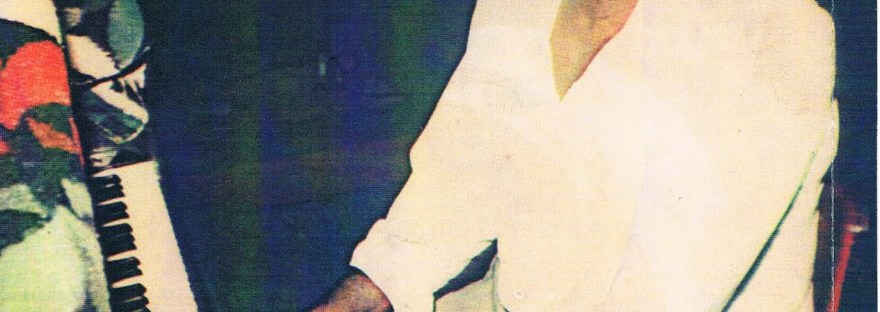
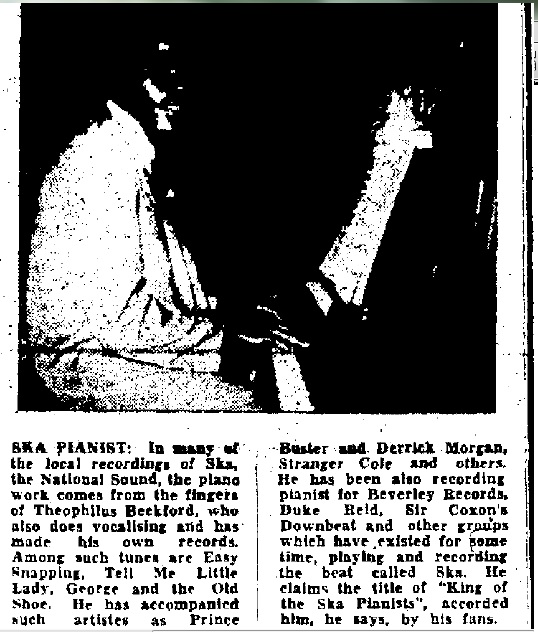
I always thought they called him Easy Snappin’, not because his song was arguably the first ska song, but because Theophilus was too hard to say! Kidding of course, but I would like to take some time to look back on Easy Snappin’, or Theo, or Theophilus Beckford, that talented pianist to whom we really owe a debt of gratitude. He helped to launch a genre.

Theophilus Beckford was born in 1939 in Trench Town, the same neighborhood that gave us Bob Marley, Alton Ellis, Hortense Ellis, and even DJ Kool Herc! His father was a skilled pianist but Beckford learned to play piano in school and was also self-taught. He performed in the style of the popular artists of the day—American R&B like Roscoe Gordon and Fats Domino. But he didn’t start recording in this style since the only real recording being done on the island at this point was from Stanley Motta who recorded calypsos. So Beckford recorded for Motta on a number of calypsos and as the recording industry developed when Ken Khouri established Federal Records, Beckford was able to develop the style he loved—American R&B which evolved into ska.

Many will argue that “Easy Snapping” was a boogie shuffle tune, and there is something to be said for that. But Easy Snapping features a more punctuated piano rhythm that is less slippery than the shuffle beat, and it also features brass, so it can easily be argued that it is the first ska song. Some say that it is neither R&B nor ska, it is somewhere in the middle, so it a way it is the Lucy of evolution, the missing link. Whatever your take, it is evident that this song, and this artist, are essential to the creation of ska and the genres that follow.

“Easy Snapping” was recorded for Coxsone at Federal Records in 1956 for Studio One’s first ever recording session. Michael Turner writes in Beat magazine in 2001, “The song was recorded for Coxson Dodd in 1956 at Federal studio, but at the time recordings were pressed onto soft acetate for sound-system use only. Three years later the commercial release of records in Jamaican began . . . ‘Easy Snapping’ was released late in the year and its lazy intonation and emphasis on the offbeat made it a massive hit, and presaged the development of a unique Jamaican sound.”

theo-beckford-nov-20-1960

The song was an immediate hit and stayed on the charts for 18 months. It was also released in the UK on the Blue Beat label. Of course, Beckford received no royalties from this song even though it was used in a European jeans commercial later on. The song on Coxsone’s Melodisc label is credited to Theophilus Beckford, Clue J and His Blues Blasters while the Blue Beat version is credited to Theophilus Beckford, Clue J and His Blues Blasters, Trenton Spence and His Orchestra. The B side of both releases was the tune “Going Home.” He recorded others for Coxsone as well as Simeon Smith who was better known as “Hi-Lite.” He performed piano as a studio musician for hundreds of recordings. According to Mark Lamarr, “As pianist in Cluett Johnson’s Blues Blasters and as a session musician, he played on countless cuts for Prince Buster, King Edwards, Leslie Kong, Duke Reid and Coxsone Dodd.”

theo-5-10-1964

Growing frustrated with receiving no pay from Coxsone and others, Beckford established his own label in 1961, King Pioneer, and he released many of his own tunes—perhaps the first DIY guy! He became producer on his label for artists such as Frank Cosmo, Daniel Johnson, Keith Walker, Lloyd Clarke, Wilfred Brown, the Greenbusters, the Meditators, the Pioneers, Toots & the Maytals, and Eric Monty Morris & Patsy Todd on the duet “Don’t Worry to Cry.” Michael Turner writes, “Approximately 50 songs came out on this label between 1962-66, and most of these were strong works exhibiting the many styles and flavors of ska.”

theo-photo1

In later years, after ska and rocksteady and reggae was considered “oldies music” or “granny music” by Jamaican youth when dancehall took over, Beckford was able to eke out a meager living by performing at gigs anywhere he could find. “Things are rough on my side and I am surviving through the will of God and the love for the music,” said Beckford in a Jamaica Gleaner article in 2000. “Today as I listen to music on radio and sound system and recognise that I created some of these tunes. I feel strongly that I am not given full recognition for my work.” A year later, Theophilus Beckford was dead.

theo-photo2

On February 19, 2001, Beckford went to resolve a dispute with a man in Callaloo Mews. After leaving the residence, the assailant “chopped” Beckford in the back of the head with an axe, according to the Jamaica Gleaner, and he was killed. His son Lloyd stated, “What kind of society is this where a 65-year-old man can be so brutally murdered and to think that it is someone who is well known and has contributed to the development of his country.” Certainly, Beckford has left a legacy. He is to be respected for his contribution to the development of the Jamaican music. The Guinness Book of Who’s Who in Reggae credits Theophilus Beckford with creating “the feel and soul of ska.” Let’s give credit too.

Uncategorized

The Australian Connection

aussies

My friend Kingsley Goodison, also known as King Omar, puts on a wonderful show in Jamaica each year called Tribute to the Greats. He publishes a magazine and program to accompany this show and the publication in 2012 for the 15th annual Tribute to the Greats show contained a wonderful article on the Australian connection that I would like to share. Kingsley has been in the music industry for decades. He is brother to Bunny Goodison, music historian, and Lorna Goodison, author and professor. Kingsley worked for Studio One for many years and he is a legend.

Here is the article from his program:

The Australian Connection

Jamaica’s music scene has attracted people from all over the world from its early beginnings and Tribute to the Greats has acknowledged this in the past. The Cuban connection was with recognition of Rudolph “Baba Mack” McDonald and other Afro-Cuban artistes. The Caribbean connection which celebrated the contributions of Trinidad and Tobago’s Lyn Taitt, Kenrick “Lord Creator” Patrick, Kenneth Lara, and Barbadian Jackie Opel.

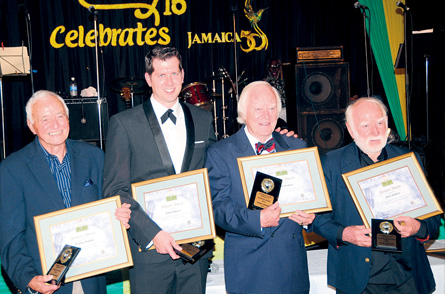
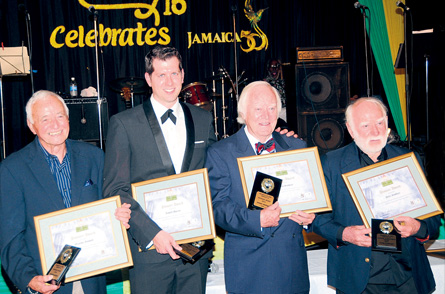
For the 15th Anniversary of Tribute to the Greats, it was decided that the Australian connection would be highlighted. Dennis Syndrey, Graeme Goodall, Peter Stoddart, and Lowell Morris will be recognized at the Awards Show and Dance for their contribution to the Jamaican scene.

Graeme Goodall Graeme Goodall: Born in Melbourne, Australia, Goodall first came to Jamaica in the early 1950s, assisting administrators at the fledgling Radio Jamaica to install its broadcast network.

Goodall was with pioneer music producer when he established his first recording studio in the last 150s. When Chris Blackwell started Island Records in 1959, Goodall and music producer Leslie Kong were partners in the company.

Though Goodall founded Doctor Bird Records when he moved to London in the 1960s, many associate him with his work as a sound engineer, especially at Federal Records where he fine-tuned countless hit songs.

He is also credited with helping to get Jamaican music on British pirate radio in 1965, paving the way for ska and later rock steady to make it on mainstream airwaves in that country.

Dennis Sindrey: Australian born Dennis Sindrey began his musical career playing guitar in various clubs and hotels in Melbourne, Australia along with fellow band members Lowell Morris (drums) and Peter Stoddart (piano). The group’s manager and band leader Max Wildman, accepted invitation to come to Jamaica in 1958 and play at the renowned Glass Bucket Club. They christened themselves the Caribs and began their musical sojourn in Jamaica. When the Glass Bucket closed, the Caribs, now including other local musicians became the house band at the Myrtle Bank Hotel.

The Caribs also established themselves as a backing band and performed duties for many artistes signed with Chris Blackwell’s Island Records. While recording their own records at RJR, they became acquainted with fellow Australian, recording engineer Graeme Goodall, a relationship which continued for several years.

The Caribs broke up some years later when Lowell and Max returned to Australia, but Sindrey remained in Jamaica playing guitar for Byron Lee and the Dragonaires and Kes Chin’s Souvenirs. He continued to record with famous producers including Coxsone, Prince Buster, and Leslie Kong. He has played on recordings for the Skatalites, Millie Small, Laurel Aitken, Owen Grey, Jimmy Cliff, and many others. In 1962, he joined with Stoddart and formed the New Caribs and performed at the Sheraton Hotel.

In 1968 Sindrey moved to the US where he continued to be involved with the music business. He met up with Graeme Goodall when a concert series titled “The Legends of Ska” was held in Toronto, Canada. In 2008, Stoddart, Morris, and Sindry held a Caribs Reunion concert in Melbourne which has a vibrant ska scene. Sindrey continues to make music in South Florida.

Uncategorized

Baby Talk

millie

The first time my friend Michael Turner chatted me up about the way many female singers use a baby voice we were at Gloria’s in Port Royal and I was too distracted by the head and tail still on his red snapper and the froth on my Red Stripe to get past the surface response of, “Yeah, there are a few of them, aren’t there?” We threw out Millie Small of course, and a few others. The second time he mentioned it was recently on instant messenger and he sent me few links to some Hazel & the Jolly Boys tunes, and there it was again. I had to investigate.

Why the baby voice? Why do a number of women in the early 1960s sing like a little tiny girl? It can’t be real, right? It sounds like a falsetto. It’s the difference between the Madonna of “Like a Virgin” and the Madonna of “Like a Prayer.” Two different voices, one contrived, one full and deep. Vocal personas. Of course the most notable of examples is Millie Small’s “My Boy Lollipop,” and considering the popularity of this song, I have come up with a couple of theories on the baby voice and would like your opinions, so chime in at the comment section at the end. And if you’re not sure what I mean, here are a few links:

Millie Small’s Sweet William: http://www.youtube.com/watch?v=qsZ2LMmc8J8

Hazel & the Jolly Boys and the Fugitives: http://www.youtube.com/watch?v=mFZY-qRkxNM

Hazel & the Jolly Boys and the Fugitives: http://www.youtube.com/watch?v=435G6-ISqlY

Okay, so let’s start at the beginning. It has been theorized that the falsetto (and I do believe this is related, as I will show) originated in African folk music. I’m not sure this really translates to Jamaican culture though because the African folk music featuring falsetto came from the Mbube style of South Africa, and the tribes that came to Jamaica through the slave trade came from West Africa, so there may or may not be a connection. But the early American rhythm and blues forms, and the music that preceded that, like blues and gospel, also featured falsetto, and this music definitely influenced Jamaican music.

In the 1930s and 1940, even before those radio broadcasts came to Jamaica via New Orleans, Miami, and Nashville radio airwaves, groups like the Swan Silvertones and the Soul Stirrers used falsetto in their repertoire. One of the most important blues singers, “Howlin’ Wolf who helped to develop the Chicago blues style, combined both falsetto howl and a growling voice to characterize his own sound. Clarence “Frogman” Henry, Jr. had his classic novelty R&B tune “Ain’t Got No Home,” in which he uses a falsetto.

In the 1950s, groups like The Ink Spots, Little Joe & The Thrillers, Jan & Dean, the Flamingos, Frankie Lymon & the Teenagers, and dozens of others used a falsetto for the high tenor to round out the full line-up of harmonic tones. Were these groups an influence on Jamaican vocalists? You betcha they were! Patsy Todd told me herself, “I’m somebody who liked to listen to the radio, and I really got interested in this group, Frankie Lymon & the Teenagers. I used to hear them singing and I used to sing after them.”

We know that a number of Jamaican vocalists over the years then employed the falsetto from time to time, including the Jiving Juniors in 1962 with “Sugar Dandy,” Desmond Dekker in plenty of songs, and of course, Junior Murvin in the classic Police and Thieves in 1976 to name just a few.

How is the falsetto connected to the baby voice? They sure aren’t the same thing. Well I would argue that it is a woman’s attempt at a tiny little voice, like the falsetto. A female voice attempting a falsetto is, well, just a female voice in a way, so perhaps they were trying to minimize their voice in the same style—after all, Jamaican musicians during this era were attempting to emulate the sounds they heard from America with their own take on it.

But I do have a few other thoughts on this subject too. I really do feel that Millie Small’s voice in her “My Boy Lollipop” classic is her singing voice. I just talked to Millie a few months ago and her voice is tiny, even in conversation. That’s not to say that as Millie’s singing voice matured that other deeper qualities didn’t come out, but in 1964 at age 15 when that song was recorded, she was using her little girl voice which can be heard in almost all of her other songs like “We’ll Meet” with Roy Panton in 1962, “Sweet William” in 1964, and “Hey Boy Hey Girl” with Jimmy Cliff in 1966. Considering that a little girl voice was so popular during this era that even the men were trying to use one, Millie sure didn’t try to get rid of it. The heavy tones and gloomy themes of Billie Holliday and female jazz singers were no longer in fashion. It was upbeat, spritely, fresh, and independent. Considering the popularity of this song, which was HUGE, it’s not too farfetched to see that many other vocalists continued in the same vein. In 1967, Hazel Wright recorded “Stop Them” with the Jolly Boys and the Fugitives, with the B side “Deep Down,” both of which feature the baby voice. There are others too so identify some more in the comment section, if you hear one or two.

There is one more thing I want to mention before I finish my end of the discussion here, especially since the form of the duet was so popular during this time. There is the underlying, certainly not overt, image of the female as sweet, demure, needing a strong man for survival, while the male is the strong provider, the savior, the powerful character. This is a traditional and stereotypical role for men and women, especially during this era. Before you cry foul, think about the images portrayed in American television during the late 1950s and early 1960s, the images of sexuality and femininity—they are innocent and wearing pearls. That’s not to say there weren’t other images of women during this time, but the baby-voiced girl certainly fit in with the times.

Just a few of my thoughts. What are yours?

And I am adding this paragraph to my post after reading some EXCELLENT comments made by fellow JA music aficionados. The influence may very well be Shirley & Lee, that duo that has hugely popular in Jamaica during the late 1950s. The vocal team was from New Orleans so not only were Jamaicans getting songs like “Let the Good Times Roll” and “The Flirt” on radio from WNOE, but they also witnessed Shirley & Lee in person since they performed in Kingston a number of times. They performed at the Carib Theater in October, 1957 when they were billed as “The Sweethearts of the Blues.” They returned in August 1961 and performed at the Palace Theater, and again in July, 1962 when they performed at the Ambassador, the Ritz, in Spanish Town, and the Cosmo Race Course and their songs were frequently ranked on Jamaican charts.

For a sample of Shirley & Lee, check this out: http://www.youtube.com/watch?v=uM9yYL6BD-4

Thanks, all, and keep the dialogue going!

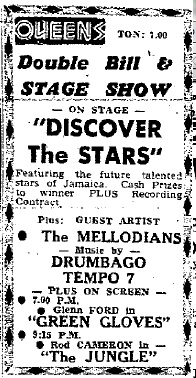
Drumbago

Drumbago

drumbago

Every good musician has a nickname. Well, maybe not every musician, but many of them. And Jamaican culture is certainly known for dishing out some pretty fantastic nicknames, like Bunny and Wingy and Chicken. And I always love Jamaican musician nicknames, like Trommie for the trombonist, Drummie for the drummer, Saxa for saxophonist in the case of the Beat, and other classics—Tan Tan, Ribs, Cannonball, Sparrow, Clue J, Scully, Junior, Stranger, and one I wrote about last week—White Rum. Of course all of the royal monikers like Sir and Duke and Prince and Lord were ways to take back colonial power. Heck, Jamaica itself has a nickname—Jamrock. When I was on the Kingston waterfront one day and saw a huge black bird, I asked my taxi driver what the name of the specie was and he said, “We call them Old Man Joe.” Same thing happened when I saw a fish—“black fish.” Nicknames are so much a part of Jamaican culture, in many cases they take over the birth name.

So it got me thinking, there was a man I always heard of by his nickname and rarely his real name, and I wanted to find out a bit more about him. It’s easy to figure out which instrument he plays, with a name like Drumbago, and it turns out he had quite an important career, helping to shape the ska rhythm.

Drumbago’s real name is Arkland Parkes, although the only two articles that the Daily Gleaner ran on him, when he died, name him as Auckland Parkes. That’s probably not accurate, and perhaps comes from a mix up with Auckland Park, which is a suburb of Johannesburg, South Africa. Either that, or Auckland is just a typo, which is also likely.

Prince Buster asserts that it was he who created the ska style and claims to have asked Drumbago to play a march, a style of song that Prince Buster favored even as a young child, the same march-style of music that was played during carnival and in processions, heavy with drums. Prince Buster says he asked Drumbago to stress the offbeat and asked guitarist Jah Jerry to perform a guitar strum and Dennis Campbell to perform saxophone syncopation to accent the rhythm, thus creating the ska sound. As we know, there are many versions of the birth of ska, but there is no question that Drumbago was there at the beginning. In fact, he performed on what is widely accepted as the first recorded ska song, “Easy Snapping.”

drumbago-jan-14-1967

Drumbago performed drums for a number of musicians in the studios during the early days, including Justin Hinds & the Dominoes, Don Drummond, Jah Jerry, Rico Rodriguez, Deadley Headley Bennett, Baba Brooks, Clancy Eccles, Derrick Morgan, Karl Bryan, Eric Monty Morris, Roy Panton, Roland Alphonso, Stranger Cole, and with the Skatalites. Drumbago even performed with the Gaylettes fronting on vocals—Judy Mowatt, Beryl Lawson, and Merle Clemonson before Mowatt went on to perform with the I-Threes.

drumbago-aug-3-1968

He had his own groups, or whatever producers wanted to call the lineup on the record label, including D Bird and The Drumbago Band, Drumbago and His Harmonizers, Drumbago’s All Stars, Drumbago and Jazz Beat, Drumbago and Prince Buster All Stars, Drumbago and The Blenders, Drumbago and Soul Rhythms, Drumbago and The Dynamites, Drumbago’s Orchestra, Magic Notes and Drumbago, Monarchs and Drumbago All Stars, The Drumbago Ska Band, Raymond Harper with the Drumbago Band, and he also did producing for musicians as well.

drumbago-july-13-1966

The following are the two articles that the Daily Gleaner ran when Drumbago died—one announcing his death and recapping his life, and the other on his burial. Take note of some of the mourners at his funeral which includes many musicians.

Mr. Auckland Parkes, musician, dies

From the Daily Gleaner, January 23, 1969

Mr. Auckland Alvin (Drumbago) Parkes, leader of the Drumbago Orchestra, died on Sunday [January 19, 1969] in the Maxfield Medical Centre Hospital, after a short illness. He was living at 8 Crescent Road, Kingston 13. He was regarded as one of the best drummers in Jamaica and in addition played the flute. Mr. Parkes was also a pioneer in local recording when he began making recorded music back in 1959.

He started his musical career at the age of 15 playing the drums in his brother’s  (Mr. Luther Parkes) orchestra. After leaving his brother’s band he appeared in night clubs and on stages throughout the Island with other top orchestras which included Eric Deans orchestra, Val Bennett and his All-Stars and Frankie Bonitto Combo.

Weekend shows

Sometime in the late 40’s he formed his own orchestra and had regular weekend shows at the then Silver Slipper Club, Cross Roads, where his versatility on the drums earned him the name “Drumbago.”

He then took on a contract at the Baby Grand Club, Cross Roads, and played there on weekends for seven years before leaving and entering the recording field.

He also did a two-year stint in the United States and for a period he was top drummer in orchestras on tourist cruise ships. On his return to Jamaica he continued his performances to many capacity audiences at theatres and night clubs.

After giving up the Baby Grand engagement he continued with the orchestra but concentrated more on records and playing at street dances at all the independence festivals.

Recordings

Some of his earlier recordings were “Second Fiddle,” “Chariot Rock,” “Betrayers Downfall,” “Easy Snapping,” “Humpty Dumpty” sung by Eric Morris; and was featured musician for Prince Buster’s All-Stars.

In the 1962 independence celebrations he was the drummer in Derrick Morgan’s hit tune “Forward March,” and his band figured at the street dances.

He continued making records up to the time of his death and in the latter part of 1968 he recorded tunes such as “Mary Poppins,” “Dulcimina,” and his latest hit which was released a few weeks ago is the current No. 1 tune “Everything- Crash.” He also has a lot of tunes which are complete but not yet released on the recording market.

Survivors are his brothers Luther, and Pastor Arnold Parkes, sister, Olive (Mrs. McCatty), nieces, Mrs. Vera Hanson, Dahlia and Marjorie, adopted daughter, Jennifer, nephews, Ernie, Michael and John, and other relatives. Funeral services for Mr. Parkes will be held on Sunday at Sam Isaacs Funeral Parlour, 44 Hanover Street, at 3 p.m. Interment will be at the May Pen Cemetery.

Mr. Auckland Parkes Buried

from the Daily Gleaner, January 28, 1969

Funeral services for Mr. Auckland (Drumbago) Parkes, leader of the Drumbago Orchestra, who died recently in the Maxfield Medical Centre Hospital after a short illness, were held at Sam Isaacs Funeral Parlour, Hanover Street, on Sunday afternoon. Interment followed in the May Pen Cemetery. The services were conducted by the Rev. S. E. Johnson of the New Testament Church of God, who eulogized Mr. Parkes as a good family man and a person who was loved by all who knew him.

Mr. Parkes, who died at 50, was regarded as one of the best drummers In Jamaica and in addition played the flute. He was also a pioneer in local recording when he began making recorded music back In 1959.

Pallbearers were: Mr. Luther Parkes and Pastor Arnold Parkes (brothers), Mr. Ernest Hanson, Mr. Bill Campbell, Mr. Richard Williams and Mr. Boysie Stewart.

Family mourners were- Mr. John Hanson and C. Hanson (grandnephews). Misses Dahlia Hanson and Majorie Hanson (grandnieces), Olive Parkes (sister). Mr. Albert Parkes, (son) and Master Richard Parkes (grandson).

Among the many other mourners were: Mr. Cleveland Webber, Mr. Stanley Notice, Mr. C. Campbell, Mr. Percival Dillon, Mr. Alvin Wilson, Mr. A. O’Brian, Mr. Claude Gobonrne, Mr. Alphonso Dockett. Miss Shirley Thompson, Miss Monica Paige, Messrs Arthur Lee, Clifton Thompson, Clancy Eccles, C. O Brian, Percy Myers, Val Bennett and Mr. Clifton Bailey. _Mr. Hedley  Walker, Mrs. I. Miller. Mr. Eric Phillips Mr. Mapletoft Poulle, Mr. Alfred O’Brian, Mr. J. Coleman, Mr. P. Cole, Mr. R. Patterson, Mr. J. Thompson, Mr. Cecil Savery Mr. D. Saunders, Mr. V. Anderson, Mr. A. J. Stephenson, Mr. George Tucker, Mr. L. Malabre, Miss P. Anderson, Miss I. Stuart, Mrs. I. Francis, Mr. Ernest McGann and Mr. V. Wallace.

Silver Slipper Club

The Silver Slipper Club

silver-slipper-don-d-4-23-1956

Last October I wrote about the Glass Bucket, so now I’d like to take some time to talk about another venue that gave ska musicians the opportunity to showcase their talent and earn a living—the Silver Slipper.


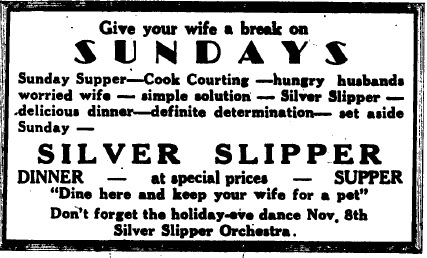
The Silver Slipper opened on May 23, 1931. The short comment about its opening in the Daily Gleaner stated, “Another night club dawns on us—the ‘Silver Slipper’ at Cross Roads which opens next Saturday. We hear it will be well worth a visit.”


silver-slipper-9-23-1933

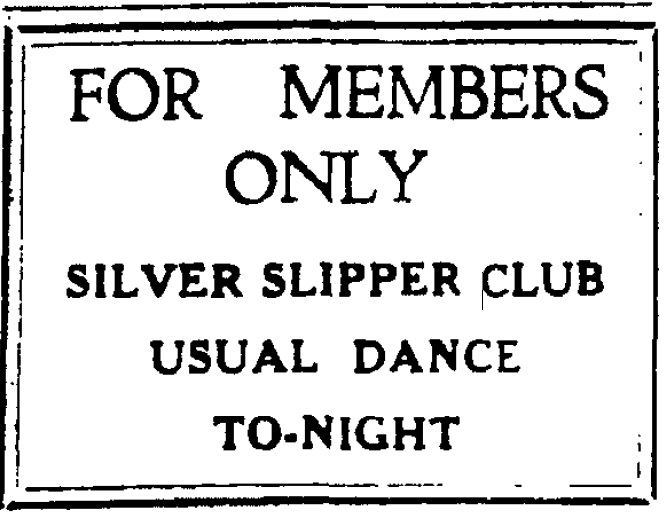
The address was 9 Old Hope Road and it was a members-only club, which was really just a euphemism for whites only. Patrons included barristers, doctors, tourists, and the military. They also occasionally opened their doors to host charity events, such as raising funds for tuberculosis treatment in the mid-1930s, which was an illness that gripped the island, the Jamaica Olympic Association, and St. Joseph Infant School.


silver-slipper-11-4-33

In the 1930s, the entertainment was largely musical and occasionally featured other entertainment as well, like magicians. Guest musicians were brought in from the United States, such as baritone saxophonist Bob Martin in 1933; famous dancers, Cherie and Tomasita straight from the Broadway review, in 1934; and Gaile Darling in 1935 for a three month engagement. Senor Juan Lucas’ Sonora Marimba and Jazz Orchestra along with King’s Rhythm Aces were the house bands in the mid-1930s. In December, 1934, the Silver Slipper’s dance hall and supper rooms were remodeled and enlarged.


In the 1940s and 1950s, the Silver Slipper continued to host private affairs such as annual dinners for exclusive schools like the St. George’s Old Boys Association (alma mater to Byron Lee and former Prime Minister Edward Seaga), Immaculate Conception High School Association, Bethlehem College Old Girls, and other select groups like the Melbourne Cricket Club. Over the decades, year after year, the Silver Slipper Club also played host to the Caribbean Table Tennis Championships. The Silver Slipper Club even hosted a number of large auctions, selling furniture, appliances, carpets, and equipment since it could house the lots.


In the 1940s, music at the Silver Slipper came from two prime orchestras—George Moxey & His Orchestra, and Milton McPhearson & His Orchestra. They performed the jazz standards of Europe and the United States.


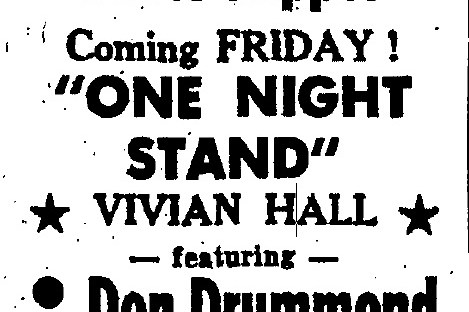
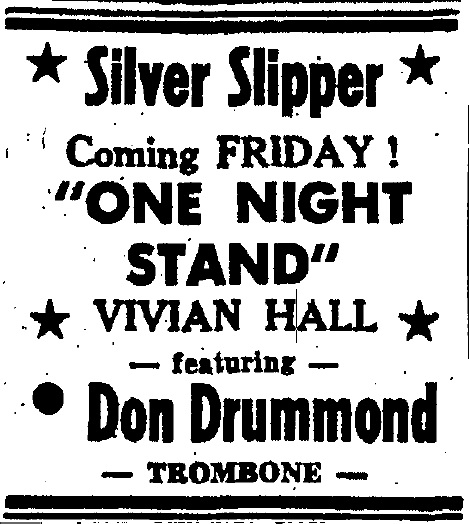
In the 1950, music came from Sonny Bradshaw and his band with Baba Motta on piano. They called themselves Sonny Bradshaw and the Real Gone Guys. Frank Bonito and His Orchestra were also a standard, and Baba Motta also performed at the Silver Slipper with Harold “Little G” McNair and Lord Fly in a band called the Mechanics All-Star Orchestra. Other orchestras performing at the Sliver Slipper Club in the 1950s were led by Roy Coburn (and his Blue Flame Orchestra), Val Bennett, Vivian Hall, and George Alberga. Eric Deans performed at the Silver Slipper from time to time, as he did in June 1955 in what the club billed as a “One Night Stand,” meaning they weren’t a regular act. In April, 1956, Don Drummond performed with Vivian Hall. He had previously been performing at the Colony Club, with Eric Deans, and the Bournemouth Club headlining his own band.
silver-slipper-wong-9-29-58


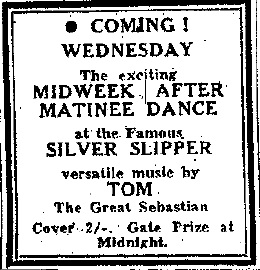
Also in the 1950s, Tom “The Great Sebastian” Wong had his sound system located at the Silver Slipper. Because it was such an upper class club, the sound system was sometimes referred to as an “uptown set.” Tom Wong was a table tennis player from Jones Town who built his own sound system from goods he acquired at the hardware store he operated. Also in the 1950s, Duke Reid and his sound system played at the Silver Slipper as well.


Duke-reid-barn-dance-april-28-1956

The recording era was not good for live entertainment. The clubs were once the source for all music in Kingston, but when the sound system operators left the clubs to enter the studios in the 1960s, records could now be purchased for music in the home, in the yard. Plus, live musicians could find employment in the studio so the clubs began to suffer. And the music began to change. Large-scale jazz orchestras were no longer popular in the United States and so when tourists came to the island to visit they didn’t want to hear this old-fashioned music. American rhythm and blues was the thing, and Jamaican music changed to reflect the tastes of the people.

silver-slipper-close-10-4-1967

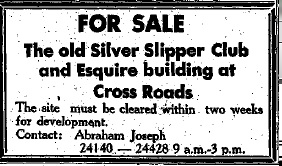
In October 1967, just after hosting its last Caribbean Table Tennis Tournament, the Silver Slipper Club closed its doors for good. They ran a want ad in the Daily Gleaner with the notice that they were clearing the building for development. In November the building was demolished.

A front page story in the Daily Gleaner on October 5, 1967 stated, “’Silver Slipper’ has had a long and colourful history as a centre of entertainment in Kingston. It was one of the pioneer night clubs of the city, sharing honours with the long-vanished Bronx Park, Springfield Club, and the still-existing Glass Bucket Club (now re-named the VIP Club). Situated near Up Park Camp it was at one time the popular haunt of English soldiers before 1962. In more recent times, it has been a sports center, being especially used as a venue for table tennis competitions. Mr. Joseph, who acquired the building recently, has advertised it for sale, as the site has to be cleared within two weeks for the start of the new commercial development there.” That commercial development was the Silver Slipper Plaza, a shopping center that still stands there today.


Although I wasn’t there to witness the Silver Slipper Club in its heyday and have only driven past the Silver Slipper Plaza to pay my respects, many of you have memories and history to share, so post your comments here and continue the discussion.

Uncategorized

Prince Buster Takes on the Beatles?!

beatles

Daily Gleaner, March 23, 1964

I do love me a good Prince Buster laugh, because he is such a character. He cracks me up with his bravado, his machismo, his brazen balls.

I blogged a few weeks back about his time as a “boxer” and it still makes me chuckle that Prince Buster has even been called a boxer, but it’s because he is such a masterful marketing guru, for himself! In interview after interview he tells journalists and fans that he began as a boxer. He boxed one round in his entire life, and that round was rigged for him to win! Read the blog post for details on that humorous tale.

I also blogged recently about his stirring the pot in the U.S. with other artists who were at the Peppermint Lounge to promote the ska dance and sound. Check out that blog too.

His Judge Dread songs are nothing short of classic. And the whole feud with Derrick Morgan is legendary. Prince Buster’s claims of being the first to invest ska, the first to play ska, the first to create the word ska, etc. just make me smile–really smile, not a sneer, because to me, Prince Buster epitomizes the stick fighting culture that is so much a part of ska. Is there no one who better characterizes the theater of ska than Prince Buster?

So then, without further ado, here is the text of the article. The headline speaks volumes though. And if anyone knows what became of this claim detailed below, please share, as I’d love to know.

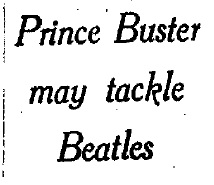
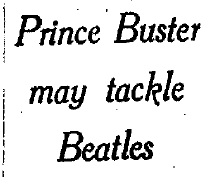
Prince Buster May Tackle the Beatles

Prince Buster, pioneer of the Jamaican sound now known in London as Blue Beat, returned to the island by air on Monday. He had been in London for several weeks, during which he appeared on BBC-TV and ITV, singing his Blue Beat Hit Song, “Wash Wash.”

This was the singer’s fourth visit to London, where he now has an agent, in charge of promoting his records and arranging future personal appearances.

Buster says he plans to return to London in May to do more television and stage shows. He plans to take along a quintet of Jamaican musicians who have backed him in his recordings.

One of the projects which may materialise then for the group is to appear opposite the Beatles at the London Palladium, according to Prince Buster.