Sparrow Martin, Uncategorized

Sparrow Martin–Drummer, Bandleader, Alpha Legend

sparrow-martin

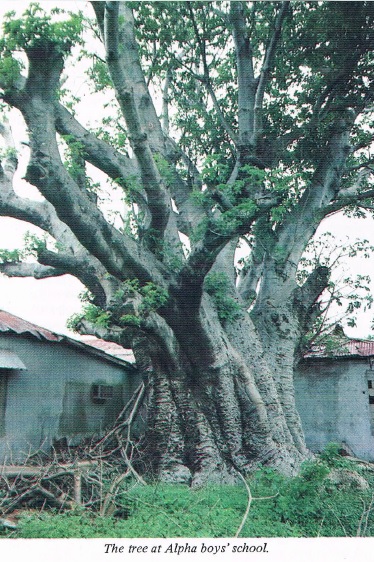
I came across this article on Sparrow Martin while combing through the Star Newspaper archives and was reminded of yet another Jamaican musician who has never quit and continues to leave a legacy to the next generation of musicians. I have had the pleasure of meeting him a number of times and he is always full of love and smiles. He has coined  nickname for me–Scary Bird. I’m a tenacious American, what can I say?! In 2011 he told me how he got his nickname while a student at Alpha Boys School. “We were told in school we are not to go out in the rain ’cause of the cold that you would catch, and we liked to play in the rain. But Sister (Ignatius) always come down when the rain starting. She would come down with her umbrella and she walk and look to see who is in the rain. So one day, I was in junior home, and I didn’t see the Sister was coming up. I was playing in the rain. So I climb up in a tree and when I climb up, it start to rain some more. And she come under the tree and said, ‘Come out of the tree, you naughty little sparrow. What would your mother do if you stayed here and drown?’ The boys now heard her so they start singing, ‘Sparrow treetop, la la la la la.’ From that come my name. When I left Alpha, I wanted a name as a musician, so I used the name because my name is Winston Martin, so the name is Sparrow Martin, and I became world famous.”

tree

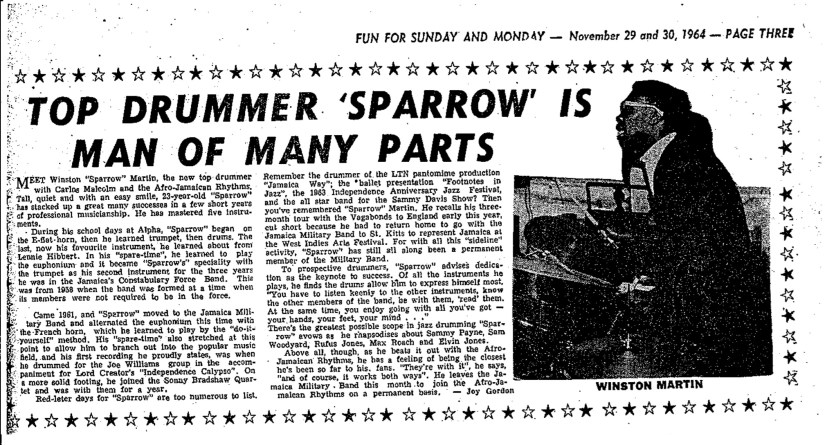
The following is the text of the Star Newspaper article from November 29, 1964:

Top Drummer ‘Sparrow’ is a Man of Many Parts

“Meet Winston ‘Sparrow’ Martin, the new top drummer with Carlos Malcolm and the Afro-Jamaican Rhythms. Tall, quiet and with an easy smile, 23-year-old ‘Sparrow’ has stacked up a great many successes in a few short years of professional musicianship. He has mastered five instruments.

During his school days at Alpha, ‘Sparrow’ began on the E-flat horn, then he learned trumpet, then drums. The last, now his favourite instrument, he learned about from Lennie Hibbert. In his ‘spare time’ he learned to play the euphonium and it became ‘Sparrow’s’ specialty, with the trumpet as his second instrument for the three years he was in the Jamaica’s Constabulary Force Band. This was from 1958 when the band was formed at a time when its members were not required to be in the force.

Came 1961, and ‘Sparrow’ moved to the Jamaica Military Band and alternated the euphonium this time with the French horn, which he learned to play by the ‘do-it-yourself’ method. His ‘spare-time’ also stretched at this point to allow him to branch out into the popular music field, and his first recording he proudly states, was when he drummed for the Joe Williams group in the accompaniment for Lord Creator’s ‘Independence Calypso.’ On a more solid footing, he joined the Sonny Bradshaw Quartet and was with them for a year.

Red-letter days for ‘Sparrow’ are too numerous to list. Remember the drummer of the LTN pantomime production ‘Jamaica Way;’ the ballet production ‘Footnotes in Jazz,’ the 1963 Independence Anniversary Jazz Festival, and the all star band for the Sammy Davis Show? Then you’ve remembered ‘Sparrow’ Martin. He recalled his three-month tour with the Vagabonds to England early this year, cut short because he had to return home to go with the Jamaica Military Band to St. Kitts to represent Jamaica at the West Indies Arts Festival. For with all this ‘sideline’ activity, ‘Sparrow’ has still all along been a permanent member of the Military band.

To prospective drummers, ‘Sparrow’ advises dedication as the keynote to success. Of all the instruments he plays, he finds the drums allow him to express himself most. ‘You have to listen keenly to the other instruments, know the other members of the band, be with them, ‘read’ them. At the same time, you enjoy going with all you’ve got–your hands, your feet, your mind . . . ‘

There’s the greatest possible scope in jazz drumming ‘Sparrow’ avows as he rhapsodies about Sammy Payne, Sam Woodyard, Rufus Jones, Max Roach, and Elvin Jones.

Above all, though, as he beats it out with the Afro-Jamaican Rhythms, he has a feeling of being the closest he’s been so far to his fans. ‘They’re with it,’ he says, ‘and of course it works both ways.’ He leaves the Jamaica Military Band this month to join the Afro-Jamaican Rhythms on a permanent basis.” –Joy Gordon

Sparrow came to Alpha Boys School because he was a bit unruly. He told me, “My father couldn’t mind me. I was a guy who was very rude, didn’t want to go to school.” After he left Alpha and performed with the Constabulary and Military bands, and Carlos Malcolm’s group, he event formed a group of his own, as seen here in this advertisement from the Daily Gleaner, December 3, 1980.

sparrow-martin-band

Sparrow Martin had a successful career in music before bringing his knowledge to the youth as band master at the Alpha Boys School. “I used to do recordings and I left all of my musical life and it feels good,” he told me about taking on the role as band master in 1989. He still leads the boys band today even though Alpha Boys School is now known as Alpha Institute and is a day school only, no boarding after over a century of housing and schooling the students. When I drove by the school on South Camp Road last week, even the sign had changed to proclaim the new name, Alpha Institute. And Sparrow continues to school his boys in music and today leads his own band of musicians, a group that in 2011 he was just starting to put together in his creative mind. He told me in 2011, “I am very excited about the New Skatalites, the Young Skatalites, because I think it is going to be very big. These guys are young. I was with them, there are five of them who are ages 23 to 25. When they founded the Skatalites band, these guys were over 30 years old and you guys have more of an advantage because you are young,” he said. That band is not called the Young Skatalites but instead is Ska Rebirth. They were formed in 2011 and I had the pleasure of seeing them perform in 2013 during a rehearsal. They performed Skatalites tunes classics like Guns of Navarone and Rockfort Rock.

sparrow-martin1

Just last week, another group that Sparrow leads, the Alpha All Stars, performed for Reggae Month with Travis Wedderburn on trombone, a young graduate of Alpha who promises to be the next Don Drummond, and Alpha Old Boy and Skatalites’ Lester Sterling on sax. Who is that on drums? Yes, Sparrow himself!

sparrow-alpha

sparrow-alpha2

Below is an article ran in the Jamaica Gleaner on April 30, 2012:

sparrow-martin-gleaner

Winston ‘Sparrow’ Martin, OD, has had a highly distinguished musical career and is now celebrating 50 years in the music industry.

Since 1989, he has been the musical director of the Alpha Boys’ School Band. In 2007, he was awarded a Bronze Musgrave Medal for his eminence in music, and was only just awarded at the Caribbean Community of Retired Persons Limited’s Jamaica 50 Living Legacy Award for contributing invaluable service to Jamaica since Independence. It is indeed noteworthy that Sparrow was one out of two musicians so awarded.

Ska Rebirth

Now focussed on his brainchild, Ska Rebirth, a band formed in June 2011, the band is said to be Jamaica’s only existing ska band.

Sparrow leads the charge as its band master, and is also on drums, and has a complement of nine persons. The other band members are: Odane Stephens (keyboards), Kemroy Bonfield (saxophone), Rayon Thompson (saxophone), Camal Bloomfield (saxophone) Lance Smith (trumpet), Kemar Miller (trombone), Rohan Meredith (bass guitar) and George Hewitt (lead guitar).

More than half of the band members are graduates of Alpha Boys’ School, the home of ska music. The band is deeply committed to keeping the indigenous music form, ska, alive in Jamaica and the rest of the world; following in the tradition of their mentor, the legendary Skatalites.

“What we are doing here is not just starting a band!”, says Sparrow, in between one of his signature off beat, on beat, snare drum slaps, during a Ska Rebirth rehearsal session, “We are starting a movement, one which will bring back the original sound of ska from its roots and home, Alpha Boys’ School in Kingston, Jamaica, and spread it once again across the entire world, this is the real SKA Rebirth!!”

Since inception, Ska Rebirth has performed four times: On the talent stage at the 16th Annual Jazz Festival in January 2012, where they thrilled the audience who danced to the memorable ska sounds.

Flexibility with music

They also entertained at the Jamaica Cricket Association Annual Awards Dinner held at The Jamaica Pegasus on February 18, 2012, displaying their flexibility with background music during dinner and a lively entertainment segment. Among the distinguished guests there were the prime minister and governor general.

They again graced the stage during a joint venture that was held with Vinyl Record Collectors Association, Jamaica Chapter, on February 25, at Heather’s Garden Restaurant on Haining Road. Here the band showcased its versatility in a live show, doing a number of jazz and blues cover pieces, tantalising ska beats and backing the renowned ‘Stranger Cole’.

The band’s most recent event was a lunch-hour concert hosted by the Institute of Jamaica on March 29, targeting school children at the primary level. The children were thrilled with the novel sounds of ska and were eager to show their moves in the dance competition.

sparrow-martin2

Here is an interview with Sparrow Martin in 2007 on YouTube.

Here is a rehearsal of Ska Rebirth performing in 2013 on YouTube.

Here Ska Rebirth performs live on Jamaicansmusic.com

Anita Mahfood - Margarita, Don Drummond

Margarita and Domestic Violence

margarita

American news has been finally focusing on the epidemic of domestic abuse, particularly in professional sports like football. It always brings to mind, for me, the abuse that Margarita, Anita Mahfood, suffered at the hand of her professional boxer husband Rudolph Bent before leaving him to enter a relationship much worse, the one with Don Drummond that would end in her death at his hand. This past week I traveled to Kingston where I combed through the Star Newspaper archives which are still in original form, never digitized or put on microfilm, and with white-gloved hands, turning the pages of the yellowed and crumbling bound editions of the newspaper, I came across the following article. I picture it here and have transcribed the text below and ask the following question for those who have claimed that Margarita liked the violence, and yes, there are those men who have even spoken publicly about this theory of theirs–tell me how a woman likes this? That is all I will say for fear of letting my anger toward such claims run away with me.

From The Star, Saturday, November 21, 1964

Chopped, hit, kicked by her boxer husband

Repeated beatings by Jamaican and British Honduran middleweight champion, Rudolph Adolphus Bent (now in America), of his dancer wife, led her to seek her freedom from him in the Divorce Court yesterday. The court heard her story, of a number of violent assaults in which the boxer’s fists were brought into play, in her undefended petition.

Petitioner was Anita Bent (nee Mahfood), who is Jamaica’s premier rhumba and interpretive dancer with the stage name of “Margarita.”

Mr. Justice Shelley granted her a decree nisi with costs against her husband. Custody of the two children of the marriage is to be decided in Chambers. Petitioner was represented by Mrs. Margaret Forde, Legal Clerk.

Mrs. Bent wept as she told the Court that her husband had forcibly taken away the children and transported them to his homeland, British Honduras where they now reside with his mother. Mrs. Forde said that respondent entered an appearance only with regard to their custody.

Petitioner said that they were married in St. Andrew on March 15, 1961, but were never happy as he gave her no monetary support and had too many girl friends. She gave her present address as 32 Coral Way, Harbour View.

Assaults

She recounted some of the many assaults made on her by respondent. She said in June, 1961, he came home about 3 a.m. and when she spoke to him he told her, “Why don’t you take your pickney and go and leave me in peace?” Then he hit her with his fist in the right eye and on the mouth, which was cut and started bleeding. He grabbed her by the hair, opened the door and threw her outside. Next he threw their little daughter, Susie, after her.

Shelter

She ran up Slipdock Road to a friend in her nightgown and found shelter. In July, 1961, they quarrelled over money and he said, “You want money. Well, you’re not getting any from me.” He twisted her arm and choked her.

In September, 1961, there was another row over money and a girl and he tore off her dress and punched her down on the bed. He put a pillow over her face and tried to suffocate her. Another boxer in the house came in and rescued her, she said. A further assault was committed in November, 1961, when he choked her and tore off her clothes. She then left him to live apart as she was afraid of him.

In February, 1962, he asked her to return to him and hen she said she would not, he dug his two fingers into her eyes, hit her on the chin with his elbow, chopped her on the side of the neck with his open right hand and kicked her down. This took place while she was alone in her father’s home.

After they returned living, in July, 1963, he dragged her by the hair, thumped her with his fist in the face and tore off her clothes. Her sister came to her rescue.

Blood

Fay Roberts, dressmaker of 2 Glasspole Avenue, gave evidence of the assault committed in June, 1961. She said she was at the Slipdock Road address when Mrs. Bent came screaming into the home with blood flowing from her mouth and her eye swollen. She was in her nightgown and was carrying her baby.

Uncategorized

Jive Talking and Toasting part two

Last week I wrote about the connection between toasting and jive talking from Cab Calloway and Albert Lavada Hurst, which writer and historian Beth Lesser brought my attention to through her work. This week I continue this connection between the jive talking DJs in America and toasters like Count Matchuki, Sir Lord Comic, and King Stitt and I focus on a few of the key DJs during the 1950s.

vernon-winslow2

One of these jive-talking DJs was Vernon Winslow who broadcast his show, “Jam, Jive, ‘n’ Gumbo,” from New Orleans with his character, “Dr. Daddy O,” and partner DJ Duke Thiele who portrayed the character of “Poppa Stoppa.” Winslow explains, “Poppa Stoppa was the name I came up with. It came from the rhyme and rap that folks in the street were using in New Orleans. Poppa Stoppa’s language was for insiders.”

vernon-winslow

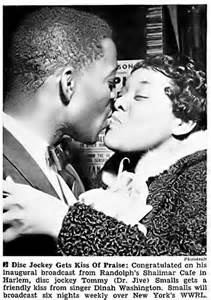
Tommy Smalls was a DJ in New York known as “Dr. Jive,” though he got his start in Savannah, Georgia. His catch phrase was, “Sit back and relax and enjoy the wax. From three-oh-five to five-three-oh, it’s the Dr. Jive show.” He was known as the “Mayor of Harlem” and unfortunately, in 1960 he was one of the DJs arrested, along with Alan Freed, in the payola scandal.

tommy-smalls-dinah

tommy-smalls

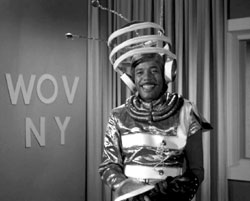
And Douglas Henderson, known as “Jocko” broadcast from a number of cities with his show, “Rocket Ship.” Henderson was also known as the “Ace from Outta Space.”Author Bill Brewster writes of Henderson: “Using a rocket ship blast-off to open proceedings, and introducing records with more rocket engines and ‘Higher, higher, higher…’ Jocko conducted his whole show as if he was a good-rocking rhythmonaut. ‘Great gugga mugga shooga booga’ he’d exclaim, along with plenty of ‘Daddios.’ ‘From way up here in the stratosphere, we gonna holler mighty loud and clear ee-tiddy-o and a bo, and I’m back on the scene with the record machine, saying oo-pappa-do and how do you do?”

jocko

jocko2

Notice any similarity between the jive talking of these DJs and the toasts of Lord Comic and Count Matchuki? Some of Matchuki’s toasts have the same language as the jive of these DJs. Matchuki’s toast include “When I dig, I dig for mommy, I dig for daddy, I dig for everybody,” and “It’s you I love and not another, you may change but I will never,” as well as, “If you dig my jive / you’re cool and very much alive / Everybody all round town / Matchuki’s the reason why I shake it down / When it comes to jive / You can’t whip him with no stick.”

Count Matchuki, born Winston Cooper in 1934, is widely considered the first toaster. He was raised in a family that had more money than others so he grew up with two gramophones in the home and was exposed to swing, jazz, bebop, and rhythm & blues. He says that he got the idea to begin toasting over records after hearing American radio. He told this to Mark Gorney and Michael Turner as they recount in a 1996 issue of Beat Magazine. “I was walking late one night about a quarter to three. Somewhere in Denham Town. And I hear this guy on the radio, some American guy advertising Royal Crown Hair Dressing. ‘You see you’re drying up with this one, Johnny, try Royal Crown. When you’re downtown you’re the smartest guy in town, when you use Royal Crown and Royal Crown make you the smartest guy in town.’ That deliverance! This guy sound like a machine! A tongue-twister! I heard that in 1949. On one of them States stations that was really strong. I hear this guy sing out ‘pon the radio and I just like the sound. And I say, I think I can do better. I’d like to play some recordings and just jive talk like this guy.”

count-machuki

Sir Lord Comic, whose real name was Percival Wauchope, began as a dancer, a “legs man.” He began toasting for Admiral Deans’ sound system on Maxwell Avenue in 1959 and his first song was a Len Hope tune called “Hop, Skip, and Jump.” In Howard Johnson and Jim Pines’ book, Reggae: Deep Roots Music, Sir Lord Comic recalls, “When the tune started into about the fourth groove I says, ‘Breaks!’ and when I say ‘Breaks’ I have all eyes at the amplifier, y’know. And I says, ‘You love the life you live, you live the life you love. This is Lord Comic.’ The night was exciting, very exciting” (Johnson Pines 72). Lord Comic’s first toast, he says, was, “Now we’ll give you the scene, you got to be real keen. And me no jelly bean. Sir Lord Comic answer his spinning wheel appeal, from his record machine. Stick around, be no clown. See what the boss is puttin’ down.”

lordcomic

One article in the Daily Gleaner on May 1, 1964 advertised Sir Lord Comic’s performance at the Glass Bucket Club, an upscale establishment. “Sir Lord Comic will be at the controls with his authentic sound system calls,” it stated. Some of his recorded songs include “Ska-ing West,” “The Great Wuga Wuga,” “Rhythm Rebellion,” “Jack of My Trade,” and “Four Seasons of the Year,” among a few others. Sir Lord Comic’s “The Great Wuga Wuga” was likely inspired by the jive talk of Douglas “Jocko” Henderson who spoke of the “great gugga mugga.” Additionally, Henderson’s show, “Rocket Ship,” became a song recorded by the Skatalites with Sir Lord Comic toasting over the instrumentals, calling out the title of the song to begin the instrumentals and continuing with his percussive techniques.

Last week, a reader made me aware of a connection between Canadian jive-talking DJs as well and they cited this article here. His name was Charlie Babcock and he came to Kingston in 1959.  He was the “cool fool with the live jive.”

babcocok

Share the connections you see, or hear, between jive-talking American DJs and Jamaican toasters!

Toasting

Jive Talking and Toasting

hepcat002

I was reading Beth Lesser’s amazing Rub-a-Dub Style: The Roots of Modern Dancehall, which is available for free download here, and I found a quotation from Clive Chin that set me off on a wild goose chase through the roots of toasting. I have long had a fascination with the connection between toasting and hip hop and have written about that in this blog before, and presented on it at conference after I had the pleasure of interviewing DJ Kool Herc last year, but I hadn’t thoroughly ventured back to jive–until Beth Lesser.

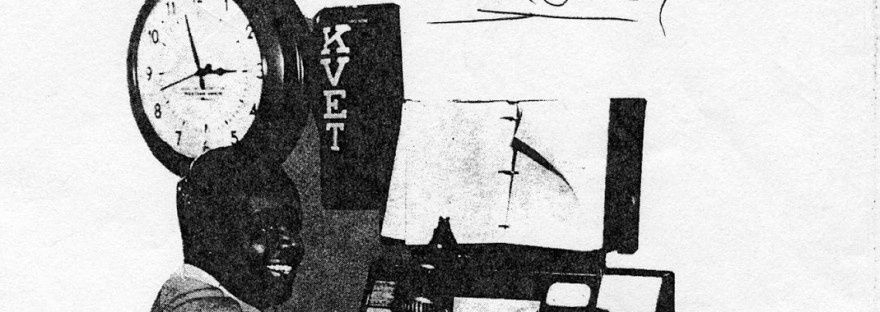
Clive Chin, writes Lesser, remembers toaster Count Matchuki carrying around a book. “There was one he said he bought out of Beverly’s [record shop] back in the ‘60s. The book was called Jives and it had sort of slangs, slurs in it and he was reading it, looking it over, and he found that it would be something that he could explore and study, so he took that book and it helped him.” Lesser writes that this book of jive may have been a boo, written in 1953, The Jives of Dr. Hepcat, which was published by Albert Lavada Durst, a DJ on KVET-AM in Austin, Texas. This version (read the entire copy here) featured definitions for words and phrases commonly used by jive talking DJs like “threads,” which are clothes; “pad,” for house or apartment; “flip your lid,” for losing one’s balance mentally; and “chill,” to hold up or stop. Durst wrote in the introduction to his book, which sold for 50 cents, “In spinning a platter of some very popular band leader, I would come on something like this: ‘Jackson, here’s that man again, cool, calm, and a solid wig, he is laying a frantic scream that will strictly pad your skull, fall in and dig the happenings.’ Which is to say, the orchestra leader is a real classy singer and has a voice that most people would like. For instance, there was a jam session of topnotch musicians and everything was jumping and you would like to explain it to a hepster. These are the terms to use. ‘Gator take a knock down to those blow tops, who are upping some real crazy riffs and dropping them on a mellow kick and chappie the way they pull their lay hips our ship that they are from the land of razz ma tazz.’

cab-calloway

I decided to search further and found there was another popular book of jive written before Dr. Hepcat, although it is likely that Matchuki obtained Durst’s version given the era and the content. But Cab Calloway had his own publication of jive called “Cab Calloway’s Hepster Dictionary: Language of Jive” which was first published in 1939 and then revised to add more words in a 1944 printing. Calloway was the original emcee, the master of ceremonies, the hepcat, who understood jive and brought it to those who wanted to become part of this culture. As frequent band leader at the Cotton Club in front of Duke Ellington’s band during performances that were broadcast all over the continent, and as star in a number of feature films, Calloway brought the language of Harlem, jive, to audiences uneducated in the dialect of the black musicians. He established jive as a form of discourse.

CallowaySignedHepster018

Some of the words in these dictionaries, and certainly the word “jive” itself, appear in the toasts of Count Matchuki, Lord Comic, and King Stitt. The style is similar as well, scatting over the music, punctuating the rhythm with verbal percussion, and boasting. Next week I will blog about the jive-talking American DJs like Vernon Winslow, Tommy Smalls, and Douglas Henderson, who influenced the Jamaican toasters since these similarities are fascinating as well.

Uncategorized

Sheila Rickards–The I’m Gonna Live Girl!

sheila-rickards

The following is a excerpt from my book, Songbirds: Pioneering Women in Jamaican Music on the vocalist Sheila Rickards:

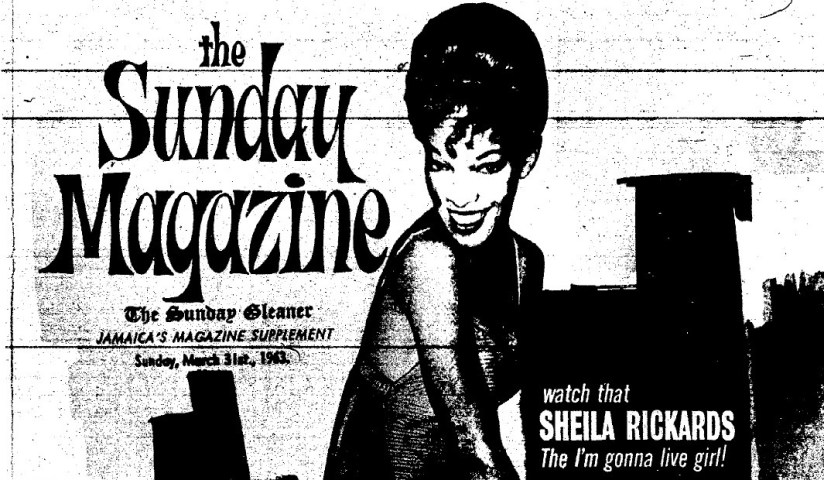
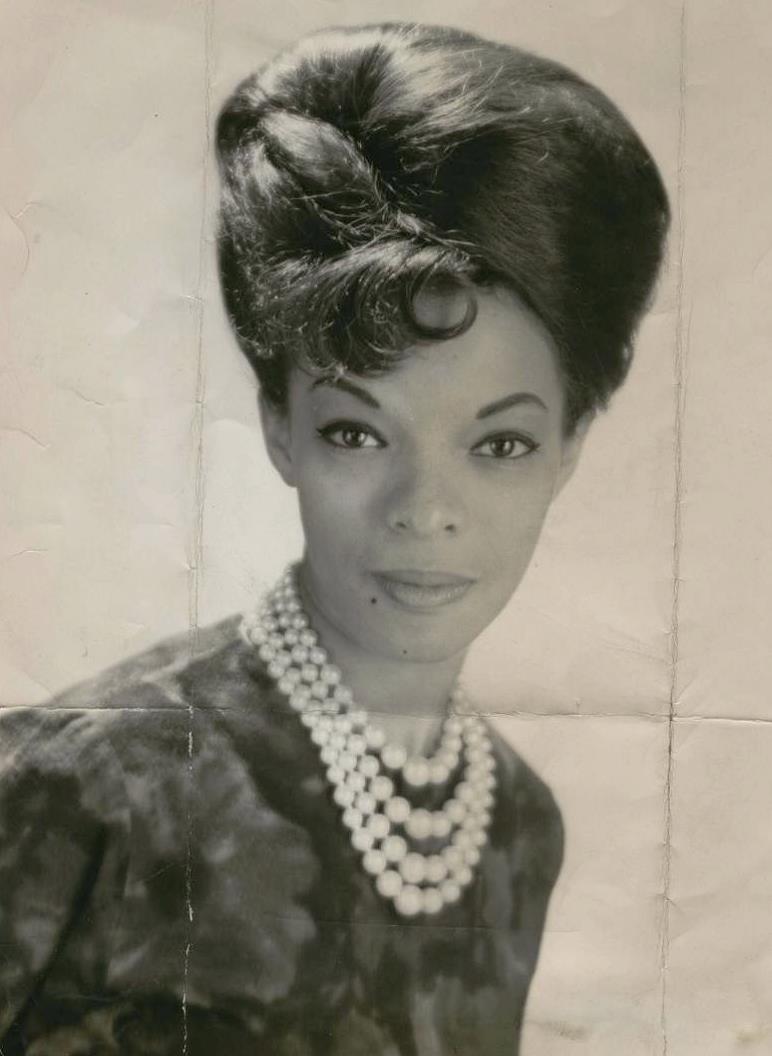
The Daily Gleaner on March 31, 1963 stated that she was born a “preemie” weighing only three pounds at birth. She was born just seven months into her mother’s pregnancy in 1942. Sheila got her start at age 14 when she appeared on the Lannaman’s Children’s Hour, a talent show broadcast on RJR. She then got the chance to compete at the Vere Johns Opportunity Hour in 1956 where her talent for singing jazz was recognized. She was hired to perform with the Baba Motta at the Myrtle Bank Hotel and the Glass Bucket for long runs, as well as on the North Coast and for Sonny Bradshaw. “From Colony Cottage Hotels on and then Nassau. There, it was the Goombay Club for nearly a year of making warm friends with every not she sang. Spots at the Junkanoo Club there too, singing onetime with Billy Cooke and his Combo who did a spread in Nassau at the time. And at the Nassau Beach Lodge. She says, ‘I had one of the swingingest times of my life!” states the Gleaner article which goes on to list another number of performance venues that booked Rickards. She was billed as the “I’m gonna live girl” after one of her performances at the Ward Theatre Pantomime where she sang a song with these words.

Sheila Rickards’ father, Ferdinand Arthur Rickards, was a contractor for the Sugar Manufacturers Association. He grew up in St. Catherine and was a performer—a singer, actor, and comedian. He helped foster his daughter’s love for music by purchasing records for the family phonograph. There were over 200 records in their Greenwich Town home, which was quite a substantial amount in the 1960s for a family to own. Her father said, “Sheila was born to be a singer, she’s been singing since she was four years old, started music when she was seven, very musical like her mother and sisters.” Her sister, Thelma, sang on the radio, on ZQI.

longshot-april-1-1969

Sheila Rickards performed opened for Sammy Davis Jr., when he came to Jamaica and she became well acquainted with him and his wife. In fact, she even babysat their eight-year-old child for a couple of days. Sheila traveled to the United States to try to further establish her career. That same Gleaner article states, “And now Sheila is in America and the house, they [her parents] say, is too quiet without her. She stays in America with the family of Mrs. Benskin who visited Jamaica last year and was so impressed with Sheila’s talent that she insisted that she come to the USA and train. She will, go to a school to do dramatics and to develop her singing and acting. Singing and acting she wants to make her ‘career!’ And she will also study dress-designing which she says she will make her ‘profession.’” Dan Monceaux, director and camera operator for a documentary on Sheila Rickards which never came to fruition says, “Many people knew of her, but not of her whereabouts. Evidently she emigrated to the USA, and married, likely changing her name in the process. I believe she had ambitions to make it in the USA, but these dreams were never realised.”

sheila-rickards-gleaner

The film was constructed around a song that Rickards recorded for Bunny Lee called “Jamaican Fruit,” a haunting song whose lyrics talk of the slave trade and is a fairly obvious reference to Billie Holiday’s “Strange Fruit.” Monceaux says, “The song ‘Jamaican Fruit’ has very strong lyrics for its time, and our research revealed that it was actually a cover (with lyrical variation) of a song by American soul singer Zulema Cousseau (her artist name was simply ‘Zulema’).” Zulema’s version was called “American Fruit.” Rickard’s version states, “We came from a distant land / our lives already planned / we came in ships from across the sea / and never again our home we’d see / and now we’ve become Jamaican fruit of African roots.” It talks of how their children’s last names were erased, they were commodities, and it encourages an uprising that is not present in Zulema’s version. “The time has come for us to join hands / let’s not be punished by the rules of this land / now that we’re aware of what we must do / let us no longer be fooled, no longer be fooled / let us all be black, let us all be black / and Jamaican fruit of African root / I wanna be black, let me be black, black is beautiful.” Rickard’s original version was only released unofficially in Canada, according to Monceaux, but his co-producer, Chris Flanagan, negotiated rights to re-release the song. Her whereabouts are still unknown.

sheila-rickards-gleaner-march-31-1963

Listen to a sample of Sheila Rickards’ “Jamaican Fruit of African Roots” from Shella Records HERE

Sheila Rickards & Mapletoft Poule Orchestra’s “Say and Do” HERE

More info on Shella Records, the documentary, and quest to find Sheila Rickards HERE

Uncategorized

Last Train to Expo ’67

expo-67-a

I have written before about the 1964 World’s Fair in New York City where Byron Lee & the Dragonaires made an appearance to debut the ska, along with numerous other Jamaican musicians, vocalists, dancers, and delegates, but did you know there was another World’s Fair where Byron Lee & the Dragonaires performed? Expo ’67 in Montreal was an incredibly popular and well-attended World’s Fair, so successful that organizers extended the length of the fair beyond the October 27th end by two days, on October 29th. It was such an important event for Montreal that they even named a baseball team after the festival–the Montreal Expos. The fair kicked off on April 28th, 1967 and a number of notable musicians performed at Expo 67 including The Supremes during a live broadcast of the Ed Sullivan Show, Petula Clark, Thelonious Monk, The Tokens, Jefferson Airplane, Tiny Tim, and even the Grateful Dead. Numerous dignitaries from around the world attended, including Queen Elizabeth II, Lyndon Johnson, Robert Kennedy, Jackie Kennedy, Princess Grace, Charles de Gaule, and perhaps most interesting for those fans of Jamaican music–Harry Belafonte and Haile Selassie.

But fans of Jamaican music know best of Expo 67 from the Melodians’s tune, Last Train to Expo 67, recorded for Duke Reid in 1967. It might be hard to take a train from Jamaica to Montreal, but trains were popular objects in Jamaican music (and all music, really) as symbols of transition, movement, and escape. Perhaps some collectors even know of the Diamonds’ Expo ’67 (Silhouette) recorded on the JDI label, for Copley Johnson. of the same name.

Expo 67 was an important event for Jamaica. The Daily Gleaner on June 2, 1967 reported that the Jamaica Military Band traveled to the fair in August of that year to perform at “Jamaica Day,” August 3rd. The newspaper stated, “‘Jamaica Day’ has been so named by Expo ’67 Authorities as a tribute to Jamaica’s participation in Expo ’67 and the authorities hope that Jamaicans will try and attend on that day. The Jamaica Military Band returns to Canada for the period August 23 to 30 to appear in the Calypso ’67 Carnival in Gait and later in Toronto. This tour is being arranged by the Jamaica Tourist Board and the band is part of the Jamaican participation.”

expo-67-b

Edward Seaga, who was at that time Minister of Finance and Planning, also attended Expo 67 on Jamaica Day and he also met with dignitaries on economic and trade matters. Prime Minister Hugh Shearer also attended. In December, 1967, Shearer received a gold medal of commemoration from Expo 67 officials for their participation in the fair which exceeded attendance expectations.

Tony Cohen, also known as “Caps,” said in a Jamaica Gleaner article in 1995 that Byron Lee & the Dragonaires performed during Jamaica Day. Cohen was a percussionist and sometimes vocalist for the band. He stated, “I recall with pride our performance on Jamaica Day at the Montreal Expo in 1967. Thirty five thousand persons were in attendance. That was my first concert outside of Jamaica. It was magnificent, awesome.” The band performed on Thursday, August 3, 1967 at a reception for Shearer at the fair, which was followed by a performance of the National Dance Theatre Company.

expo-67-flag

Even though Byron Lee & the Dragonaires performed, and even though there were songs commemorating the fair, the focus was not on music this time around, as it was during the World’s Fair in 1964 in New York. This time, the focus was on cocktails. That’s right, cocktails. Jeffrey Stanton on the westland.net website describes the Jamaica Pavilion as the following:

“The Jamaican pavilion was a replica of a 19th century two-story country shop. It was constructed of thick, sand-colored plaster walls with shuttered upper windows and a cedar shingle roof. The entrance was through a small courtyard attached to the main pavilion. Panels and displays in the open entranceway told the proud story of the island’s industrial, social and cultural progress. The visitor passed through carved wooden doors into a smaller foyer displaying artistic works, and into the large bar, a cool, high ceilinged oasis. Barrels of rum, coffee and ginger lined the upper balcony and baskets and cylindrical wicker fish traps hung from the heavy beams. Cases along the walls displayed a wide variety of Jamaican products. Bartenders served the tastiest, most thirst quenching rum punch at Expo. Jamaican hostesses dressed in vibrant pink and orange, offered a choice of a Soon Come Sling, Half Moon Haze, or Look Behind Ambush rum punch to visitors seated at corner tables.”

expo-67-pavillion-2 expo-67-pavillion

Above is a photo of the Jamaican pavilion in recent years, as well as one from 1967 during the fair.

Below are a few of the cocktails available at Expo 67 at the Jamaica Pavilion which were described in a brochure.

expo-drinks expo-drinks2

See a promotional video for Expo ’67 HERE.

Listen to the Melodians’ song HERE.

Listen to the Diamonds’ song HERE.

expo-67-from-gleaner-1-25-67-air-canada-ad

Uncategorized

Bumps Jackson

bumps-jackson

I’m trying to locate Keith “Bumps” Jackson and hoping today’s post will help someone to point me in the right direction. He was a bassist who performed with Byron Lee & the Dragonaires before relocating to the U.S. to found his own group, Bumps Jackson & the Caps. Below is an article that ran in the Daily Gleaner, June 23, 1969.
Bumps Jackson . . . Arranger, composer, guitarist and band leader

“Music is a mind-soother; it’s one of the ways In -which an individual can express himself” says ‘Bumps’ Jackson, tenor guitarist and leader of the Caribbean No. 1 band, BYRON LEE AND THE DRAGONAIRES. Born in Kingston on December 1, 1946. Keith Jackson later nick-named “Bumps’ attended Central Branch Primary and Excelsior School. He was graduated in 1965. From an early age Bumps had a flare for music and during his spare time especially during summer holidays, be com posed songs. It was in 1964 that he was first exposed to a musical instrument — practicing the bass-guitar with the Tytans band. After several months of thorough rehearsals, Bumps gained confidence and when the band’s bass-guitarist left he took over the role. He was associated with Tie and the Tytans for a year, after which he joined the Virtues.

Until late 1965, Bumps had only short engagements with most of the Island’s leading bands. He felt that those he had been around with did not really have anything to suit him. He tried free-lancing and in this way became associated with Byron Lee in Christmas of 1965. Bumps Jackson recalls that one night he was listening to the Dragonaires at the Club Sombrero, when Byron Lee approached him and asked: “How come a good bass player like you is not working?” Bumps said he told Byron that he was not interested in being confined to one band.

Byron Lee had to travel quite often to the United States and Canada on band business so he arranged with Bumps to take his place whenever he was not available. Bumps then became associated with the Dragonaires. After four months he was introduced to the six-string tenor guitar and took the bandstand as a second guitarist when Byron was able to play the bass. During that time Bumps created a name for himself and to many music fans he was regarded as one of Jamaica’s leading bass and tenor-guitarist. In the Dragonaires Ken Lazarus was the No. 1 tenor guitarist and leader in the latter part of last year. Lazarus left the group and Bumps took over as deputy band leader.

Bumps’ greatest moment came in January of this year when he was appointed leader and his first assignment was a Sunday night at the Club Maracas, Ocho Rios. “It was a fantastic experience for me and one I’ll never forget” he recalls. “I kept calm and observant and the other boys gave me confidence as the night went by,” he told me. Bumps says: “Most people feel that being a band leader is an easy job, but it is certainly one of the most difficult.” One has to develop a good working relationship with the members and Bumps says this the Dragonaires have achieved. As a member of the band, Bumps has travelled to New York. Boston, New Jersey, Connecticut and Lake George in the United States and to Toronto and Montreal in Canada. The band’s recent tour to Belize, British Honduras came in for high praises and was described as one of the best tours. Bumps is the band’s arranger and composer and his work includes Keith Lyn’s latest hit “Having a hard time.” He has been featured also in several recordings with the bass guitarist from Ska to Rock Steady and Reggae. “The Dragonaires are sounding magnificent,” says the leader, “and all I am interested is to keep it on a standard second to none in Jamaica and to maintain our place at the top in the Caribbean.” —J.S

Uncategorized

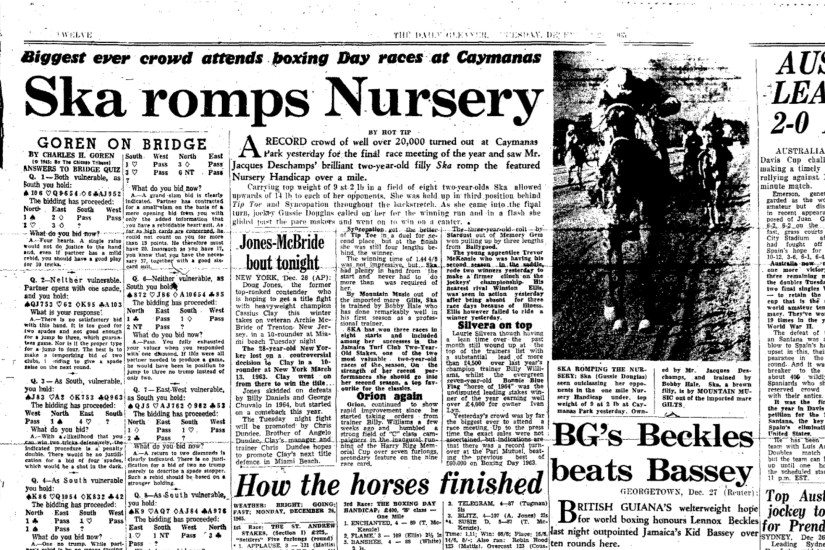
A Horse Named Ska

ska-romps-nursery

This horse has a name, Ska, so take that America (the band, not the country)! I came across this article that was written during the summer of 1964, when ska was all over the Daily Gleaner after finally being accepted by the colonial newspaper. Apparently, ska was such a rage that owner Jacques Deschamps named his horse after the genre! It got me thinking about Jamaican music and the horses. I’ve previously written about Jamaican music and boxing, which you can read about here, and there is definitely affair between the Jamaican culture and boxing, but there is also one between the Jamaican culture and horse racing.
Perhaps the most well-known song about a race horse is that classic, “Longshot Kick De Bucket,” by the Pioneers. Before this song was made, the Pioneers recorded their song “Longshot (Buss Me Bet)” which was written by Lee “Scratch” Perry, according to Dave Thompson in his book, Reggae & Caribbean Music, and was produced by Joe Gibbs. This racehorse, Long Shot, had a long career, yet never won. “He gallop, he gallop, he gallop, but he couldn’t buss [bust] the tape.”
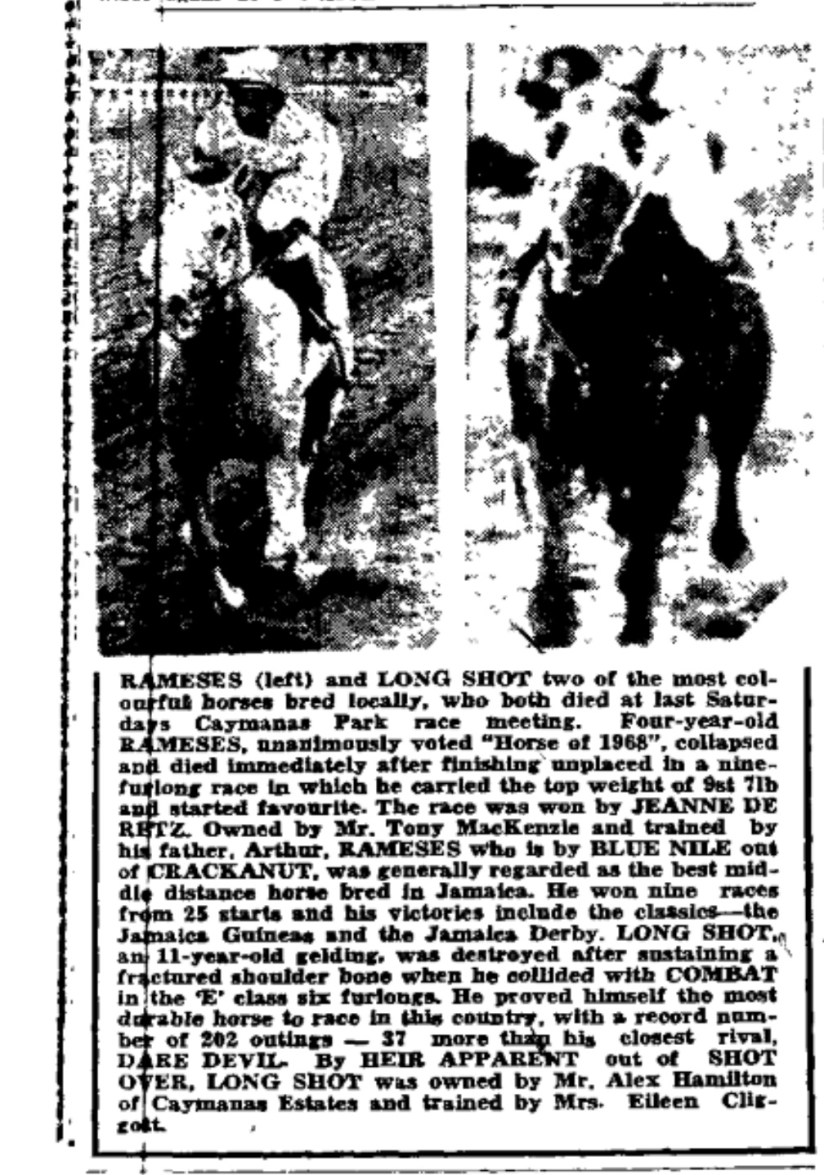
Their more popular sequel, “Longshot Kick De Bucket,” was about that same horse and begins with the same horse track trumpet call. According to Kevin O’Brien Chang and Wayne Chen, it was producer Leslie Kong (Beverley’s) who first heard about the death of Long Shot and so he had the Pioneers write and record a song about it and it was not only an immediate hit, but it has been covered many times over, namely by The Specials, as a staple of Jamaican music. The song references Caymanas Park which is the popular horse track in Kingston. The lyrics tell of the death of Long Shot, and the details of his death are told here, in this article I found in the Daily Gleaner on April 1, 1969, along with a photo of Long Shot! There he is folks, before he kick de bucket! And here’s Rameses who also met his demise that same week. The article states this horse was voted the “Horse of 1968.” Naturally, he became the subject of the Pioneers “Poor Rameses,” which has a similar sound to their previous horse homages. A post mortem conducted on Rameses revealed that he died of a heart attack. There is a trophy called the Rameses Trophy which is named in his honor and is still awarded today at Caymanas Park.

longshot-april-1-1969

Yet another Jamaican music and horse race connection comes with Vincent Edwards, better known as King Edwards, who ran a sound system with his bother George called The Giant. It was one of the big three sound systems along with Coxsone Dodd’s Downbeat and Duke Reid’s The Trojan. But did you know that King Edwards was also involved in horse racing? Today, King Edwards is the president of the Jamaica Racehorse Trainers Association (JRTA). In an interview with Michael Turner and Brad Klein in February 2013, King Edwards told him of his work with horses. “I’m a politician. And a race horse trainer. I’m training horses now. For forty nine years. Even when I was a member of Parliament I was a trainer,” Edwards said. You can read the entire interview here, and I would recommend you do—it’s fantastic!

There have been plenty of songs referencing horses and horse racing over the years, including “Race Horse Touter” by Leon Wint which was later covered by Ranking Roger, and “Horse Race” by Derrick Morgan and Neville Brown. There were horse songs full of innuendo like “Small Horse Woman,” “Horse Tonic,” “Ride a Cock Horse,” and “Ride a Wild Horse.” There were horse songs full of metaphor like “Death Rides a Horse,” “Selassie Rides a White Horse,” and “Can’t Flog a Dead Horse.” Then of course, there was the record label called Horse, a sublabel of Trojan Records, appropriately!

horse
Share your Jamaican music and horse connections in the comment section below!

SKA, Uncategorized

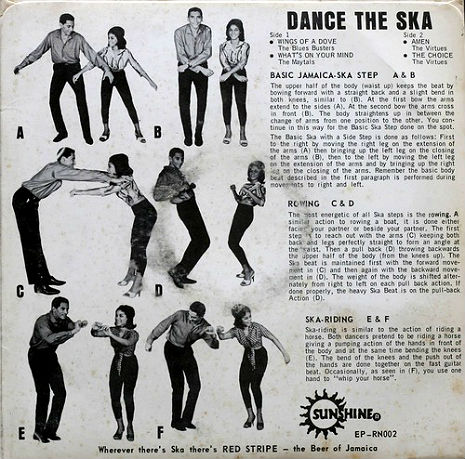
How to Dance the Ska

skaaaaaaaaa

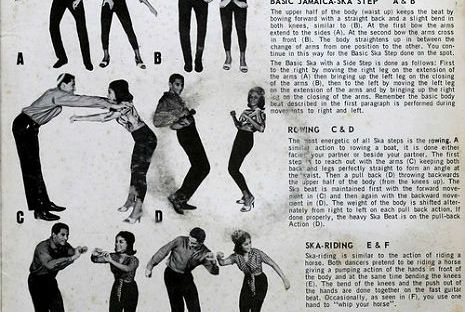
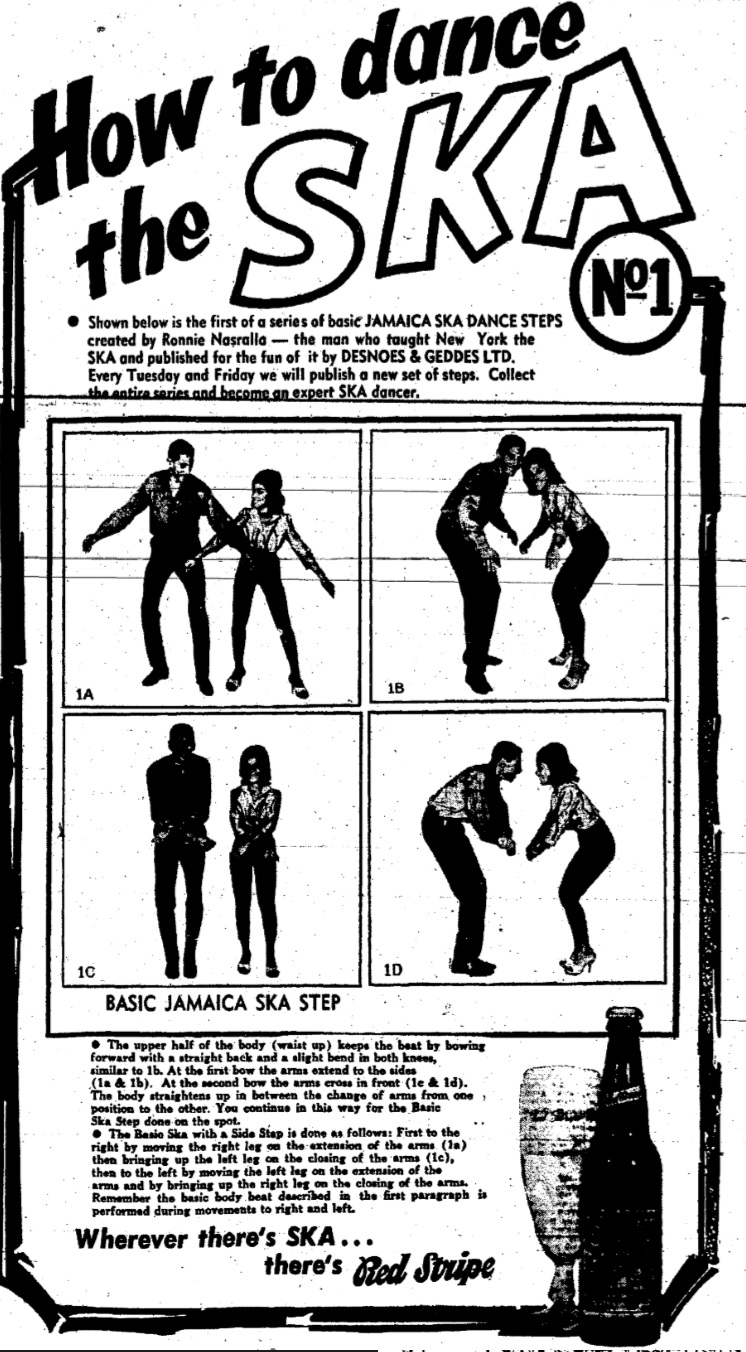
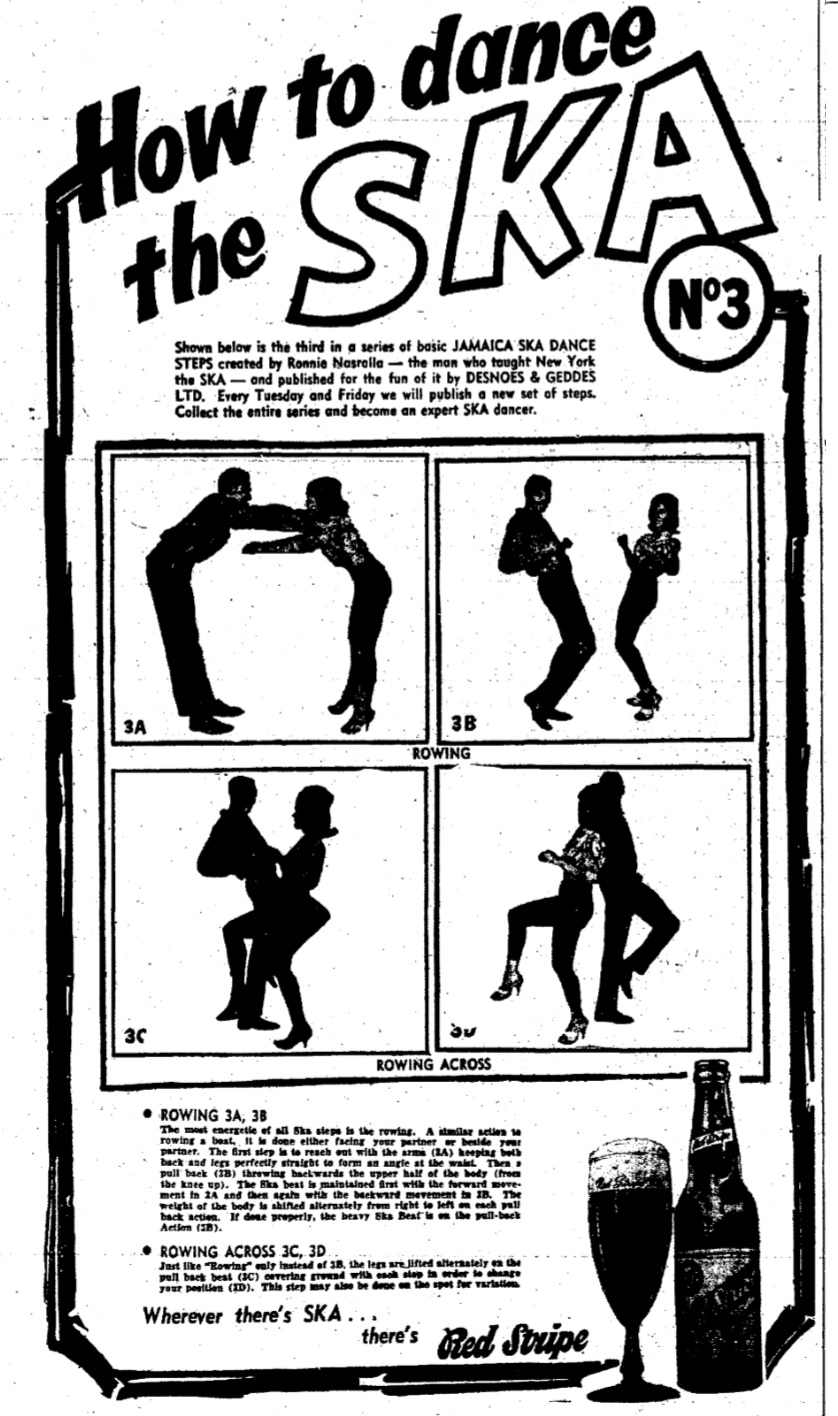
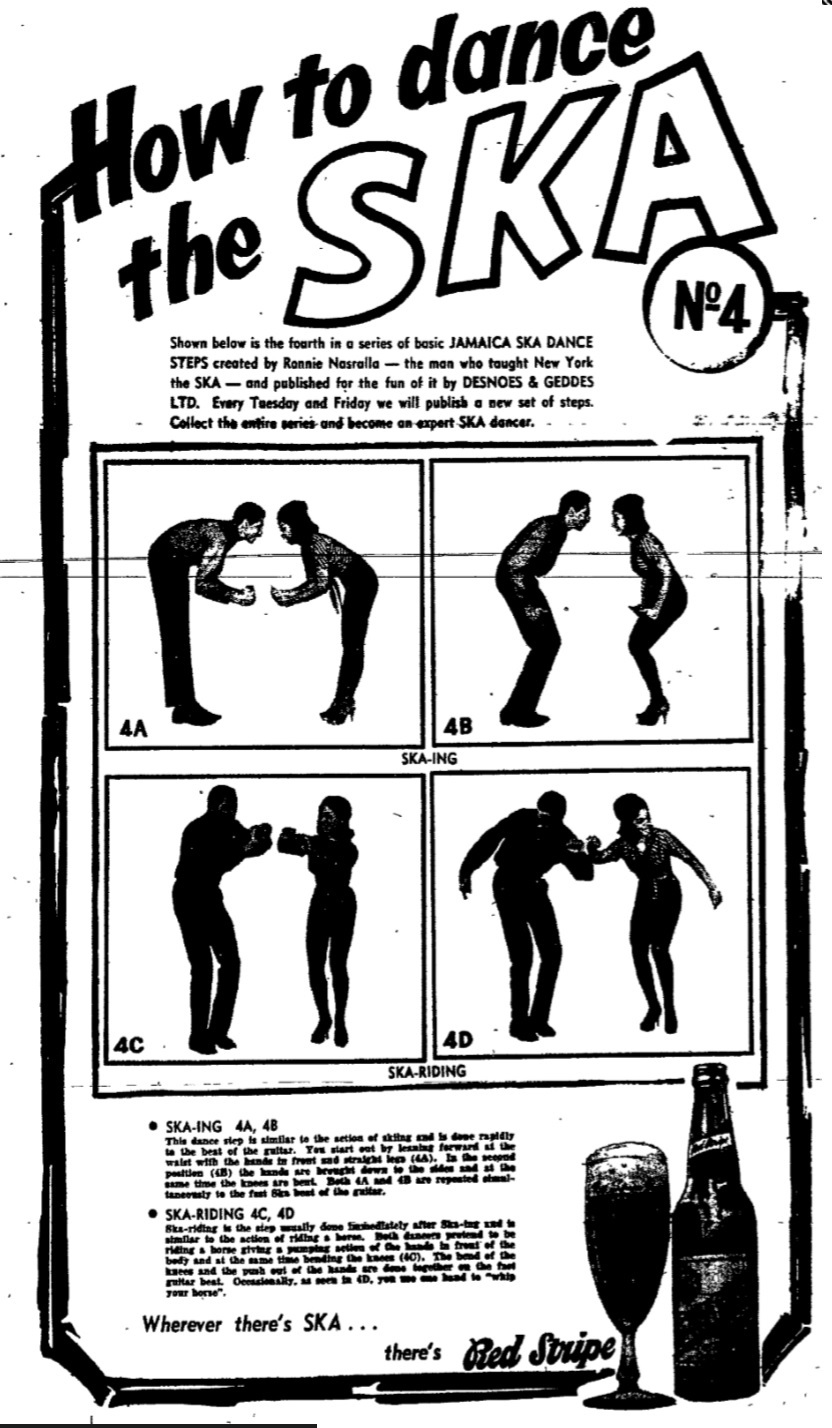
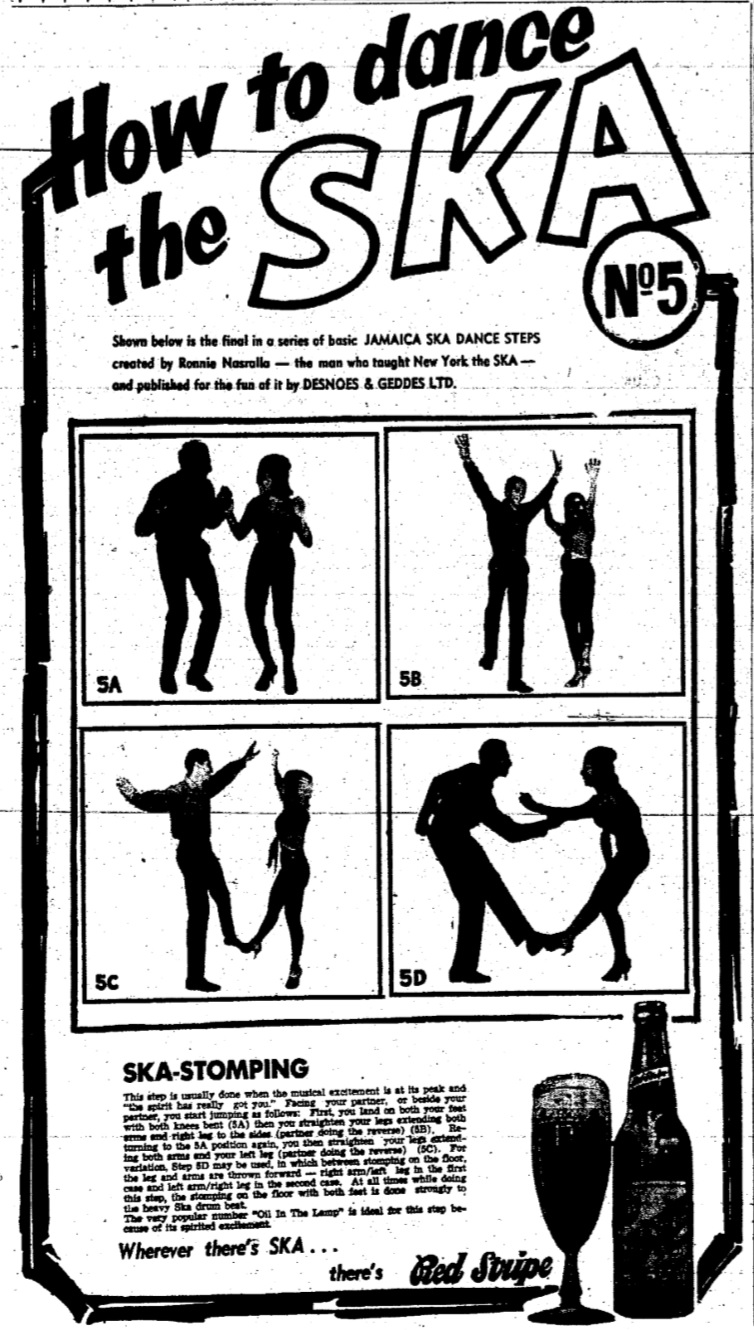
We have seen the photographs of Ronnie Nasralla and Jeannette Phillips teaching us to dance the ska, step by step. These guides appeared on the back of various LPs, especially those by Byron Lee & the Dragonaires. But a dig through Daily Gleaner archives this week revealed that these dance steps also appeared in the newspaper in the summer of 1964, and so I post them here for you to see. They are essentially the same as those on the back of the albums, but they are sponsored by Desnoes & Geddes, the brewer of Red Stripe.

First a little background, which I posted earlier this year. Ronnie Nasralla told me how he came to create these dance steps to showcase the ska with Seaga and Byron Lee. “Let me tell you how it started. One day, Eddie Seaga, who was my close friend, called me. Eddie Seaga was friends with my sister. He was my sister’s boyfriend and he used to come by my house and I help him with his political campaign. Advertising was my forte. So I did all the advertising for the government, Eddie Seaga at that time. I help him with all his promotion. He told me he heard a music that was breaking out in Western Kingston called ska and he asked if I could promote it for him, so I said, ‘Well, I’d like to learn about.’ And we organized and I said, well Byron Lee is the best person to promote it. So we get together with Byron Lee down in Western Kingston and I learned the ska music. Eddie organized a dance at the Chocomo Lawn in Western Kingston—it’s an outdoor nightclub. And Byron played there and all the ska artists performed with Byron and it was a sensation. He [Seaga] said to me, ‘Ronnie, move around the crowd and see what they are doing on the dance floor and see if you can come up with a brochure about how to dance the ska. So I did that, saw the people dancing around and came up with a brochure about a week after, how to dance the ska, give them different steps in the ska, and something that they could use to promote ska worldwide. That brochure was used by the government, they put it in all the record albums and it was sent all over the world and I was asked to go to the states and promote the ska with somebody and I got Jannette Phillips to dance with me. Jannette was a dancer, a belly dancer, a friend of my sister. We took pictures doing the different steps and the brochure was produced and given to the government and it was put in all the ska albums,” says Nasralla.

Nasralla had traveled to the U.S. with the group of musicians from Jamaica to promote the ska at the 1964 World’s Fair in New York. You can read more about this visit in my posts here: Ska Ska Ska! Jamaica Ska!

Without further ado, here are the advertisements from the Daily Gleaner, so get ready to put on your dancing shoes!

ska-no-1-june-23-1964

Hedley Jones

Pioneer Hedley Jones

hedley

The renowned historian and musicologist Garth White recently brought to my attention the contributions of Hedley H.G. Jones to the world of Jamaican music. So today Foundation Ska honors this great inventor and musician who was born on November 12, 1917 and is still alive and well in Montego Bay at 97 years young! Hedley changed music forever in Jamaica and throughout the world with his invention in 1940 of an electric guitar with amplifier. Although Rickenbacker and Gibson had been making electric guitars in the 1930s for use in the big bands and orchestras (so they could be heard over the large number of horns), these were not commercially available and certainly not in Jamaica, and Hedley’s was the first with a solid wood body. A photo of Hedley Jones in the Daily Gleaner on September 2, 1940 (seen below) features the caption, “AUTOMATIC GUITAR AND ITS MAKER Mr, H. G. Jones of Kingston who has, after a lot of experimenting, produced the Electric Spanish Guitar he is seen holding in the Picture. The principal feature of the guitar is its electro-magnet pick-up which has been made up from a pair of horse-shoe magnets and a number of stove bolts. The sound reproduction of the instrument is very good, as compared with the commercial types of electric Hawaiian guitars, a few of which are in the island. So far, Mr. Jones’ guitar is the first of its kind here, and should prove a success as the maker promises to go further into that branch of electricity. Says Mr. Jones: ‘It’s a pity that a few of our talented young men have not the ‘push’ to make ourselves of some benefit to this our island, but I hope to pursue the line I have started to a real success, provided I get the necessary encouragement to do so—-that’s in the line of L.S.D as these instruments are very costly ones’ to build.’”

hedley-1940

Hedley trained as an electronics technician during WWII and he went on to open his own electronics shop which also housed a record store called “Bop City” that sold records largely imported from England. He sold amplifiers, repaired equipment, and built sound systems. Then, in 1947 he built the first sound system, his own, which he used to amplify the sounds of the records he sold at his shop and demonstrate his skills as an electrician. After attracting a crowd, his first customer for one of these new sound systems was Tom “the Great Sebastian” Wong who went on to launch the era of sound systems that continues even today, all over the world.

hedley-feb-22-1948

Hedley was also president of the Jamaica Federation of Musicians in the 1980s and 1990s. He spoke out against the use of technology in music which he felt replaced musicians with computers and eroded the art. He was outspoken on issues such as copyright infringement and he felt that the Jamaican music industry was rife with violations and any laws or contracts that protected the musician were frequently relegated to the trash can. He battled the hotels to use the musicians of the JFM rather than shirking their fees to obtain musicians who didn’t abide by professional standards. His son, Ron Jones, was also an electronics technician and musician and was blind. Ron died on March 20, 2000 at the age of 45 and his father Hedley performed in a jazz band at a celebration of his son’s life.

september-19-1950

You can hear Hedley Jones himself talk about his guitar here in an interview conducted by the esteemed historian Daniel Neely. The Caribbean Quarterly, December 2010, included a brilliant article entitled “The Jones High Fidelity Audio Power Amplifier of 1947,” written by Hedley Jones himself on how he invented the sound system. Here, the pioneer speaks:
IN THE YEAR 1940, I designed and built a solid Jamaican mahogany-body electric guitar, which required a special type of audio amplifier design that would properly respond to particular guitar sound frequencies generated from a magnetic transducer. The amplifier should be portable, responsive, self-contained with its own speaker and cabinet, and be able to accommodate at least two instruments. It should be equipped with individual volume and tone compensating controls; not the high cut-off tone control commonly used in radio circuits of those days, which served to subdue static noises, but specially designed electronic tone compensating circuits. This type of amplifier required knowledge of sound engineering. There were no amplifiers commercially available at that time for the required purpose. Most superheterodyne radio receivers were equipped with two stages of audio amplification and were totally inadequate and unsuitable for the reproduction of an electric guitar. Although there were some high-quality radio receivers around, owned by people with ample means (the famous Scott thirteen-tube superhet receiver sold by Frank E. Lyons and Company of Lyons’ Wharf in Kingston, for instance, used an output section of six valves in push-pull parallel circuitry, driving a thirty-inch electro-dynamic speaker weighing over eighty pounds, housed in a silverplated steel enclosure set on casters), such luxuries were not available to me for the simple reason that I could not afford them. I probed around for electronic literature, and discovered some audio circuit designs in electronic magazines, such as the British Wireless World, and the USA publications Radio Electronics and Electronics World. Using the information thus derived, I designed and, with some experimentation to avoid electronic feedback howls, produced a reasonable guitar amplifier of good response and fidelity.

I produced an electric guitar and amplifier for Fitz Collash, guitarist and music arranger for the Milton McPherson ten-piece orchestra. I supplied the band of the USA Military Expeditionary Force stationed at Vernamfìeld, Sandy Gully, Clarendon, with a guitar constructed from Jamaican mahoe and satin woods, along with a compensated amplifier using power pentode output tubes. The same was done for Don Hitchman of the Red Gal Ring Sugar Hill Club in St Andrew with the exception of the guitar, which was an American Gibson hollow-body concert model that I converted to electric. As was done for Hitchman, the same was done for Victor Brown, guitarist with the Redver Cooke Red Devils dance band; guitarist Gladstone Taylor of the Roy White dance orchestra; Jellicoe Barker, who led his quartet doing hotel duty on Jamaica’s north coast; and my own guitar-led sextet doing duty at the Silver Lining Club in downtown Kingston. My electric guitar served to bring me a sort of connoisseur status among musicians of the era.

Later, when I volunteered for war service and joined the British Royal Air Force in 1943, my commanding officer would give me the privilege of constructing and using an electric guitar during my war service. On my return from the war in 1946, I did electronic guitar conversions complete with amplifiers for Keith Stoddart of the Sonny Bradshaw Seven, and Ernest Ranglin of the Val Bennett Band. Bennett was a comical tenor-saxophone-playing bandleader – in the tradition of the colourful American Cab Calloway, who visited Jamaica with his band and was featured at the popular Carib Theatre in Cross Roads, Kingston, in or around 1950. Bennett wore colourful five-shilling Jamaica Government Savings Bank notes as lapel bouquets. Ernest Ranglin’s guitar-playing was a feature of the Bennett band as well as of the Colony Club band of 1951 led by Eric Deans (whose real name was Dudley McMillan). The devastating hurricane in August of that year put paid to one of my converted model guitars on loan to Ranglin.

I must note here that there were public address systems commercially available in at least one electronics store in downtown Kingston. These were RCA public address systems suitable for voice only, making use of piezo-electric microphones (crystal types). These systems were unsuitable for amplification of the electric guitar. Designing electronic guitar amplifiers made me acquire sound amplifier techniques, knowledge and experience not then known, nor available in Jamaica, and not practised elsewhere except by specialist electronic sound engineers. I had to design and wind my own power output transformers. This activity was always a very long and tedious process, done entirely by hand. The magnetic pick-ups used in my guitars were also hand-wound; and thanks to my very first apprentice – Duke Lawrence1 – who learnt very quickly to use my coil winding jig, made from a Meccano set and hand drill purchased from Hole In the Wall (a small variety hardware store in downtown Kingston, which also supplied me with appropriate gauges of magnet wire), I was always able to do a fairly good job.

But one day in 1941, something quite inadvertent took place. I received for repair a Marconi six-tube radio, which used an audio coupling transformer as a transducer in its output stage. I discovered the fault as a defective transformer, which I replaced with a new unit before delivering the finished job to its proud owner. The audio quality of the radio was so remarkable that I immediately, out of sheer curiosity, dismantled the discarded unit. The coils of the transformer were wound in four sections on two collapsible forms, the smaller inserted within the larger. I found that each section of the secondary winding had the electrical characteristics and physical proportions necessary to fit into the design of my guitar units. I had quite unexpectedly and ironically made a discovery that solved my guitar unit coil winding problems and freed Duke to concentrate on my guitar amplifier transformer designs. Duke’s obvious relief was my gain in achieving audio output transformer and guitar magnetic pick-up design unit perfection.

I continued to study the subject of sound engineering, eventually becoming quite adept in sound amplifier engineering designs. At this time I was also an electronics practitioner quite adept at radio repairs. The types of radios I was required to repair were: Zenith, Philco, Westinghouse, Marconi, Tesla, General Electric, RCA, His Masters Voice, Philips, Telefunken, Kolster Brandes, Sears, Pilot, Farnsworth, GEC of London, Hallicrafters, Scott, and a host of other makes, all available through Jamaican manufacturer’s representatives, who made a fetish of tying up any importation of foreign electrical home appliances on which they could lay their hands, making it well nigh impossible for anyone with entrepreneurial ability to import name-brand electronic parts or accessories, particularly at that time with a war on. This was an opportunity for introspection and innovation.

By 1943, with World War II having been in progress for over three years, I had made considerable innovative inroads, and my skills at radio repairs, manufacturing electric guitars and electric guitar amplifiers, as well as playing the guitar, had improved tremendously. On 8 May that year I made a decision to volunteer for war service in the British Royal Air Force (RAF). My aim, if I survived the war, was to become an electronic sound engineer of some reckoning; so I applied for the radar engineering category as an optional trade in that organisation, and was promptly told by the recruiting officer that my Third Year Pupil Teachers’ Examination Certificate obtained from the Jamaican school system – although it allowed me access to college training – did not qualify me for that category of electronic engineering. I should have been a matriculant. I was told I did not qualify for radio wireless engineering either, but the categories of wireless operator and electrician were available, either of which I could choose. I chose to be an electrician, and was subsequently called up, given a few weeks of military training at the Palisadoes Military Training Camp situated in Port Royal, and transferred to the Up Park Camp in Kingston for military fieldwork.

One year later, on Sunday 8 May 1944, I, along with two thousand other airmen and two thousand Jamaican farm workers destined for the USA, was put aboard an awful ship in Kingston Harbour – the SS Cuba – awful because it was dirty and unkempt. The ship set sail from the Kingston Harbour for Newport News, Virginia, USA. The ship docked at Newport News the following Thursday morning, 12 May. After undergoing a process called delousing, which entailed being sprayed with an unfamiliar chemical, we were made to pass through an automatic hot and cold shower – like a Jamaican cattle-dip process. The RAF group was subsequently carted off to Camp Patrick David.

After a further two weeks’ sojourn there, we were taken by rail to the city of New York, where we boarded a vessel that was included in a trans-Atlantic convoy. This was D-day six. Approximately nine days out of New York harbour, the convoy was put on U-boat alert. Depth charges were deployed and the convoy, which was scheduled to dock at Southampton, England, was diverted via the Irish Sea, to dock at Liverpool on 18 June. We RAF personnel were taken to Camp Filey in East Yorkshire for further training and orientation under wartime conditions. In August (by then I had gained a point in rank – from A2 to Ai – for aircraft recognition) we were called up for muster (orientation), and I again chose the radar engineering category. Little had I realised that the Jamaican recruiting officer (Mr Ernest Rae, Sr.) had recorded that I had considerable experience in electronic circuitry. The English RAF interviewing officer presented to me the schematic circuit diagram of a complicated superheterodyne radio receiver, then asked me five questions regarding the circuitry. I promptly answered three questions correctly, and another partially, while the answer to the fifth eluded me. The officer commended me with the following remark: “023 Jones, you are the type of man we want.” My RAF service number was 714023 – and he recommended me for training as a radar engineer.

Off to the Royal Technical College of Glasgow, a company of twenty- two, including me, was sent. From September 1944 to January 1945 we were given intense training in electrical theory, radio reception and transmission theory and practice, six days per week, ten hours per day. In February 1945, eighteen of the twenty-two, including myself, graduated from the college with diplomas in radio engineering. After a brief one-day holiday, off to the number 12 radio school in Swindon, Wales, we went for training in basic radar theory and practice. Another six weeks of intensive equipment-training ensued. Then we moved again. After further intensive training and successfully sitting the various written and oral examinations, we graduated from the number 3 radio school in Cosford, Midlands, in June as radar engineers. Fifteen of the original eighteen trainees graduated.

On 8 May 1945, victory in Europe was declared. I would spend another year in Europe doing various technical radar duties and services all over the British war-torn country, the nearby French coastline and Ireland.

On 8 May 1946, two thousand West Indian RAF personnel sailed out of the Scottish harbour of Glasgow City on the Norwegian vessel SS Bergensfjord,2 destined for our separate countries of abode and disbandment. On Sunday 19 May the ship set anchor in Port of Spain, Trinidad. On Monday we set sail for Jamaica; and after what so far had been an uneventful journey, an element of the Jamaican psyche for resisting insulting behaviour took hold when some Norwegian security police pointed a gun and used insulting remarks to a group of Jamaican airmen. The vehement protestations resulted in the military’s declaration of a mutiny at sea, the arrest of a few, and a diversion of the intended dispersion site from Palisadoes to the Mona prisonof-war camp (at the present site of the University of the West Indies). Here we went through the process of disbandment on 24 May.

As an aid to rehabilitation, we were given a choice between obtaining a two-acre plot of land in the parish of Trelawny or a repayable loan of fifty pounds. I selected the latter option, and in collaboration with a close RAF buddy, Altamont Edwards, opened an electronic service facility called “Premier Radio Service” at the odd address of 136 7A King Street in Kingston. The partnership lasted only a short while before Alty decided to do electrical installation and moved on to Montego Bay to ply his trade in the fast-expanding tourist industry. We decided on his keeping the name “Premier” and I moved on with the name “Hedley Jones’ Radio Service”. In December 1946 I took the decision to add a record sales department. It had transpired that as the war progressed, most of the big bands mentioned earlier had disintegrated, some of their personnel going into war service as I had done, while others went into formation of smaller groups serving the musical needs of the then rapidly growing tourist industry on Jamaica’s north coast.

The paucity of live music to which the urban population of Kingston had been accustomed resulted in a turn towards recorded music, which had begun to be supplied by three innovators: Count Goody and Count Nicholas out of western Kingston (Pound Road, now Maxfield Avenue), and Tom Wong, a small hardware store owner operating out of his business place in upper Luke Lane, Kingston. These perspicacious gentlemen had bought into the idea of supplying recorded music for house parties, and used some of the popular dance halls in the heart of downtown Kingston, such as Forrester’s Hall on North Street, Jubilee Tile Gardens on upper King Street, Success Club on Wildman Street, the People’s Onward Relief Association (PORA) on Laws Street and Central Branch School Hall on Church Street, to their advantage.

These popular dance halls that had in the pre-war and early war years accommodated the big bands providing live dance music for common folk, now featured what were commonly called “sound systems”3 – a Tom Wong designation. The sound system operators mentioned above used RCA PA systems with very limited audio range, as they were made for voice reproduction and their output mostly was with steel re-entrant horns as speakers. Where there existed a cone speaker, it was a small unit in a no-vent wooden enclosure hung from any convenient structure. The operators mentioned above depended on me to service their equipment. I made improvements where possible, but was limited by the original purpose of the equipment plus the speaker limitation. Except to point out these drawbacks, I made no attempt to sell to them ideas that perhaps they could ill afford.

I made a decision to sell recorded music, and immediately ran into a brick wall. The recordings used by the existing systems were mostly commercial 78-rpm discs of big band recordings of popular tunes from movie shows available from the four record sales departments downtown, or R&B discs brought back by returning war and farm workers or obtained by other means, fair or foul.

I discovered that it was impossible to import the most popular labels. The brands RCA, His Master’s Voice, Decca, Brunswick, Parlophone, Columbia and Capitol were all tied up by commission agents – mostly lawyers with offices along Kingston’s Tower and Duke Streets; and whatever was available had to be acquired via these commercial agents. Fortunately for me, during my sojourn in England, I had become acquainted with some export sources, which I immediately contacted. I was informed that they could comply with the supply of any label I desired. Thus began my foray into the sale of commercial recordings, which served to break the cartels. My English suppliers added the Savoy label, which covered recordings of all the American and European jazz greats of the era: the MGM label featuring the George Shearing Quartet and the voice of Billy Eckstine, as well as the Mellodisc label which featured the West Indian calypsonian great, Lord Kitchener. These labels with their offerings made a direct and astonishing impact on the record-buying public, as the sales were nothing short of phenomenal. I remember dispensing of a shipment of three hundred Mellodisc recordings of Lord Kitchener’s “Kitch Come Go to Bed” in only two days. The manufacturer’s representatives of the establishment, taken by surprise, did not take this interference very lightly, and I was later to suffer somewhat for my feistiness and effrontery.

For this my record-selling venture, I needed top-class reproduction, so I immediately imported two eighteen-inch English Celestian bass woofers (speakers) and half a dozen of the twelve-inch, heavy-duty variety. These arrived in February 1947. I mounted the woofers in bass reflex cabinets that I had constructed for them and turned to my trusted power amplifier designs to set them alive.

The amplifier I had prepared was of split spectrum design, powered by two RCA 807 power pentodes (designed for the modulation stages of highfrequency radio transmitters) in a 120-watt class ABi push-pull output configuration. The pre-amplifier section was built around active filters designed to split the audio frequency spectrum into three overlapping frequency components, fed into parallel-connected double triode cathode followers, each with their individual volume controls. This approach eliminated the need for the proverbial tone control, and the raucous surface noises that emanated from the old PA systems with their high audio hum, used to play gramophone recordings, were on their way out. The modern split-spectrum active-filter equaliser – although I did not recognise it then – had arrived.4

I had also designed and constructed a pre-amplifier with switch-selectable equalisation compensation for all the record manufacturing companies who provided non-active filter circuitry for their high-fidelity (hi-fi) micro-groove recordings just being put on the open market. The various compensations included Columbia, RCA, Decca, Philips, RIAA, and Orthroscopic circuit legends with claims of electronic compensation for the Fletcher-Munsen effect of the human ear.

My record sales department was given the name “Bop City” with a flashing electric sign espousing my radar technology; and although I sold a variety of recording labels with popular and R&B titles on 78-rpm discs, my accent was on the jazz development taking place and the new technology of hi-fi in stereo. I still have in my possession two such demonstration recordings of the era.

With my record sales department in place, I designed and built a highfidelity audio amplifier using my newly acquired electronic technology. Equipped with what I presumed to the best recorded sound reproducer anywhere, I set out on a Saturday night in mid-1947 to demonstrate my thunder. I started to play some Perez Prado recordings. A crowd gathered, and from the crowd emerged two streetside dancers. They called themselves “Pam-Pam” and “Chicken”. Little did I realise that Tom Wong’s sound was contracted to perform at the Jubilee Tile Gardens, almost opposite my business place. Tom’s puny sound with his re-entrant steel horns was no competition for my bass reflex baffles, mid-range speakers and high-range tweeters. His dance, in Jamaican parlance, flopped.

The following Monday morning, I was in for a surprise, as Tom paid me a visit, complete with cash down for one of my amplifiers. Within two weeks his system was transformed with a Jones amplifier and two bass reflex speaker baffles loaded with twelve-inch heavy-duty Celestian speakers. The true Jamaican sound system was born, and scratchy recorded noises receded into oblivion forever.

ACKNOWLEDGEMENTS

I deem it appropriate to end this essay with a few plaudits for some of the individuals who helped me along the way. My sincere thanks to Tom Wong, the first owner of one of my systems; Roy Johnston, salesman of Desnoes and Geddes Red Stripe Beer, and the very first user of my speaker horn-type baffle boxes, which were nicknamed the “House of Joy”; Duke Reid for giving me the opportunity to build his first two systems; Yellow Canary from Seaforth, St Thomas; Clement Dodd (“Coxon” the original until polluted to “Coxsone” by persons unknown); and many others from all over Jamaica, who lent their support. I also thank Mr Bridge of Times Store’s radio department, who recognised my potential for electronics and gave me discarded battery radios that I experimented with, and managed to convert to electric mains operation. Finally, I am grateful to Mr Galbraith, chief engineer of the firm of Wonard’s Radio Engineering in downtown Kingston, and an RAF buddy with like training, for recommending me to the Kingston Technical High School Board as the only one he thought capable of setting up their day-release classes to instruct students in radio technology. This I did for five years, from 1959 to 1964, thereafter pulling up roots and exiting Kingston for the friendly city of Montego Bay.

We thank Hedley Jones for graciously giving us permission to include this essay, an adaptation of a chapter of his forthcoming autobiography, in this publication.

NOTES

1. I originally trained six apprentices. First was Duke Lawrence, who subsequently became chief engineer for the British Overseas Airways Corporation (BOAC), London. Second was Arthur Hassan, subsequently employed to the Jamaica Broadcasting Corporation (JBC) studios, Kingston, as operator. Third was Fred Stanford, Duke Reid’s sound engineer for a decade. He migrated with his family to the USA in 1962, taking the Jamaican sound system expertise to the New York Borough of Brooklyn, from where he launched the Jamaican contribution to the world of electronic sound reproduction. Fred was a witty fellow. He found sobriquets for both sound operators Tom Wong and Duke Reid, naming Tom “The Great Sebastian” and Reid “The Trojan”. He also named Roy Johnston’s huge sound baffles “The House of Joy”. Fourth was Jackie Eastwood, who served as the sound engineer of Sir Coxsone Downbeat (Clement Dodd, chief executive officer of Studio One) from 1956 onwards, still operating from his electronic repair establishment in Kingston. Fifth was Neville Cha Fung. He migrated to the USA during the early fifties; there he pursued studies in electronics at the college level, emerging with a degree, before joining the family electronics sales business (KG’s) of Kingston. Sixth was Ucal Gillespie. He joined Fred Stanford in Brooklyn, New York, USA, during the late 1960s.

There were also others who emerged from my electronics classes at the Kingston Technical High School, which (as noted in my acknowledgements) I taught from 1959 to 1964. For example, there was Richards, whose first name eludes me at this juncture; this student migrated to the USA and pursued further studies in electronics, joining the NASA work force, where he was elevated to an electronic design engineer. Last but by no means least is Oval Lue, who emerged from my Kingston Technical High School classes to eventually become the chief engineer of JBC TV studios in Kingston.

2. Two years later, in the late summer of 1948, the British ship SS Windrush docked at the Victoria Pier in Kingston Harbour, discharging its human cargo of the last remnants of RAF service personnel wishing to be back home in Jamaica. The goodly ship then sailed out with the first wave of the mass emigration of Jamaicans to Great Britain that was to follow in subsequent years – and accompanying that emigration would be the initial entry of the Jamaican sound system that was to make a profound change to the music accepted as normal by the British people.

3. The sound system style of recorded music reproduction is a Jamaican phenomenon, of Jamaican originality, conceived on the science of electronic sound reproduction, firstly around my electric guitar amplifier designs of the early World War II years. This original initiative was considerably advanced by the training I received in the Royal Air Force (RAF) of Great Britain as a colonial war service volunteer airman (RAF radar engineer). There have been several claims and counter-claims as to origin, but the foregoing and what follows are the plain unadulterated facts, which may not be successfully refuted anywhere in the world. The identification by sundry writers of the 1960s to 1970s as the beginning of the sound system/dancehall era, is woefully off-base. Those days saw the growth and enhancement of the phenomenon as a result of the proliferation of recorded music and local recording studios, and the rapid expansion of radio and television broadcasting as well as the rise of road bands. Until the publication of Norman Stolzoffs Wake the Town and Tell the People (Durham, NC: Duke, 2000), there had been no proper investigation of the subject. And even Stolzoff was misled in certain aspects, perhaps inadvertently by individuals who were too young to know. I must also emphasise that considerable research was done on early designs of audio power amplifiers; and those who benefited most did not have a clue regarding the design origins.

Persons who wish to call themselves musicologists ought to avail themselves of any opportunity to make a scientific study of the art of music. One typical example of the use of natural resonance can be found in the design of the brass instruments of an orchestra. The instruments are designed using the natural harmonics of any given note or sound so that only three valves are found necessary to produce myriad octaves of musical tones by the application of human choice and ingenuity. This simply means that music is of cosmic origin and retains both beneficial and destructive powers, depending on its use. This comment is not intended as a barb. I do hope my readers consider this sound advice.

4. Two gentlemen – Mr Baldwin Lennon, musicologist, a government civil servant who subsequently became chief accountant for the commercial firm of H. D. Hopwood and Company Ltd., and Mr Oscar Durant, violinist and musicologist, at the time senior shorthand writer of the Supreme Court of Jamaica – bought into my invention. In 1950 I designed and built a three-channel stereo audio amplifier. Each channel – bass, mids and highs – was fed via an active filter into triode cathode followers (in order to minimise audio hum) with individual volume control and a complete amplifier power output stage, each into its own separate speaker system. This surely was a very complex arrangement at that time. These gentlemen each purchased a system complete with a pre-amplifier with equalised compensation (Fletcher-Munsen equalisation) for any recording from any recording company they chose. The reader will recognise, and please pardon, the foregoing as technical jargon. This could hardly have been avoided, considering what is being described.

My own prototype, a bit cumbersome, disintegrated when I moved from the capital city to Montego Bay in 1965, but I produced another three-channel stereo system for Mr Peter Honiball, owner and operator of the famous Club 35 of Montego Bay, in 1966. Most of what I retained, including my very first design of a twin bass guitar (1961), suffered from irretrievable damage in a very devastating flood that damaged my business place in Montego Bay on the night of 12 June 1979. I am still in possession of an amplifier for electronic instruments which I designed and built in 1956, as well as my present 70-watter built in 1986 and still in use. All my amplifiers have been tube (USA)/valve (UK) types.

Author Affiliation

HEDLEY JONES is an historical figure in the development of modern Jamaican music. He is the author of Jamaica electronic sound technology, an important agency in the articulation of the modern global soundscape.

april-19-1964

Here is an article that appeared in the Jamaica Gleaner on August 24, 1987 written by Carmen Patterson with the title, “Hedley Jones, inventor, creating the unusual.”

AS AN inventor, St Catherine-born Hedley Jones, has had no fame, nor has he made a fortune He gets satisfaction from doing and creating things that are different from the usual A radar electronics engineer trained by the RAF in World War II Hedley read of the development of the electric guitar m the United States in 193O s and took nine months of continuous work to create the first solid-body electric guitar in 194O His was an advancement on American guitarist Charlie Christian s electrified standard model, made by Gibson Guitar Company, USA Twenty years later, Hedley built the twin-neck electric five-string bass and guitar, the only one of its kind Over the years he has built several amplifiers, one of which, although 32 years old, is still in use today. As a young musician, who was taught vocals by his parents, Hedley resolved never to play a manufactured instrument and set about building his own Ukelele, tenor banjo and a cello and bow, all of which he played well as a child JFM’s President Hedley Jones is widely known as the decisive president of the Jamaica Federation of Musicians, who some members consider harsh. His aim is to instil discipline among performers, by dealing with the problems of drug abuse and indecency on stage. To this end, the JFM, through its president, recently suspended Gregory Isaacs from the Federation due to a number of court appearances on charges of cocaine involvement and at the recent Festival Song Finals Lovindeer’s performance, carried live on national television, was chicled by the JFM because of his choice of songs and props. Medley is also concerned about the quality of lyrics that is being unleashed on the public and cites the urgent need for our musicians to be formally trained so that the local product can progress professionally and commercially. He has been involved in the transition of Jamaican music before he built Studio One on Brentford Road, Kingston and worked as recording engineer in the -Coxon Studio for Bob Marley’s classic ‘It hurts to be atone’. As designer he created the early sound systems used by Tom ‘The Great Sebastian’, Coxon, Duke Reid, Mellow Canary and others. He’s also known as guitar teacher and stage performer at such old Kingston favourites as Glass Bucket Club and Carib Theatre with the 20-piece Carlysle Henriques Orchestra of the early 40s featuring Mapletoft Poulle, Joe Harriot and Wilton Gaynier. He’s known at the Cellar Club, Club 35, Breezy Point and Tryall Club in western Jamaica. Astronomy fascinates him But only very close associates know of Hedlev’s fascination for astronomy and his obsession with research in history — whether Black, Indian, Chinese or Mexican — and the scriptures. He has reams of notes from his research that just this month he organised to have typed, for posterity. His love for the outer worlds spurred him to build a telescope 16 years ago, which he used to re-discover Halley’s Comet on the night of November 2, 1985. And every night otter a day’s work as an electronics engineer In Montego Bay, Hedley makes preparation to gaze at the stars from 1O p.m. to 3 a.m. It was in April 1956 while watching the planets Jupiter and Venus in close western coni unction with the new moon, that the inspiration came for the first and only poem he has written. It says in part: I LOOKED: A western planetary conjunction; a wonderous sight; As if to outshine the crescent moon, did Venus and Jupiter shed their light. AND LO! The tri-starred orion with Sirius, Green Dog Star gay, imbued with perspective; exquisite nebulae! An act of nature’s interplay. Amid transcendent, immaculate and resplendent beauty. The cosmic scene stood vigil, sentinel of life’s eternal duty. I WONDERED! How prone was man to spurn his maker. This was the perfect picture God the master painter. “A look into the outer world makes me humble. Sometimes seeing certain aspects of the Heavens for the first strikes a feeling of unbelief for a time, but never to the point where I feel I shouldn’t look. I always want to take a second and third look to make sure that what I saw is really there. But seeing it again and again, does not dispel my awe”, he beamed. Studying the effects of astral travel Hedtev’s Insatiable appetite for knowledge, especial ly of the spiritual world, also led him to study the effects of astral travel. He said those who possess the gift should not be frightened of it, but use It to develop greater knowledge at the time of travel. He disclosed that one night, during man’s first landing on the moon, lust as he was about to fall asleep he found himself looking down at his body lying in the bed. He recalled learning that during such ‘spirit travel’ the traveller could learn any subject he wished. So, because he always wanted to know more about the moon, he said aloud, ‘Moon’. In a flash he found himself landed on the moon. But he didn’t stay long, because shortly after he landed, he woke up. Hedley’s life-long ambition has been to establish a planetarium In Montego Bay and he completed a feasibility study on the project in 1978. However, because of red tape it fell through. But being the patient and determined person he is, Hedley has not given up the Idea and intends to revitalise the project. For him the planetarium would mean ‘that every child in Jamaica would have a chance to look above him, into the vault of the sky — and that’s striving for the highest goal. Isn’t It?”

dec-15-1955