Lord Charmer

Lord Charmer–Louis Farrakhan

Though it is not new news, it was still new to me, to discover that the Nation of Islam leader Louis Farrakhan, whose mosque I frequently pass on Stony Island in Chicago, was once Lord Charmer the calypso singer. Even the Nation of Islam website itself states this. “Popularly known as ‘The Charmer,’ he achieved fame in Boston as a vocalist, calypso singer, dancer and violinist.”
charmer
Louis Farrakhan was born Louis Eugene Wolcott in the Bronx, though his parents were Caribbean. His mother was from St. Kitts and Nevis and his father was Jamaican, though he never met him. He lived with his mother and his stepfather who was from Barbados though he died when Louis was three so his mother moved to the Bronx and then to Boston. While in Boston, Louis developed his love for music and he took violin lessons, growing proficient on the instrument. He performed with the Boston College Orchestra at age 13 and he won a number of competitions for his skill. In 1950 he performed as Lord Charmer, a calypso singer, touring as well as recording a number of songs, including the classic folk tune “Jumbie Jamboree” which he recorded as “Back to Back, Belly to Belly” with the Johnny McCleverty Calypso Boys in 1954. The Kingston Trio recorded their version, “Zombie Jamboree,” four years later and Harry Belafonte recorded his cover in 1962 before Peter Tosh and the Wailers in 1965 and The Jolly Boys in 1989.
charmer3
charmer4
Though I’d love to have a copy of this album, or even the CD, they go for hundreds and thousands of dollars! So have a listen to this classic “chune” here.
Below is an article on Louis Farrakhan’s calypso career that appeared in the Washington Post in 1995.
Louis Farrakhan, Calypso Charmer
Washington Post
October 14, 1995
She knew him as “The Charmer,” and he certainly was that. A lean and handsome young man, with a hint of island breeze in his patter, he’d drop by Daisy’s desk at the neighborhood newspaper every so often with a new publicity photo, hoping to plug one of his upcoming calypso shows.

“Oh, honey, he was gorgeous,” remembers Daisy Voigt, who in those days wrote a teen column under the name Dizzy Dame Daisy. “He was as fine as new wine. We were all half in love with him. We thought he was as good as Harry Belafonte.”

It was lower Roxbury, Boston, the mid-1950s. Belafonte’s Caribbean sound was breaking big-time, but in the neighborhood, Voigt said, The Charmer held sway. Everybody also knew him as Gene Walcott, the musical pride of the West Indian immigrant community served by the Boston Graphic weekly newspaper. In coming years, he would make news under another name: Louis Farrakhan.

The calypso period isn’t a part of the Honorable Minister’s resume that’s eagerly promoted by the Nation of Islam, but those early years help to illuminate his personality. Louis Farrakhan (born Louis Eugene Walcott) always wanted to be a musician. The man has been drawing — and pleasing — crowds since the age of 16, as both a calypso singer and a classical violinist.

“Music, like truth, is the essence of my life,” the minister says in a recent Nation of Islam video — yes, a music video — that documents his talents as a violinist. “People really don’t know Farrakhan, they don’t fully know the soul of a man — and I think that can be expressed through music.”

He’s been in the spotlight since playing the violin as a teenager on television’s “Ted Mack Amateur Hour” in 1949. He’s expert at arranging music and words to move the mind, the body and the soul: His calypso-tinged tune “A White Man’s Heaven Is a Black Man’s Hell,” released in the late 1950s, became a standard for the Nation of Islam. He wrote and starred in two musical plays. He even released a lively recording in the ’80s that represented a reaffirmation of his calypso roots.

From his earliest years, Farrakhan, 62, has been drawn to both the classical and calypso genres, which share a certain power and passion. His mother, who immigrated to the United States from the British Caribbean colony of St. Kitts, was an Episcopalian and supported her son’s violin training. She was somewhat chagrined to see her son performing as The Charmer at age 16 in nightclubs — “a child in a Gomorrah of marijuana, loose sex and double-entendres,” according to “Prophet of Rage,” a forthcoming biography of the Nation of Islam leader.

“Some of them were songs with double meanings,” Farrakhan explains in the book, written by Arthur Magida, a former writer for the Baltimore Jewish Times. “On the surface, it was one thing, but underneath it was kind of filthy. {My mother} would register some of her disapproval of my gyrations in my dance and some of the songs that I sang.”

Like today’s rappers, calypsonians hail from an African tradition that places the singer’s wordplay and message in the forefront. “It’s much more of an oral tradition that values extemporaneous speaking and singing; musically it’s not a very rigorous form,” says Jeffrey Thomas, a calypso scholar and steel band percussionist in Chicago. “Words are used to sway people and get their attention, so I find it revealing that Farrakhan came out of that tradition.”

Those who heard the musical stylings of young Walcott — who sometimes went by the nickname Calypso Gene — were impressed. “He was good, there was no question about it,” says Voigt, who now lives in Washington. “My theory is that if there hadn’t been a Harry Belafonte, there would have been a Gene Walcott. But in that historical moment there could only be one — it was what society would tolerate.”

Even then, his message was political. As a student in the early ’50s at the Winston-Salem State Teachers College — where he was known to serenade classmates on guitar and ukulele with his calypso trio — Walcott titled one of his songs “Why America Is No Democracy.”

Recordings of Farrakhan’s pre-Nation of Islam work are exceedingly rare, if they exist at all. Nation of Islam officials in Chicago said this week that they were unable to locate any calypso material to make available to the press. “The minister may have some of that,” said Sister Safia Muhammad, Farrakhan’s personal assistant. “I don’t know if he will release any of his personal collection at this point.”

Publicity stills of the singer are also hard to find. Magida has been unable to obtain one for his biography of Farrakhan, which is due to be published in February.

Farrakhan has not authorized the biography, but he has facilitated Magida’s research in some ways, inviting the author to dinner and encouraging old friends to talk. This opens up Farrakhan’s little-known calypsonian past, when the singer was earning up to $500 a week by touring the Northeast and Midwest. When Farrakhan married at age 20, he listed his occupation as “musician.”

After he joined the Nation of Islam in 1955, Farrakhan continued touring and singing, staging his plays “Orgena” (“A Negro” spelled backward) and “The Trial.” His best-known song was “A White Man’s Heaven,” a favorite on jukeboxes at Nation of Islam snack shops in the ’60s.

The lilting tune, which features guitar, bongos and piano, backs a fiery excoriation of white oppression of African Americans throughout history, especially during slavery. Sings Farrakhan, then known as Louis X:

“Though you are pregnant, black woman, you pull the plow/ Like a horse, like a mule, sweat from your brow

“He filled your womb with his wicked seed/ His half-white children you were made to breed. Ah, my friends, it’s easy to tell: White man heaven is black man hell.”

Writer and music critic Nat Hentoff once characterized Farrakhan’s singing voice as “high, flexible, attractive.” “Entertaining and inspirational” is how Washington writer and Nation member Askia Muhammad describes Farrakhan’s style. He recalls hearing “White Man’s Heaven” in the ’60s along with another jukebox number, “Look at My Chains,” that had “a real West Indian flavor.”

“Obviously, it’s not very commercial, but it’s not meant to be,” says Skippy White, a former Boston deejay who has one of the rare copies of the original “White Man’s Heaven” 45. “It was meant to deliver a message and that’s exactly what it did.”

Despite his popularity as a performer, Farrakhan dropped his musical efforts in the early 1960s, reportedly at the urging of Elijah Muhammad, founder and leader of the Nation of Islam. “Do you want to be a song and dance man or do you want to be my minister?” Elijah Muhammad asked his acolyte, according to Magida’s book.

“When I gave up my music and became totally focused on the plight of black people, I became somewhat nationalistic and narrow in my focus,” Farrakhan reflects on the music video. But he eventually returned to recording — updating “White Man’s Heaven” in 1979 with a flourish of flute and funky bass, and releasing a 12-inch record with two tunes, “Let Us Unite” and “Benefit of Unity,” in 1984.

“Let Us Unite” calls for an end to the kind of racial and religious strife that many critics say Farrakhan is guilty of fomenting:

“Well, I’m talking to you: Muslim, Christian and Hebrew/ It’s the thing to do/ We’ve got to unite or else we are through,” Farrakhan sings in a crisp Caribbean accent.

On the video, Farrakhan puts it another way. “Music is a universal language,” he says. “There is healing in music.”
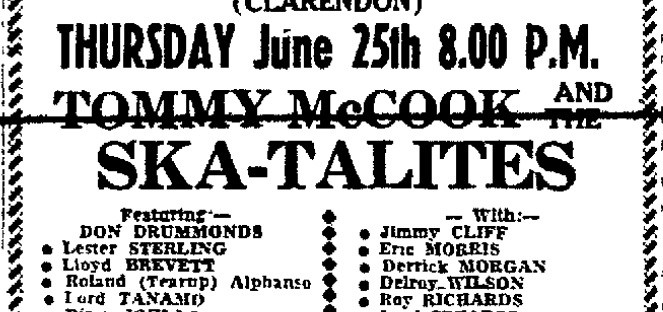
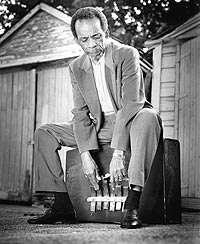
Lord Tanamo, Skatalites

Tribute to Lord Tanamo

tan

Lord Tanamo and his rhumba box

The music world received the news that yet another Jamaica legend had recently passed away, and so Foundation Ska pays tribute to this musical master, Lord Tanamo, who died on April 12th at the age of 82 in Toronto, Canada. He was former member of the legendary Skatalites and the Jamaica Observer wrote of him:

The singer/percussionist, who was born Joseph Abraham Gordon, combined ska with mento and calypso on several of his songs including Japanese Invasion. He led the Skatalites on songs like Come Down and I’m In The Mood For Ska.

Musicologist Kingsley Goodison remembers Lord Tanamo as a very influential member of the Skatalites.

“In addition to having his own songs, he was a percussionist as well as a back-up vocalist. He acted as emcee for the band and introduced the songs before they were played,” Goodison told the Jamaica Observer.

Raised in Denham Town, West Kingston, Lord Tanamo was strongly influenced by the legendary Trinidadian calypsonian Lord Kitchener, who lived in Jamaica during the 1940s.

At the dawn of the 1970s, when calypso and mento waned among Jamaican artistes, he kept the beat alive with songs like Rainy Night In Georgia, originally done by Tony Joe White.

He migrated to Canada during the mid-1970s but continued to record singles and albums for producers in Jamaica, most notably Bunny Lee and Sonia Pottinger.

“He left and went to Canada with keyboardist Jackie Mittoo. They performed together and became a big hit there,” Goodison added.

In 2008, Lord Tanamo suffered a stroke that left him unable to talk.

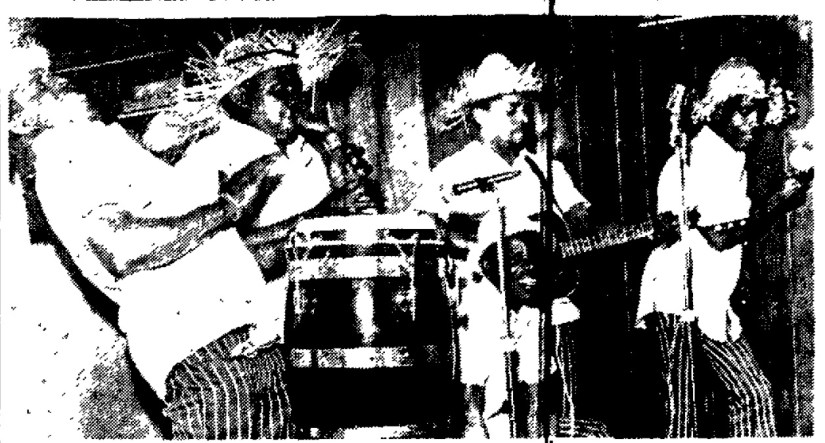
tanamo-6-26-69-calypsoniansLord Tanamo and his Calypsonians, from the Daily Gleaner, June 26, 1969.
A 2002 article in NOW magazine out of Toronto includes words from Tanamo himself. The article states: The Kingston, Jamaica-born Joseph “Lord Tanamo” Gordon, who has made Toronto his home for over 35 years, helped create the sound we now know as ska by combining elements of calypso gleaned from Lord Kitchener with the lilting mento rhythms of his childhood.

“When I was about four years old,” recalls Tanamo from his home at Dufferin and Eglinton, “a fella, Cecil Lawes, came into my yard with a rumba box, which is similar to a marimba. I liked the sound from the first time I heard it. That’s where it all came from.

“Later, when I was a teenager, I began performing on the corner with Cecil and his rumba box. In the day I’d put on torn pants and a straw hat and sing calypso to hustle the tourists, and then at night I’d put on my suit and tie and sing ballads with a band. It was all just music to me.”

It was a few years later, in the spring of 64, that Tanamo would make his most notable mark in ska history, following a fateful recording session with some of Jamaica’s top young studio talent.

“When we did recordings, the musicians were usually paid individually, but for some reason on this date Mr. Khoury made out only one cheque payable to me. So I said, “Gentlemen, since we have this bulk payment, why don’t we form a band?’

“When they asked me what we should call it, I thought, well, we’re playing this way-out music and the Americans were sending satellites into space after the Russian Sputnik. So I said, “Let’s call it the Skatallites,’ because ska was the thing everyone was doing.”

Along with naming the Skatalites, Tanamo is also credited with being among the first of many popular Jamaican artists to take up residence in Toronto, where he opened the Record Nook, the city’s first record shop selling the exciting new music coming out of the Caribbean.

“I think it was in 64 that the Eaton’s company sent for me, through the Jamaican Tourism Board, to come to play some shows in Canada with the rumba box. When I arrived in Toronto, I liked the multicultural atmosphere and I guess I fell in love.

“It happened at a show,” he remembers wistfully. “I saw a young girl crying at the front and I asked if my music was making her sad. She told me that it was actually making her happy. For some reason, I married her, and I’ve been trapped here ever since.”

tanamo-star
tanamoarticle

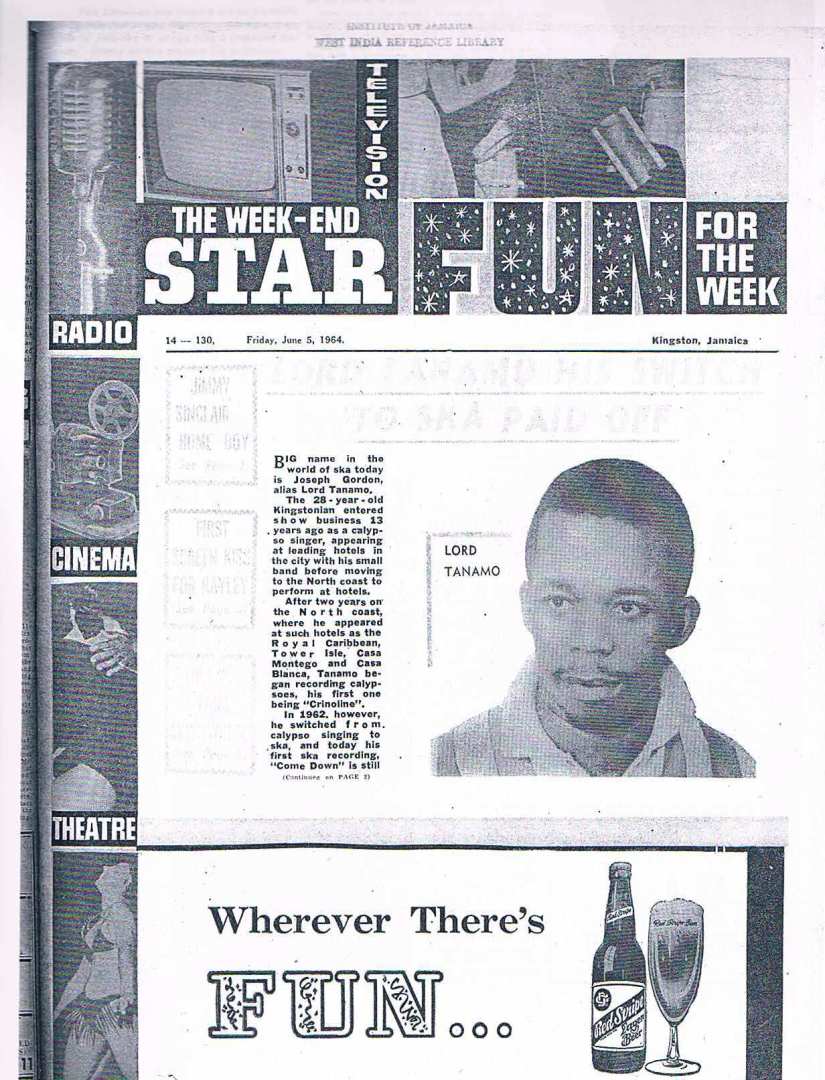
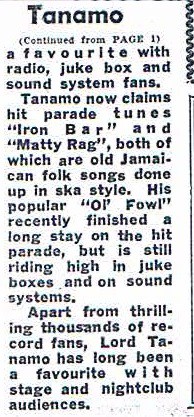
This article in the Jamaica Star, June 5, 1964, noted how Lord Tanamo had switched from calypso to ska. What a dapper young Tanamo! Handsome fellow! In case you don’t want to get out your glasses, here’s what the article says:

Big name in the world of ska today is Joseph Gordon, alias Lord Tanamo. The 28-year-old Kingtonian entered show business 13 years ago as a calypso singer appearing at leading hotels in the city with his small band before moving to the North coast to perform at hotels. After two years on the north Coast, where he appeared at such hotels as the Royal Caribbean, Tower Isle, Casa Montego and Casa Blanca, Tanamo began recording calypsoes, his first one being “Crinoline.” In 1962, however, he switched from calypso singing to ska and today his first ska recording, “Come Down” is still a favourite with radio, juke box and sound system fans. Tanamo now claims hit parade tunes “Iron Bar” and “Matty Rag,” both of which are old Jamaican folk songs done up in ska style. His popular “Ol’ Fowl” recently finished a long stay on the hit parade, but is still riding high in juke boxes and on sound systems. Apart from thrilling thousands of record fans, Lord Tanamo has long been a favourite with stage and nightclub audiences.

tanamo-9-14-57From the Daily Gleaner, 9-14-1957

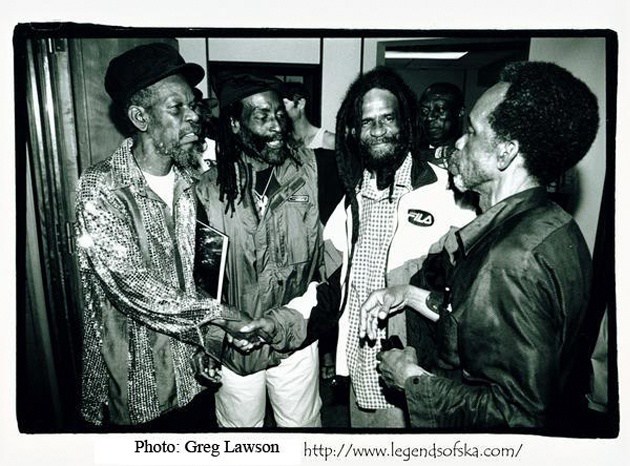
Lord Tanamo is photographed below during the Legends of Ska Concert back in 2002 in Toronto. Tanamo is on the far right next to Johnny “Dizzy” Moore, Justin Hinds, and Stranger Cole.

Tanamo-ska-concert

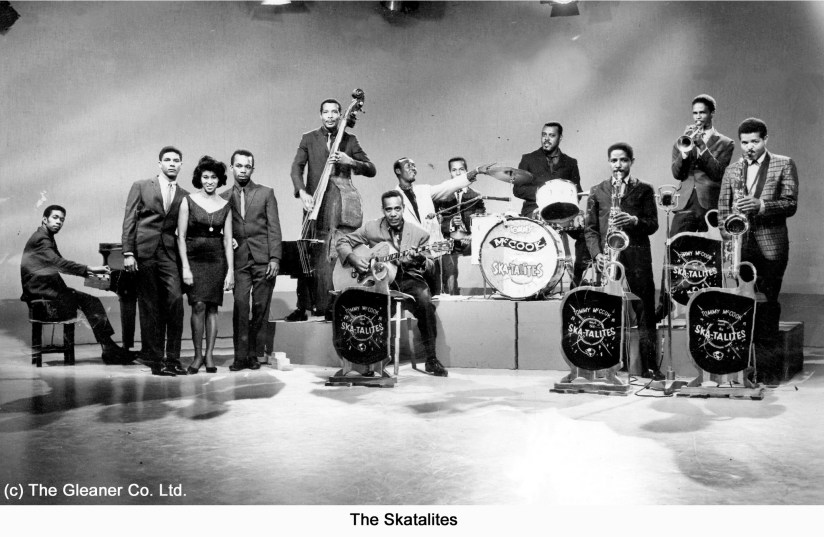
And of course, here is the great Lord Tanamo here with the Skatalites, as one of the four vocalists for the legendary group. Lord Tanamo is to the right of Doreen Shaffer.

The Skatalites
The Skatalites

From the Daily Gleaner, June 26, 1969: Calypso Group in Montreal–MONTREAL, June 16. Terres-des-Homes (or Man and his World) 1969 got off to a roaring start with a huge fireworks display on Thursday June 12th. Total attendance for the first three days was 297,000 visitors. Feature attraction at the Jamaica Pavilion this year is the Jamaican Group of Lord Tanamo and his Calypsonians. This group is already an early favourite and has drawn special attention with its unique Jamaican musical instrument— a rhumba box and a bamboo saxophone, with a fork and grater occasionally thrown in. When asked about the durability of his saxophone, Wilbert Stephenson replied that he keeps it in a cool place to avoid possible splitting of the bamboo due to heat and as an added precaution he brought an extra one with him. The group will play daily at the Pavilion until the Fair closes in September. Personnel of the group is as follows: Lord Tanamo (Joseph Gordon), guitar; Carlton Lewis, maracas and bongo drum; Cecil Laws (rhumba box); Cecil Largie (congo drum); Wilbert Stephenson (bamboo saxophone).

tanamo3

Mike Garnice has substantial information on Lord Tanamo and his mento career which can be found HERE

So raise a Red Stripe in toast to Lord Tanamo, and enjoy these fine chunes from Mr. Gordon!

Iron Bar

Come Down

Dash of the Sunshine

Watch him perform in 2003 at the Glastonbury Festival with Lester Sterling, Lloyd Knibb, and of course, Ken Stewart on keyboard and band manager for decades! I’m in the Mood for Ska

One of my favorites, a tribute that Lord Tanamo did as a tribute for Don Drummond, Big Trombone

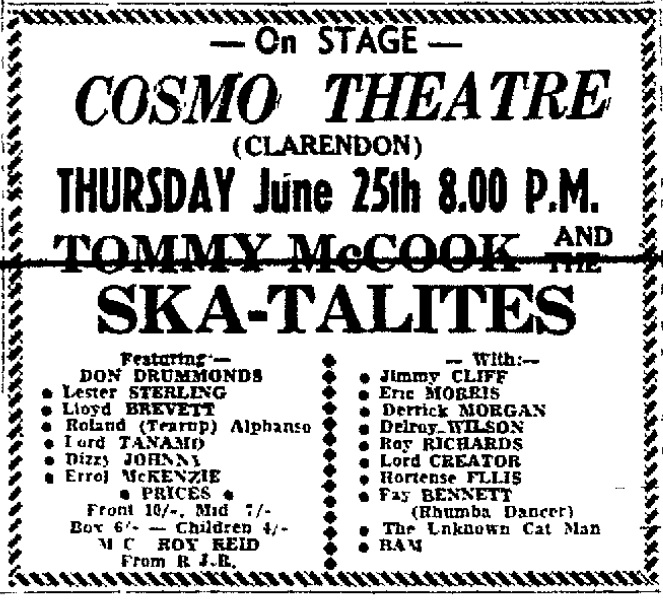
tanamo-skatalites-ad-6-21-64From the Daily Gleaner, June 21, 1964.