Uncategorized

Sound System Makes Electric Meters Spin

yardman

With such large cabinets of speakers known as Houses of Joy projecting waves of boogie woogie sound down the block, it’s no wonder that sound systems were known to sap an amp or two. This article from the Star Newspaper, May 28, 1964, tells of one sound system that made bills fly. What was even more interesting about this sound system is that it appears it may have been taking that electricity from a nearby government office that was attached to the same meter. The article reads, ” . . . In his memo, the MO(H) [Minister of Health] said that the bills for electricity used by the Health Office, Port Maria, appeared to be very high, although during this period November 1963 to March 1964, very little use was made of the electric fans and there had not been any need to use the lights. He wondered whether the sound system used by the yardman or some member of his household was not responsible for the excessive amount of current consumed, and he, the MO(H), suggested that the Health Office be metered separately from the yardman’s residence.” Sure enough, they agreed to install a separate meter so that the yardman’s sound system didn’t get put on the health department’s tab!

Vincent Bogle

Jamaican Rhumba Box Goes Modern

rhumba

This article appeared in the Jamaica Star newspaper on Friday, May 22, 1964 and announced, “Jamaican rhumba box goes modern.” Last December I wrote about Hedley Jones and his musical inventions, and you can read that HERE. But here is another innovator, Vincent Bogle, who improved on the rhumba box. The article reads:

Traditional artists who bewail the rapidly changing face of Jamaica’s folkways had better prepare themselves for some shaking news. The Jamaican rhumba box, which for years has given its distinctive sound to the island’s calypso bands, has gone modern.

Vincent Bogle, one of the island’s leading makers of these distinctive instruments, has produced a new design which adapts this primitive instrument to the demands of today’s amplified, electronic orchestras.

Formerly, rhumba boxes were acoustical, depending on a closed column of air projecting through a sound hole to amplify the sound. Tuned keys of spring metal were rigidly mounted on the front board of the soundbox, generally made of mahogany or cedar and the player sat on the box in order to play it.

Mr. Bogle’s new design is a radical departure from traditional design. The new box is hand-held and in fact is not a box at all. It is a solid-bodied instrument with the keys mounted on it, and with two microphones affixed. The player now plays standing, or seated on a chair, and the sound of the box is fed electronically into an amplifier and to a speaker.

The improved rhumba box reflects the gradual modernization of Jamaica’s calypso orchestras. Such leading groups as the Lord Jellicoe Calypso Band at the Sheraton-Kingston, and Calypso Joe’s group at Flamingo/Courtleigh Manor, shifted to the use of string bass because of the tonal and sound limitations of the old box. Some groups have been using amplified bass guitars following the trend started by the island’s popular dance orchestras.

The rhumba box itself is an African instrument, said to be about six centuries old. Instruments of many differing types, but all similar in basic principle, are found throughout the West Coast of Africa, as well as in Rhodesia and Tanganyika. They all use the method of having tuned spring metal “keys” which are plucked to obtain music, and in each case the keys are mounted on a sounding box which amplifies and projects the sound.

A good rhumba box of the old type, sturdy enough for knockabout use by a working calypso band, sells for about seven guineas. The new design “guitarumba” costs 17 pounds, 10-. Most of the cost is for the two microphone pickups. Mr. Bogle says he has registered the design.

Desmond Dekker

Desmond Dekker’s Girls

dekker8

Desmond Dekker was perhaps most well-known for his rude boy songs, the lyrics that celebrated rude boys, but also told them to keep a cool head. His songs also told of the problems of everyday people, those who slaved for bread so every mouth could be fed, how it is very hard sometimes for a man to find his own meal and sometimes he has to go out and steal. He told of how money is so hard to get and so easy to go. Even though there were troubles and misery, he encouraged us to live in unity and since we were one creation we should live as one nation.
But then there were Desmond Dekker’s women, or more accurately, the girls and the themes of love and unity didn’t seem to apply to the male and female sexes. Sure there were sweet love songs in the tradition of American rhythm and blues, but then Dekker had a definite opinion when it came to relationships. They were bloodsuckers, cannibals, seducers who lured men to evil. Women were either the recipient of troubles, or the creator of troubles. In “You’ve Got Your Troubles,” Dekker isn’t feeling much sympathy for the subject of this song, a recipient of troubles, identified only as “girl.” He sings, “You’ve got your troubles baby, I’ve got mine.” It’s not a shared misery, a community of support. He is exhausted, tired of hearing this girl’s troubles as he sings, “What’s wrong with you? Lord knows. . . . Don’t come running to me baby with all your troubles.”

dekker6
Women are the creator of trouble and problems. In “This Woman,” Dekker doesn’t mince words when he sings, “Oh yeah, here is a Jezebel, more like a lion, here is the root of all your pain, she is a Jezebel, more like a lion, she is the root of all your pain, don’t let she rotten you, don’t let she get to you, and when today she’ll try to come into your heart. Here is a Jezebel, no, you are a cannibal, you are the root of all the evil, you are a Jezebel, like a parasite, you are the root of all your pain.” He is advising other men to resist this evil creature who will create misery and devour them, like Jezebel, the biblical character who, through her made-up beauty, seduced her husband into worshiping false gods. Jezebel is a symbol of sexuality and trickery, a woman who was evil and cunning. She is also invoked in Justin Hinds in his song, “Carry Go Bring Come,” a song that Dekker covered with The Specials.

dekker5
In “Carry Go Bring Come,” women are gossipers, stirring up trouble, creating problems. Carry go, bring come, is the act of spreading gossip. “This carry go bring come, my dear, brings misery . . . You’re going from town to town making disturbances, It’s time you stopped doing those things, you old Jezebel . . . It needs no light to see you’re making disturbances . . . It’s better to seek a home in Mount Zion high, Instead of keeping oppression upon innocent man . . . Time will tell on you, you old Jezebel.”
In Dekker’s songs “Mother Pepper” and “It’s a Shame,” he again sings of women as gossipers and trouble makers, insulting them with the same phrase in both songs, “Just stand and look at your mouth, it big as the Gulf of Mexico.” “Mother Long Tongue” is also about a gossiper as Dekker sings, “In the morning when you wake, you don’t wash your mouth, you just lippy lippy lippy gal, wha wrong with you.” A lippy lippy gal is one who talks too much, a blabbermouth.

dekker4
There is no unity and equality in Dekker’s “A Wise Man,” when he sings, “A wise man keepeth his life, and the life of his wives and kin . . . Take the tip from me yeah, and you will see Lord.” What Dekker means by keeping his life is subject to interpretation, but it is evident that if the man, or the wise man, is the keeper of the life of his wives (multiple) and kin, then the man is certainly in the seat of power, and Dekker is offering his advice to his listeners on this subject as the man with the wisdom.
In “Dracula,” Dekker’s female subject can either be a monster of novelty in this humorous song, a reference to a duppy, or a metaphor for a blood-sucking creature. It may, in fact, be a little of all of these possibilities. Dekker doesn’t sing of a vampire, but he sings of Dracula, the most popular vampire, an icon of pop culture and movies, so there is a bit of fun play present in this song. But there is more than just whimsy in Dekker’s song. He is also being quite nasty about the woman about which he sings. She, a vampire, is a thing of evil. The vampire does appear in Caribbean folklore as Old Higue, a duppy. But some Jamaican musicians, namely Lee “Scratch” Perry and Peter Tosh, have used vampires to describe people who are leeches, who suck the life from others, who exploit and take from others. Dekker sings, “One rainy night, as I was walking on the beach, I meet a girl, believe me folks she was fabulous. I held her hands, she held mine too, she smiled at me, believe me folks, she was a Dracula. So beware my friends, for she’s pretty smart, she has a face like an angel, and eyes like blazing fire. Her teeth is gruesome, ready to stick your veins, do not fall in love for that girl, she is a Dracula.”

dekker3
Dekker’s women could also be useless, inept, unworthy of being an obedient wife. In “Get Up Edina,” (sometimes spelled Adina) this “girl” is lectured and warned by Dekker, and it is important to note that Edina is referred to as a “girl” instead of a woman, meaning that her status is below his, she is subservient and young, still needing some tutelage and education. She is not yet mature and he is commanding her, “Get up Edina . . . I said to get up Edina, girl. I send you a school, you won’t learn, I send you a church, you won’t hear, I’m gonna send you back to your mama’s house, I’m gonna send you back to your papa’s house, I’m gonna send you back where you come from, I said to go home, go home, Edina,” scolds Dekker. He ends with an insult, “I say you down a di gully,” meaning she is to be thrown out into the street, into the gully, the gutter, where the garbage and waste water run.

dekker2
According to some claims, there are two songs in which Dekker speaks to his younger sister, as an older brother, correcting her for her mischievous ways. Lorna Dekker In “Pickney Gal” his little sister steals money from him and he tells her to “come here,” likely for a scolding or to be corrected in some way for her transgressions. Colin Larkin in his Encyclopedia of Popular Music writes about Dekker’s song, “It Mek,” which was originally titled, “A It Mek,” which means “that’s why it happened,” that the song “was inspired by Desmond’s sister Elaine, [sic. Lorna] who fell off a wall at her home and cried ‘like ice water.’” It wasn’t the first time he had counseled children. In “Honour Your Mother and Father,” he tells all children to do as the title suggests. It is a song about obedience. Although the song “Parents,” which seems like a counterpart to “Honour Your Mother and Father,” advises them to “take my advice and you will find your reward, parents do not provoke your children to wrong.”

dekker1
Speaking of parents, in “Licking Stick” Dekker sings of a young girl who has been corrected by the rod, beat, given a “licking” with a stick at the hands of her father and she pleads to her mother for mercy. “Papa, papa, papa; do not lick me with that; mama, mama, mama; it licked too hot; I’ve got the flipping hiccups, mama; I’ve got the flipping hiccups, papa; mama, mama, mama; are you feeling sick; papa, papa licked me; with the licking stick . . . mama, please tell daddy; do not hit me with that; mama, I’m feeling pain; I’m really, really feeling; mama, help me tell my daddy; to help me, I can’t stand it, I can’t; no, I can’t stand it; no, no, I can’t.” If the song weren’t so upbeat and lively, and if Dekker’s voice weren’t so beautiful, the song would almost be too painful to listen to.
He gives more advice and warning to a young girl in “Mother Young Gal,” by using a poem and a proverb. He sings, “’Come into me parlor’ said the spider to the fly, long run, short catch, mother young gal.” The Spider and the Fly is a poem by Mary Howitt that tells of a cunning Spider who ensnares a naive Fly through the use of seduction and flattery. The poem is a cautionary tale against those who use flattery and charm to disguise their true evil intentions. “Come into my parlour,” has become an aphorism used to indicate a false offer of help or friendship that is in fact a trap. He sings of a “long run short catch,” which is a Jamaican proverb meaning that it may take a long while for you to be caught and punished for wrong-doing, but you will be caught one day.

dekker7
But Dekker was far from perfect in his songs. Here he was, doling out guidance, reprimanding, scolding, even name calling, yet he himself was guilty. In “Baby Come Back” he sings, “There ain’t no use in you crying, ‘cause I’m more hurt than you, I shoulda not been out flirting, but now my love is true.” Dekker was unfaithful to his partner, yet he is telling her that he hurts more than she does, so he is the victim of his own actions.
Dekker was and always will be the “King of Ska,” undeniably a beacon of Jamaican music. He did worry about what would happen to the “Young Generation” and he appealed to those in his own country, in the UK, and now, people all over the world even almost a decade after his death. His voice is sublime, his songs are infectious. His lyrics represented generations. As a woman, I do not think any differently of Dekker knowing his struggles with the female species. Perhaps here, again, he was a mouthpiece for the people, a reflection of what he saw, a conduit through which the music and society flowed.

Uncategorized

People Get Ready–Curtis Mayfield and Jamaica

TheImpressions1

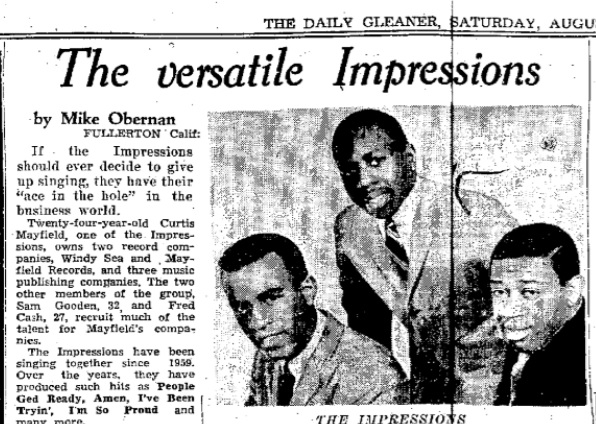
Journalist Robin Murray once wrote, “When Curtis Mayfield’s group The Impressions touched down on Jamaican soil in 1967, the move garnered a reaction akin to the opening phase of Beatlemania.” The year was more accurately 1966, but Murray’s sentiment is not lost—The Impressions, and Curtis Mayfield, were of huge importance in Jamaica. Clinton Lindsay has written of Curtis Mayfield and The Impressions, “Their impact spread far and wide, even here in Jamaica, where they had more of their songs covered by Jamaican groups than any of their contemporaries, which included outstanding performers like The Drifters, The Temptations, The Four Tops, Little Anthony and the Imperials, and a little before them, The Platters.”
smashville-ad-sept-30-1966

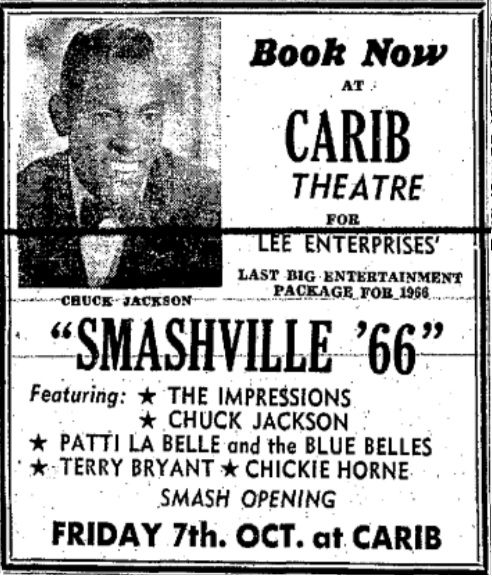
The Impressions came to Jamaica through Lee Enterprises, Byron Lee’s entity that brought American artists to the island. The show was called “Smashville ‘66” and it featured a number of performers at the Carib Theatre including Chuck Jackson, Patti Labelle and the Bluebells, as well as the Impressions. All of the performances were supplemented by Byron Lee and the Dragonaires, The Itals, Hortense Ellis, and emcee Tony Verity. After the show came to Kingston, it moved on to other locations on the island, including Duncans, Mandeville, and Port Antonio.
real-jamaica-ska

Curtis Mayfield and Ska
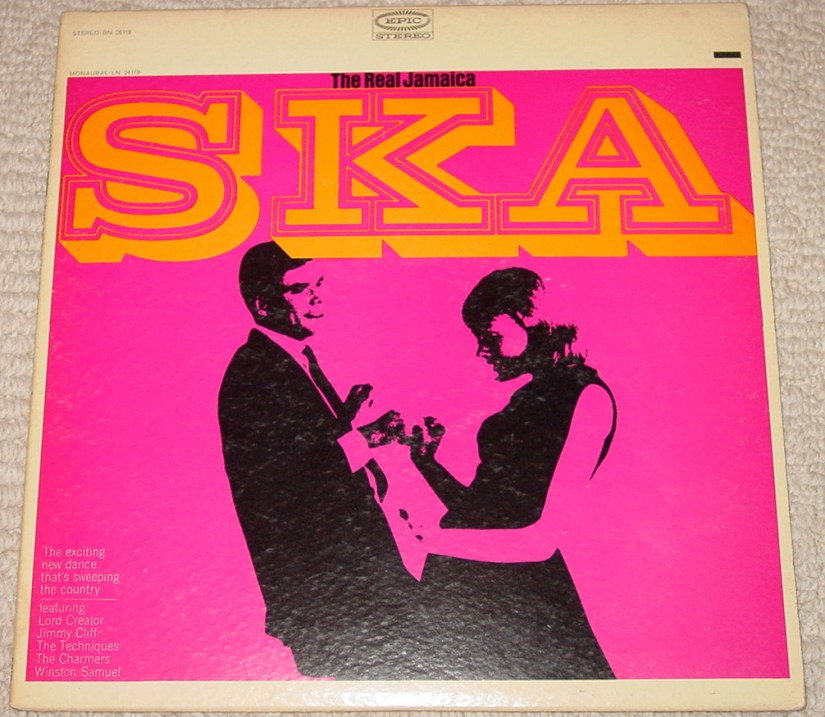
1966 wasn’t the first time that Curtis Mayfield had touched Jamaican music. It seems that in 1964, Jamaican music had touched Mayfield as he and Chicago producer extraordinaire Carl Davis, produced the LP “The Real Jamaica Ska” in September of 1964. Carl Davis had been to Kingston along with Major Lance and Billy Butler. Major Lance was a recording artist produced by Davis, as was Billy Butler who was also Jerry Butler’s younger brother. Jerry was a member of The Impressions with Mayfield. The Daily Gleaner, May 27, 1964 details the trip that Carl Davis and Billy Butler made from Chicago to Studio One. “’The Jamaican ska is a terrific beat, and sooner or later it’s going to gain a lot of ground in the United States,’” Mr. Carl Davis, a producer of one of America’s major recording companies said on Monday. Mr. Davis and two American pop singers, Major Lance and Billy Butler, on contract with Columbia Record spent the weekend exploring “the possibilities for ska promotion” in the U.S. and to make recordings of “this new crazy beat.” They left from Palisadoes by Pan American flight for Miami. Major Lance and Billy Butler, who came to Jamaica specifically to make recording of the ska were prevented from doing so by the immigration authorities who regarded this as a form of employment, Mr. Davis said. The singers did not obtain work permits. He said however that “they had picked up a few ideas here and the boys might use them in future recording.” Over the weekend 12 ska recordings by Jamaican artists, backed by Byron Lee and the Dragonaires, were made. Mr. Davis said that he was ‘very excited’ about Lord Creator’s ‘Don’t Stay Out Late,’ ‘No One,’ by the Techniques and Jimmy Cliff’s ‘Ska All Over the World.’ He said that these three records will be released shortly and the others would follow gradually according to how the new beat caught on. The producer, who had been with Columbia for four years, said that more sober” lyrics should be written for the record and they could be geared towards the teenagers. In the United States he said adults take the cue from teenagers and if they like a beat the adults usually do too. He said that in Jamaica he saw more adults than teenagers doing the ska. Mr. Davis spoke highly of the assistance received from the Ministry of Development and Welfare.” That minister was Edward Seaga. The record that came from this weekend recording session was “The Real Jamaica Ska” LP which Curtis Mayfield helped to compile with Davis. Billy Butler and Major Lance did not appear on the album.
impressions-aug-5-1967

Curtis Mayfield and Rocksteady
Curtis Mayfield’s importance in the rocksteady era goes beyond the songs that a number of vocalists and groups covered. It comes in the formation of the trio itself, for which The Impressions were the model. A feature on the Heineken Star Time rocksteady show in the Jamaica Gleaner, November 1, 2000 noted this relation. ”However while Jamaican artistes were continuing their tradition of transforming and covering American soul hits of mainstream artistes like Jerry Butler, Sam Cooke, Chuck Jackson, Ben E. King, the Drifters, Marvin Gaye, the Temptations, the Four Tops and the Miracles, none of them was as important to the growth and development of rock steady as Curtis Mayfield and the Impressions, whose string of hit recordings provided many Jamaicans with material that suited this new sound. As a matter of fact, the Impressions also caused another quiet revolution in Jamaican music — being the birth of trios (possibly) beginning with the Wailers and including the Gaylads, The Heptones, The Paragons, The Jamaicans, The Melodians, The Silvertones, The Uniques, The Techniques, and The Sensations, among others. It is quite noticeable that the lead singers of most of these groups — Pat Kelly, Junior Menz, Slim Smith, Bunny Wailer—all sounded much like Curtis Mayfield and vocal arrangements were very close to The Impressions. Curtis Mayfield’s influence was to continue for successive generations of Jamaican singers during the Bunny Lee, Joe Gibbs, and Channel One periods in the mid to late 1970s,” stated the article.
Jamaican Appearances
In addition to their tour of Jamaica in 1966, The Impressions also performed in 1968. “THE IMPRESSIONS who arrived yesterday to take part in the cabaret at the Charity Ball at the National Arena tonight, having an informal chat with Byron Lee (left), of Lee Enterprises. The Impressions ara (from left), Fred Cash, Curtis Mayfield and Sam Gooden. The Impressions who will be among the many foreign and local artistes at the ball, were coming from a live performance on CBSTV, New York,” read a Daily Gleaner article on December 14, 1968.

impressions

Jerry Butler, one-time member of The Impressions, performed in Kingston at the Wyndham Hotel in early August, 1986. The local band Kotch opened the sold-out show and Butler paid tribute to Curtis Mayfield and said the group was sticking by his pursuit of a political career in Chicago. Butler is a Cook County Commissioner, a post to which he has been elected since 1985. In 1990 they performed four shows for a performance called Nostalgia in Gold—two in Kingston, one in Negril and one in Ocho Rios—but sans Mayfield. The Impressions consisted of Fred Cash, Sam Gooden, Ralph Johnson, and Smokie Hampton for these shows. Other times in the mid-1970s, movie theaters like the Tudor in Mandeville broadcast performances of Curtis Mayfield in concert with other American soul artists like Gladys Knight, Dionne Warwick, and the Chi-Lites.
people

Popularity of Recordings
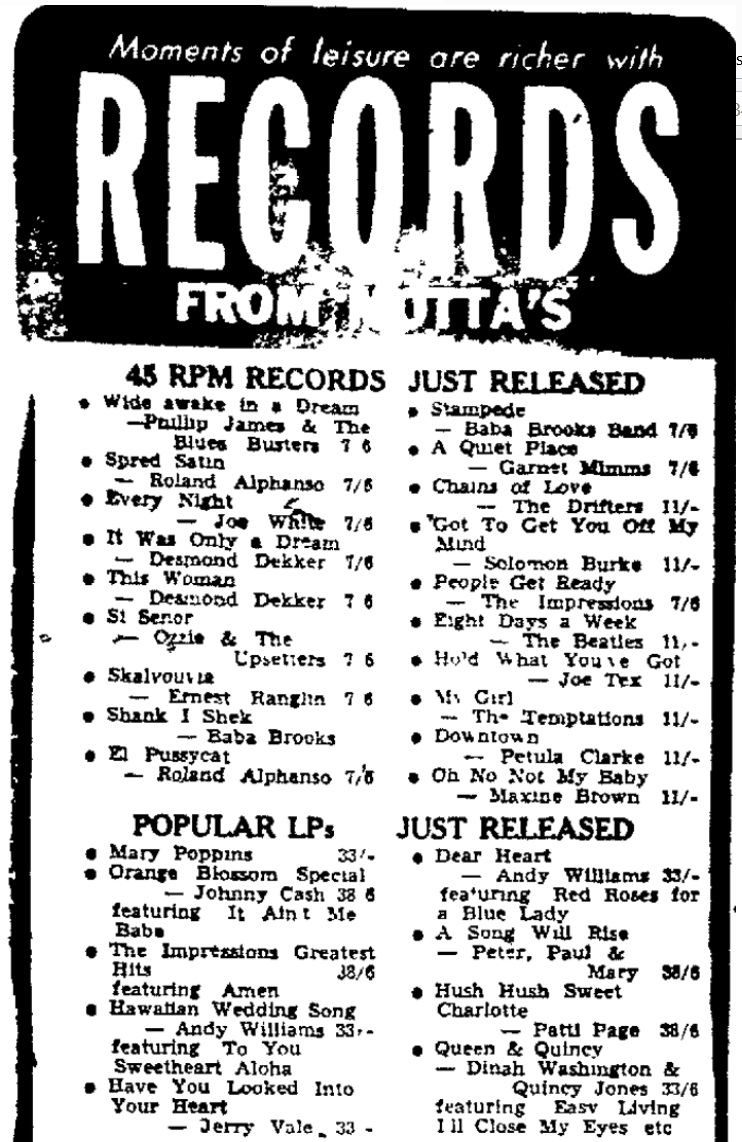
Curtis Mayfield’s recordings sold well in Jamaica. Numerous advertisements for local record shops include The Impressions on their lists of new 45s and LPs for sale. Columnist “Dee Jay” write in the “Off the Record” column in the Daily Gleaner on November 20, 1966, “There’s hardly any need to introduce a new disc by The Impressions except to say ‘it’s here’. This one is PEOPLE GET READY on the ABC-Paramount label. The Impressions have proved long ago — and in person — that they sing the kind of song that Jamaicans love. Since they formed their group eight years ago they have produced hit after hit, many of them written by leader Curtis Mayfield. This one includes ‘You Must Believe Me’, ‘Sometimes I Worker’, ‘Can’t Work No Longer’, ‘Hard To Believe’, ‘Emotions’, ‘Get Up And Move’.” A few months later, the same “Dee Jay” sings the praises of another record when he/she writes in the Daily Gleaner, July 23, 1967, “One of the most consistently popular American singing groups with Jamaicans is The Impressions, three young men who have made such hits as ‘Gypsy Woman’, ‘Keep On Pushing’ and ‘Amen.’ Now they can be heard on the ABC Records disc THE FABULOUS IMPRESSIONS. Tremendous credit for their decade of success must go to lead singer, Curtis Mayfield, whose compositions have put them way ahead of dozens of other vocal groups. This time he contributes all but one of the eleven numbers — that one is the pop classic “100 lb. of Clay”. They include “You Always Hurt Me”, “It’s All Over”, “You Ought to Be in Heaven”, “I Can’t Stay Away From You” and “She Don’t Love Me”, to pick out some of the best.
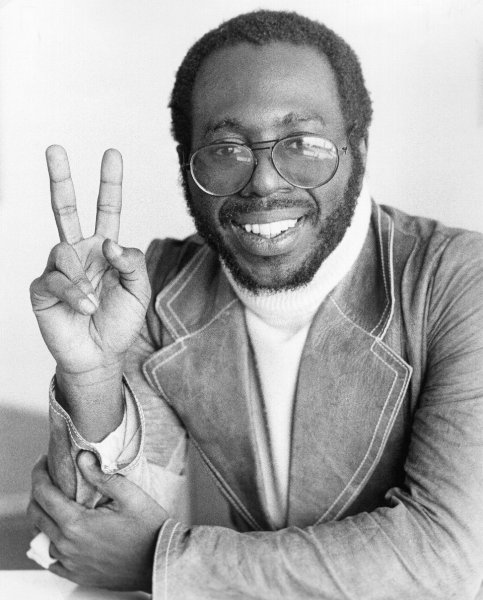
Curtis Mayfield also owned a record label with partner Eddie Thomas called Curtom Records and he distributed “Hacka Tacka (I Like It, I Like It)” by Jamaica vocalists Joy Roberts and Richard McDonald on the Buddah imprint, according to an October 11, 1975 Daily Gleaner article, but I am wondering if this might be the same as Baba and Roody’s “Hacka Tacka Music” that was on the Epic label and the CBS label., or the same as Sweet and Rich’s “Hacka Tacka (I Like It, I Like It) on the Federal label. Joy Roberts had been a member of the Heptones at one time. Additionally, a Daily Gleaner article on November 21, 1974 reports that John Holt was invited to audition for Curtom Records by an executive, but I can’t find anything that says what might have come from this meeting.
curtismayfield

Curtis Mayfield & The Impressions and Bob Marley & The Wailers
Numerous journalists and historians have noted the link between The Impressions and The Wailers and it has now become common knowledge that Marley’s “One Love” was inspired by Mayfield’s People Get Ready.” Journalist Orville W. Taylor writes in the Sunday Gleaner on February 20, 2005, “One Love can be traced back to Curtis Mayfield,” and journalist Claude Mills concurs in Jamaica Gleaner, January 2, 1998 when he writes, “Bob Marley and the Wailers tried to sound like Curtis Mayfield and the Impressions.” Melville Cooke (Cookie) in the February 10, 2005 issue of the Jamaica Gleaner writes of One Love, “It has been made into Marley’s signature song while Curtis Mayfield, who has writing credits, has been disregarded.” Cooke writes again on January 8, 2006 about the link, but this time reveals Byron Lee’s take on the Wailers/Mayfield connection, as well as connections between other Jamaican and American artists. “With the Jamaican music industry just beginning to rotate on the turntable of African retentions and North American influences, the performers did not take to the stage with just their own material. Lee said Jimmy Cliff did Otis Redding, Sam and Dave were the Blues Busters, Tony Gregory did Ray Charles, Marcia Griffiths performed Curia Thomas’ songs and The Wailers delivered like Curtis Mayfield and the Impressions. “They would do the foreign songs and then come back on with their own songs,” Lee said.’” During a lecture in 2002, Dr. Omar Davies, minister of planning, stated that One Love, which was named as BBC’s song of the 20th century, is an “adaptation of the Curtis Mayfield hit ‘People Get Ready.’”

Other Artists
In a Jamaica Gleaner article written by Winston F. Barnes on May 16, 1982, The Techniques are credited with bringing quality music to the studios and Barnes specifically cites their cover of a Mayfield classic. “Slim Smith and The Techniques also crafted Curtis Mayfield hits in songs like ‘Little Did You Know,’ music which has caused many to be convinced that the music from the sixties is the best we’ve created so far.” Quite an accolade. The Techniques also recorded Mayfield’s “You’ll Want Me Back” under the title “You Don’t Care,” while at Studio One.
In a Daily Gleaner article on December 21, 1982, legendary vocalist Johnny Osbourne says that while he was growing up in the “government yard” he listened to Curtis Mayfield and cites him as an influence. In May of 1969, Jimmy James toured England with the Vagabonds and he performed material by Curtis Mayfield along with Otis Redding. Derrick Harriott recorded “Mama Didn’t Lie” in April, 1967. This song, recorded by Jan Bradley for Chess Records in 1963 was written by Curtis Mayfield. Paulette Walker recorded it as well in 1978. Eric Donaldson of “Cherry Oh Baby” fame performed Curtis Mayfield’s “You Must Believe Me” in the mid-1970s, as did Dennis Alcapone, Delroy Wilson, John Holt, and Pat Kelly. “Keep On Pushing” was always one of Mayfield’s biggest hits, and so it is no wonder that it was covered in Jamaica by Tony Mahoney, Niney & the Heptones, Lloyd Robinson & Glen Brown, Earl George, and Cornel Campbell. “People Get Ready” was covered by Dandy Livingstone, Devon Russell, Johnny Osbourne, Junior Murvin, The Minstrels, The Pyramids, Sil Williams, The Talents, and The Tidals, as well as Bob Marley & the Wailers. The Mad Lads had “Ten to One” and the Wailers did “Just Another Dance.” Pat Kelly had a version of The Impressions’ “Soulful Love,” while the Uniques copied “My Woman’s Love,” “I’ve Found That I’ve Lost” and “Gypsy Woman” for producer Bunny Lee. The Heptones covered “Choice of Colors,” and “Right On Time” was recorded by the Sensations for Graeme Goodall’s Doctor Bird label. The list goes on and on.
im-so-proud

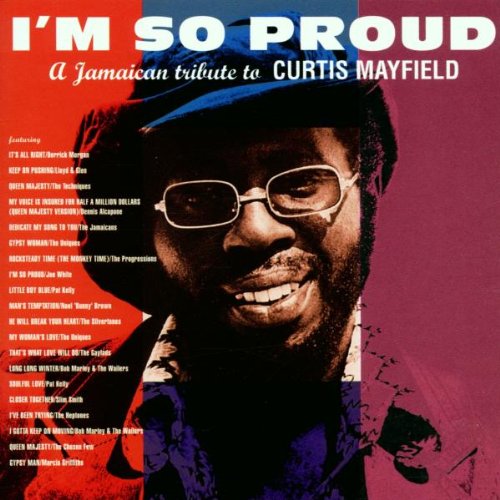
I’m So Proud: A Jamaican Tribute to Curtis Mayfield
The Trojan compilation I’m So Proud: A Jamaican Tribute to Curtis Mayfield assembles 20 of the best covers (or inspired originals) from Curtis Mayfield and The Impressions. I’ve been enjoying this one myself and the tracks include “It’s All Right,” from Derrick Morgan; “Keep on Pushing,” from Lloyd & Glen; “Queen Majesty,” from The Techniques; “My Voice Is Insured for Half a Million Dollars,” from Dennis Alcapone; “Dedicate My Song to You,” from The Jamaicans; “Gypsy Woman,” from The Uniques; “Rocksteady Time (The Monkey Time),” from The Progressions; “I’m So Proud,” from Joe White; “Little Boy Blue,” from Pat Kelly; “Man’s Temptation,” from Noel “Bunny” Brown; “He Will Break Your Heart,” from The Silvertones; “My Woman’s Love,” from The Uniques; “That’s What Love Will Do,” from The Gaylads; “Long Long Winter, from Bob Marley & the Wailers; “Soulful Love,” from Pat Kelly; “Closer Together,” from Slim Smith; “I’ve Been Trying,” from The Heptones; “I Gotta Keep on Moving,” from Bob Marley & the Wailers; “Queen Majesty,” from Chosen Few; and “Gypsy Man,” from Marcia Griffiths.

In 1991, The Impressions were inducted into the Rock and Roll Hall of Fame, and in 1999, the year of his death, Curtis Mayfield was inducted as a solo artist. You can read more about Curtis Mayfield here: rockhall.com/inductees/curtis-mayfield/bio/

Uncategorized

Are Jazzmen Discontented Over Money? No Says Hibbert

jazz-money

I thought this article that I found in the Star Newspaper, May 31, 1964 was pretty interesting. It gives two credible and authoritative views on the time when many hornmen were leaving jazz to play ska, and leaving Jamaica to play in Europe. Reading the response that Lennie Hibbert gives may, in fact, be the words of a fighting man who is defending his craft. Here is a perspective and counter perspective, from the time capsule.

Are jazzmen discontented over money?

‘NO’ SAYS HIBBERT

A suggestion that Jamaican jazz musicians are discontented because they are poorly paid for their services has been refuted by Lennie Hibbert, President of the Jamaican Jazz Association, and Sonny Bradshaw, President of the Jamaican Musicians’ Union.

In a letter to the WEEK-END STAR jazz musician Lloyd Davis of 20 Southern Cross Drive, Harbour View, said that he had never been a success in Jamaica. This was not because of the quality of the music, but because of bad handling of the musicians, he claimed.

Jazz fans lost interest because they were given so few opportunities to support the art, and jazz musicians drifted into other fields of music, such as blues and calypso, because it was more financially rewarding.

Interviewed on the matter, Mr. Davis said that it was because of lack of proper payment that many of the top musicians refused to turn up for concerts. When this happened managers were prepared to hire musicians of inferior ability–and the public suffered.

In his letter he pointed out that at the Jazz Concerts sponsored by Canada Dry last month, pianist Doug Logan was absent from some sessions and trumpeter Jackie Willacy and saxophone players Roland Alphonso and Tommy McCook left early.

“It was quite evident that there existed a wave of discontentment among the musicians,” Mr. Davis claimed.

“The whole thing is preposterous” was the comment of Jazz Association President Lennie Hibbert. “Some people want to destroy the reputation of the Jazz Association–something they will not succeed in doing.”

If there were any disagreements, he added, they did not arise over musicians’ wages. He was aware that some players felt they could not use the piano at the Jazz Club on Orange Street as its tone was not very good.

“Any misunderstandings were not serious,” said Mr. Hibbert. “Jamaican jazz are very loyal. They fully realize they cannot make a pot of gold from jazz here. They are just carrying on because of their love of music.”

Sonny Bradshaw, President of the Musician’s Union, said that no word of any misunderstandings between musicians and managers over the question of proper payment had been brought to his attention.

He agreed with Mr. Hibbert that Jamaicans would have to learn to appreciate jazz before it could gain a proper foothold here.

Last word from Mr. Hibbert: “The people rave over rock ‘n’ roll and Ska, but when it comes to good music they just turn up their noses.”

Uncategorized

Let’s Do the Rocksteady

A few months ago I shared the advertisements that Ronnie Nasralla had made showing how to dance the ska. These advertisements pictured himself with Jeannette Phillips along with dance steps, five of them to be exact, and they appeared on the back of Byron Lee & the Dragonaires’ albums, and in the Jamaica Gleaner and the Jamaica Star newspapers for five sequential weeks. These dance steps were also demonstrated at the 1964 World’s Fair in New York and at various events in the United States during that year, by Ronnie & Jeannette, Sheila Khouri Lee, and other dancers who brought the ska to the world. You can see these advertisements and read about them here.

IMG_2214
IMG_2215-150x150
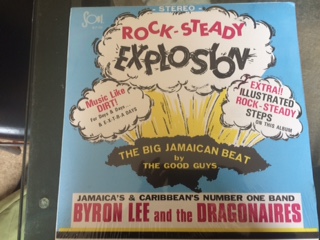
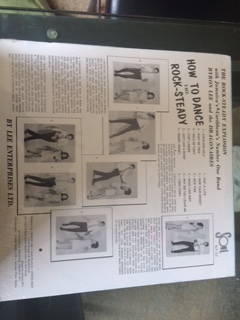
So when I saw the back of this Byron Lee album, I realized that a similar approach was taken a few years later with the rocksteady, and it got me wondering about the dance steps for this genre that came in 1966 to 1968.

Ronnie Nasralla is this time photographed with a different female dancer, perhaps because Jeannette Phillips had gotten married, although I am not sure who the new dancer is, so if anyone knows, please comment below.

The dance steps are as follows:

The dance steps are described on the back of the album, so put on your dancing shoes and get ready.

One step shuffle — completely relax then sway your body from right to left sliding on your feet, allowing your hands to sway from side to side (A) following your hip movement. The shoulder must be raised and tucked under the chin. This shuffle is done all around the dance floor with couples swaying in and out of each other.

Stamp one foot at the same time bending both knees (B). Come up wriggling the body very loosely, then extend the foot which you did not stamp to the side (C). Repeat using other foot going to other side. This is done facing your partner. A variation of the step is shown in (D) where the leg is placed forward then backward instead of to the side. The girl does the reverse by placing her leg backward when her partner places his leg forward. When the leg is placed forward you lean back, and when the leg is placed backward, you lean forward. Remember: loosely wriggle your body when coming up on each stamp.

A bouncing one step action like marching with the body bobbing at least two beats to every step (E). The whole body is loose with the hands very limp up about chest high. This is a continuous action with the partners “marching” and bobbing all over the dance floor.

A variation to this step is when the right leg is placed across the body (F). Then you press back by placing the left or back leg further behind at the same time, leaning forward from the waist (G). You continue by stepping to the right, then left, then ready to repeat. The same marching action is continued during this, only with the hands swinging alternately to maintain balance.

The “Rock Steady” dance is probably the most relaxed dance ever done — the whole body at all times must be loose & “oily” and partners never touch each other. They get on and leave the floor together but once on the floor, everyone dances with everyone, getting into the spirit of the Rock Steady beat which is sensuous, heavy and throbbing. The lyrics are so catchy that they are sung by everyone while dancing.

Alton Ellis recorded his hit “Rock Steady” for Duke Reid in 1967. The lyrics gave a few tips on how to dance the rock steady, whose steps were more smooth and fluid than the ska since the tempo and energy were more subdued as well.

Better get ready
Come do rock steady, ooh
You got to do this new dance
Hope you’re ready
You got to do it just like uncle Freddy
If you don’t know

Just shake your head, rock your bodyline
Shake your shoulders, ev’rything in time
Then see
Oh-oh-oh-oooh-oh-ooh

You got to shake your shoulders

Better get ready
Just to do rock steady, yeah
You got to do this new dance
Just like Freddy
You got to do it just like uncle Freddy
If you don’t know it

Shake your head, rock your bodyline
Shake them shoulders, ev’ry thing in time
Then see
Oh-oh-oh-oooh-oh-ooh

You got to shake your shoulders

Now you’re ready
Let’s do rock steady, yeah
You got to do this new dance
Now that you’re ready
You got to do it just like uncle Freddy
Now that you know it

Shake your head, rock your bodyline
Shake your shoulders, ev’rything is fine
Now see
Oh-oh-oh-oooh-oh-ooh

Ev’ryone, oh dance

Hopeton Lewis’s “Rock Steady,” recorded in 1967 for Merritone, also offers a few instructions for the rock steady dance:

People get ready
This is rock steady
Keep those dancin’ shoes on
Keep those feet movin’
People are you ready?
This is rock steady

Shoulders jerkin’
Heads are movin’
Hear the beat now
Move your feet now
Then go steady
If you’re ready
People are you ready?
This is rock steady

Shoulders jerkin’
Hips are movin’
Hear the beat now
Move your feet now
If you’re ready
Go rock steady
People are you ready?
This is rock steady

People get ready
This is rock steady
Keep those dancin’ shoes on
Keep those feet movin’
People are you ready?
This is rock steady

Although it offers no actual dance steps, Dandy Livingston’s “(People Get Ready) Let’s Do Rocksteady,” recorded in 1967 for King Edwards’ Giant label told us, “When you’re feeling blue, you know just what to do, do rocksteady, uh-huh.” There’s the Uniques’ “People Rocksteady” where Slim Smith sings, “Out in the moonlight we will dance.” And there were plenty of other songs that referenced the genre but not too many that gave us the dance steps we needed to do the dance, possibly because the era of the twist and mashed potato and stroll were now passé.

Share your thoughts on the rocksteady dance below, especially any memories from the days when it originated.

Uncategorized

Lord Tanamo

09251201

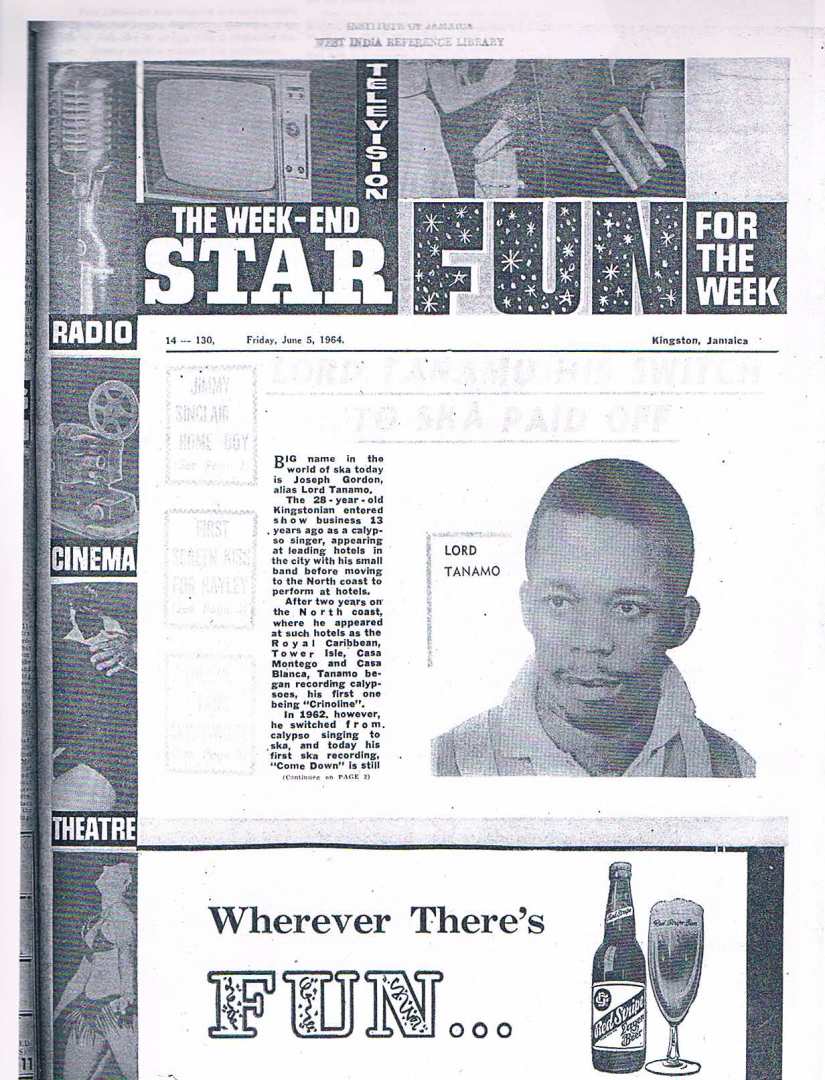
Found this article in the Jamaica Star recently, noting how Lord Tanamo had switched from calypso to ska. What a dapper young Tanamo! Handsome fellow! In case you don’t want to get out your glasses, here’s what the article says:

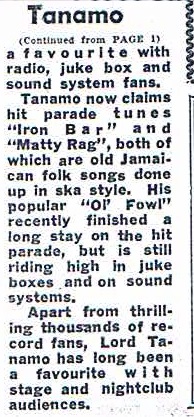
Big name in the world of ska today is Joseph Gordon, alias Lord Tanamo. The 28-year-old Kingtonian entered show business 13 years ago as a calypso singer appearing at leading hotels in the city with his small band before moving to the North coast to perform at hotels. After two years on the north Coast, where he appeared at such hotels as the Royal Caribbean, Tower Isle, Casa Montego and Casa Blanca, Tanamo began recording calypsoes, his first one being “Crinoline.” In 1962, however, he switched from calypso singing to ska and today his first ska recording, “Come Down” is still a favourite with radio, juke box and sound system fans. Tanamo now claims hit parade tunes “Iron Bar” and “Matty Rag,” both of which are old Jamaican folk songs done up in ska style. His popular “Ol’ Fowl” recently finished a long stay on the hit parade, but is still riding high in juke boxes and on sound systems. Apart from thrilling thousands of record fans, Lord Tanamo has long been a favourite with stage and nightclub audiences.

If you have the chance to see the Legends of Ska documentary by my good friend and skamrade Brad Klein at the International Ska Festival at 2pm on April 4th, BFI Southbank in London, you’ll see footage of Lord Tanamo performing at the Legends of Ska concert on his rumba box–what a treat! Here he is photographed below during the concert. Tanamo is on the far right next to Johnny “Dizzy” Moore, Justin Hinds, and Stranger Cole.

tanamo

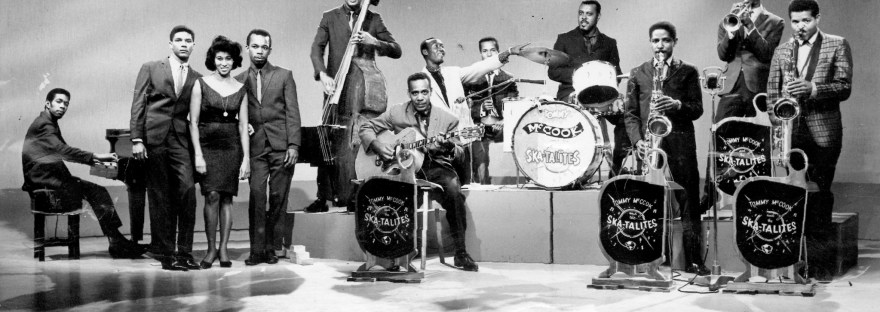
And of course, here is the great Lord Tanamo here with the Skatalites, as one of the four vocalists for the legendary group. Lord Tanamo is to the right of Doreen Shaffer.

The Skatalites
The Skatalites

So raise a Red Stripe in toast to Lord Tanamo, and enjoy these fine chunes from Mr. Gordon!

Iron Bar

Come Down

Dash of Sunshine

Watch him perform in 2003 at the Glastonbury Festival with Lester Stirling, Lloyd Knibb, and of course, Ken Stewart on keyboard and band manager for decades! I’m in the Mood for Ska

One of my favorites, a tribute that Lord Tanamo did for Don Drummond Big Trombone

Click on the link to Side A to hear Crinoline Incident and click on Side B to hear Wedding Bells

Uncategorized

Happy Birthday Cosmic Don

clinton-hutton-don-drummond

Yesterday, March 12th, was Don Drummond’s 83rd birthday, had he been provided with proper treatment for his mental illness, given Margarita love and respect instead of violence and death, and gone on to live and share the wealth of his talent with the world as he did for his short 37 years. Don Drummond was a complicated man with genius skills on the trombone and my book, Don Drummond: The Genius and Tragedy of the World’s Greatest Trombonist unravels the myth behind the legend, but today I would like to share a few of my favorite works by the master, and a few photos that I took while in Jamaica in recent years.

Please share your thoughts on Cosmic Don. Keep the beauty of his spirit alive by enjoying his music, today and every day.

Confucious

Addis Ababa

Cleopatra

Alipang

Music is My Occupation

Jamaica-011

Jamaica-027

palace

bellevue

rusden-house11

Jamaica-027

Jamaica-156-300x200

Uncategorized

Roy Panton–Over 50 Years of Sweet Song

panton1

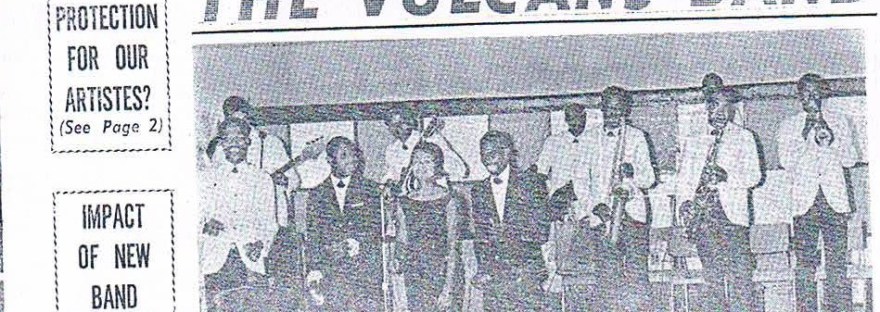
This photo appeared in the Star Newspaper on November 6, 1964. A few days ago I sent this to Roy Panton who appears smiling to the right of Phyllis Dillon in the front row and he told me how this moment with the Vulcans was a happy one for him, but shortly thereafter he and Phyllis experienced a disappointment. “They went to Germany without us,” Roy told me. I know that this may have been horrible for Roy at the time it happened, and still it is hard for him to remember without feeling sadness today, but I told him that had he gone, his life’s path would have been altered so who knows if it was actually may have been for the better. He told me that he also had recorded a song with Rita Anderson (Marley). “At Studio One. I only recorded there once. Title was “Everyday,” but don’t know if it was ever released. And by the way my first recording was for Duke Reid not Beverley. Stranger & I recorded two songs titled, “Adam & Eve b/w “Freedom Land” but Duke change the name to “Come and Hold My Hand.”

panton2

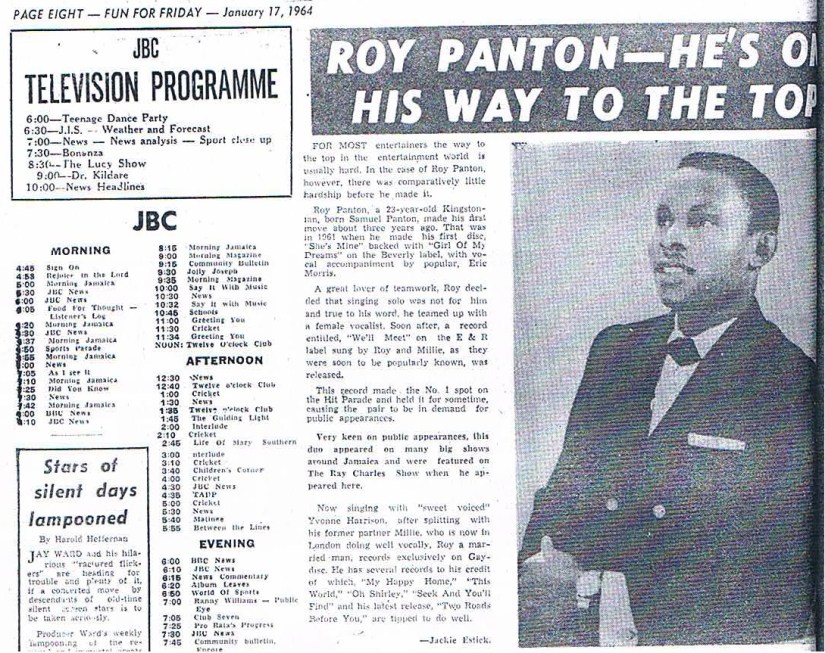
The above article appeared in the Star Newspaper with a dapper-looking Roy Panton on January 17, 1964. The article reads:

For most entertainers the way to the top in the entertainment world is usually hard. In the case of Roy Panton, however, there was comparatively little hardship before he made it.

Roy Panton, a 23-year-old Kingstonian born Samuel Panton, made his first move about three years ago. That was in 1961 when he made his first disc, “She’s Mine,” backed with “Girl Of My Dreams” on the Beverly [sic.] label [Roy Panton says this is not true as noted above] with vocal accompaniment by popular Eric Morris.

A great lover of teamwork, Roy decided that singing solo was not for him and true to his word he teamed up with a female vocalist. Soon after, a record entitled, ‘We’ll Meet’ on the E&R label sung by Roy and Millie, as they were soon to be known, was released.

This record made the No. 1 spot on the Hit Parade and held it for sometime, causing the pair to be in demand for public appearances.

Very keen on public appearances, this duo appeared on many big shows around Jamaica and were featured on The Ray Charles Show when he appeared here.

Now singing with “sweet voiced” Yvonne Harrison after splitting with his former partner Millie, who is now in London doing well vocally, Roy, a married man, records exclusively with Gay-disc. He has several records to his credit of which, “My Happy Home,” “This World,” “Oh Shirley,” “Seek and You’ll Find,” and his latest release, “Two Roads Before You” are tipped to do well.”

–Jackie Estick

As mentioned in the article, Roy recorded and performed with Millie Small beginning in 1962 and it was their song “We’ll Meet” that piqued Chris Blackwell’s curiosity in Small’s tiny voice, leading to her future success. “She got the opportunity to go to England with Chris Blackwell. We talked about it and I told her, it’s an opportunity, why not?” says Roy.

millie

Yvonne Harrison recorded with Roy Panton in 1964 and today the duet is married and performing all over the world. “Don’t ask me how Roy and I got together. I don’t remember. I think it was Derrick who told him about me. Roy and I did a lot of stage show and were all-island tours with Byron Lee, we were the local artists when the foreign artists came to Jamaica—to name a few, Jackie Wilson, Solomon Burke, the Drifters, and quite a few others,” says Yvonne.

She explains how they got back together. “I lived in Kitchener for a while. I came over in ’91, lived in Kitchener, all this time not knowing that Roy Panton, my partner all those years, was living in Canada. I thought he was in England and he thought I was still in New York. It wasn’t until I decided to move down to Jamaica in ’97 and I was there for a while when Michael Barnett who puts on a show, Heineken Startime, he wanted me to do a show with Derrick Morgan on the show. Michael Barnett is also a good friend of my nephew. So in talking to him he asked me, ‘Where is Roy?’ So I said he is in England and just then it was Merritone (producer Winston Blake) who was in Canada, in a show, and he happened to see Roy. Merritone was at the show and said he knows where Roy is, he has connections. And so they wanted to put on the 60th birthday party for Byron Lee in Jamaica and so the plan was to bring Roy down and we do the show. So, not seeing Roy in over 40 years, I decided to come back up to Canada, meet with him to do some rehearsals and see if our voices were still in working condition. Unfortunately, the show didn’t come off because of funds, but I think it was a way of Roy and I connecting. I met him in August of 2005 and we were together in October and got married on June 23, 2011,” she says.

It was the rekindling of a musical career too, for Yvonne as well as the duo of Roy & Yvonne. But Yvonne points out that the two never had a romantic relationship in the early years. “When we sang before, it was business because I was involved with somebody else and he was married and I keep out of that thing because back home it was a known fact that when a female and male work together there’s something hanky panky going on. But I stayed out of that because I didn’t want to get involved in that kind of thing. He used to tell me he was afraid to hold my hand because when he hold my hand I pull it away when we are on stage,” says Yvonne.

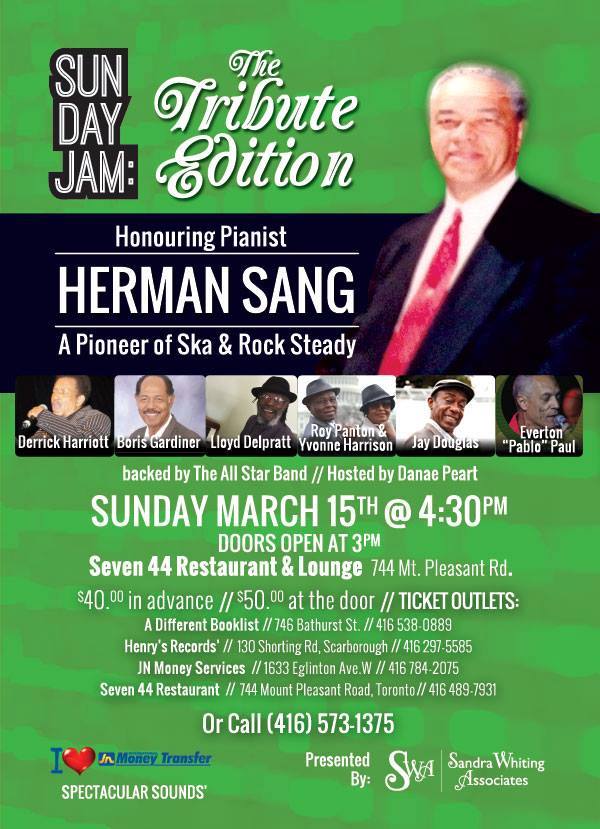
The couple will perform on March 15th in Toronto, so make sure to check out this fantastic-looking show if you are in the area.

sang

Uncategorized

Granville Williams

granville-photo

Granville Williams was leader of his own orchestra which he founded in the late 1950s. Granville was a keyboard player who performed on numerous recordings on piano and organ. He was also a musical arranger. There are advertisements for Granville’s orchestra performing in December, 1959 at the Mimosa Lodge.

mimosa

Granville also performed with Byron Lee & the Dragonaires as guitarist and arranger during the early 1960s. In late 1964 Granville  teamed up with Ernest Ranglin to “produce a band whose brassy big-band sound is tempered with imaginative arrangements and some first class solo work,” according to the Star Newspaper, November 19, 1964. They made their debut on October 30, 1964 at the St. Andrew Club and it was a big success. Granville’s brother, Audley Williams, performed on bass guitar, recruited from his position with the Carlos Malcolm Orchestra along with drummer Freddie Campbell. Granville brought Sammy Ismay to play tenor guitar [sic. should be tenor saxophone] from Byron Lee & the Dragonaires, as well as Roland Alphonso from the Skatalites. Vocalist Lloyd Williams came from his own small combo. It was a 14-piece group. Ernest Ranglin had just returned from England.

granville-star

granville-star1

Granville recorded with other musicians and vocalists such as Baba Brooks, Ernest Ranglin, Derrick Harriott, Lascelles Perkins, Roy Shirley, Ken Boothe, and many others. He had his own album, Hi-Life, released in Jamaica 1966 on his own label, G.W.O., and in the U.K. on the Island label in 1967. The back of the album tells the story of the orchestra:

From the moment in 1964 the Granville Williams Orchestra was first heard, it was obvious that this was a band destined to be among the select top five in the country. For although the band itself had just been born, it consisted of some of the most talented and respected musical giants in Jamaica.

Although still in his twenties, Granville has had many years of musical study and experience behind him. In fact, he relates, he had been playing piano since the tender age of five. Of course in those days, under the watchful eye of his mother and school music teacher, his taste leaned towards the classics, but as he grew older, Granville was quick to realise that in Jamaica a musician was more likely to make a living if he jazzed it up a little.

So it was then that Granville, having come to a compromise with himself and between Bop and Bach, made his professional debut at the Shaw Park Hotel–as a cocktail pianist. It was round about here that the second of young Mr. Williams’ two great loves–acting, which also had been with him since childhood, began to have an effect on the first–music. For it was from the filmed life story of another pianist, the immortal Eddie Duchin, that Granville drew a great deal of his inspiration.

At about this time Granville turned his attention to the organ which had become a more popular instrument than the piano for band work, but in 1963 Granville decided to devote himself to drama and to this end he left the Island and went to the United States to study. It wasn’t very many months however, before news of the great Ska boom reached him and the potential of this new Jamaican music caught his imagination. He came home and in partnership with the great guitarist Ernest Ranglin, formed the Granville Williams Orchestra–a big, brassy, hard-punching 15-piece band that had an immediate impact on the Jamaican public.

In the short time of its existence a lot of things happened to the band and to its personnel, but it never left the headlines of the entertainment world. Now a nine-piece band, with three vocalists, the orchestra is still noted for its punchy big-band sound, but more important, it has matured into one of the most versatile groups in the Island.

To demonstrate this versatility, many of the currently popular beats have been included in this first album by the Granville Williams band. On ‘Sloopy’ and ‘Loving Feeling’ we hear the latest Motown beat. A little bit of Soul is in there on ‘More’ and a Latin beat on ‘La Engandora.’ With ‘My Pussin’ we switch to calypso and this is coupled with ‘Come Le We Go.’ ‘Tear Up’ and ‘High Life’ are among the examples of our Ska beat. One of the highlights of this record is a really driving arrangement of the old Glenn Miller favourite ‘String of Pearls.’ The popular singer and recording star Derrick Harriott is featured on some of the cuts along with resident vocalist Lloyd Williams.

Granville Williams is a young man who has come a long way in a short time and judging from this first L.P. he and his orchestra are destined for even greater heights.”

album

Granville’s younger brother Audley Williams was a musician in his own right. He was born in Kingston in 1953 and was discovered by Byron Lee and asked to perform on bass guitar whenever Byron went abroad on business. Audley was a tall man who went to St. Jago High School and he started out performing piano when he was six years old. He went on to master the vibraphone, violin, harmonica, accordion, organ, steel guitar, percussion instruments, and the bass guitar. He left Byron Lee to perform with the Kenny Williams Orchestra, the Caribs, and Kes Chin & the Souvenirs for two years. He also performed for Carlos Malcolm and his Afro-Jamaican Rhythms for two years, traveling to Miami, Puerto Rico, Trinidad and Tobago, Barbados, Martinique, Montserrat, and Venezuela. He composed music, radio commercials, and he recorded for RCA before joining his brother’s band. He moved to Canada in later years along with his other brother, Clinton.

audley-williams

I am looking to find Granville Williams to interview him and so if you know his whereabouts, please let me know. I have heard that Audley pass away in recent years, but Granville is still alive and living in Jamaica perhaps. In the 1980s, Granville entered politics and he served as Parliamentary Secretary in the Ministry of Labour and Public Service. In the meantime, enjoy a few of Granville Williams’ popular tunes!

The Jerk

Honky Tonk Ska

Popeye Ska

Wailin’

Santa Claus is Ska-Ing to Town

gwo